After AICPA's Digital-Asset Update, Reserve Schedules Matter More Than Reposts
After AICPA's stablecoin and mining update, the useful signal is not another repost but a concrete request involving reserve data, accounting policy, mining statements, controls, or audit support.
Signals to watch
- reserve schedule or custody evidence format change
- stablecoin accounting-policy review
- mining-pool statement or hosting allocation gap
- audit procedure change tied to SAS 146 or SAS 148
The same AICPA headline can appear twenty times in an authorised Web3 finance Telegram group without creating one piece of actionable work. The useful messages usually look messier: “auditor wants reserve and supply at the same cutoff—anyone have a format?”, “pool statement only shows net payout, need fee and host split”, or “SAS 146 changed our review file, not sure what to redo.” These are representative fragments, not verified buyer quotations. The writer’s company, authority, budget, deadline and current provider may all be unknown.
That is the reader task after AICPA’s 25 August 2026 update: separate repeated news from downstream work involving accounting policy, reserve and custody data, financial-system mappings, mining statements, controls or audit support. The announcement supplies the trigger. The follow-on discussion supplies the possible work object. A person must verify the rest.
Key takeaway
- A repost of “new stablecoin guidance” is awareness, not demand.
- A stronger signal names a damaged or changing artifact: a reserve schedule, accounting memo, pool statement, control record or audit procedure.
- AICPA updated a practice aid, not US generally accepted accounting principles (US GAAP) or a universal stablecoin rule.
- The public message does not prove the writer’s identity, purchasing authority, budget, deadline or willingness to change providers.
- Service providers should qualify the source and work object before interpreting a fragment as a commercial project.
This article uses public AICPA material and representative message patterns for market analysis. It is not accounting, audit, tax, regulatory or legal advice, and it does not describe verified customer requests.
The first capture fixes the trigger and date. It proves that AICPA & CIMA published the update on 25 August 2026. It does not prove that any company has started a project because of it.
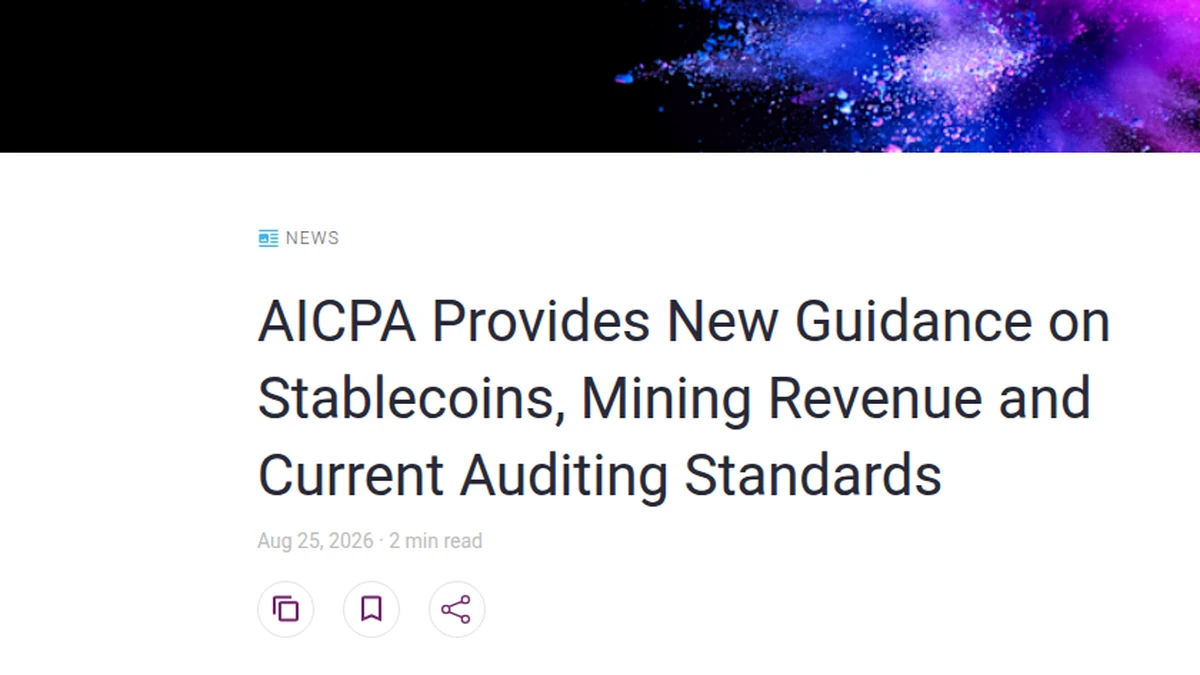 AICPA’s announcement page identifies the three subjects and the 25 August 2026 publication date. Source: AICPA & CIMA.
First separate the headline from the work object
Three message types may use almost identical words while carrying different value.
| Fragment and example | What it establishes | What remains unknown |
|---|---|---|
| Repost: “AICPA finally published stablecoin guidance” | The writer saw the news | Whether the writer has an accounting problem or role in a project |
| Interpretation question: “Does this mean reserves and token liability can be netted?” | A technical uncertainty exists | Entity, contract, reporting framework and whether external help is wanted |
| Work-object problem: “Custodian file is T+1 but supply report closes at UTC midnight; audit asked for one schedule” | A specific evidence and cut-off gap may exist | Speaker identity, materiality, authority, deadline, budget and incumbent provider |
The third message deserves review because it contains a noun that can be inspected and a mismatch that can be confirmed. It is still not a procurement brief. A provider should not infer a signed engagement, send unsolicited outreach or claim that the writer is a buyer merely because the fragment sounds concrete.
Different providers notice different objects. An accounting adviser may care about the obligation memo; a custody specialist about ownership, restrictions and cut-off; a software team about mappings among token supply, subledgers and the general ledger; and an assurance provider about evidence and controls.
What AICPA actually changed
The AICPA announcement describes three updates: a stablecoin-issuer chapter about token obligations and reserve assets; an auditing chapter for mining-pool participants and data-center hosts; and updates through Statement on Auditing Standards No. 148 (SAS 148), including SAS 146 and AU-C Section 220 revisions on engagement quality management.
The second capture preserves the source’s vocabulary. It describes accounting considerations for stablecoin issuers and auditing guidance for mining arrangements. It does not display one mandatory journal entry or one revenue formula.
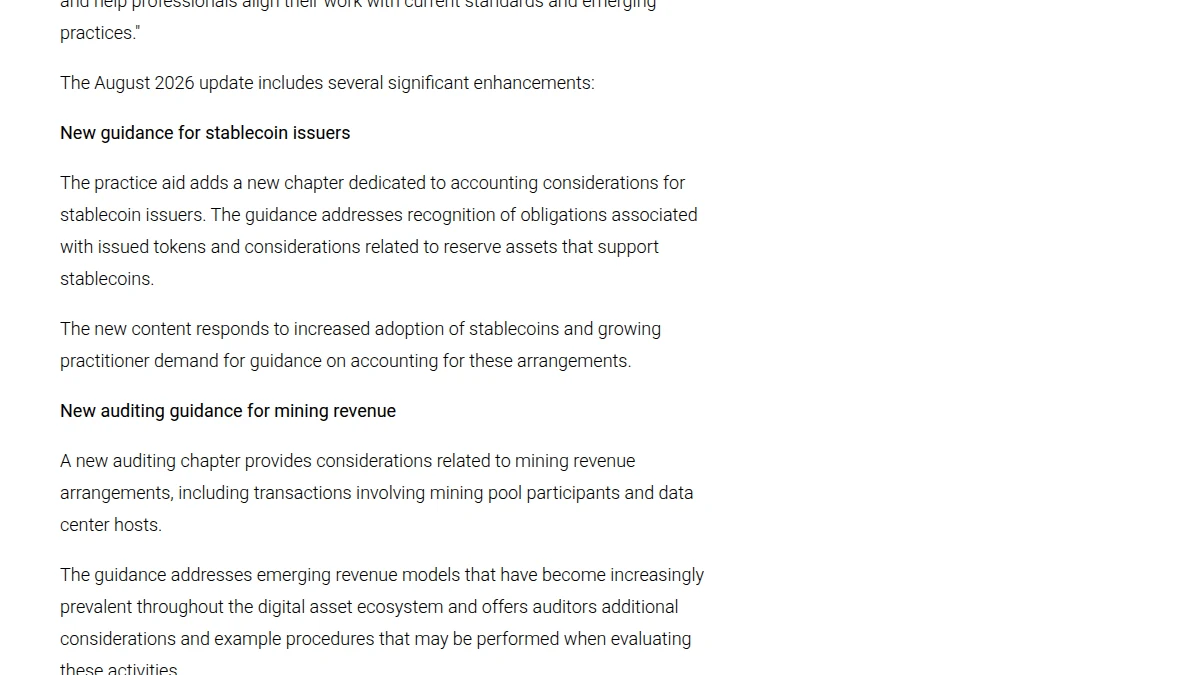 The public announcement separates obligations and reserve assets for stablecoin issuers from audit considerations for mining-pool participants and data-center hosts. Source: AICPA & CIMA.
SAS 146 and SAS 148 are formal auditing standards. The digital-assets practice aid is nonauthoritative application material: it helps practitioners apply existing requirements but does not amend US GAAP or generally accepted auditing standards. “AICPA changed the stablecoin rule” is therefore less reliable than a message naming the contract, memo or audit procedure under review.
The public resource page was available during research, but the full member resource was not reviewed in this session. Claims here do not go beyond the public announcement.
Stablecoin follow-on work starts at a reconciliation boundary
A stablecoin has at least two accounting objects. The issued token may create an obligation whose recognition and presentation depend on holder rights, redemption mechanics, the responsible legal entity and the applicable reporting framework. The reserve side may include cash, bank deposits, government securities or other assets with different ownership, restriction, valuation and counterparty risks.
That separation produces concrete follow-on messages: “Need one file tying circulating supply to issuance and redemption at month-end”; “reserve report has balances but no restriction flag from the custodian”; “legal says issuer is entity A, ledger liability is still in entity B”; or “Treasury closes in New York time, token report closes at UTC—auditor asked about cut-off.”
These examples remain incomplete. They do not reveal materiality, whether the facts are accurate, who owns the task or whether an outside provider is permitted. But they name records that an adviser, data vendor, custodian, financial-software provider or assurance team can ask a human reviewer to verify.
A vague message such as “stablecoin audits will be huge” has none of those anchors. It may be commentary, promotion or speculation. The distinction is the presence of a work object and an observable gap, not the confidence of the wording.
Mining follow-on work appears between the chain record and the contract
A block explorer can show that an address received an asset. It does not prove why a reporting entity was entitled to it, whether a pool retained fees, whether a host receives a revenue share, whether every payout was recorded or which accounting period applies.
That is why mining-related fragments often point to off-chain evidence: a pool statement that shows only a net payout; a hosting invoice whose variable charge cannot be traced to the reward calculation; a payout address changed without a complete approval record; a wallet total that does not reconcile to the pool portal at cut-off; or an audit request for evidence of completeness, rights or control.
The AICPA update gives those questions a current professional reference. It does not turn chain data into sufficient audit evidence and does not announce a new mining-revenue recognition formula. A reviewer should therefore preserve whether the writer refers to a pool, miner, host, wallet, exchange or accounting system. Removing that context can turn a real evidence gap into a misleading generic “mining accounting lead.”
Standards updates can create quieter service signals
The final source capture confirms that the practice aid reflects standards through SAS 148, includes SAS 146 and AU-C 220 revisions, and consolidates Chapter 5 material on existence, rights and obligations without changing the underlying guidance.
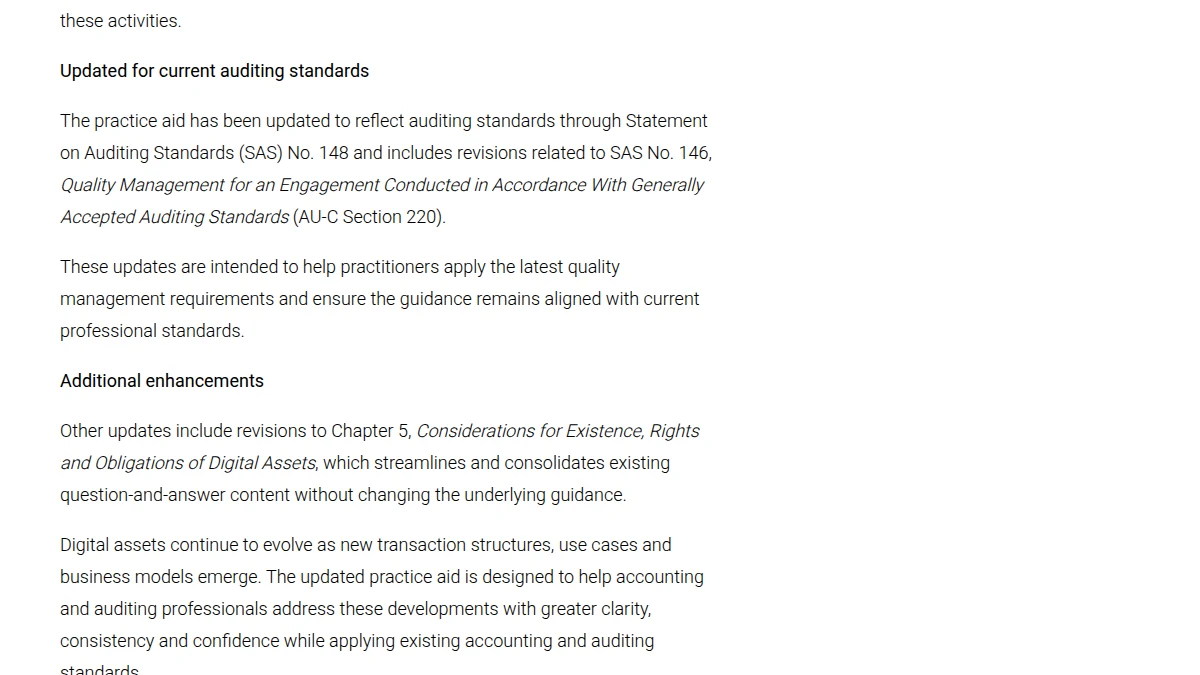 AICPA says the practice aid reflects auditing standards through SAS No. 148, includes SAS No. 146/AU-C 220 revisions, and consolidates Chapter 5 material without changing its underlying guidance.
For an audit-support or assurance provider, the useful follow-on message may not mention stablecoins or mining at all. It may say that last year’s review template no longer fits, an engagement-quality role must be reassigned, or a digital-asset workpaper needs new supervision evidence. The phrase “SAS 146” is a clue, but the inspectable object is the procedure, template or control record.
This is also where overstatement is common. The source says the Chapter 5 content was streamlined without changing its underlying guidance. A post calling every editorial consolidation a new compliance obligation should be downgraded until a primary source or responsible professional explains the change.
A human reviewer needs six missing facts
Before a provider treats a fragment as worth commercial follow-up, a reviewer should recover six facts: original source; writer role and entity; affected memo, schedule, statement, mapping, control or procedure; trigger and timing; the writer’s authority; and the next non-sensitive document or responsible person that could confirm the issue. Unknown facts must remain unknown.
In authorised Web3 finance and operations groups, TOP Prospect can retain the original source and time, collapse obvious reposts, group related fragments and rank them for human review. It cannot authenticate the writer, determine accounting treatment, confirm budget or authority, inspect private files, declare an engagement or contact someone automatically.
A detailed fragment can still be irrelevant to a provider. The company may already have an audit firm, the issue may be immaterial, policy review may be handled internally, or sharing the necessary records may be prohibited. A public announcement can also prompt advisers to market services before clients have changed anything.
That is the trade-off in using an industry update as a market signal. Waiting for a complete request reduces false positives but misses early changes. Acting on every technical question creates noise and risks crossing consent boundaries. The sensible middle is to preserve provenance, look for a concrete work object and ask a human reviewer to verify role, permission and timing.
FAQ
Does an AICPA repost indicate a service opportunity?
No. It shows awareness. A stronger fragment identifies an affected artifact or evidence gap, but identity, authority, budget and timing still require verification.
Did AICPA issue a new stablecoin accounting standard?
No. The 25 August release announced an updated digital-assets practice aid. It helps practitioners apply existing standards and does not create one accounting answer for every token or reserve arrangement.
What mining discussions deserve review?
Messages naming a pool statement, hosting allocation, payout-control record, cut-off mismatch or completeness request are more useful than broad predictions. They remain unverified until their source and context are checked.
The announcement is a verified trigger. A fragment naming a broken schedule or changed procedure is a possible signal. Only human verification can connect the two without inventing a buyer, project or conclusion.
Frequently asked questions
Does reposting the AICPA announcement indicate a service opportunity?
No. A repost establishes awareness only. A useful follow-on signal names a work object, while buyer identity, authority, budget and timing may still be unknown.
Did AICPA issue a new stablecoin accounting standard?
No. AICPA updated a nonauthoritative digital-assets practice aid that helps professionals apply existing accounting and auditing standards.
Can blockchain records alone support a mining-revenue audit?
No. Chain data can support a transaction, time and address, but contracts, pool allocations, hosting terms, completeness, cut-off and wallet control require other evidence.
Sources and further reading
Market and risk discussion is supporting evidence
Top Prospect is primarily a Telegram lead-generation product. Market and risk discussion can add context to a candidate lead, but it does not become a verified incident, trend, or sales opportunity automatically.