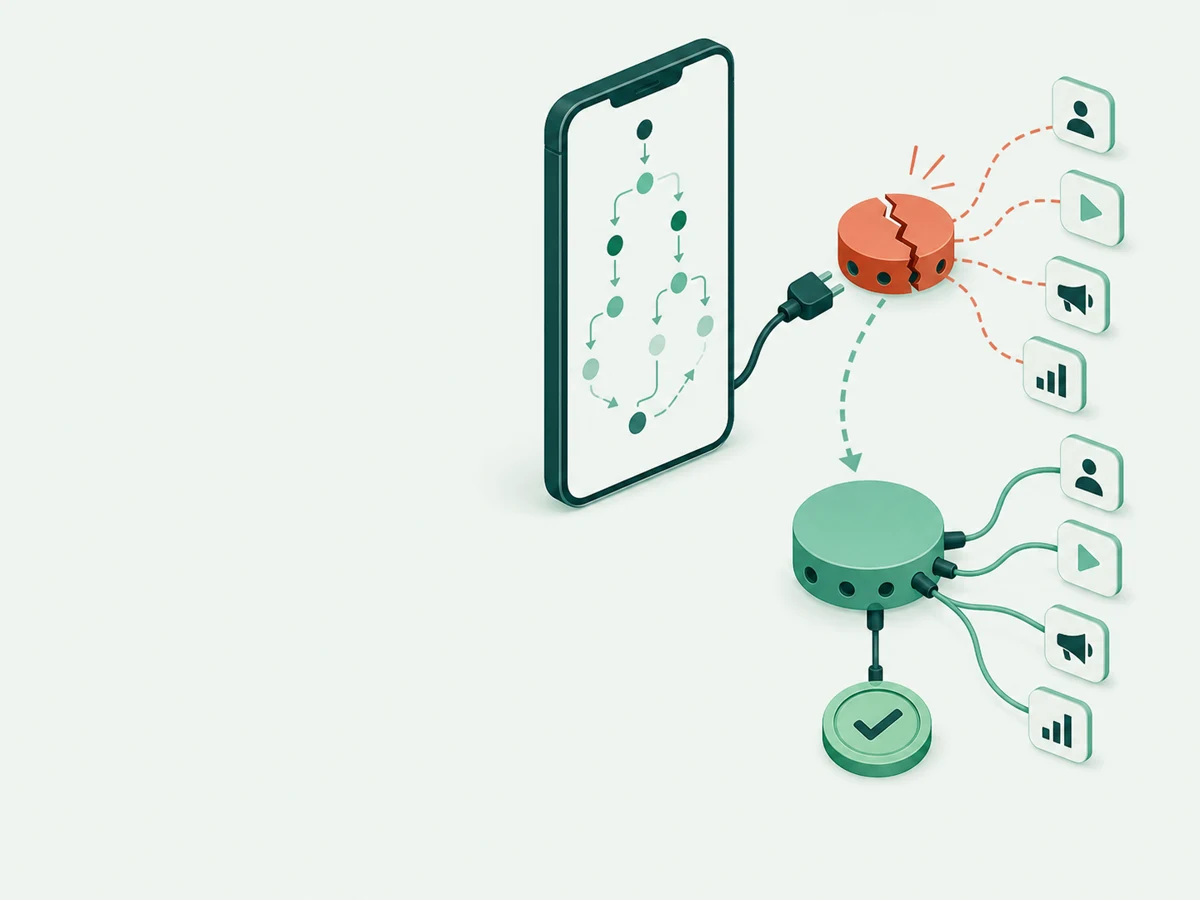
Conditions for Testing Hybrid Commissions in One Affiliate Program
A market lead at an Affiliate & cross-border growth provider can compare flat CPA, repeat-purchase rewards, revenue share, and tiered settlement inside one program before deciding whether the case belongs in broader trend research.

Workflow / architecture · Representative workflowThis page documents a representative operating model for this type of work. It does not describe a named customer, live product-operation record, testimonial, contract, revenue result, or verified conversion.
Signals to watch
- The program explicitly considers how flat CPA could combine with repeat-purchase or revenue-share terms
- Tiered-settlement support, decision ownership, and test status remain unverified
- A broader trend would require independent programs with their own configuration or test activity
A market lead at an Affiliate & cross-border growth provider who sees one program discuss “lower flat CPA, then add repeat-purchase or revenue-share terms” first needs to decide whether that settlement design can work inside the project. CPA means payment for an agreed action, such as a qualifying first order. Considering another model does not mean that a settlement sheet has been changed, and it does not show a market-wide shift.
This is a composite illustration, not a live product-operation record or evidence from a named brand or publisher. It preserves one incomplete project: the team is considering hybrid commissions and asks whether the platform supports tiered settlement. The market, category, compliance conditions, owners, and test state remain unknown.
Identify the difference the proposed change is meant to solve
Flat CPA concentrates payment on one agreed action. A repeat-purchase reward introduces a later purchase condition. Revenue share calculates compensation from an agreed revenue base. Tiered settlement changes the rate or treatment when defined conditions are met. These options alter payment triggers, duration, and reconciliation fields; they are not interchangeable columns.
For one project, the team needs to explain why flat CPA is insufficient, which trigger it may add, who can supply the corresponding transaction record, and whether the platform can calculate and settle the required tiers. When the discussion supplies none of those answers, the market lead can record “model change under consideration,” not “new model launched.”
| Settlement option | Condition the project must define | What can be said now |
|---|---|---|
| Flat CPA | Qualifying action and confirmation point | Comparison baseline |
| Repeat-purchase reward | How a later purchase is recognized and observed | Possible added condition |
| Revenue share | Revenue base and permitted deductions | Possible calculation method |
| Tiered settlement | Conditions that trigger each tier | Platform configuration to verify |
Treat configuration questions as preparation, not adoption
“Hybrid commissions sound fairer” is an opinion. “Can the platform settle a first order, repeat purchase, and revenue-share component by tier?” exposes a configuration question. It remains solution design until an owner, test scope, and settlement fields appear.
The record should keep counterevidence close. A project may lack the records needed to calculate repeat purchases. A local rule may prevent a proposed payment arrangement. The team may ultimately retain flat CPA. Each outcome weakens the claim that a commission model is changing.
Decide when one program belongs in trend research
Within authorized Telegram groups that a user intentionally connects, TOP Prospect can deduplicate same-source forwards, retain the original message, source, time, and project context, and surface the discussion as a candidate Signal (an item awaiting human review) with a priority. It does not verify settlement configuration, prove adoption, or contact the poster automatically. The user still confirms project identity and implementation activity before making a judgement.
Copies of the same discussion across groups remain one source. Broader evidence could form only if other independent programs raise their own settlement questions and proceed to configuration, testing, or program-design activity. Markets and categories also stay separate because a feasible commission structure in one setting may not fit another.
Preserve two possible answers before the next design cycle
The project record may conclude “ready for a configuration test” or “conditions are insufficient; retain flat CPA.” Both are more informative than a predetermined shift.
If later independent sources do not appear, this discussion remains one project sample. If independent programs produce their own verifiable implementation actions, the market lead can raise the trend priority. A market pattern is built from separate project decisions, not from a settlement sheet that has not yet been changed.
Market and risk discussion is supporting evidence
Top Prospect is primarily a Telegram lead-generation product. Market and risk discussion can add context to a candidate lead, but it does not become a verified incident, trend, or sales opportunity automatically.