“Singapore Google Cloud by Friday”: Five Checks Before a Supply Review
A multi-cloud channel seller needs the resource, region, current constraint, delivery window, usage and billing conditions before treating a Telegram post as a buyer request rather than a reseller broadcast or price check.
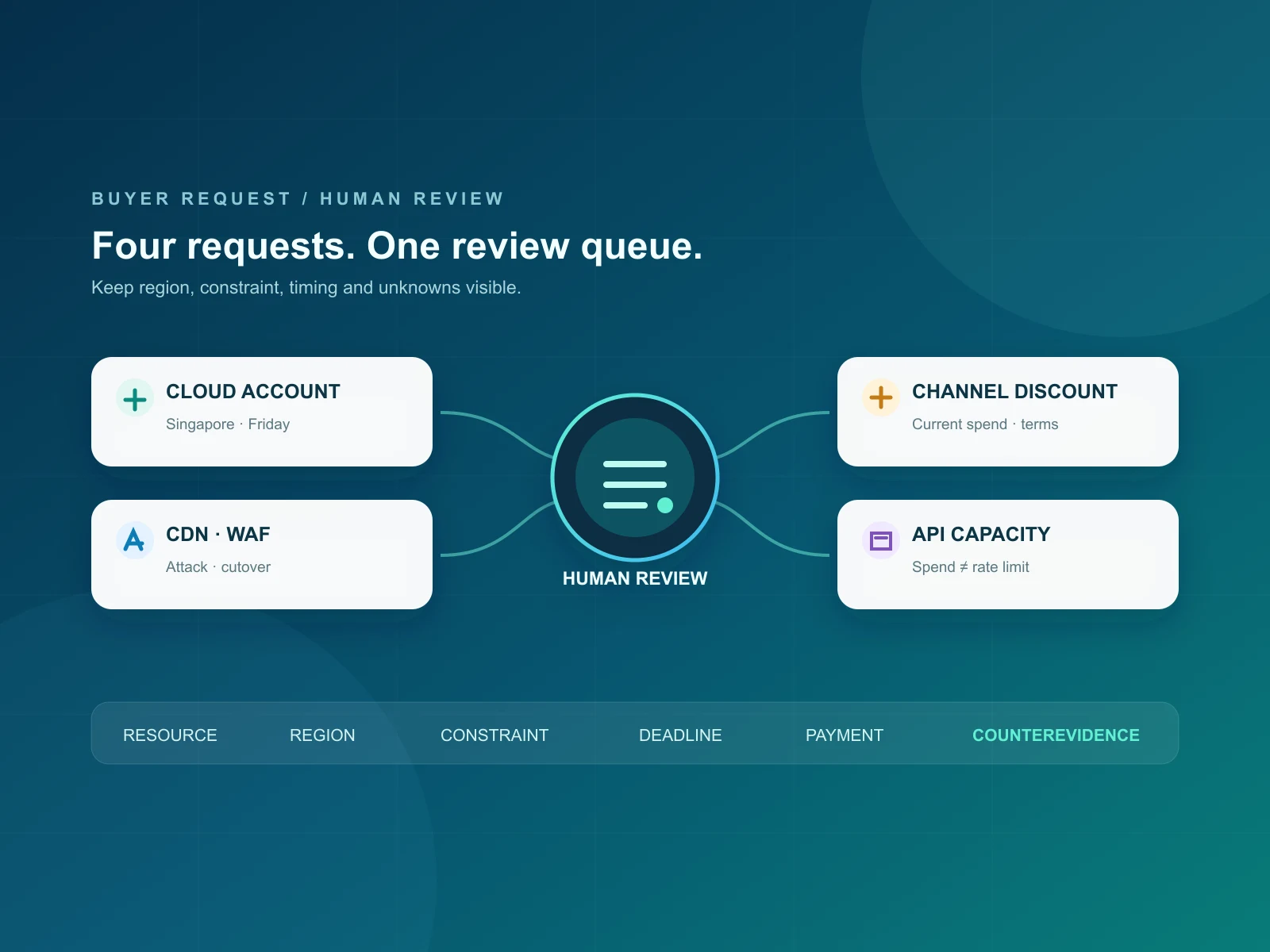
Illustrative industry workflow · Representative workflowThis page documents a representative operating model for this type of work. It does not describe a named customer, live product-operation record, testimonial, contract, revenue result, or verified conversion.
Signals to watch
- A named cloud resource and region connect to a delivery date or an existing operating constraint
- A CDN or WAF replacement request includes an affected service, traffic condition, cutover window, or current-provider limitation
- A channel-discount complaint includes current spend, covered services, billing entity, and a real comparison point
- An AI API capacity request separates daily spend from model access, rate limits, payment eligibility, and the legitimacy of any resale or relay route
“Need a Singapore Google Cloud account. Can it be active by Friday?” “Our route keeps getting attacked; we need another CDN or WAF now.” “The discount on Tencent Cloud International is no longer enough. Looking for another channel.” “Need Claude API capacity, about USD 300 a day. Can we pay in USDT?”
These are representative fragments, not verified customer messages or completed purchases. For a business-development lead at a multi-cloud international channel provider, each contains something that may justify review. None confirms who the writer is, which company they represent, whether they control a budget, or whether they are the user, an integrator, a reseller, or another person forwarding a request.
The difficult part is not recognizing the product names. It is keeping four different procurement objects out of one undifferentiated “lead” bucket. A cloud account request is shaped by region, billing, service access, and quota. A CDN or WAF request starts with an operating incident and cutover conditions. A channel complaint depends on current spend and contract terms. An API-capacity request must separate dollars from requests and Tokens. If sales asks the same three qualification questions in every case, important constraints disappear.
The configured target proves positioning, not results
An anonymized provider supplied the recognition-target positioning below. It describes a seller aggregating international resources from Tencent Cloud, Alibaba Cloud, Huawei Cloud, Google Cloud, and adjacent CDN, web-security, AI compute, and model-API services. It also names the types of companies the seller wants to find and the problems those companies commonly report.
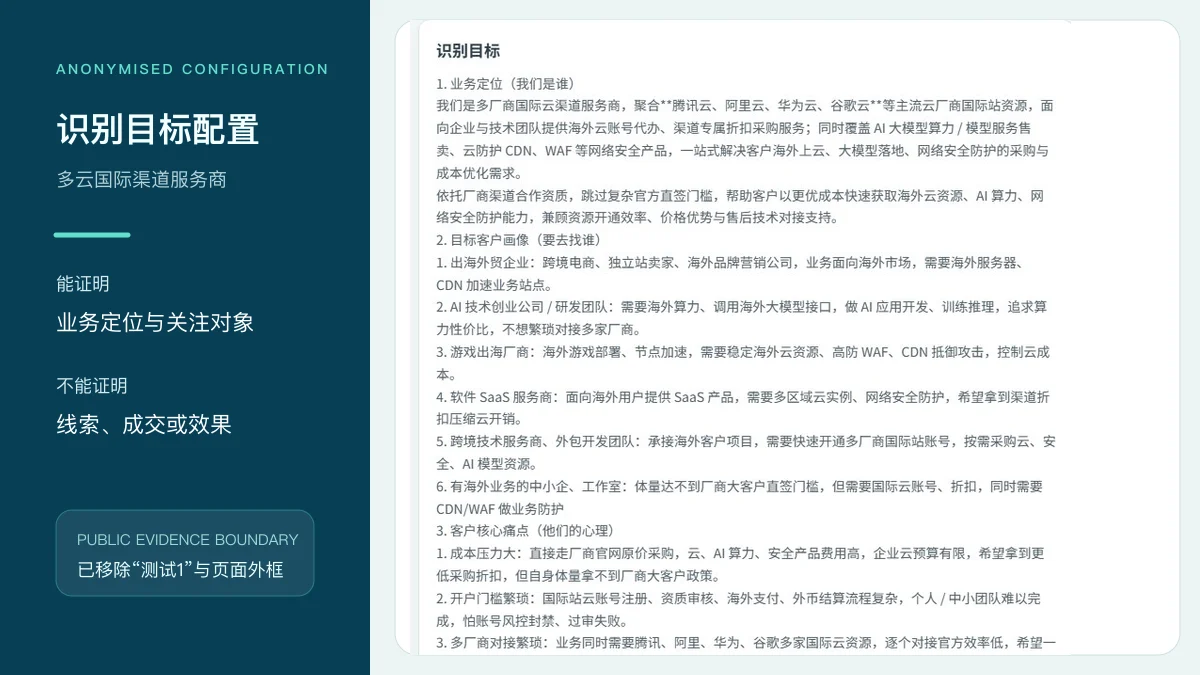 The public crop removes the generic test title and page chrome. It supports the provider’s positioning and recognition criteria; it does not show generated leads, buyer identities, conversions, or customer performance.
That is a useful starting scope. It is not evidence that a newly saved target has already produced matching results. It also cannot convert a seller’s inventory announcement into a buyer request. “Google Cloud accounts available, agents wanted” is supply. “Looking for upstream partners” is recruitment. “Best discount in the market” is promotion. Those posts may describe the provider’s commercial environment, but they do not belong in a buyer-review queue unless a separate buyer-side message exposes a resource, problem, and time window.
“Singapore by Friday” opens five checks, not a quote
The first fragment is more useful than “need a cloud account” because it names a provider, a location, and a delivery date. Sales can independently check that the requested location exists. Google Cloud’s Compute Engine documentation lists asia-southeast1-a, asia-southeast1-b, and asia-southeast1-c in Jurong West, Singapore.
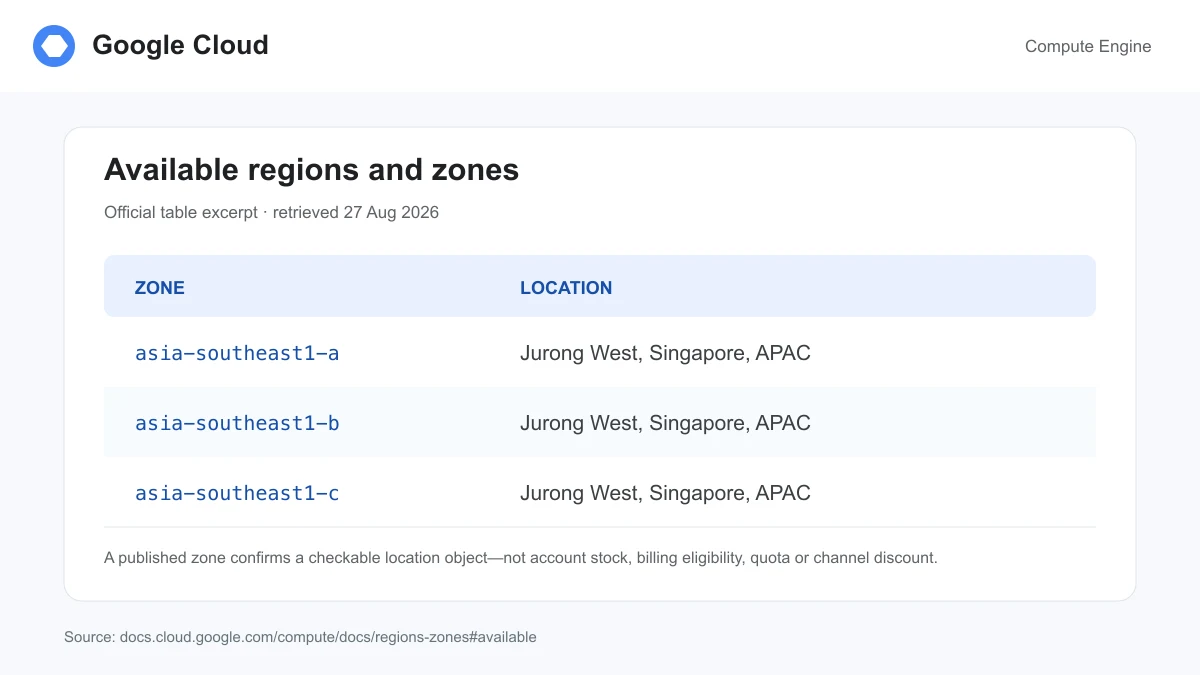 Google Cloud documents the Singapore location. That fact does not prove that a particular account, billing profile, service quota, discount, or channel inventory can be delivered.
The next human questions should recover five distinct objects:
- Account and purpose. Is the request for the poster’s own organization, an end customer, a managed project, or resale? What legal or policy restrictions apply?
- Services and quota. Does “account” mean basic billing access, Compute Engine capacity, GPU quota, Kubernetes, storage, or several services? A region can exist while a required service or quota remains unavailable for that account.
- Billing entity and payment. Which entity contracts, which currency and payment route are acceptable, and is a channel discount tied to committed spend or a specific service?
- Deadline. Does Friday mean the project starts Friday, the account must pass an internal check by Friday, or the buyer only wants an answer by Friday?
- Scale. One account with ordinary usage is different from several accounts, a large monthly commitment, or capacity needed for an end-customer launch.
If the poster answers only “any account is fine,” the message does not become stronger. It may indicate an early price check, a forwarded request, or an account purpose that the seller should not serve. The right response is to preserve the deadline while keeping purpose, billing, service access, and authority blank.
The same location discipline applies across the other vendors. Tencent Cloud, Alibaba Cloud, and Huawei Cloud publish first-party infrastructure or location directories. Those pages help sales check whether a region is a real delivery object. They do not verify a reseller’s stock, discount, activation promise, or buyer eligibility.
“We keep getting attacked” is not yet a CDN/WAF specification
CDN means content delivery network: distributed infrastructure that serves content closer to users. WAF means web application firewall: a control that inspects web requests and applies security rules. A buyer may need one, the other, or both, but “the route keeps getting attacked” does not identify the affected layer.
Before checking a replacement service, the BD lead needs an incident-shaped description: affected domain or application, countries and users affected, traffic pattern, peak volume, current delivery path, current protection, symptoms, first-seen time, and an acceptable cutover window. A complaint about latency can be a CDN issue, an origin problem, an application failure, or a network route. A WAF false positive can look like an attack outage. The message must not assign fault to the incumbent provider before someone with authorized technical access checks the evidence.
A useful next step may be a technical clarification rather than a product quote: “Which domain or service is affected, what changed, and what must remain online during cutover?” If the writer cannot name an affected service or timing, keep the candidate under observation. If the seller does not offer the required region, capacity, or protection scope, close it instead of treating urgency as fit.
“The discount is not enough” becomes useful when the comparison has a base
A channel-discount complaint is different from a service failure. It can indicate switching intent, but only when sales can establish what is being compared. “Tencent Cloud International is too expensive” leaves current services, monthly spend, billing entity, discount basis, commitment, and renewal date blank.
The BD lead should ask what the buyer uses now, which services dominate the bill, whether the current price is official or channel-based, when the term can change, and what commercial condition is actually unacceptable. A five-point discount improvement may matter on sustained infrastructure spend and be irrelevant on an uncertain test. A lower headline rate may also exclude support, credit terms, or services included in the current arrangement.
Counterevidence must be allowed to stop the hypothesis. The poster may be collecting quotes for a reseller sheet, complaining without permission to switch, or comparing discounts that apply to different service baskets. A real review object appears when current spend, covered services, decision timing, and a responsible role begin to align.
USD 300 a day does not define Claude API capacity
The AI API fragment sounds concrete because it includes a daily amount and payment question. Yet money describes only one boundary. Anthropic’s official documentation separates spend limits from rate limits and says limits depend on a usage tier. It also notes that a nominal requests-per-minute rate can be enforced over shorter intervals.
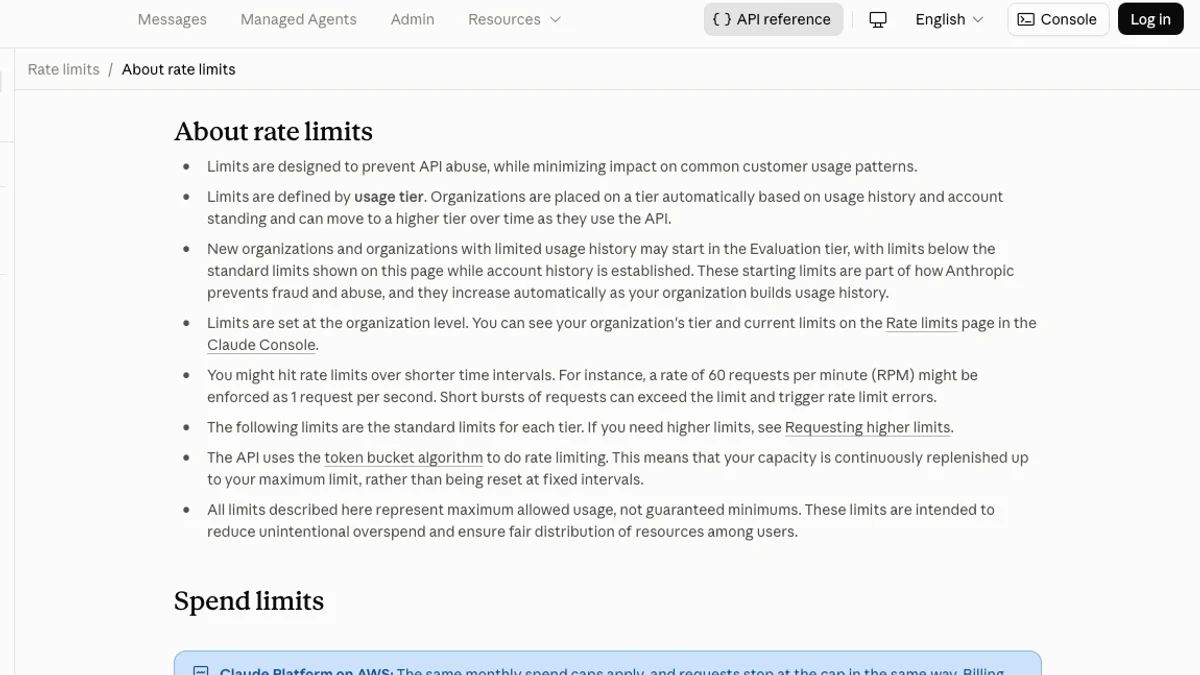 Anthropic documents rate limits and spend limits as separate controls. A stated daily spend does not prove model access, requests per minute, Tokens per minute, payment eligibility, or permission to use a resale or relay route.
Sales therefore needs to recover the model, workload pattern, peak concurrency, RPM (requests per minute), TPM (Tokens per minute), input/output mix, continuity requirement, account route, and payment conditions. “USD 300 per day” could describe a steady production workload, a short burst, an estimated resale request, or a number copied from someone else.
The route matters as much as the volume. The buyer may want direct vendor access, an authorized resale arrangement, invocation credits, or an API relay. The seller must not infer that a Token or relay offer is legitimate merely because the message names a known model. Account ownership, authorization, acceptable use, credential handling, and applicable commercial terms still require human review. If the writer will not clarify the access route, the candidate should not advance to supply checking.
This request also shows why the site keeps two related industries separate. A multi-cloud seller can encounter AI API capacity as part of a broader overseas-resource conversation, so it belongs in this provider workflow. A page whose main object is model quota, invocation Token, or API relay routes belongs under the existing AI API and model-invocation services industry, not a new top-level cloud-channel industry.
Put the four messages side by side: what is missing, and what happens next
The four messages above are missing different facts. Sales does not need a generic field dictionary at this point. Start with the exact words in the group, note what still needs an answer and what cannot yet be promised, then choose whether to check supply, ask another question, observe, or close the item.
| What appeared in the group | What is still missing | What cannot be promised yet | Next move |
|---|---|---|---|
| “Need a Singapore Google Cloud account. Can it be active by Friday?” | Whether this is for the poster, a client, or resale; required services and quota; contracting and payment entity; whether Friday means an answer or go-live; account count and expected usage | That an account is available, the required quota can be opened, or Friday delivery is possible | Clarify first the purpose, services, quota, billing, and date; then check supply if those answers are specific |
| “Our route keeps getting attacked; we need another CDN or WAF now.” | Whether the affected object is a domain, application, origin, or network path; start time, affected regions, peak traffic, current stack, existing protection, and acceptable cutover window | That the incumbent caused the problem, CDN/WAF will solve it, or the seller has suitable regional capacity | Clarify first the affected object and timing; observe if the poster cannot explain them, and close if the required region, capacity, or protection is outside the seller’s scope |
| “The discount on Tencent Cloud International is no longer enough. Looking for another channel.” | Services in use, monthly spend, whether the current price is direct or through a channel, commitment terms, contract-change date, the real objection, and whether the poster can change channels | That a new channel will reduce total cost, the discounts are directly comparable, or a switch has been approved | Clarify first the spend, contract, and comparison base; check supply only when real usage and authority exist, and close when this is only complaint, price harvesting, or a request without authority |
| “Need Claude API capacity, about USD 300 a day. Can we pay in USDT?” | Model, workload, peak concurrency, RPM, TPM, input/output mix, continuity requirement, account source, payment conditions, and whether the route is direct, authorized resale, invocation credits, or an API relay | That USDT is available, daily spend defines capacity, the account or Token source is legitimate, or the relay is authorized | Clarify first the workload, payment, and access route; check supply only after those answers are complete, and close if the requester will not identify the route |
After the user selects Telegram groups they are authorized to access and defines recognition conditions, TOP Prospect retains the original message, source, time, and context, removes clear same-source duplicates, and presents the candidate Signal and its reasoning for human review. It does not authenticate the poster, verify inventory, determine the cause of an attack, approve an API route, or contact group members automatically. Every action in the last column remains a sales decision.
The final decision has four paths:
- Check supply: the resource, region, purpose, current constraint, and delivery window are specific enough for a real availability check.
- Clarify first: the message contains a meaningful object, but billing, quota, technical scope, authority, or access route can still change the answer.
- Observe: a problem or comparison is visible, but no responsible role or decision window has emerged.
- Close: the item is supply promotion, agency recruitment, a repeated forward, an unsupported request, or outside the seller’s permitted offer.
“Singapore by Friday” deserves faster review than “cloud accounts available.” It still does not deserve an invented buyer, quota, discount, or contract. The useful advantage is not declaring a lead early; it is reaching the first responsible question before the request disappears into the next screen of group messages.
Frequently asked questions
Does a request for a Singapore Google Cloud account prove that the poster can buy?
No. The region and deadline make the post worth checking, but identity, authority, account purpose, billing entity, quota, payment eligibility, and procurement status remain unknown.
Is a daily API spend amount enough to quote Claude API capacity?
No. Spend limits and rate limits are separate. Sales still needs the model, request and Token rate, usage pattern, account route, payment conditions, and permission to resell or relay the service.
What should happen to reseller inventory posts and agency recruitment?
Keep them out of the buyer-review queue unless a separate message exposes a buyer-side resource, constraint, timing, and role. Supply availability is not demand.
Sources and further reading
How a Signal worth attention is found
See how Top Prospect finds and organizes Signals worth checking, keeps the original Telegram context, removes duplicates, and helps you decide what to review first. You decide whether to follow up and what to do next.