“We Spend $200 a Day and Need Limits for 20 Developers”: Is This API Token Request Ready for a Quote?
API Token and managed-key sales teams can qualify a USD 200-per-day, 20-developer request by checking measured model spend, peak traffic, key ownership, limit behavior, billing, and the launch date before quoting.
Signals to watch
- The stated daily spend comes from a recent measured usage window rather than an estimate copied from a plan
- The team can map developers, applications, batch jobs, and shared services to keys or stable usage identifiers
- Peak RPM, Token rate, concurrency, model mix, and retry behavior explain the required capacity
- Billing ownership, allowed access route, rollout date, and a responsible technical or purchasing contact are named
At 10:17 a.m., a message appears in a Telegram group used by AI infrastructure sellers:
Representative simulation, not a customer quote or TOP Prospect result “We are spending about USD 200 a day now. Twenty developers need separate quotas because one person burned through the shared key last week. We launch the new coding workflow next Wednesday. Need GPT and Claude access, invoice to Hong Kong. Who can support this?”
This is the kind of message a Token seller should read quickly. It names current spend, team size, a control problem, two model families, a billing location, and a date. It is much stronger than “need API, best price.”
It is still not ready for a price sheet.
Sales does not know whether USD 200 came from yesterday’s dashboard or a manager’s estimate. It does not know whether all 20 developers call models directly, whether one batch service creates most of the cost, or whether “separate quotas” means a hard stop, a warning, or merely separate reporting. It also does not know who owns the account, who approved the budget, which access route is permitted, or whether the person posting is allowed to buy.
The right response is follow up now, quote later. The first goal is to turn three attractive numbers—USD 200, 20 people, next Wednesday—into a workload the supplier can actually price and support.
Key takeaway
- USD 200 a day sounds substantial, but it does not reveal the model mix, Token volume, request peaks, or whether the number is measured.
- Twenty developers do not automatically require 20 equal limits. People, applications, background jobs, and shared services consume differently.
- A team budget and a provider rate limit control different things. Staying under one does not prevent hitting the other.
- A detailed message deserves fast human review, not a claim that TOP Prospect has verified a buyer or a budget.
USD 200 a day is a starting point, not a capacity specification
The arithmetic is easy. At the same pace, USD 200 a day is USD 6,000 over a 30-day month and USD 73,000 over 365 days. Those projections explain why sales should not leave the message unread for a week.
But money alone does not tell a supplier what to provision. The same daily total could come from a large number of low-cost requests, a smaller number of long-context requests, image generation, reasoning-heavy calls, or a nightly batch running an expensive model. Two teams can spend the same amount and require completely different request rates, support, fallback behavior, and model access.
Ask where the number came from:
- Is USD 200 the average of the last seven completed days, yesterday’s peak, or a future estimate?
- Does it include development tests, failed calls, retries, cached input, and non-text requests?
- Which models account for the largest three lines of spend?
- Is the team paying one provider directly, using approved credits from several providers, or calling through an authorized relay?
- Did usage rise gradually, or did one new workflow cause the jump?
OpenRouter’s Usage Accounting documentation illustrates the kind of evidence that makes the answer useful: per-response prompt, completion, reasoning, cached-Token, and cost information. The documentation proves that these measurements can exist in that service. It does not prove that the simulated team has collected them or that another platform exposes identical fields.
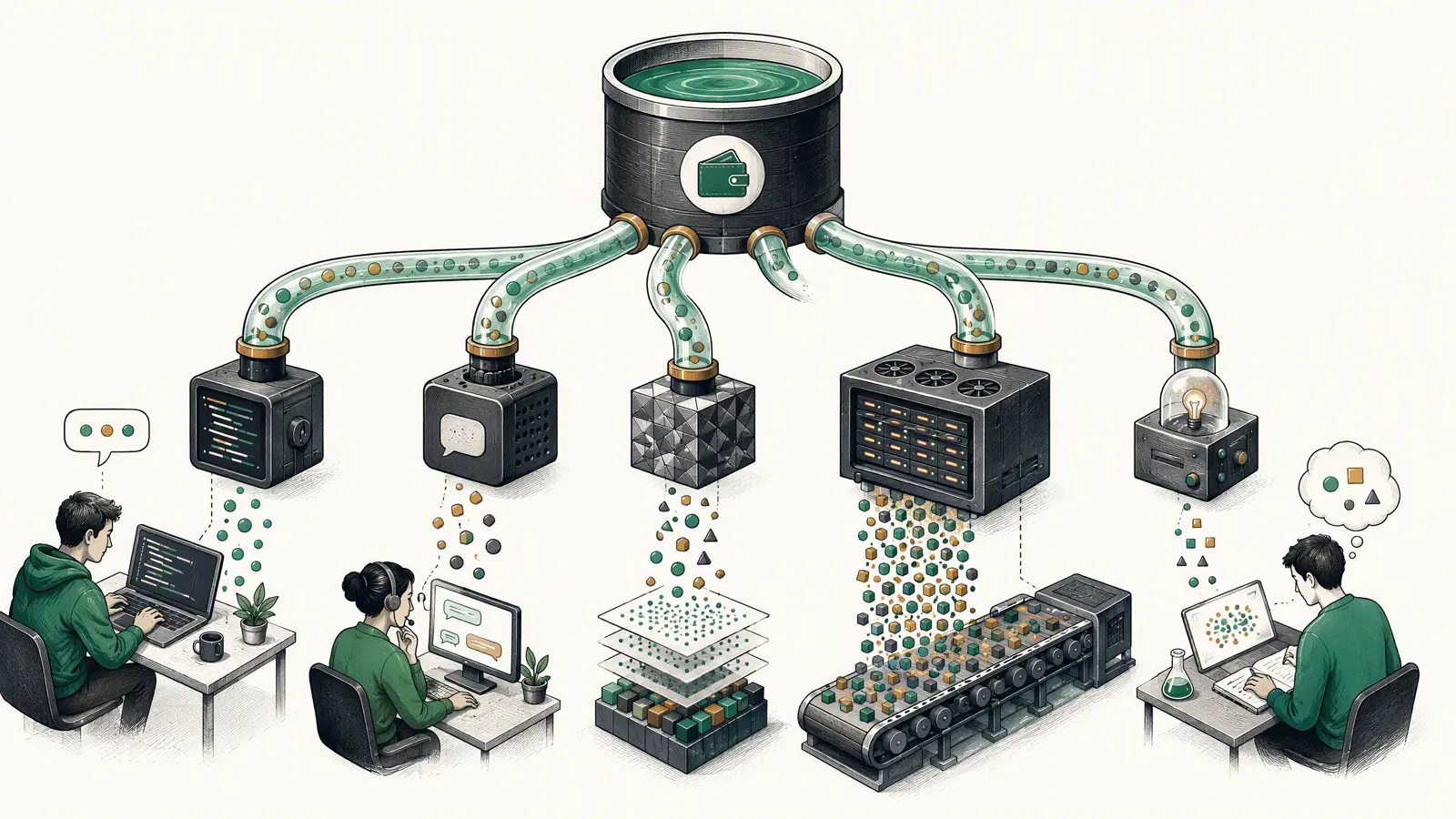 The same USD 200 daily spend can come from interactive coding, support automation, batch processing, or experiments with completely different Token profiles.
A useful first attachment is not a screenshot containing a secret key or full billing identity. It is a redacted seven-day export or summary showing date, model, request count, prompt and output Tokens, cost, and the key or application label. That lets sales see whether the number is stable, seasonal, or dominated by one job.
Twenty developers may represent five very different workloads
Dividing USD 200 by 20 gives USD 10 per developer per day. That is valid arithmetic and usually a bad allocation plan.
Imagine this representative distribution:
| Workload | People who touch it | Share of measured daily cost | What needs control |
|---|---|---|---|
| IDE coding assistant | 14 developers | USD 55 | Per-user visibility and a sensible warning threshold |
| Automated code review | 4 maintainers | USD 40 | A service key, repository labels, and concurrency control |
| Nightly test generation | 2 platform engineers | USD 80 | A batch key, model rule, retry policy, and a hard ceiling |
| Support and documentation tools | 6 occasional users | USD 15 | A shared application identity and basic usage reporting |
| Experiments | changing group | USD 10 | Short-lived keys or a small sandbox budget |
The rows deliberately overlap: one developer may use the IDE assistant, maintain the batch service, and run experiments. This is a simulated example, not an observed customer distribution. Its purpose is to show why “20 people” does not equal “20 identical keys.”
Sales should ask for a map with four columns: person or team, application, key or stable identifier, and measured usage. If the customer cannot produce that map, the first deliverable may be a short usage audit rather than a bundle of 20 quotas.
“Separate quotas” is not one product requirement
When someone asks for quotas, determine what must happen at the limit:
- Reporting only: show cost by developer or project, but do not interrupt requests.
- Warning: alert an owner at 50%, 80%, or another agreed threshold.
- Soft budget: mark the project as over budget while allowing approved work to continue.
- Hard stop: disable or reject calls after a defined amount.
- Scheduled reset: restore the allowance daily, weekly, or monthly at a named time zone.
- Emergency override: let an authorized owner temporarily raise the limit for a release or incident.
These options lead to different operational promises. “Daily limit” is incomplete until both parties name the reset time, behavior at exhaustion, owner of an override, and treatment of requests already in flight.
OpenRouter’s Management API Keys documentation describes programmatic key creation, automated distribution and rotation, usage monitoring, disabling keys that exceed limits, optional credit limits, and daily, weekly, or monthly resets. That confirms that key-level controls are concrete technical requirements. It does not say that every team should issue one key per human or that those controls satisfy a particular buyer’s policy.
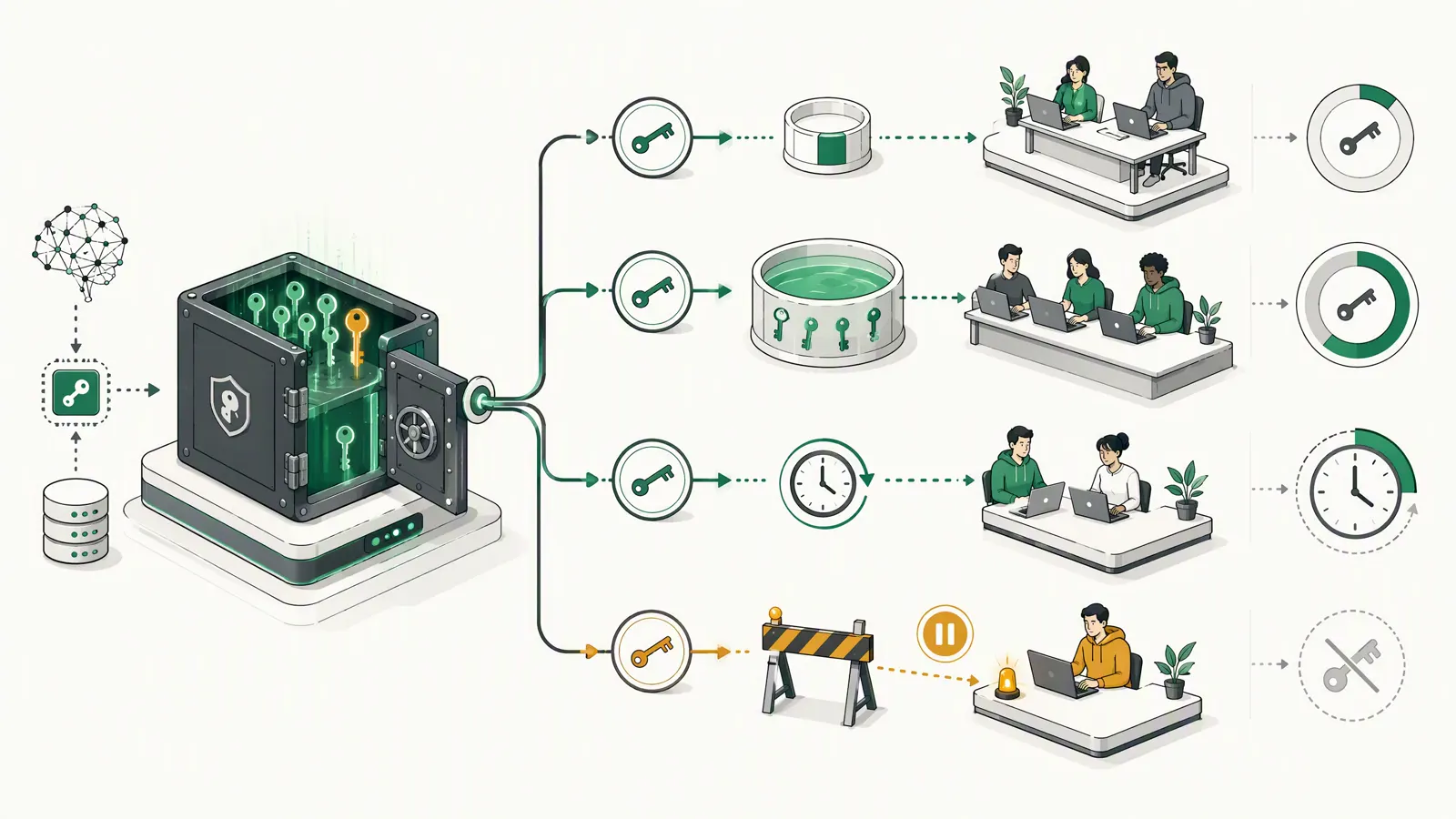 “Separate limits” may mean a shared pool, per-person caps, scheduled resets, or temporary suspension. Sales needs to clarify which arrangement the team expects.
The seller also needs to separate human credentials from application credentials. A developer should not paste a shared production key into a laptop simply because the team asked for “20 keys.” Background services need controlled storage, rotation, revocation, and an owner. Individual development access may need separate identities and narrower permissions. The correct structure follows the customer’s applications and security policy, not the headcount printed in a group message.
Budget limits and traffic limits answer different questions
A quota may prevent one project from spending more than an agreed amount. It does not guarantee that 20 developers can all send requests at 10:00 a.m. without throttling.
Anthropic’s rate-limit documentation separates spend limits from rate limits and describes throughput with measures such as requests per minute and input or output Tokens per minute. In plain language: one control asks, “How much money may this account use?” Another asks, “How much traffic may pass during this short period?”
That is why sales still needs:
- normal and peak requests per minute (RPM);
- input and output Tokens per minute (TPM);
- concurrent requests and average request duration;
- the time zone and length of the peak window;
- retry behavior after a timeout or 429 response;
- workloads that must run immediately versus those that can queue.
If all 20 developers begin an automated review after the same merge, the team may hit a rate limit while daily spend remains below USD 200. If a nightly batch uses long prompts and an expensive model, it may exhaust the daily budget without creating a high request count. The quote, routing design, and support plan change in each case.
Ask which model and which key are causing the money
The most useful qualification question is often not “Can you share your total Token count?” It is “Which model and which key produced most of the cost in the last complete week?”
OpenRouter’s Analytics API cost-control guide describes breaking account spend down by model and then drilling into the API keys responsible. It also notes that real usage history is required; without a few weeks of data, there may be little to analyze. The guide supports the investigation method, not the simulated numbers or an assumption that a key always maps to one person.
 A useful spend figure appears only after each key is connected to a model, an application, and an accountable owner.
A sales rep can request a redacted table rather than raw account access:
| Required field | Example of a useful answer | Why it changes the offer |
|---|---|---|
| Measurement window | “Last seven complete UTC days” | Separates an average from one peak day |
| Model | “Model A for IDE, Model B for review” | Exposes price and access differences |
| Key or app label | “ide-team, review-bot, nightly-tests” | Connects spend to something the buyer can control |
| Daily cost range | “USD 165–230” | Shows variance and the needed buffer |
| Peak traffic | “85 RPM, 1.4M input TPM at 14:00 UTC” | Tests whether a spend-only quote is insufficient |
| Failed and retried calls | “11% retried after 429 on Monday” | Finds cost or traffic inflated by client behavior |
Every value above is representative. None should be inserted into the buyer record unless the team supplies it.
The first reply should recover one missing fact
When the group rules, relationship, and contact permission allow a response, do not send a questionnaire with 15 fields. Ask for the evidence that most changes the decision.
If the message says “about USD 200,” reply:
Representative simulation “Is that the measured average from the last seven complete days? If you can share a redacted split by model and key or application label, we can tell whether this is mainly capacity, cost control, or key management.”
If the spend is measured but key ownership is unclear:
Representative simulation “Do the 20 developers call the API directly, or do most requests come through shared applications and batch jobs? We would design limits differently for those two cases.”
If the workload is clear but the date is vague:
Representative simulation “What must be working by next Wednesday: billing, key distribution, per-project limits, a backup route, or the full production migration?”
The answer determines the next action:
- Schedule a scoped call when measured usage, workloads, owner, payment, allowed route, and a real date align.
- Clarify first when the number is measured but models, peaks, key structure, or limit behavior are missing.
- Observe when the usage is only a forecast and no rollout owner or date exists.
- Close when the requester will not explain account ownership, allowed access, or commercial use, or asks for credentials or routing the supplier cannot lawfully provide.
How TOP Prospect fits before the sales call
The workflow starts with source permission. A user deliberately selects and connects Telegram groups they are authorized and otherwise permitted to process. Telegram’s current Content Licensing Terms restrict scraping, indexing, harvesting, aggregation, and specified AI or machine-learning uses, with a narrow consent exception described in the terms. Group access alone is not blanket permission for every processing purpose.
Within the permitted source set, TOP Prospect can retain the original message, source, time, and nearby context. It can group repeated versions and surface a candidate that joins a spend figure, team size, control problem, billing condition, and date. A salesperson can then read the thread and ask the missing question.
TOP Prospect does not inspect the buyer’s billing account, validate a usage export, verify the keys, calculate an enforceable quota, confirm model access, or approve a relay or resale route. It does not verify identity, purchasing authority, contact permission, or a completed deal, and it does not automatically contact the poster.
For the earlier classification step, use the four-message test for API Token buyer signals. For a broader multi-provider request, see the multi-cloud AI API demand workflow. This article begins later: a team-volume message has already reached human review, and sales must decide whether its numbers are ready for a responsible commercial conversation.
Follow up quickly, but do not price three numbers
“USD 200 a day, 20 developers, next Wednesday” is enough to justify prompt attention. It is not enough to divide the budget by headcount and sell 20 identical keys.
Recover the measured period, model and key split, real applications, peak traffic, limit behavior, billing owner, permitted access route, and exact rollout step. Then the seller can decide whether the team needs more credits, better cost attribution, project keys, hard limits, traffic capacity, or a different technical design.
The opportunity is not the number USD 200. It is the moment when a team can show where that USD 200 goes, who controls it, and what must change before next Wednesday.
Frequently asked questions
Does USD 200 per day across 20 developers prove enterprise API demand?
No. It is worth timely clarification, but sales still needs the measured period, model mix, application workloads, peak rates, key structure, billing owner, authorized access route, and decision date.
Should sales divide USD 200 by 20 and quote a USD 10 daily limit for each developer?
No. Equal division is only arithmetic. Real usage may concentrate in two batch jobs, one shared service, a small group of heavy users, or expensive models. Limits should follow measured workload and the buyer's control policy.
Are team spend limits the same as provider rate limits?
No. A spend control governs money or credits, while provider rate limits govern request or Token throughput. A team can stay under budget and still hit a short traffic limit.
Sources and further reading
This article is human-authored. TOP Prospect processes only Telegram groups the user has explicitly authorized and connected. Its output supports human sales judgement; it does not replace human decisions and does not automatically contact or message group members.
How a Signal worth attention is found
See how Top Prospect finds and organizes Signals worth checking, keeps the original Telegram context, removes duplicates, and helps you decide what to review first. You decide whether to follow up and what to do next.