Win security & compliance clients in 4 steps — and they come to you
Six months watching tender portals produced 2 opportunities. A four-step routine — pick the timing, search the right groups, recognize distress, judge by hand — makes security clients surface in Telegram at their most urgent moment.
First, my own miserable numbers.
Selling security and compliance services, I watched every tender portal like a hawk — first refresh every morning. Half a year: 2 opportunities, both priced against seven competitors.
Then I changed exactly one thing: I moved half of that portal-watching time into Telegram groups, reading messages.
The first month, I tagged 40+ messages from people rushing security compliance (illustrative example): a team two weeks from launch with no penetration test report, a founder stuck on a client’s security questionnaire, an audit that just came back with findings.
Clients don’t show up on tender portals. They show up before them.
Here is the four-step routine. Walk all four, and clients meet you at their most urgent moment.
Step 1: only watch people who are out of time
The iron law of this market: compliance without a deadline isn’t a need — it’s studying.
Two people can type the same words, “we’re looking into SOC 2”:
- One said it six months ago and is still “looking into it” — knowledge hoarding;
- One says “client acceptance next month, the report has to exist” — deadline racing.
Watch the second kind. Rushed people cluster in three scenarios:
Pre-launch
A product ships, a client or platform demands a security report. The date is set by someone else and will not move.
Mid-audit
Annual audits, spot checks, client due diligence — the auditor hands over a list of findings and security demand explodes on the spot.
Post-incident
Scanned, extorted, rumors of leaked data. Nobody compares vendors at this stage; there is only “who can start now”.
Aim your group pool at these three scenarios and your competitor is no longer the seven firms on the tender portal — it is time itself.
Step 2: search the right groups — security clients don’t sit in “security groups”
Another counterintuitive one: buyers of security services rarely appear in “cybersecurity groups”.
Half the seats there belong to fellow vendors.
The real gathering places are the client’s own industry groups:
- Going-global SaaS and app teams — launch compliance, privacy policy, card-data handling;
- E-commerce and indie seller groups — scans, malware injections, platform compliance reviews;
- Fintech groups — regulatory reports, and penetration testing requirements (for these groups the terms are hard gates, spelled out in full on first mention);
- Corporate IT and ops groups — where technical due diligence happens before the boss signs.
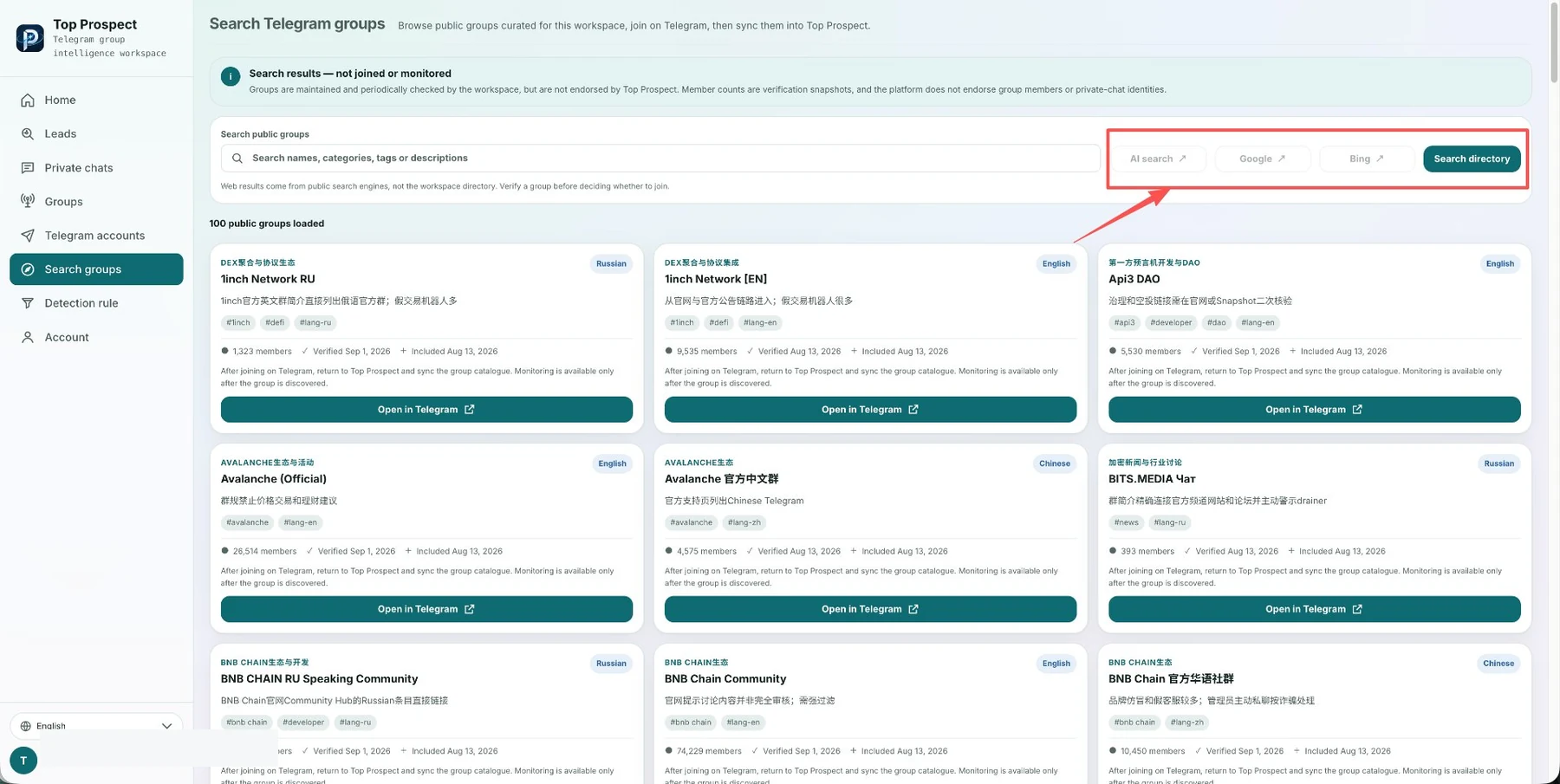
For group discovery I go straight to the TOP Prospect group search page: four entries — AI search, Google, Bing, and the built-in group library (with 100 public groups loaded) — searching by the client’s industry words, never by “security”. The result cards carry group name, description, category tags, primary language, member count, last verified time and indexed time — enough to do a first screening before joining anything. Strip out the wrong category tags and wrong languages; what remains is the pool worth watching.
Step 3: recognize three types of distress messages
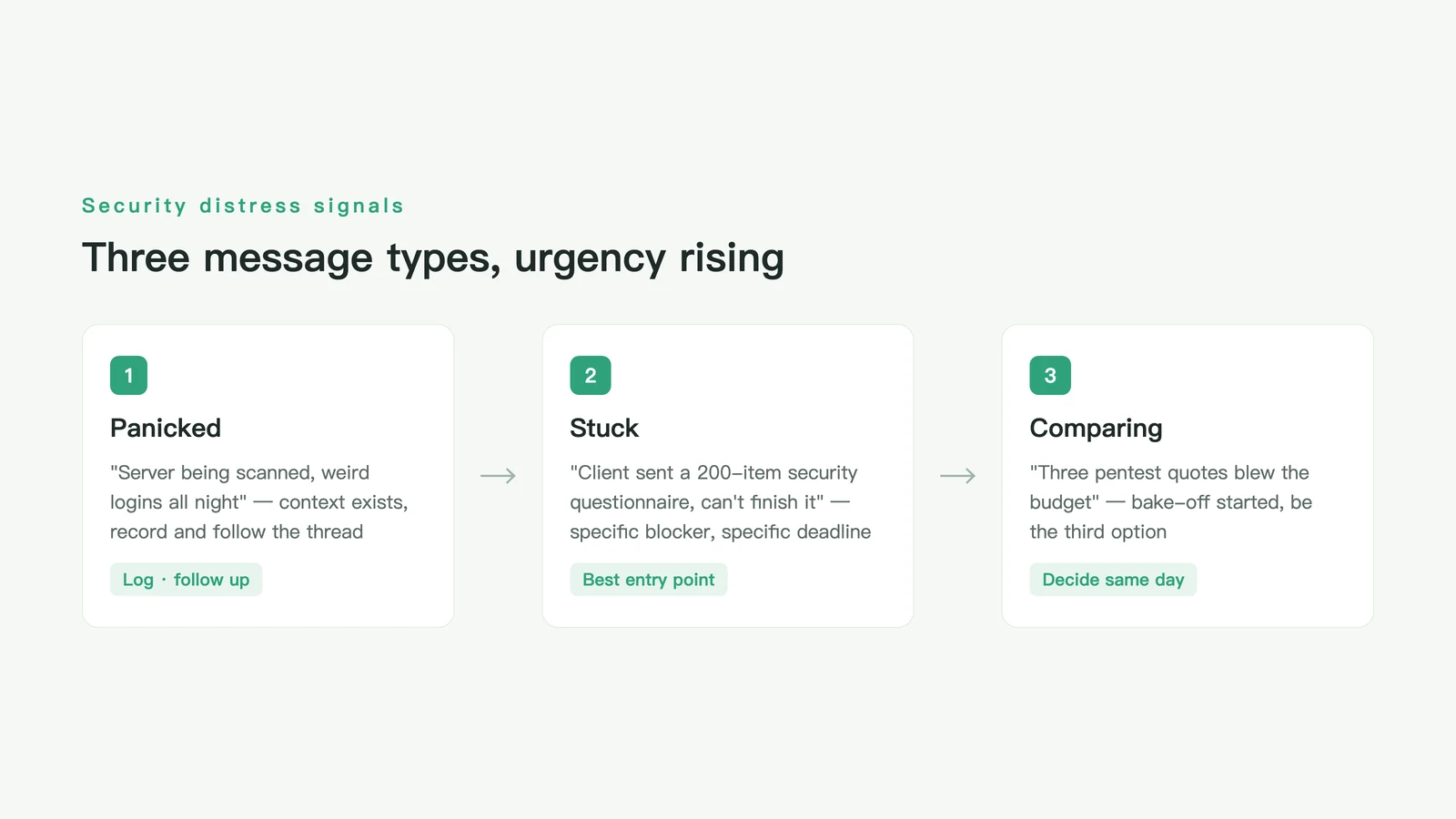
Pool built. Now read. Three signal types, urgency rising:
① Panicked
“Looks like our server is being scanned, weird logins all night — anyone seen this?”
Context already exists: which system, what behavior. The need is forming. Record it and follow the thread.
② Stuck
“Client sent a 200-item security questionnaire, we can’t finish it, anyone dealt with one?”
My favorite type. Questionnaire, audit, acceptance — the blocker is specific, the deadline is specific, and so is your service entry point.
③ Comparing
“Three penetration testing quotes (that’s the simulated-attack-report kind of service) all blew the budget — anyone more cost-effective?”
The bake-off has started. Arrive now and you face three quoted competitors instead of one panicked human. Speed matters, but so does posture — you are not the firefighter, you are the third option.
Step 4: judge by hand, then act
The most-skipped step, and the least skippable.
DM-ing the moment you see “breached” is the classic security-sales car crash — half the time you discover you have been chatting with a peer. Distress signals need the same judgment:
- Buyer or peer? (Perspective: “our systems” vs “we’ve handled dozens of client cases”)
- How far open is the window? (Panicked: follow the thread. Comparing: decide today)
- What can you actually take on? (Reports, remediation, on-site — don’t promise everything)
What a tool like TOP Prospect does is surface the groups and messages where distress signals are appearing, in the three scenarios above — the judgment and the outreach remain human decisions.
What changes after the 4 steps
Back to the opening numbers: tender portals, half a year, 2 opportunities, all price wars.
With the routine running, every client you touch meets you at their most urgent moment — pre-launch, mid-audit, post-incident. At that moment the client is not shopping for “a security vendor”; they are looking for “someone who can catch the problem today”.
Clients coming to you isn’t magic — it’s moving your appearance from the tender portal to the incident scene.
Should you still watch the portal? Sure. It’s where the process ends, not where the business starts.
Frequently asked questions
Why do security compliance clients show up before tenders?
A tender is the last box in the compliance process — by the time it publishes, the vendor shortlist is mostly settled. The real window is earlier: a launch date closing in, an audit finding, a client security questionnaire. At those moments the client is looking for someone who can start immediately.
Are people posting about breaches real clients or just lurkers?
Look for specifics. Someone in real trouble gives context: which system, when, what the scanner found. A news link plus "stay safe everyone" is a repost — watch only. Context-rich distress deserves same-day human judgment.
Which of the 4 steps gets skipped most often?
Step 4. People see the word "breached" and rush to DM, then discover they have been chatting with a peer. Distress signals also need judgment: who is posting, how far open the window is, what you can actually take on — decide first, then act.
Sources and further reading
This article is human-authored. TOP Prospect processes only Telegram groups the user has explicitly authorized and connected. Its output supports human sales judgement; it does not replace human decisions and does not automatically contact or message group members.
How a Signal worth attention is found
See how Top Prospect finds and organizes Signals worth checking, keeps the original Telegram context, removes duplicates, and helps you decide what to review first. You decide whether to follow up and what to do next.