Spotting super affiliates: the 3 words pros use in Telegram chats
In affiliate marketing, "I have big traffic" costs you hours. Three words — cap, EPC, payment run — separate pros from pretenders, plus three follow-up questions to verify before you quote.
Last week, in the same affiliate group, two people both claimed to “have big traffic”. One spent three days on emoji and “bro, how much do you think I could run?” The other opened with: “what’s the cap (volume limit) on this offer (promotion task)?”
The moment that word came out, I knew the second one deserved serious attention. The dashboard screenshot he sent later showed five figures in monthly commissions (illustrative). Total screening cost for both conversations: ten minutes.
In the affiliate world, vocabulary is seniority.
1. “I have traffic” is the cheapest sentence in the industry
Traffic scale can’t be verified on the spot, and the claim costs nothing — anyone can make it. Affiliate managers read it ten times a day and have long stopped believing it.
But one type of person can’t fake it: those who have actually run volume talk in industry terms. The things they care about are completely different from what beginners care about — and those things can’t be improvised.
2. Three words that tell you who’s a pro
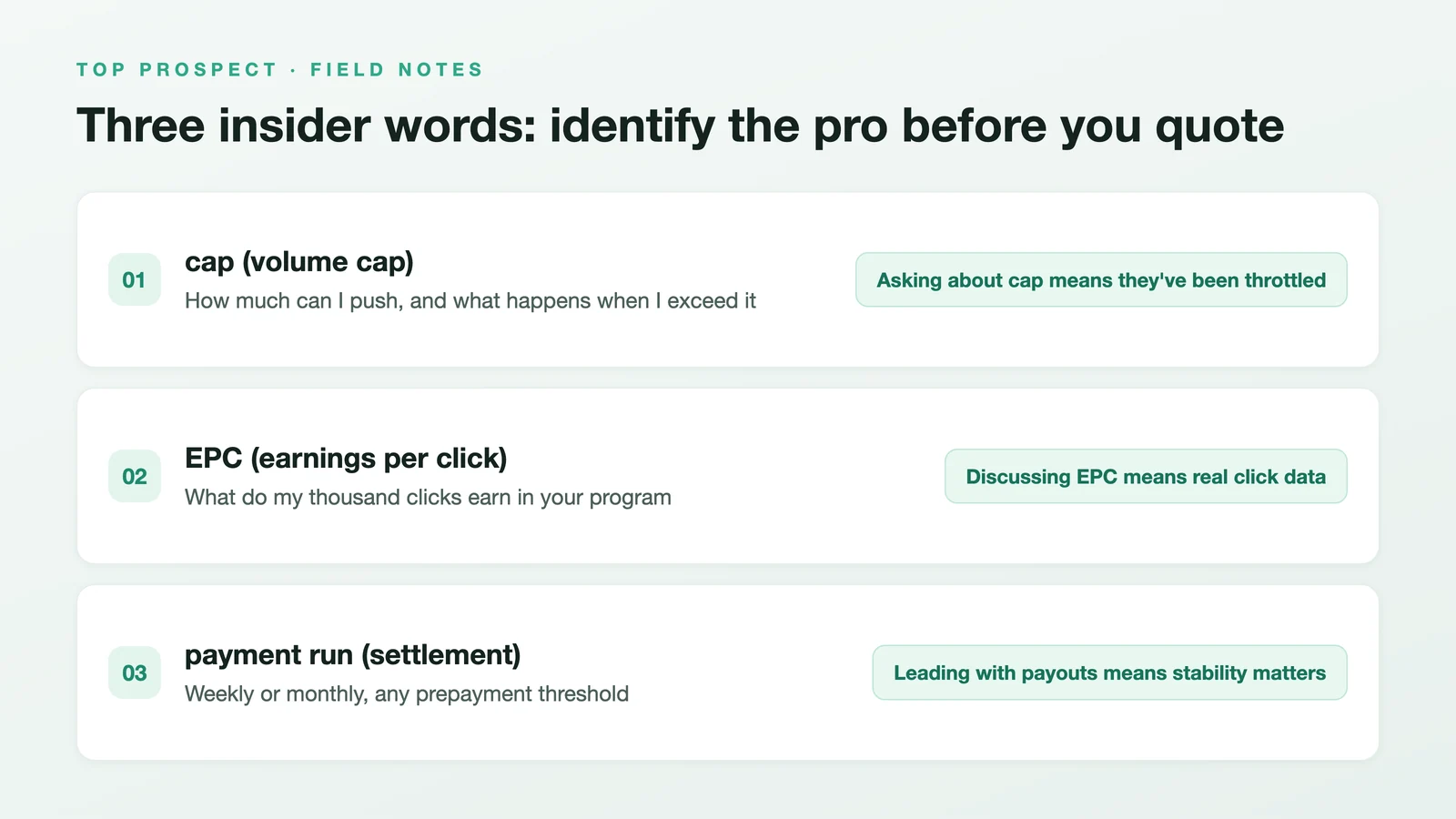
Word 1: cap (volume cap)
Anyone who opens by asking about your cap has been throttled before. Only people who have really run volume care: how much can I push, and do you cut volume or commission when I exceed it. Beginners ask “what’s the commission rate”; pros ask “how much can I actually run”.
Word 2: EPC (earnings per click)
A webmaster deciding whether your offer is worth a slot on their traffic calculates EPC first: what do my thousand clicks earn in your program. Anyone who opens with EPC has real click data — you can’t do that math without it.
Word 3: payment run (settlement schedule)
Pros care most about settlement rhythm: weekly or monthly, any prepayment threshold, and whether the last program delayed payouts. Only someone who has been burned puts the payment run ahead of the commission rate.
3. Where they gather
Big webmasters are not in “affiliate partnership” groups — most accounts with a webmaster label there are middlemen. Real traffic owners cluster in three kinds of professional groups (example):
- Affiliate marketing discussion groups: offer and channel talk, and the talk itself exposes their vocabulary
- Media buying and traffic groups: people who buy traffic naturally speak cap and EPC
- Niche webmaster groups: coupon sites, content sites, tool sites — search by niche, not by industry, and you dodge half the competitors
4. Hands-on: turn the glossary into a watchlist
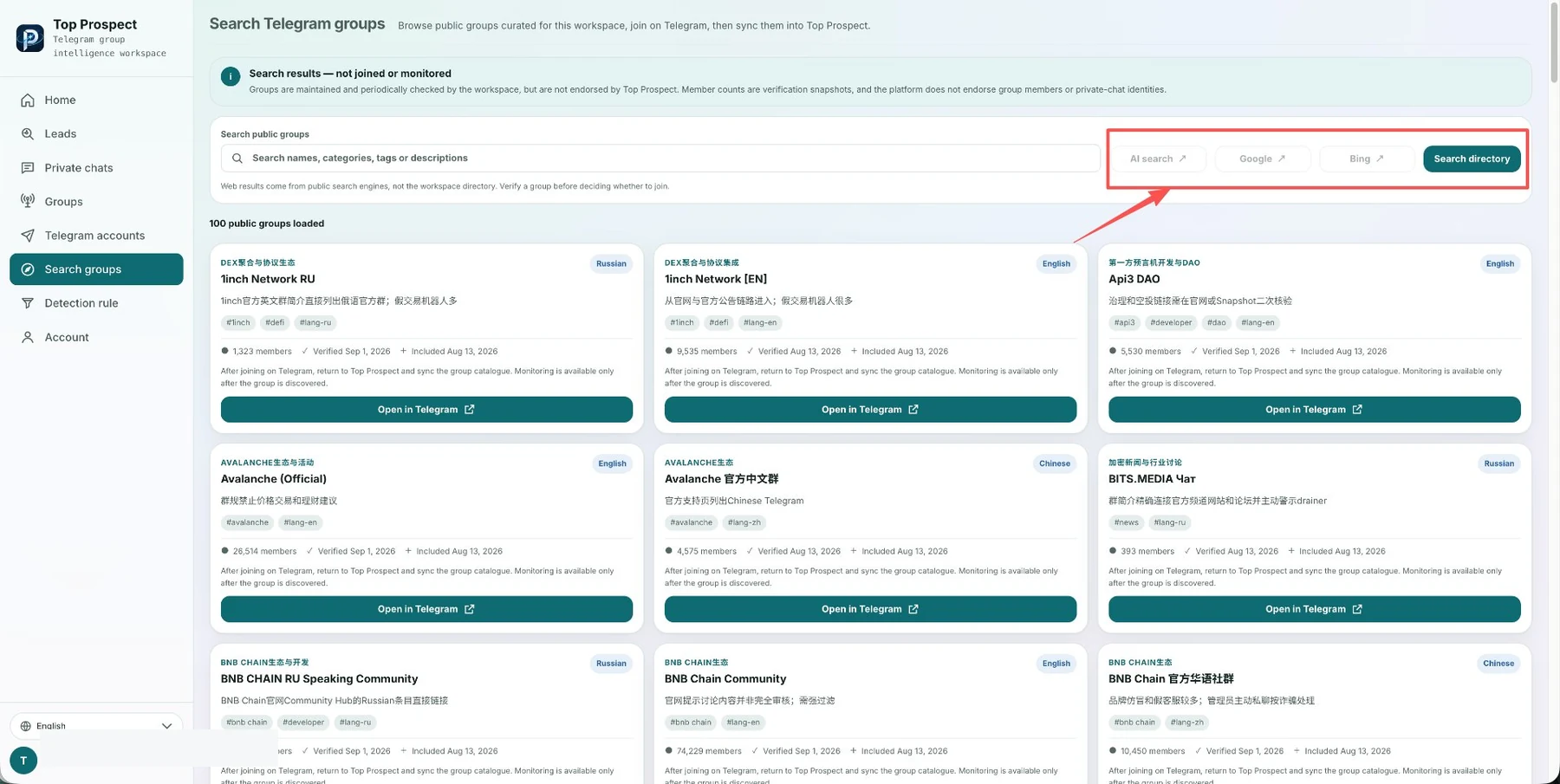
My process: use TOP Prospect to find these professional groups. It has four search entries — AI search, Google, Bing, and the built-in group library (with 100 public groups loaded). Niche keywords beat industry keywords: “coupon site” and “content webmaster” return far fewer fellow managers than “affiliate marketing”.
After the search, filter by primary language and member count, then read each result card’s group name, description, category tags, last verified time, and indexed time. Then observe with the glossary in mind: within a week, the people who talk in insider terms float to the surface. I watched 5 groups and identified 11 webmasters speaking the language (example); 4 of them later verified with real volume.
5. Before quoting, verify with three follow-up questions
The glossary is a first-pass filter; run one more pass before quoting (example phrasing):
- “What are you running now?” — a concrete niche and volume means real experience; “I run everything” buys you three more days of emoji
- “Why did the last program end?” — a specific reason means stable cooperation; hedging usually means they got cut off or walked
- “Rough daily spend?” — a range instead of an exact big number is a cautious real player; an overly precise big number should come with a dashboard first
Once all three pass, send your rate card. In the reverse order, your rate card just becomes their bargaining chip.
An affiliate manager’s time belongs to the pros. The glossary plus three questions pulls the real webmasters out of a hundred “I have traffic” claims in ten minutes.
Frequently asked questions
Why can't "I have big traffic" be taken at face value?
Because traffic scale can't be verified on the spot and the claim costs nothing — anyone can say it. Affiliates who have actually run volume prove themselves with industry vocabulary: asking about cap, discussing EPC, negotiating payment runs. If none of those words show up, the odds are they never ran volume hands-on.
Do affiliates who don't use all three words ever have real volume?
Yes, but rarely. The vocabulary is a first-pass filter; verify what passes with three follow-up questions: what they're running now, why the previous program ended, and their daily spend. If all three get solid answers, the missing vocabulary stops mattering.
After finding a pro, how do I open the conversation without being taken for another affiliate manager?
Don't send a standard rate card. Join the topic they're already discussing: if they asked about your cap, explain your cap logic; if they asked about payment runs, lead with your settlement rhythm. Pros trust people who speak the language, not people who blast messages.
Sources and further reading
This article is human-authored. TOP Prospect processes only Telegram groups the user has explicitly authorized and connected. Its output supports human sales judgement; it does not replace human decisions and does not automatically contact or message group members.
How a Signal worth attention is found
See how Top Prospect finds and organizes Signals worth checking, keeps the original Telegram context, removes duplicates, and helps you decide what to review first. You decide whether to follow up and what to do next.