GPT-6 Astra Is Out, but Is the API Actually Available? Do Not Sell a Queue as Inventory
OpenAI has released GPT-6 Astra through a staged rollout. For AI API providers, the useful Telegram signal is not urgency alone, but a verified workload, test date, expected usage, and decision path.
Signals to watch
- OpenAI has released GPT-6 Astra, but its documentation describes a staged rollout rather than simultaneous access for every API account
- A public release, access on one account, and capacity that can be allocated to a customer are three different facts
- A specific workload, test date, usage estimate, and decision date are more useful than urgency alone
- TOP Prospect organizes discussions only from Telegram groups the user deliberately selects and is authorized to process; it does not read one-to-one chats or contact members automatically
Within hours of a major model release, Telegram developer groups tend to fill with variations of the same question:
“Do you have GPT-6 Astra API access?”
“Can you activate it now? We need to test today.”
“Who has a route that can call Astra?”
These are representative composites, not customer quotations. They do not establish that a writer has a budget, purchasing authority, or even a production workload. What they reveal is a real market tension: a model can be publicly released before every account can use it, and an account can make one successful request without having capacity that can be promised to a customer.
Key takeaway
- OpenAI has released GPT-6 Astra, but the official documentation describes a staged rollout, not simultaneous availability for every API account.
- AI API providers need to distinguish “the model exists,” “our account can call it,” and “we can allocate usable capacity to a customer.”
- “We need it today” establishes time pressure, not workload, budget, business impact, or purchasing authority.
- The most useful follow-up facts are the workload, test date, expected usage, launch date, and who will decide whether the company proceeds.
Release, account access, and deliverable capacity are different facts
OpenAI’s GPT-6 Astra model documentation includes an important qualification: Astra is rolling out first to enterprises in the Trusted Access Program, while broader access through the API and the Plus, Pro, Business, and Enterprise plans is expected in the following days. That statement does not provide a precise time when every account will be enabled.
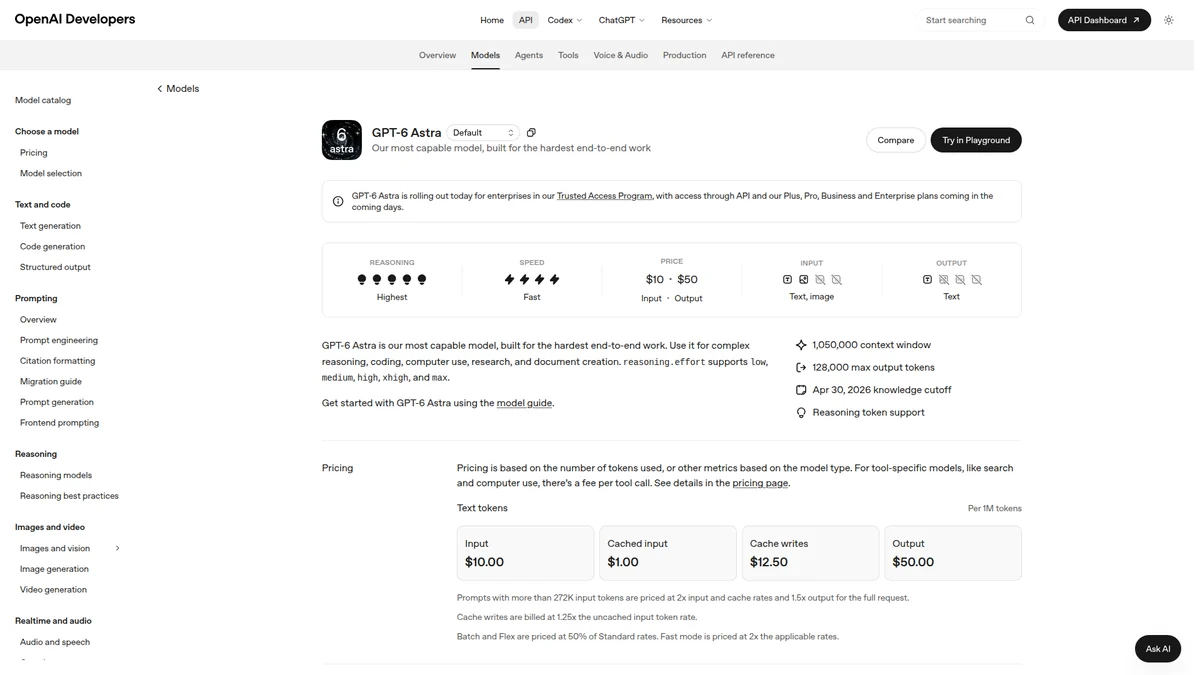 OpenAI’s page shows that GPT-6 Astra was still in a staged rollout on September 4, 2026. It also shows public per-token pricing. It does not prove that any intermediary has capacity available for resale.
For an AI API provider, the official wording separates availability into three layers:
- Model status: OpenAI has publicly released the model.
- Account status: A specific organization or project controlled by the provider can actually call
gpt-6-astra. - Deliverable status: The account’s RPM, TPM, tier, and internal allocation are sufficient for the customer’s intended test.
RPM means requests per minute. TPM means tokens per minute. Both can constrain throughput even when an API key is valid. The first layer is now true. The second and third still have to be verified account by account. Calling all three “inventory” replaces uncertainty with a claim the provider may be unable to support.
This is why the first response after a launch matters so much. A salesperson who says “yes, we have it” may win the next message but create a chain of follow-up questions the business cannot answer: When will the key arrive? How much throughput is guaranteed? Can the customer run a production test tonight? What happens if the allocation disappears?
The cost is not only a refund. In a market where upstream conditions change quickly, the customer’s most valuable impression is whether a provider reports those conditions accurately.
What does “we need it today” actually mean?
A customer asking for Astra immediately may be trying to accomplish several different things. One team wants a screenshot for a product announcement. Another wants to demonstrate a prototype to management. A third plans to place a new model behind a feature flag next week. A fourth genuinely needs production traffic tonight.
All four can write “urgent” in a Telegram group. Their capacity requirements are completely different.
A useful answer stays within what the provider has verified while narrowing the task:
“OpenAI is still rolling out access, so we cannot promise allocatable capacity yet. Are you trying to validate your interface and request flow today, or do you need Astra-specific output? If the first is enough, you can test model-independent orchestration with a current production model. If Astra itself is required, we can record the test date, request shape, and required features, then verify them when access is actually enabled.”
This answer does not invent a key or a delivery date. It also does not imply that an older model is equivalent to Astra. OpenAI’s Astra usage guide says migration requires teams to revisit the Responses API, tool use, reasoning effort, and unsupported parameters. Testing model-independent orchestration with another model can preserve engineering progress, but it cannot validate Astra’s outputs or prove compatibility.
The customer’s reply can transform a vague launch-day request into a concrete problem. “We only need to verify our user interface by Friday” is a different opportunity from “the public beta launches Monday, tool calling is central to the workflow, and traffic will arrive in two ten-minute peaks.” The second statement can be checked against actual capacity. The first may not need Astra at all today.
One successful call is not production capacity
An enabled account can still be a poor fit for the workload the customer describes. OpenAI publishes RPM, TPM, and Batch queue limits, and the permitted levels can change with usage tier. Batch queue limit refers to the total volume that can wait inside asynchronous batch processing. These are separate capacity dimensions, not one universal stock number shared by every intermediary.
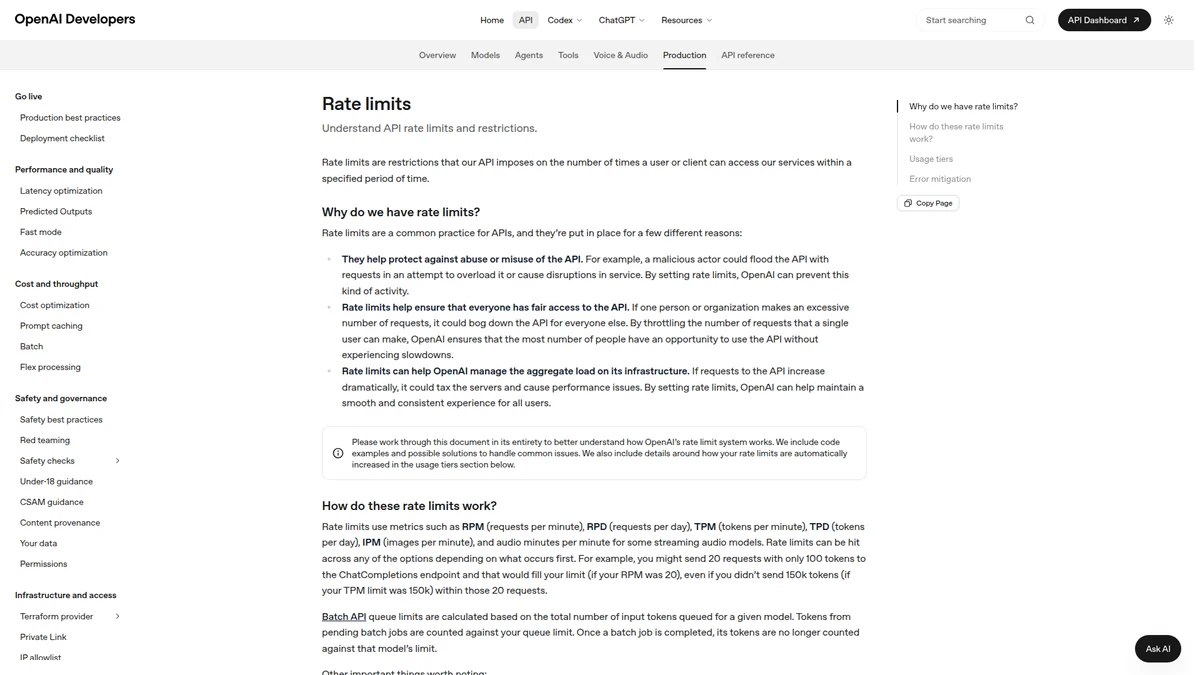 OpenAI’s rate-limit guide shows that an API account can be constrained by requests, tokens, and queue volume at the same time. The screenshot explains the capacity dimensions; it does not establish the quota of any specific provider.
Suppose a prospect estimates 50,000 tokens per day and a peak of 100,000. Even that is incomplete. Does the peak arrive over one minute or twelve hours? How long is the input context? Are responses synchronous or submitted through Batch? Does the workflow use tools? Can the test wait, shed load, or switch models when a limit is reached?
The answers determine whether a small early allocation is useful or deceptive. A single request succeeding in a console proves that the account can reach the model at that moment. It does not prove that the provider can sustain the customer’s peak, preserve the allocation for a week, or attach a service commitment to it.
The same distinction applies to public pricing. A published price establishes how OpenAI prices the model under stated conditions. It does not establish the margin, availability, invoice terms, or support obligations of a company offering access through its own service.
Launch-day demand is useful only when its context survives
The first day of a model release creates a large number of nearly identical messages: “have it,” “need access,” “urgent,” and “send price.” A simple keyword search mixes individual experiments, resellers, product teams, researchers, and production buyers into one queue.
For an AI API provider, a candidate inquiry becomes more useful when it preserves at least four fields:
- the exact capability or workload the person wants to test;
- the testing or launch date;
- the expected request shape, daily usage, and peak;
- the person or team that will decide whether testing or procurement continues after access opens.
These fields do not prove a sale. They make the uncertainty explicit. They also let the provider prioritize fairly when capacity arrives: a team with a scheduled test and a measurable workload can be rechecked before a person who asked only for a price.
TOP Prospect can organize candidate messages from Telegram groups that a user deliberately selects and is authorized to process. It preserves the original message, source, timestamp, and surrounding context and can help order items for human review. When upstream access changes, a BD team can return to the saved context, verify which tests are still active, and ask whether the earlier usage estimate still applies.
The product boundary is equally important. TOP Prospect does not read one-to-one Telegram chats or groups the user has not selected. It does not contact members automatically, and it cannot infer a person’s employer, budget, usage, or purchasing authority from one message. It reduces the chance that a relevant public or group discussion disappears into the feed; people still have to verify the demand and decide whether contact is appropriate.
A queue can become evidence, but it is not inventory
GPT-6 Astra gives AI API providers a short window of market attention. The window is commercially useful because prospects reveal what they hope to test, when they need it, and what volume they expect. It is also a trust test because the supply side is changing while those questions arrive.
The durable provider is not necessarily the first one to type “available.” It is the one that can say which layer of availability has been confirmed, what can be tested today, and what conditions must be met before production capacity can be discussed.
A queue can help a team collect and qualify demand. It can help upstream capacity be allocated to the clearest workloads first. But until the account is enabled and its usable limits are measured, the queue is still a queue. Selling it as inventory turns a temporary access constraint into a lasting credibility problem.
FAQ
Can every API account call GPT-6 Astra now?
No. OpenAI says GPT-6 Astra is rolling out first to enterprises in its Trusted Access Program, with broader API and plan access coming in the following days. The public release does not prove that a specific account has access today.
What can an AI API provider safely promise to a customer who wants to test today?
It can report whether its own account has verified access, describe the current uncertainty, and help the customer test model-independent request orchestration with an existing model. It should not promise an unverified key, quota, date, or performance level.
Does one successful Astra request prove that production capacity is available?
No. Production capacity also depends on RPM, TPM, batch queue limits, account tier, workload shape, and long-context pricing. One successful request does not prove that peak traffic can be served.
What does TOP Prospect do in this situation?
Within Telegram groups that the user deliberately selects and is authorized to process, TOP Prospect organizes original messages, sources, timestamps, and surrounding context and helps prioritize human review. It does not read one-to-one chats, contact members automatically, or verify identity, usage, budget, or purchasing authority.
Frequently asked questions
Can every API account call GPT-6 Astra now?
No. OpenAI says GPT-6 Astra is rolling out first to enterprises in its Trusted Access Program, with broader API and plan access coming in the following days. The public release does not prove that a specific account has access today.
What can an AI API provider safely promise to a customer who wants to test today?
It can report whether its own account has verified access, describe the current uncertainty, and help the customer test model-independent request orchestration with an existing model. It should not promise an unverified key, quota, date, or performance level.
Does one successful Astra request prove that production capacity is available?
No. Production capacity also depends on RPM, TPM, batch queue limits, account tier, workload shape, and long-context pricing. One successful request does not prove that peak traffic can be served.
What does TOP Prospect do in this situation?
Within Telegram groups that the user deliberately selects and is authorized to process, TOP Prospect organizes original messages, sources, timestamps, and surrounding context and helps prioritize human review. It does not read one-to-one chats, contact members automatically, or verify identity, usage, budget, or purchasing authority.
Sources and further reading
This article is human-authored. TOP Prospect processes only Telegram groups the user has explicitly authorized and connected. Its output supports human sales judgement; it does not replace human decisions and does not automatically contact or message group members.
How a Signal worth attention is found
See how Top Prospect finds and organizes Signals worth checking, keeps the original Telegram context, removes duplicates, and helps you decide what to review first. You decide whether to follow up and what to do next.