Stop Staring Only at "Any Recommendations": How B2B Sales Uses Telegram Groups for Competitor Intelligence and Market Insight
The same complaint about "high latency and a bill that doesn't add up" makes a junior BD rush in with an ad and a senior BD quietly write it down. This article lays out the three kinds of "non-demand" intelligence in Telegram groups — competitor defects, the customer's real budget and purchasing process, and hidden industry direction — and how to turn scattered fragments into evidence at the negotiating table.

Signals to watch
- A group complaint about a competitor's specific feature, latency, billing, or support
- A customer mentioning a price range, an annual-payment requirement, or cash flow — budget and payment preference
- A concentrated discussion of a new technical term or a local compliance policy
- Decision-chain information such as finance approval or contract expiry
For many B2B sales reps, BD teams, and cross-border business leads, Telegram developer groups and industry chat groups look like the most direct customer pond there is. Sitting in front of the screen every day, hunting for the people who post “any recommendations?” or “does anyone know a reliable one?” has become a daily routine.
But if you are searching for “how to do B2B competitor analysis” or “cross-border competitor monitoring,” this article may overturn an assumption you have been holding.
The best sales operators do not only use Telegram groups to fish for leads. They use them to read the weather. They know that the complaints and gripes in a group — the ones that never mention you and often look unrelated to you — can hide commercial value far more lethal than a direct “any recommendations?” request.
A real scene: from watching the drama to a single decisive move
In a certain AI API developer group, people often compare the strengths and weaknesses of different providers.
One day, a technical lead who is usually very active complained in the group:
(Note: the following is a representative composite scenario, not a real customer’s words.) “X’s (a well-known competitor) API has been way too slow lately, especially during the evening peak. Worst of all, the end-of-month bill does not add up at all, and their support is playing dead. How am I supposed to explain this to finance?”
The group instantly exploded, and everyone chimed in.
A junior BD’s reaction is to jump in immediately: “Hey, stop using X, come try us! We are fast, our billing is transparent, and our support replies in seconds!” The usual result is a warning from the group admin for advertising, or being ignored outright.
A senior BD’s approach is to quietly note the message down and stay silent.
A few days later, while following up with another wavering prospect, the BD hears: “We have been using X all along. There are some small issues, but switching providers is such a hassle.”
At that point the BD does not keep pitching how good his own product is. Instead he drops a single light remark: “I understand the concern. But I heard X has had serious latency during the evening peak lately, and their end-of-month reconciliation often goes wrong. Did your finance team push back on that?”
The prospect pauses, then opens up and pours out the complaints. The BD follows through with his product’s per-key billing breakdown and SLA guarantee package. In the end, the customer switches.
That is the power of market intelligence. A customer cursing a competitor in a group is worth more than one who praises you directly.

Diagram: the same complaint, whether you rush in with an ad or write it down first, decides whether it is noise or evidence in your next negotiation; the dialogue shown is illustrative, not a real group record.
The 3 kinds of high-value “non-demand” intelligence in Telegram
In B2B acquisition, we are too used to looking for explicit purchasing requests and too ready to ignore the non-demand conversations. For cross-border competitor monitoring, three kinds of information are gold:
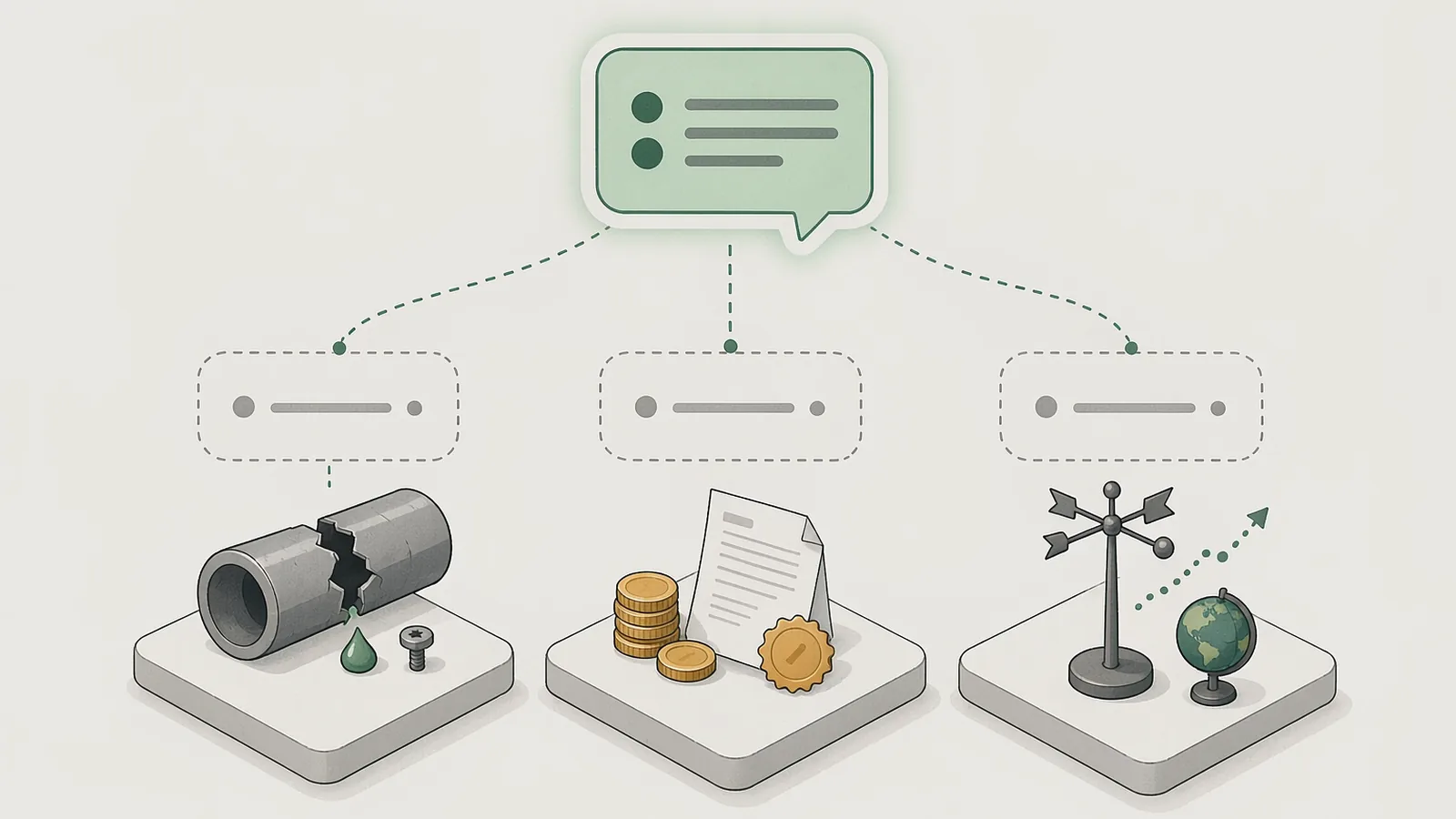
Diagram: none of these three kinds sits inside a purchasing request, yet they point to product weaknesses, a budget range, and industry direction — the parts a competitor’s official material will never write down.
1. The competitor’s fatal complaints (product and service defects)
When a customer complains in a group about a competitor’s specific feature lagging, slow support response, opaque billing, or high latency on a node in some country, that is the most authentic weakness of the competitor. These weaknesses will never appear in the competitor’s official deck, yet they are the sharpest weapon you have in a sales negotiation.
2. The customer’s real budget and purchasing process
Sometimes a customer complains in a group that a provider is too expensive to afford, or that a provider insists on annual payment their cash flow cannot take. It looks like a complaint about price. In fact, it is revealing their real budget range and internal purchasing preference. Once you know these, your later quotes can land precisely on the customer’s psychological price point.
3. The industry’s hidden direction (technology and policy trends)
When a group suddenly starts discussing a new technical term intensively, such as a certain large model’s new API format, or a country’s compliance policy, such as strict checks on cross-border data transfers, it is usually a precursor to a shift in the market. Catch these signals early and you can adjust your product strategy or sales pitch earlier than your competitors.
How do you turn watching the drama into a systematic intelligence library?
Knowing that intelligence has value is one thing. Executing on it runs into a practical problem: human attention is limited.
BDs are already tired enough from watching groups for recommendation leads. Expecting them to systematically tally and analyze who is cursing a competitor, or who is discussing an industry trend, is unrealistic. Rely on your memory and you forget within days. Rely on screenshots and you never form a structured knowledge base.
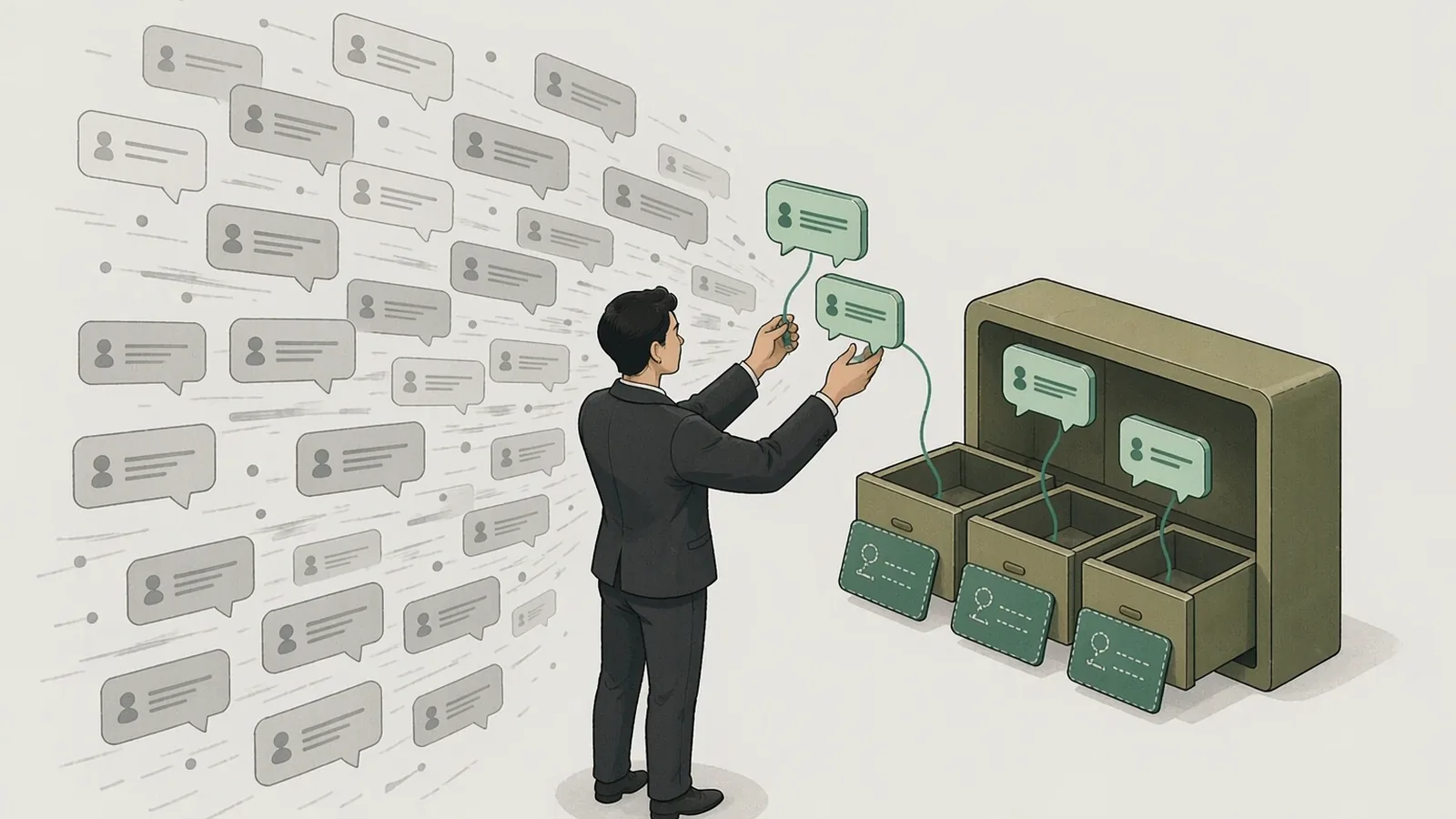
Diagram: intelligence fragments scattered across a sea of chat logs can only be pulled out again before the next negotiation if the original message, the source group, and the surrounding context are all kept together.
This is why many mature cross-border teams upgrade Top Prospect from a simple lead filter to an intelligence listening setup.
Its role stays restrained and professional:
Once you connect your own Telegram account and select the groups you are authorized to access, beyond monitoring demand words, you can also set competitor brand names, founder names, or specific industry technical terms as monitoring targets in Top Prospect.
When discussions about these terms appear in a group — whether complaints, comparisons, or trend analysis — Top Prospect extracts the original message, source group, and surrounding context in full for the BD and pushes it to a list.
It will not automatically write a competitor analysis report for you, and it will not go into a group to argue with a competitor. It simply helps you collect the intelligence fragments scattered across a sea of chat logs and keeps their full context.
When a BD is about to go after a customer who currently uses a competitor, he can open Top Prospect and quickly review that competitor’s recent history or latest moves in the group, so that at the negotiating table he knows both himself and the other side and lands a single decisive hit.
FAQ: Telegram competitor intelligence and market insight
Q1: Is monitoring competitor discussions in Telegram groups against the rules, or likely to annoy people?
A: Top Prospect strictly respects product boundaries. It only works in groups you actively select and are authorized to access. It does not read private chats, does not send messages automatically, and does not take part in group interactions. It is just a quiet information collector. How you turn the intelligence you gather into sales language, within compliance and professional standards, is entirely up to your team.
Q2: Once I have competitor intelligence, how do I use it in a sales pitch without sounding like I am smearing them?
A: High-level BDs never smear a competitor directly. They use empathy and questions. For example: “I heard you used X before? They seem to have had some fluctuations on feature Y recently — have you run into anything similar?” Leave the judgment to the customer. You are only responsible for offering the solution to that pain point.
Q3: Can Top Prospect automatically analyze a competitor’s strengths and weaknesses and generate a report?
A: No. Top Prospect’s core value is high-fidelity capture and preservation of the original context. It will not perform subjective analysis or generate reports for you. Real market insight, the breakdown of a competitor’s strengths and weaknesses, and the formulation of sales strategy must be done by your team, by hand, based on the real intelligence collected.
Q4: Besides competitor brand names, what other market intelligence can Top Prospect help me monitor?
A: You can monitor industry-wide pain-point words (such as account ban, latency, compliance), technology trend words (such as a new API standard or a new platform policy), and even customer decision-chain words (such as finance approval or contract expiry). By combining these words you can build a three-dimensional market awareness network.
Final thoughts
On the battlefield of cross-border B2B, an information gap is profit and a cognition gap is a moat.
If you treat Telegram only as a channel for posting ads or scraping leads, you will always be behind others, competing on price and response speed. But if you can treat it as a free, real-time market intelligence center — listening to customer complaints, spotting competitor weaknesses, sensing industry direction — you can hold real initiative at the negotiating table.
Stop staring only at the surface-level recommendation request. Build your signal-to-noise filter and pay attention to the real intelligence hidden behind the small talk and the complaints. When you convert the time you spend watching the drama into deep market insight, every one of your moves will be more precise and more lethal.
Frequently asked questions
Is monitoring competitor discussions in Telegram groups against the rules, or likely to annoy people?
Top Prospect strictly respects product boundaries. It only works in groups you actively select and are authorized to access. It does not read private chats, does not send messages automatically, and does not take part in group interactions. It is just a quiet information collector. How you turn the intelligence you gather into sales language, within compliance and professional standards, is entirely up to your team.
Once I have competitor intelligence, how do I use it in a sales pitch without sounding like I am smearing them?
High-level BDs never smear a competitor directly. They use empathy and questions. For example: "I heard you used X before? They seem to have had some fluctuations on feature Y recently — have you run into anything similar?" Leave the judgment to the customer. You are only responsible for offering the solution to that pain point.
Can Top Prospect automatically analyze a competitor's strengths and weaknesses and generate a report?
No. Top Prospect's core value is high-fidelity capture and preservation of the original context. It will not perform subjective analysis or generate reports for you. Real market insight, the breakdown of a competitor's strengths and weaknesses, and the formulation of sales strategy must be done by your team, by hand, based on the real intelligence collected.
Besides competitor brand names, what other market intelligence can Top Prospect help me monitor?
You can monitor industry-wide pain-point words (such as account ban, latency, compliance), technology trend words (such as a new API standard or a new platform policy), and even customer decision-chain words (such as finance approval or contract expiry). By combining these words you can build a three-dimensional market awareness network.
This article is human-authored. TOP Prospect processes only Telegram groups the user has explicitly authorized and connected. Its output supports human sales judgement; it does not replace human decisions and does not automatically contact or message group members.
How a Signal worth attention is found
See how Top Prospect finds and organizes Signals worth checking, keeps the original Telegram context, removes duplicates, and helps you decide what to review first. You decide whether to follow up and what to do next.