How to Find a Crypto Market Maker: Telegram Research and Partner Checks
How can Web3 projects find a market maker and decide whom to contact? Check Telegram messages, available history, independent sources and service fit before proceeding.
Finding a crypto market maker starts with discovering possible firms through project networks, relevant communities and official contact pages. Telegram can surface those introductions. It cannot establish that the person messaging you represents the firm, provides the service you need or is suitable for a partnership.
For a Web3 project’s business development (BD) lead, the difficult moment comes after the introduction: someone offers “liquidity support,” another promises exchange access, and a third forwards a familiar firm’s logo. Which conversation deserves another hour? The useful answer is a research process: preserve the original claim, inspect available history, corroborate independently and decide what still needs a human check.
Key takeaway
- A Telegram service pitch is a claim to investigate, not verified identity or capability.
- Available message history can expose relevant detail or inconsistencies; activity and repetition are not credentials.
- Check organizational affiliation through a separate official route before discussing contracts or transferring funds.
- TOP Prospect organizes selected-source information for review. Its priority is a reading order, not a reliability verdict.
How to find a crypto market maker without collecting random contacts
First describe the work, not the job title of market maker (MM). Do you need liquidity on a centralized exchange, support for a decentralized trading pool, or an introduction to someone who can discuss market structure? A CEX is a centrally operated exchange; a DEX is a decentralized exchange. An OTC desk arranges trades outside the public order book. These are related businesses, not interchangeable capabilities.
In its market-making guide, published on July 31, 2019, GSR explains market making through quotes to buy and sell an asset. The difference between the best buying and selling prices is the spread. This definition helps you separate liquidity work from a vague offer to “promote your token.” The article is a conceptual source, not evidence of a current offer or a recommendation to hire that firm.
Search for conversations around Market Making, Liquidity, Trading, CEX, DEX, Token Listing, OTC and Crypto BD. Pair these terms with your actual question: which venue, which trading pair, which launch stage or which kind of cooperation? Do not join a group solely because its name contains “MM.” Follow community links from a project’s official website where available, read its rules and inspect what people actually discuss.
A sentence such as “Need help with CEX listing / liquidity / market operations” bundles several different tasks. Ask which one the speaker means. Exchange listing is a separate process: a Telegram contact’s claim to have connections does not establish authority to secure a listing.
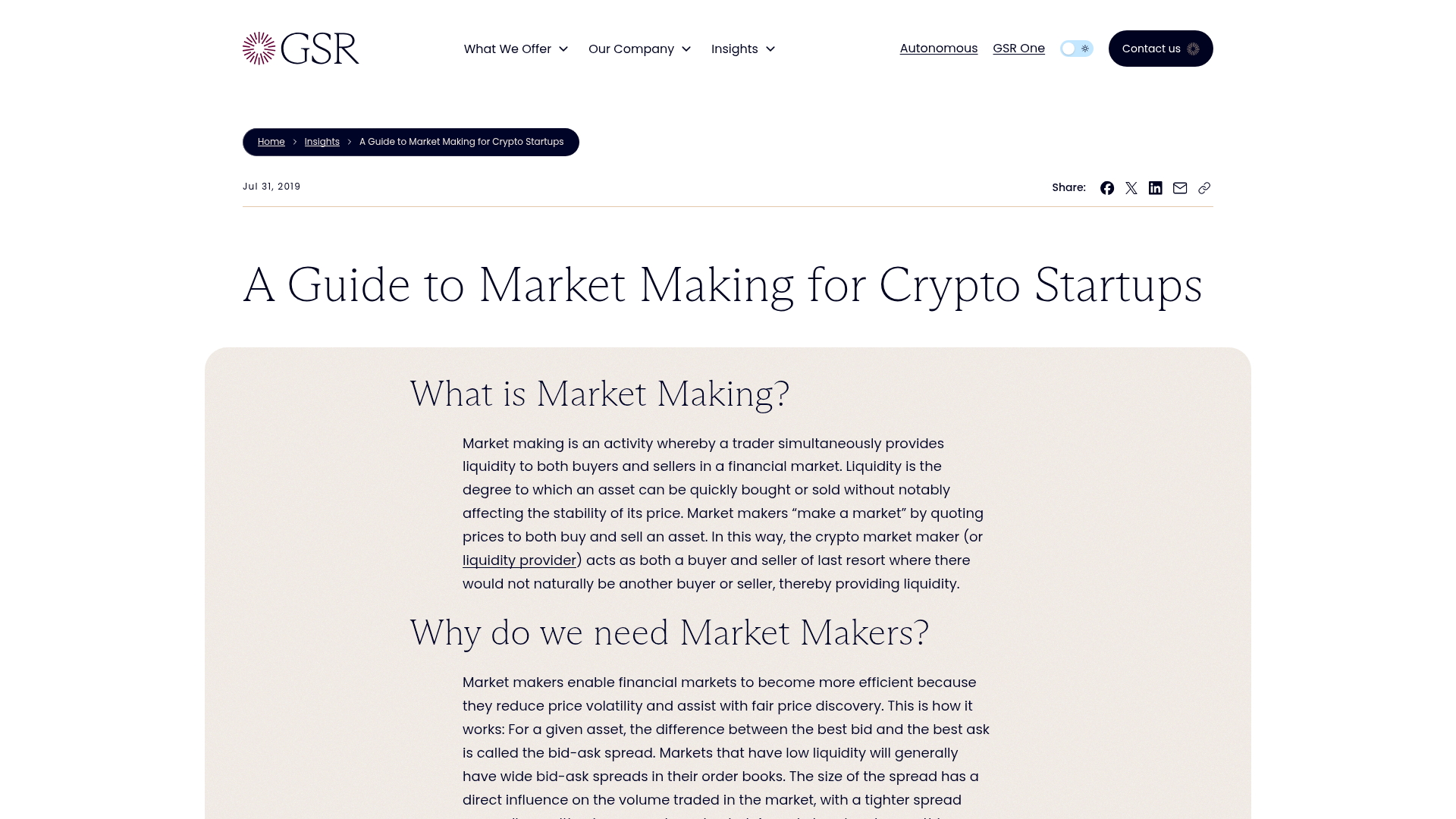
GSR’s July 31, 2019 guide, captured September 8, 2026: a definition of liquidity provision, not a current vendor ranking or endorsement.
An eight-step Telegram research process
Use the following sequence when a possible partner appears. It works for MM discovery, project cooperation and other Web3 BD introductions; it does not replace contractual or financial due diligence.
- Choose the sources. Select accessible communities relevant to the work, with appropriate permission for any collection or processing.
- Save the discussion. Keep the original message, source, timestamp and available replies—not just a cropped screenshot.
- Identify the possible match. Separate an offer of services from a request for help, a referral or a forwarded advertisement.
- Read available history. Look for specific discussions, changing claims and replies to practical questions within the records you can access.
- Flag things to check. Note repeated promotions, inconsistent affiliations or pressure to move money. Do not turn these observations into an accusation.
- Corroborate independently. Find an official contact route yourself and trace announcements back to their original publishers.
- Set review priority. Put relevant discussions with answerable questions ahead of generic pitches; keep unresolved identity separate from commercial relevance.
- Make a human decision. Decide whether to ask a public question, request an introduction, verify identity privately or stop.
The output is not “approved partner.” It is a short record that says what was observed, what remains unknown and what would justify the next conversation.
“We are a professional market maker” proves only that someone said it
Consider this illustrative message, not a quote from a real customer:
“We are a professional crypto market maker. DM me.”
There is a service claim and an invitation to talk. There is no evidence yet of institutional affiliation, past work, relevant trading infrastructure or fit for your venue. Even the invitation is limited: it does not authorize persistent advertising or sharing sensitive project information.
A Signal is information worth evaluating further, not a conclusion that has already been verified.
Now reverse the direction:
“Looking for market making partners.”
That could be a project seeking liquidity, an adviser collecting introductions or an account reposting an old request. It does not establish a live mandate, an approved budget or a decision-maker’s identity. Reading the messages around it may reveal that the project already found a partner—or that the speaker was quoting somebody else.
This is why the useful unit is the discussion with its source and time, not the isolated phrase or the Telegram username.
What to check in historical messages
History is useful when it gives you something concrete to verify. Suppose the same accessible account previously discussed the venue you use, asked about reporting requirements and explained a liquidity issue in detail. Those observations can make your next question more specific. They do not demonstrate that the account controls an institutional trading operation.
Check the period actually covered. A source connected last week may not contain months of older messages. Deleted posts, missing replies and inaccessible communities leave gaps. Also distinguish the same account from the same display name: copying a name and photograph does not create identity continuity.
| What you observe | What it does not establish | Useful next check |
|---|---|---|
| Repeated discussion of your venue and trading pair | Ability or capacity to support your project | Ask about the exact scope, operating limits and reporting |
| Similar pitches in several groups | Independent endorsements or confirmed fraud | Trace copies to the earliest available message |
| A claimed partnership and a project logo | Permission to represent that project | Find a statement from the project through its own official channel |
| A change in employer or service description | Dishonesty by itself | Ask which entity the person represents now and verify separately |
| Little accessible history | A fraudulent or unsuitable account | Record the gap and seek an introduction or official confirmation |
| Pressure to pay before basic checks | Proof of the sender’s identity or authority | Pause financial discussion and verify through a trusted separate route |
A long history can be manufactured or belong to an account whose control has changed. A short history can belong to a legitimate newcomer. Use history to find questions, not to assign somebody a permanent “safe” or “unsafe” label.
Independent sources must actually be independent
Three groups repeating the same announcement are one claim with three distribution points. A company website, its own Telegram channel and its own press release may also share one author. That can confirm what the company says; it is not three independent confirmations of delivery.
For an affiliation claim, navigate to the firm’s official website independently and use the contact route listed there. Ask whether the person represents the firm and whether the proposed engagement falls within their authority. For a claimed collaboration, look for the other party’s original statement and check what it actually confirms. “Met at an event” is not “engaged as market maker.”
GSR’s October 22, 2025 impersonation alert warns about people impersonating its company. It recommends verifying account, payment and contract details through known trusted contacts, and checking unusual requests through a separate trusted channel. This supports the verification step; it does not prove anything about an unrelated Telegram account.
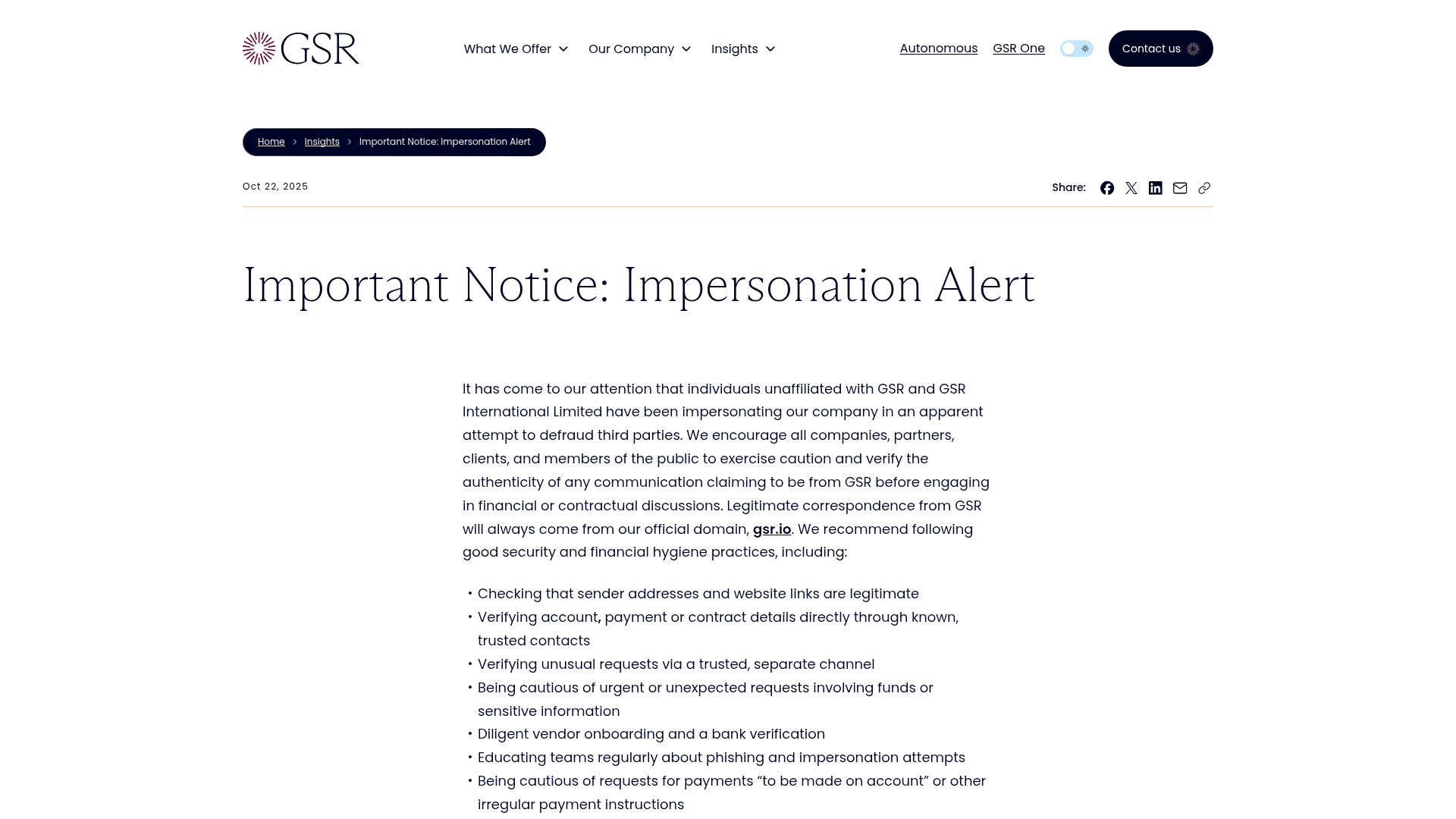
GSR’s October 22, 2025 notice, captured September 8, 2026, recommends independently checking account, payment and contract details. It is not evidence against any example account in this article.
Do not send a seed phrase, private key, login code or signing approval to “prove” your project is real. If a conversation moves toward funds, account access or a contract, involve the people responsible for those decisions. An information shortlist is not financial authorization.
Decide who deserves a conversation—not who is “trustworthy”
Imagine two explicitly simulated candidates. One advertises “liquidity, investment, listing, everything” but provides no scope. Another discusses your planned venue and asks whether you need order-book support or pool liquidity. The second is easier to question productively. Neither is verified.
For the second conversation, prepare three questions: What exactly would your organization do? Which entity would contract with us? Which independently reachable person can confirm your affiliation? Record the answers next to the original message so a colleague can see why you decided to continue.
If the offer depends on guaranteed price increases or fabricated trading activity, do not treat that as strong market-making evidence. GSR’s older guide distinguishes liquidity provision from questionable wash-trading arrangements and price or volume promises. Wash trading means creating misleading trading activity rather than genuine independent buying and selling. Stop and obtain appropriate legal and compliance review rather than negotiating around that promise.
A useful shortlist therefore has different outcomes: “relevant, identity check pending,” “needs clarification,” or “do not proceed with this request.” A numerical priority, if used, should not hide those unresolved questions.
Where TOP Prospect reduces the reading work
When the number of Telegram sources grows, reconstructing every discussion manually becomes repetitive. TOP Prospect lets users select sources and generate structured analysis for a goal, time range and message count. Candidates can retain original messages, source and time, available context, AI assessment, evidence and human review status.
For this task, your goal might be: “Find discussions of liquidity support for our planned venue; distinguish service offers from requests and flag affiliation claims that need checking.” That is a research question—not a command to certify providers.
Read the source evidence behind the AI summary. Review related Signals and priority reasons where available. An analysis can help organize what deserves attention, but it cannot fill gaps in source coverage or establish who controls an account. Saved analysis history means completed reports; it is not a complete history of a person’s activity across Telegram.
The research methodology explains the distinction between duplicate messages, context, source coverage and human confirmation. Access alone should not be treated as blanket permission to process everything: choose a lawful, appropriately authorized scope. TOP Prospect does not inspect private one-to-one chats, autonomously contact participants or decide whether a partnership should proceed.
Telegram’s content-licensing terms restrict AI-related use of platform data and describe limited consent-based exceptions. Being able to enter a group is not sufficient authorization for AI processing; check the applicable scope and consent before using an analysis tool.
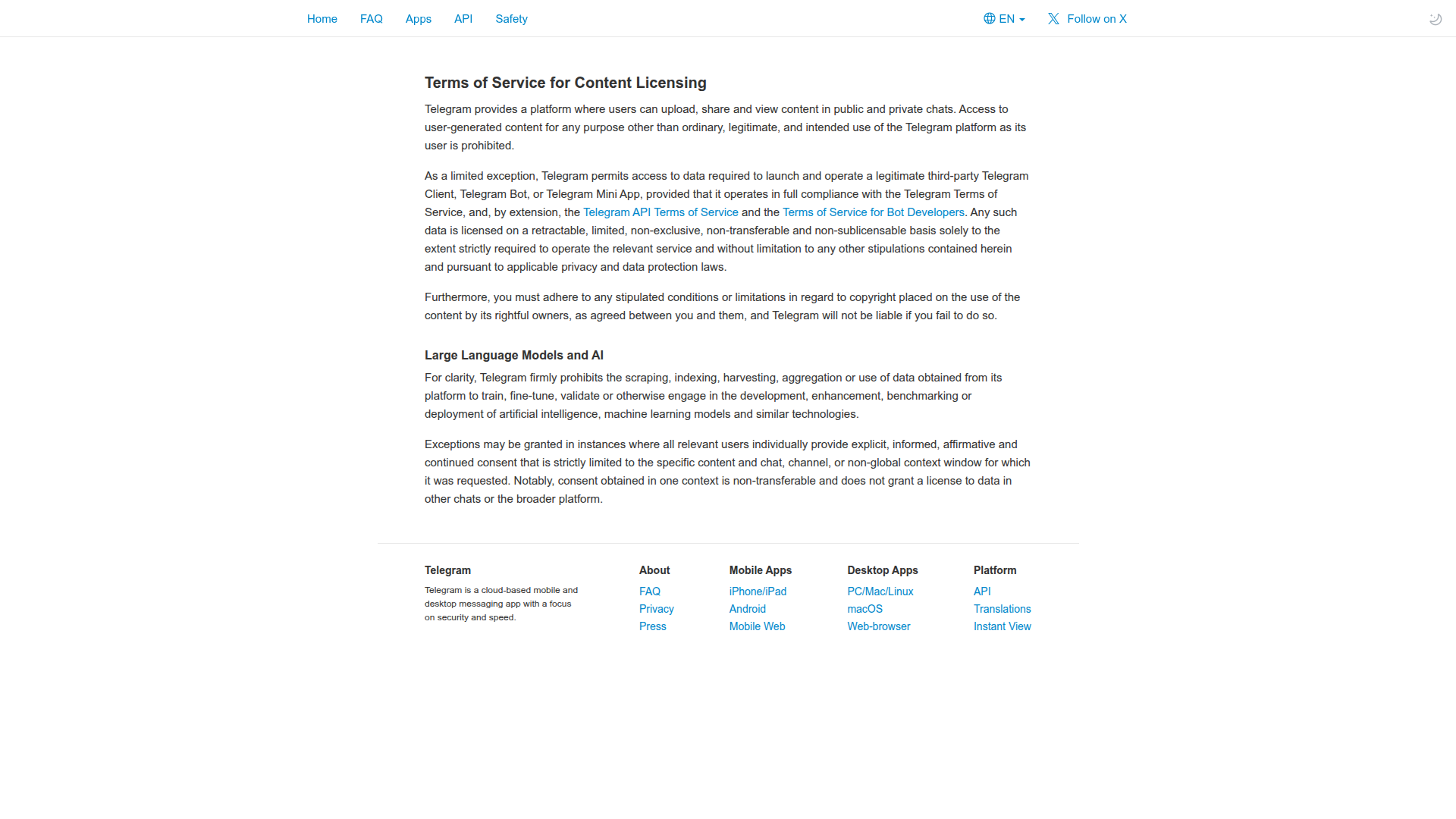
Telegram’s public terms, captured September 8, 2026. Source access and permission to process its content are separate questions.
That makes the workflow useful beyond selling: partner discovery, market research and risk-related discussion review all involve finding information worth examining. None makes an AI-generated assessment a verified business fact.
FAQ
Where can a Web3 project find possible market makers?
Start with relevant project networks, trading communities and official firm contact pages. Telegram can surface introductions and specific discussions, but finding a contact is only the discovery step. Verify affiliation and service fit separately.
Can Telegram history prove someone is a legitimate MM?
No. Available history can reveal business detail, continuity or inconsistencies. It cannot prove institutional authorization, trading capability or suitability. Missing history is also not proof of fraud.
How do you research a project found through Telegram?
Preserve the original claim and date, inspect available replies, trace project links to official sources and check claimed collaborations with the other party. Separate a reposted announcement from independently published evidence.
Can TOP Prospect determine whether somebody is a scammer?
No. It organizes relevant Signals, sources, context and assessment reasons for human review. Identity checks, financial controls and partnership decisions remain with the user.
Telegram contains more introductions than a BD can investigate deeply. The aim is not to message everyone faster. It is to know which claim you are checking, what evidence you still lack and why the next conversation is worth having.
Sources and further reading
How a Signal worth attention is found
See how Top Prospect finds and organizes Signals worth checking, keeps the original Telegram context, removes duplicates, and helps you decide what to review first. You decide whether to follow up and what to do next.