Affiliate agency prospecting: copy the 3 group lines and 2 execution details — 20 brands in a week
A brand's first step toward an affiliate program isn't a tender — it's asking a group where affiliates come from. Three launch sentences plus two execution-level tells separate brands still window-shopping from brands about to spend (illustrative example).
Consider two moves (illustrative example):
An affiliate agency rep emails three brands with a case study and a rate card. Two weeks pass with no reply.
The same week, an e-commerce lead at a cosmetics brand asks a DTC founder group: “Where do affiliate partners usually come from? We want to run a program but don’t know where to start.” Six replies, three of them from affiliate agencies.
The difference? The email landed before the brand decided anything. The group message landed when the decision was already forming.
A brand’s first move toward an affiliate program isn’t a tender — it’s asking people in a group. One agency rep turned this into a fixed routine and locked in 20 brands preparing a program in a single week (illustrative example). This article is about telling who is testing the water from who is about to pay.
1. Before a brand launches, it says these three things
An affiliate program isn’t a whim: someone has to set commission rates, wire up payouts and own the channel day to day. So before a brand pushes it forward, it asks a few questions out loud.
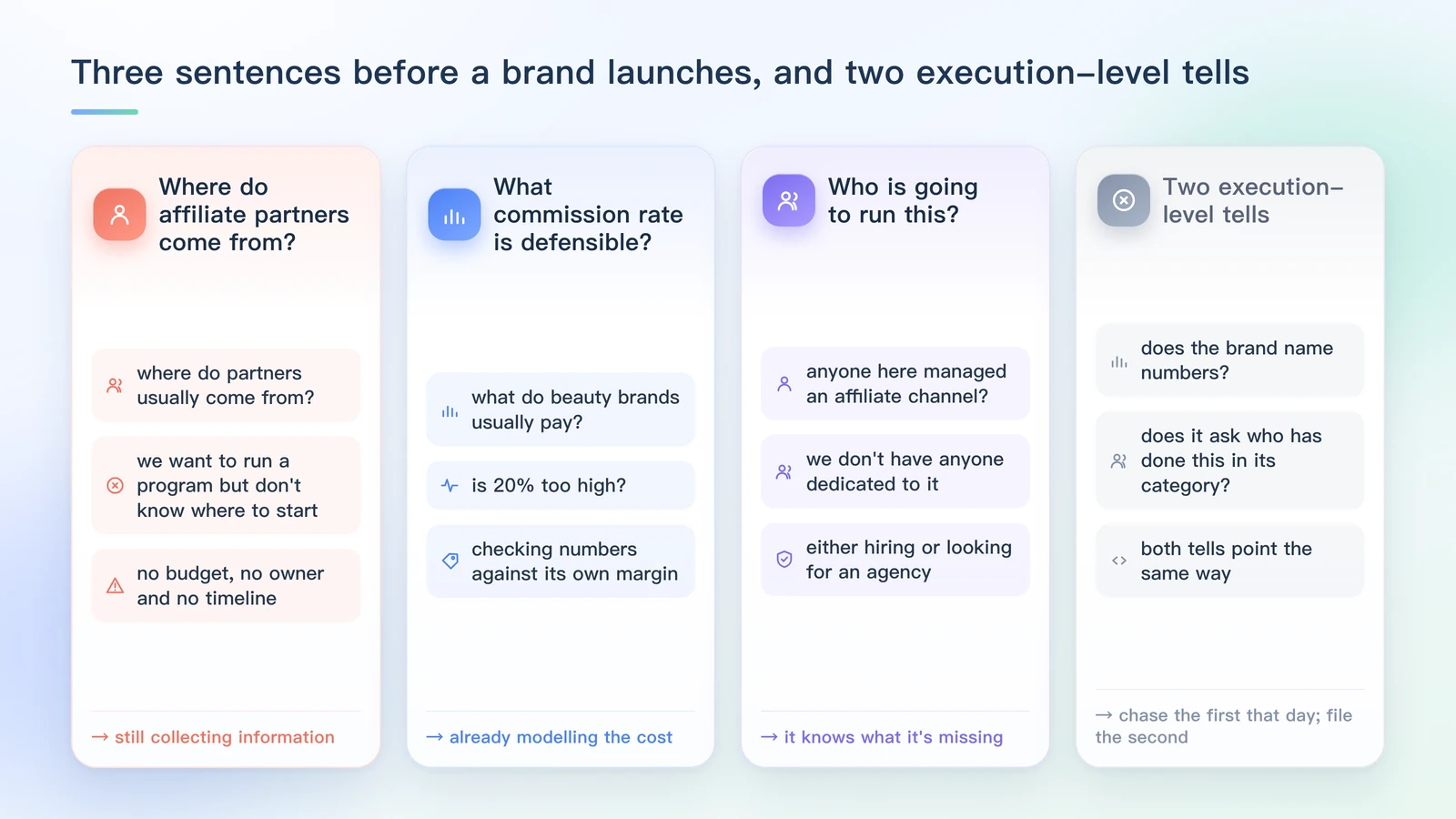
1. “Where do affiliate partners come from?”
“We want to run a program but don’t know where to start — where do partners usually come from?”
The most common opener and the easiest to misjudge. The brand is interested, but there’s no budget, no owner and no timeline yet. Send a rate card now and you’re handing a deck to someone not ready to read one.
2. “What commission rate is defensible?”
“What do beauty brands usually pay? Is 20% too high?”
Asking about rates means the brand is already modelling the cost. That carries far more weight than the first sentence — it is checking numbers against its own margin, not fishing for industry trivia.
3. “Who is going to run this?”
“Anyone here managed an affiliate channel? We don’t have anyone dedicated to it right now.”
Asking who runs it is the most concrete launch signal: the brand is either hiring or looking for an agency. You can take both, and at this point it knows exactly what it’s missing.
The window is where the last two sentences appear. The test isn’t how enthusiastic a brand sounds — it’s how deep it has asked.
2. Two execution-level tells for a real program
The same “we’re planning an affiliate program” can mean a meeting next Monday or a maybe next quarter. Two details separate them.
First tell: does the brand name numbers? “20% or 30%”, “monthly or biweekly payouts” means a plan is being drafted. “Just want to try it” means it is still collecting information. Chase the first that day; file the second for later.
Second tell: does it ask who has done this in its category? Asking for examples isn’t politeness — it is building a comparison. Once a brand starts asking whether you’ve worked with beauty brands, a shortlist already exists, and you don’t want to be missing from it.
Both tells point the same way: brands don’t buy the prettiest deck, they buy the shortest distance to the problem they have right now.
3. Where brand teams actually speak up
Brands don’t sit in “affiliate networking” groups — those are full of affiliates and networks. They stay in their own circles (illustrative example): independent-store seller groups, cross-border e-commerce operations groups, DTC founder groups and category groups.
To find them, use Top Prospect. It turns search into four entries: AI search, Google, Bing and the built-in group library (currently showing 50 public groups loaded). AI search takes plain language, so you can type “Telegram groups where DTC founders gather” without agonizing over keyword strings.
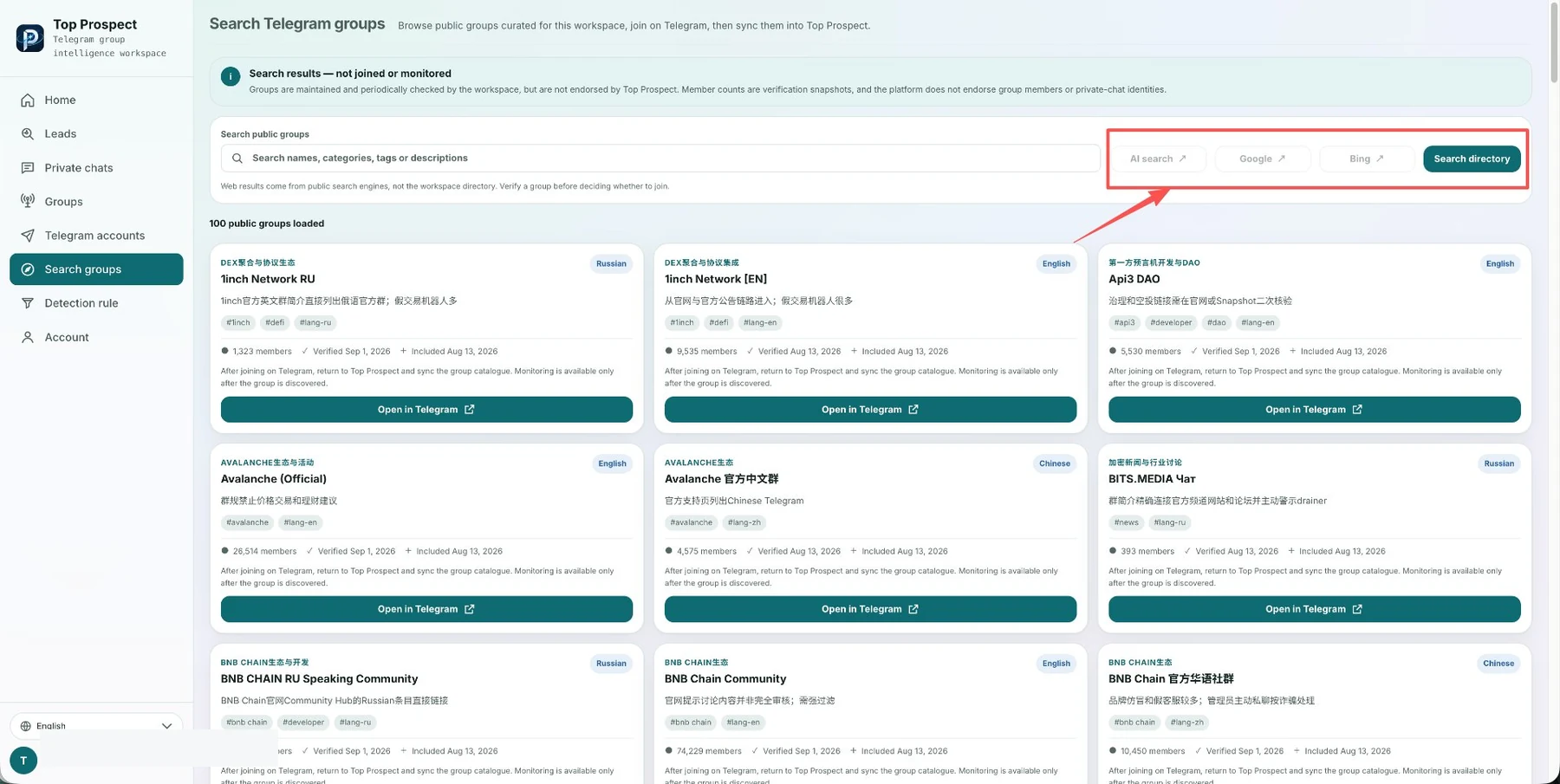
Each result card gives the group name, description, category tag, primary language, member count, last verified date and date added. Screen on two criteria: primary language should match your target market, and member count should stay modest — a few hundred founders will surface real launch discussions far more often than a group of tens of thousands.
A result isn’t a membership. The results page is explicit: finding a group doesn’t mean it has been joined, doesn’t mean collection is switched on, and doesn’t mean the platform endorses it. Joining is still manual, group by group.
4. Turn the three sentences into a rule
Adding groups is only the start. Brand groups run hundreds of messages a day, and nine out of ten are order screenshots, shipping questions and platform policy talk. The launch signals are buried between them, and manual reading never keeps up.
Hand this step to recognition rules. Building one in Top Prospect doesn’t require expressions — it’s a conversation: are you looking for clients or suppliers, what do you provide, which clients matter most, what problems do they usually hit, what conditions matter most, and where are you targeting. An affiliate agency fills in: clients; affiliate program management and partner sourcing; brands asking about partner sources, commission rates and ownership; budget and timing as priority; North America, Europe and Southeast Asia.
Bind the rule to your groups and it runs on its own, with hits scored and listed. The Groups page also lets you set a check frequency per group, from 15 minutes to 12 hours, so founder groups run at the shortest interval and the rest relax.
Rules don’t make the call for you. A top score only means “probably” — whether this brand has budget, whether it is genuinely moving, still takes opening the original message and reading it.
Closing: Turn one-off group searching into an ongoing acquisition system
Searching for groups is traditionally a one-off action. Today you search a batch, tomorrow you search another; you finish reading today’s messages, and tomorrow you start from scratch. A reusable Telegram acquisition process should look like this instead:
Build a group pool → keep monitoring → capture demand → identify signals → human confirmation → follow up
AI expands the search, Top Prospect keeps capturing change, and BD makes the final call and does the talking. Which means acquisition no longer depends on whether a BD had time to scroll Telegram today — it becomes a process that keeps running. If your clients are already on Telegram, the problem worth solving may not be “how do I join more groups” but: how do I see demand the moment it appears.
Frequently asked questions
A brand asked one casual question in a group. Worth chasing the same day?
Depends which question. 'Where do affiliates come from' is exploration — don't quote. Once it turns to commission rates, payout cycles or who owns the relationship, the brand is writing a plan, and that's when showing up matters.
Why does sending a deck and a price list backfire?
Before the brand has settled its own execution model, a deck is just a template. Answer the question it is actually stuck on — how to source partners, what rate is defensible — and it will hand you the next round of questions.
Which groups do brand teams actually use?
Independent-store seller groups, cross-border e-commerce operations groups, category groups and DTC founder groups. Wherever brands discuss growth is where an affiliate program gets mentioned.
Sources and further reading
This article is human-authored. TOP Prospect processes only Telegram groups the user has explicitly authorized and connected. Its output supports human sales judgement; it does not replace human decisions and does not automatically contact or message group members.
How a Signal worth attention is found
See how Top Prospect finds and organizes Signals worth checking, keeps the original Telegram context, removes duplicates, and helps you decide what to review first. You decide whether to follow up and what to do next.