Telegram community agency prospecting: 40 groups joined, six still talking two weeks later — read two dates first
You joined 40 groups and two weeks later only six still talk (illustrative example). Two dates sit on every result card, and comparing them tells you whether anyone maintains the group — no need to go in and find out.
Forty groups joined in one week.
Two weeks later they went back through the list. Still talking normally: six. The rest were spam feeds or silent for months. The hours spent joining were largely wasted.
That same week a competitor’s record read differently (illustrative example): they read two dates on each result card before joining anything, screened 60 still-active large groups in one evening, joined 20 of them, and within a week closed conversations with five channel owners who wanted to hand their groups to someone else.
Six kept out of forty, and five conversations out of twenty — the difference is not diligence, it is which step the judgement happens at.
1. Join first, judge later is the most expensive order
Joining looks free. Every step of it costs something.
First, every group has to be read. Once you are in, you have to go through a batch of history to know what people talk about and whether your buyers are there. There is no skipping that step, and its cost scales with how many groups you joined.
Second, dead groups keep taxing your attention. A group with two messages a month contributes a negative: it produces no opportunities while adding another line you scan past every time you open the list.
Third, the illusion is the expensive part. You think you are watching 40 groups, so you plan your workload around 40. In reality you are watching six, and the rest of your time went to noise. Get the base number wrong and every plan built on it is wrong too.
Fourth, the mistake propagates. Once a group is in your list, recognition rules read it. A dead group has nothing to read, so hits there are zero by definition. A half-dead group feeds ads and idle chat into your candidates, and you spend more time separating real hits from noise. Time saved by not filtering gets paid back double.
2. The test is two dates
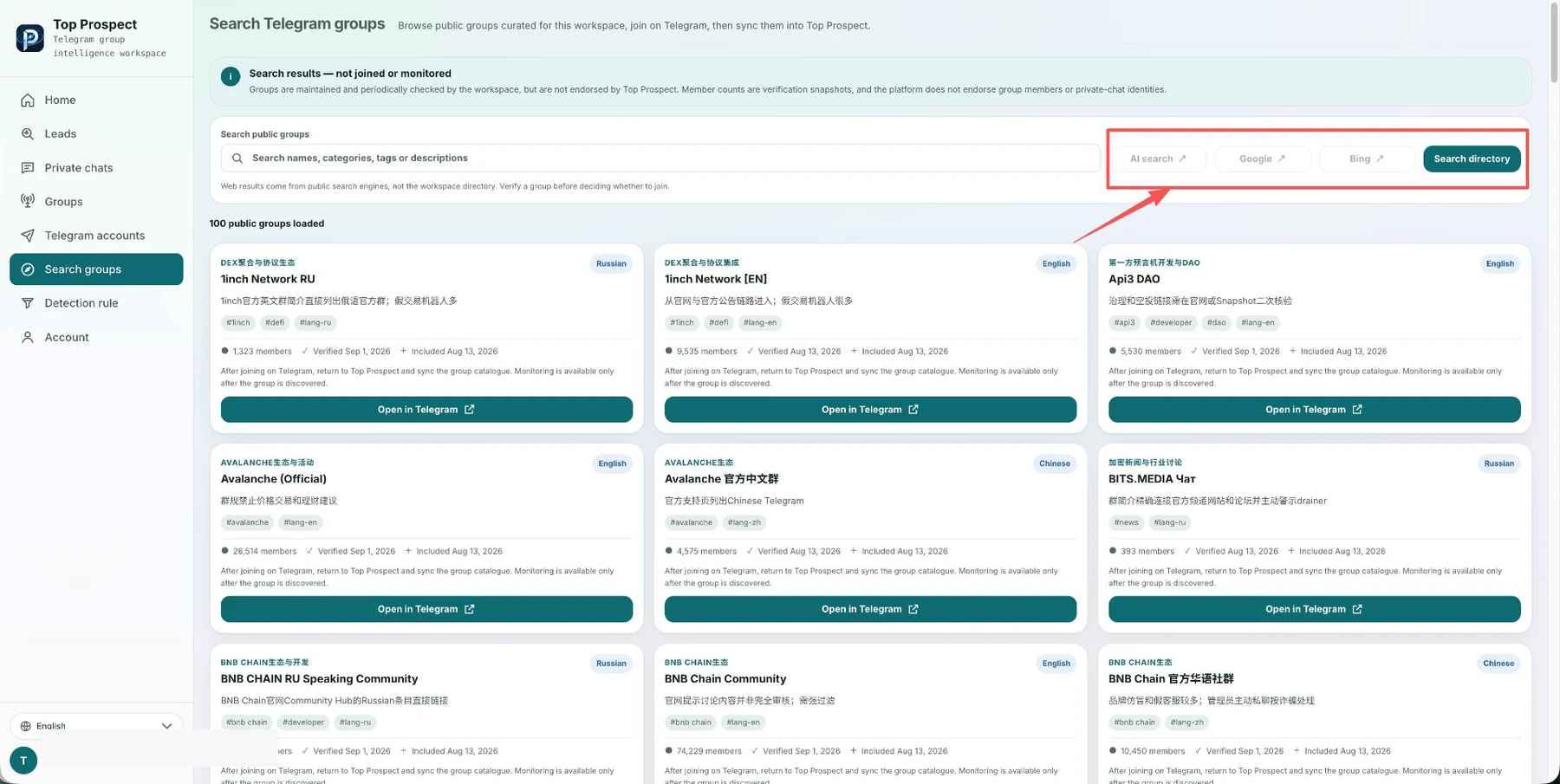
At the bottom of every search result card sit two dates: the last verification date and the inclusion date.
The inclusion date is the day the group was first indexed into the workspace. The last verification date is when the workspace most recently confirmed it still exists. The notice above the cards says it clearly: groups are maintained and periodically checked by the workspace, and member counts are verification snapshots.
A single date says little. The gap between the two is the test. A short gap means someone keeps an eye on it and has confirmed it repeatedly. A long gap means it entered the library once and nobody looked afterwards.
3. Four combinations, four readings
Put the two dates together and there are only four cases (illustrative example).
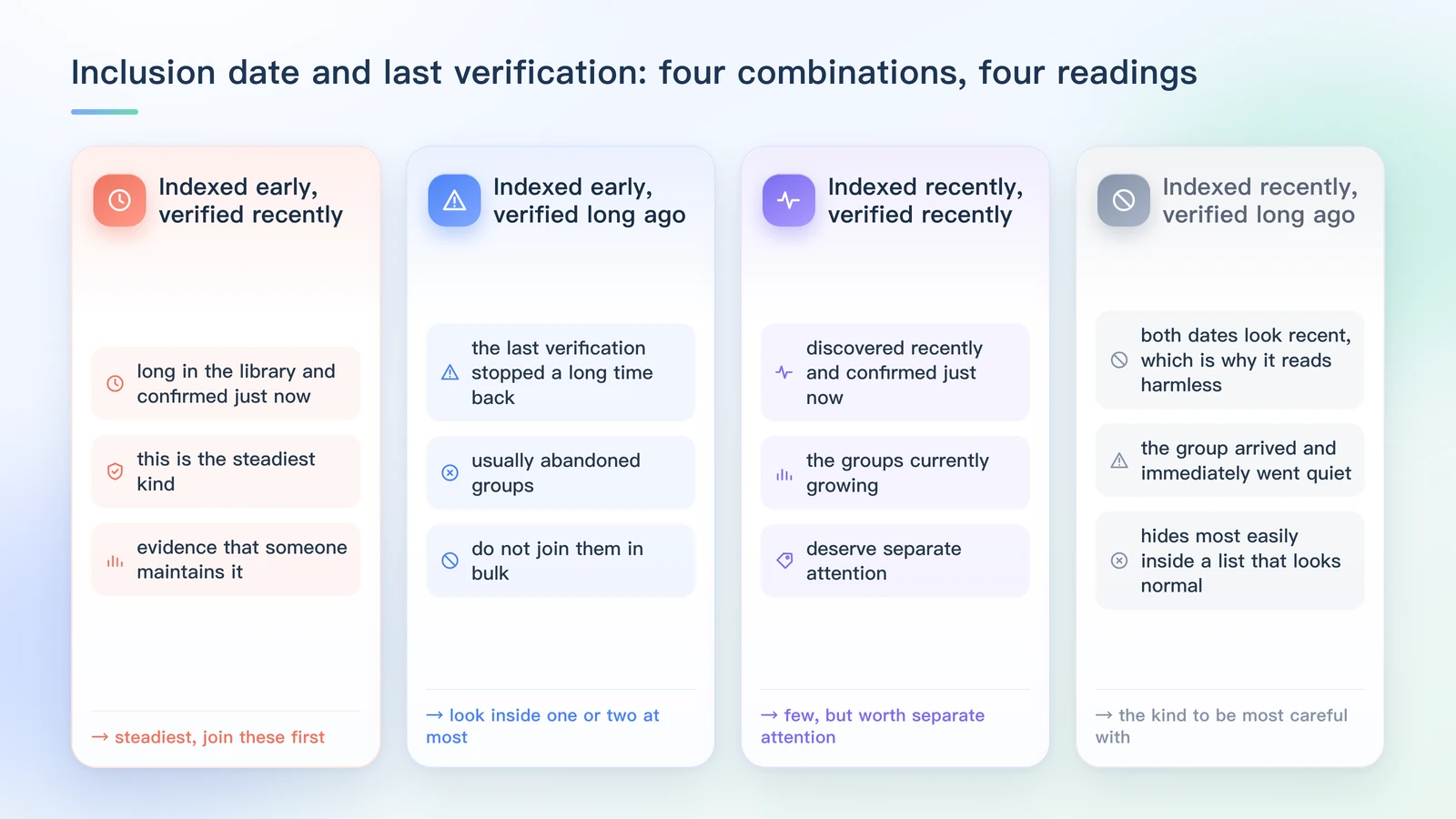
Indexed early, verified recently. Long in the library and confirmed just now. This is the steadiest kind, evidence that someone maintains it. Join these first.
Indexed early, verified long ago. Long in the library, but the last verification stopped a long time back. These are usually abandoned groups, or groups that survive with nobody discussing business any more. Pick one or two to look inside at most; do not join them in bulk.
Indexed recently, verified recently. Discovered recently and confirmed just now. There are not many of these, but they tend to be the groups currently growing, and they deserve separate attention.
Indexed recently, verified long ago. Both dates look recent, which is why it reads harmless, but it means the group arrived and immediately went quiet. Be most careful here, because this kind hides most easily inside a list that otherwise looks normal.
Four combinations compared and it becomes obvious whether a group deserves your time.
4. Why member count cannot be the test
The first instinct for many people is to sort by size. That order is backwards.
Member count is a snapshot taken at the last verification, not today’s activity. A group with tens of thousands of members may have been silent for three months, while a group with five hundred may surface a purchasing request every day. Size tells you how hard it was promoted once, not whether business is happening inside it now.
Its only real use is elimination: groups whose size is obviously wrong for you can be struck off. But do not sort by it. Sort by the two dates first.
Once the test becomes habit, the rhythm looks like this: search a batch of groups on the Search groups page, remove the obviously unmaintained ones by the two dates, keep a set by primary language and member count, then join them one by one. Remember to return to the workspace and sync the group catalogue after joining — only then can the group appear in your list and take a recognition rule.
The test also works on the pool you already have. If a group you joined long ago shows a verification date that has not moved in a long while, it is probably no longer worth the attention and can be set aside. A group pool is not better for being bigger; the few dozen that keep producing hits are enough.
At that point you hold groups confirmed to be running. Whether leads follow depends on how precisely the rules are set, not on how many groups you have.
Conclusion: stop hunting for customer groups, hunt for customer signals
A group with 100,000 members does not mean your buyer is inside. A group with 500 members may be exactly where a message looking for a supplier just appeared. So what deserves optimisation in Telegram acquisition is not: how many groups did I join? but: did I see the demand while it was still happening? AI finds you more groups, Top Prospect keeps surfacing signals, and judgement and conversation stay with a human. Moving from finding groups to finding signals is the real efficiency gain in Telegram B2B acquisition.
Frequently asked questions
Why should I be careful with groups that show tens of thousands of members?
Member count is a snapshot taken at the last verification, not today's activity. A large group holds plenty of people who joined and never speak; a big number says it was promoted hard once, not that anyone is talking now. To judge whether it is alive, the gap between inclusion date and last verification date is the better read.
Are recently indexed groups always a bad sign?
No. Indexed recently plus verified recently means it was discovered recently and just confirmed, and those tend to be the groups currently growing. What you want to avoid is the opposite: indexed long ago with no verification update for a long time.
How long without messages before I call a group dead?
You do not have to count. After joining, return to the workspace and sync the group catalogue; once the group appears in your list you can attach monitoring, and the hit record will tell you whether it produces anything. A group with zero hits for several weeks has already answered the question.
Sources and further reading
This article is human-authored. TOP Prospect processes only Telegram groups the user has explicitly authorized and connected. Its output supports human sales judgement; it does not replace human decisions and does not automatically contact or message group members.
How a Signal worth attention is found
See how Top Prospect finds and organizes Signals worth checking, keeps the original Telegram context, removes duplicates, and helps you decide what to review first. You decide whether to follow up and what to do next.