AI API sales prospecting: how do you find clients? 200 web results, three checks, 12 worth joining
A web search returns 200 groups, you join 60, and a month later only two produced anything usable (illustrative example). All three checks are written on the search page; running them cuts 200 down to 12.
A group found outside the workspace proves nothing by the mere fact of being found.
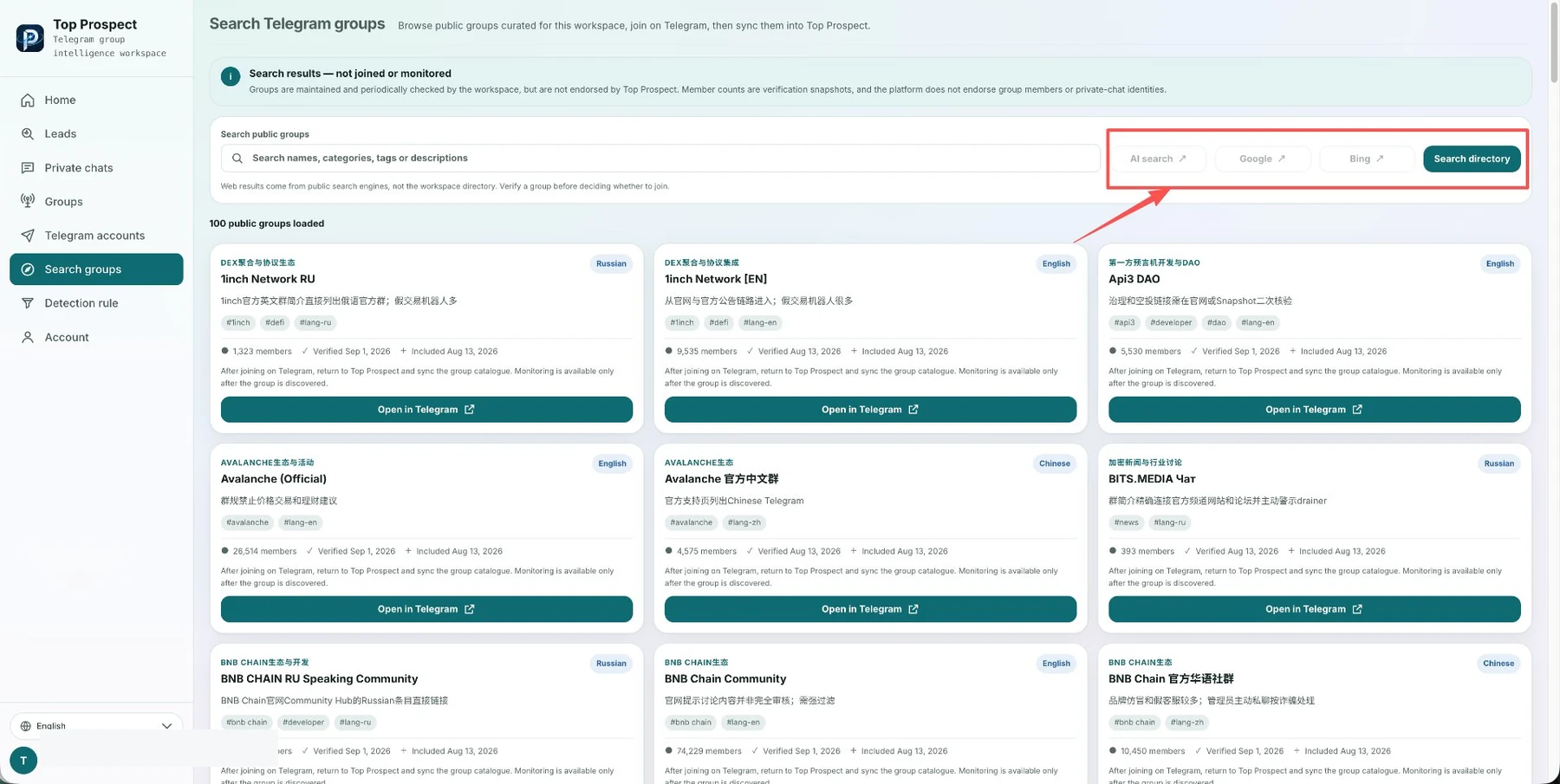
One line under the search card is easy to skip:
Results from outside come from public search engines. They are not part of the workspace directory; verify them yourself before deciding whether to join.
A sales rep in the business of passing an application programming interface (API) through to developers treated it as boilerplate. He ran a web search, found 200 groups, joined 60 of them over a week, and a month later only two had produced a single usable request (illustrative example).
The groups that cost him a month had one thing in common: they surfaced because a search engine saw words like “large language model” and “application programming interface” on their pages. Whether anyone inside was still discussing a purchase, nobody had checked on his behalf.
1. Why groups found on the web cannot be joined directly
That notice is exactly the selection rule behind web results: a group appears because a search engine indexed it, not because anyone confirmed it suits you.
Three consequences follow.
One: indexed and relevant are different things. A developer group may genuinely discuss model access, or it may have been created five years ago and now only carries bot ads. A search engine cannot tell the difference; it only knows your keywords appeared on that page.
Two: nobody has confirmed it for you. The notice above the cards says search results do not mean you have joined or enabled monitoring. Found only means it was found — not that anyone opened it, read it or checked it.
Three: the more you join, the harder your rules get to set. With more noise in the pool, every rule hit becomes less trustworthy. You lose faith in the list before you lose the habit of reading it.
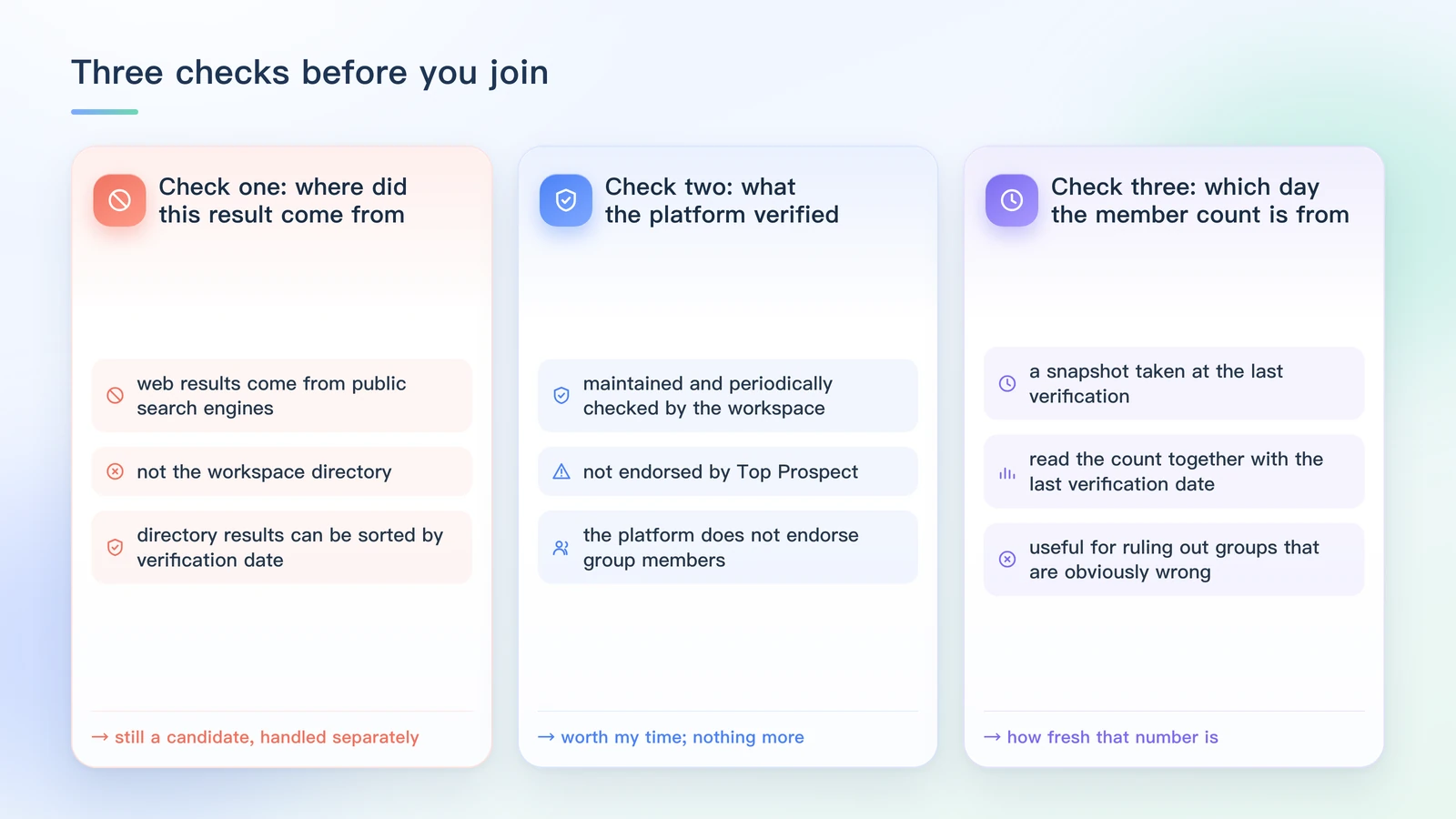
2. Three checks cut 200 down to 12
Each check has something on the interface behind it.
Check one: where did this result come from
Separate web results from directory results first. In-workspace search returns public groups the workspace has already indexed and periodically checked, with a last verification date on the card. Web results carry no such record.
The move is simple: directory results can be sorted by verification date and used directly; web results are candidates only and should not be processed alongside them. This check eliminates nothing by itself, but it decides how the next two are applied.
Check two: what has the platform verified
The notice reads: groups are maintained and periodically checked by the workspace, but are not endorsed by Top Prospect. Member counts are verification snapshots, and the platform does not endorse group members or private-chat identities.
Read it in two halves. The first half says groups in the library have someone maintaining them, which is where your time savings come from. The second half says even with maintenance, the people inside are not verified — so identities and promises still need checking after you join.
Check three: which day is the member count from
The member count on a card is a snapshot taken at the last verification.
A group showing three thousand members may have had that number recorded last week, or half a year ago. So read the count together with the last verification date to know how fresh it is. Size is useful for ruling out groups that are obviously wrong; it is not useful for ranking them.
Run all three and 200 groups typically leave single digits to a dozen or so (illustrative example).
3. What to do with the remaining 12
Joining is manual and stays manual. Go through them one at a time.
After joining, there is one step that gets skipped, and the interface states it plainly: after joining on Telegram, return to Top Prospect and sync the group catalogue. Monitoring is available only after the group is discovered. Without that sync, none of the groups you joined appear in your list and everything downstream has nothing to work with.
Only once the sync is done do recognition rules come in. If you resell model access, the phrases worth watching are: rate limits, bills that do not reconcile, context windows that fall short, suppliers changing terms at short notice. When those appear, that is your moment to speak.
A high score means suspected, nothing more. Whether to talk, and how, is still a human call.
4. Why this subtraction deserves to be fixed
Because addition is endless. A web engine gives you 200 groups today and 400 tomorrow with a different phrase. You never finish joining and you never finish filtering.
Subtraction has a boundary. Three checks in, the candidates become a dozen or so, and each check rests on wording that is printed on the interface — no experience, no instinct required. Run it once and it becomes something you can hand to a new hire.
That matters most for teams. Addition depends on who is more diligent or who will stay up scrolling, and none of that transfers. Subtraction depends on three fixed checks that fit in a document. A newcomer running them on day one will land close to what a veteran gets.
One last reminder: the checks answer “is this group worth my time”, not “is this person a real buyer”. Keep the two questions apart, or you will conclude that filtering does not help. The second question belongs to recognition rules and human judgement — that is work for after you join.
Conclusion: the thing worth automating is spotting opportunities, not finding groups
Finding 100 Telegram groups does not mean finding 100 customers. What actually has value is continuously surfacing the demand that is happening inside those groups. AI can widen your search and find more communities; Top Prospect turns those communities into a lead pool you can keep watching: find groups → verify → monitor → spot signals → judge by hand → follow up That way a BD stops repeating searches, joins and history reads each day and gives the time back to the part that needs a human — judging the opportunity, making contact and moving the deal forward. For B2B businesses across cross-border finance, AI model access, Web3, SaaS and cross-border e-commerce, Telegram is not only a community channel; it can be a public market that keeps producing demand signals. Turning scattered signals into opportunities you can follow up on is what Top Prospect is for.
Frequently asked questions
What is actually different between a web result and a directory group?
Whether someone looked at it first. Directory groups are maintained and periodically checked by the workspace, with a last verification date on the card. Web results come from public search engines — a group shows up because it was indexed, and nobody has confirmed it suits your business.
If I run all three checks, are the remaining groups guaranteed to be good?
No. The notice says the workspace maintains the groups but does not endorse the members or their private-chat identities. The checks answer 'is this group worth my time', not 'is this person a real buyer'. The second question is answered by rule hits and human judgement.
Shouldn't I join as many groups as possible and set up rules later?
That order is backwards. More groups means more noise in every rule hit, which makes the hit list untrustworthy, and eventually you stop opening it. Subtract first so a dozen matched groups remain, then turn on rules — that is when hit rates hold up.
Sources and further reading
This article is human-authored. TOP Prospect processes only Telegram groups the user has explicitly authorized and connected. Its output supports human sales judgement; it does not replace human decisions and does not automatically contact or message group members.
How a Signal worth attention is found
See how Top Prospect finds and organizes Signals worth checking, keeps the original Telegram context, removes duplicates, and helps you decide what to review first. You decide whether to follow up and what to do next.