Enterprise AI API Demand on Telegram: 3 429 Messages That Mean a Real Route Switch
Enterprise AI API demand on Telegram is not proven by a single 429 complaint. What matters is how technical facts, business accountability, procurement constraints, and migration work converge over time.
Signals to watch
- A 429 can refer to rate, credit, spend, or usage limits, so the status code is not purchase intent
- Enterprise demand forms as a technical failure becomes tied to production responsibility, budget, and supply-chain structure
- Real fallback capacity depends on a verifiably independent path, not simply another domain
- Telegram's commercial value comes from preserving how demand develops over time, not counting keyword occurrences
The loudest message in a Telegram developer group often looks like this:
“429 again. The main endpoint and the backup domain are both down. Who has a stable route?”
A few lines later, a quieter message may appear:
“We need keys separated by project, one invoice for our Hong Kong entity, and a hard monthly spending ceiling.”
Both are representative composites, not customer quotations. Neither proves the writer’s identity, budget, purchasing authority, or intention to buy. Together, however, they expose something the AI API market often misses: in a noisy environment such as Telegram, the maturity of demand is not proportional to the volume of the complaint. The meaningful question is not who sounds most urgent. It is when a technical problem starts to acquire production responsibility, budget rules, and a supply-chain decision.
Key takeaway
- A 429 is a protocol-level result, not purchase intent; the same status code can describe very different problems.
- Enterprise demand starts to form when the technical object, business consequence, and organizational constraints begin appearing on the same timeline.
- A backup domain proves only that the entry point is different. It does not prove that the account, quota, gateway, region, or upstream provider is independent.
- On Telegram, the useful unit of analysis is not one message containing a keyword. It is the way context accumulates around the same problem over time.
Why 429 creates false clarity
429 feels precise. The error code is explicit, the failed request is real, and the outage may be painful. That apparent precision makes it easy to translate the event directly into “the current provider is unstable” or “this company is ready to switch.” The status code does not support either conclusion on its own.
OpenAI’s API error documentation places several conditions under 429: exhausted prepaid credit, a request-rate limit, an organization or project spend limit, and an organization usage limit. The response to each condition is different. Pacing requests and respecting Retry-After may help with a rate limit. Repeating a request against an exhausted balance or spend cap will not restore service.
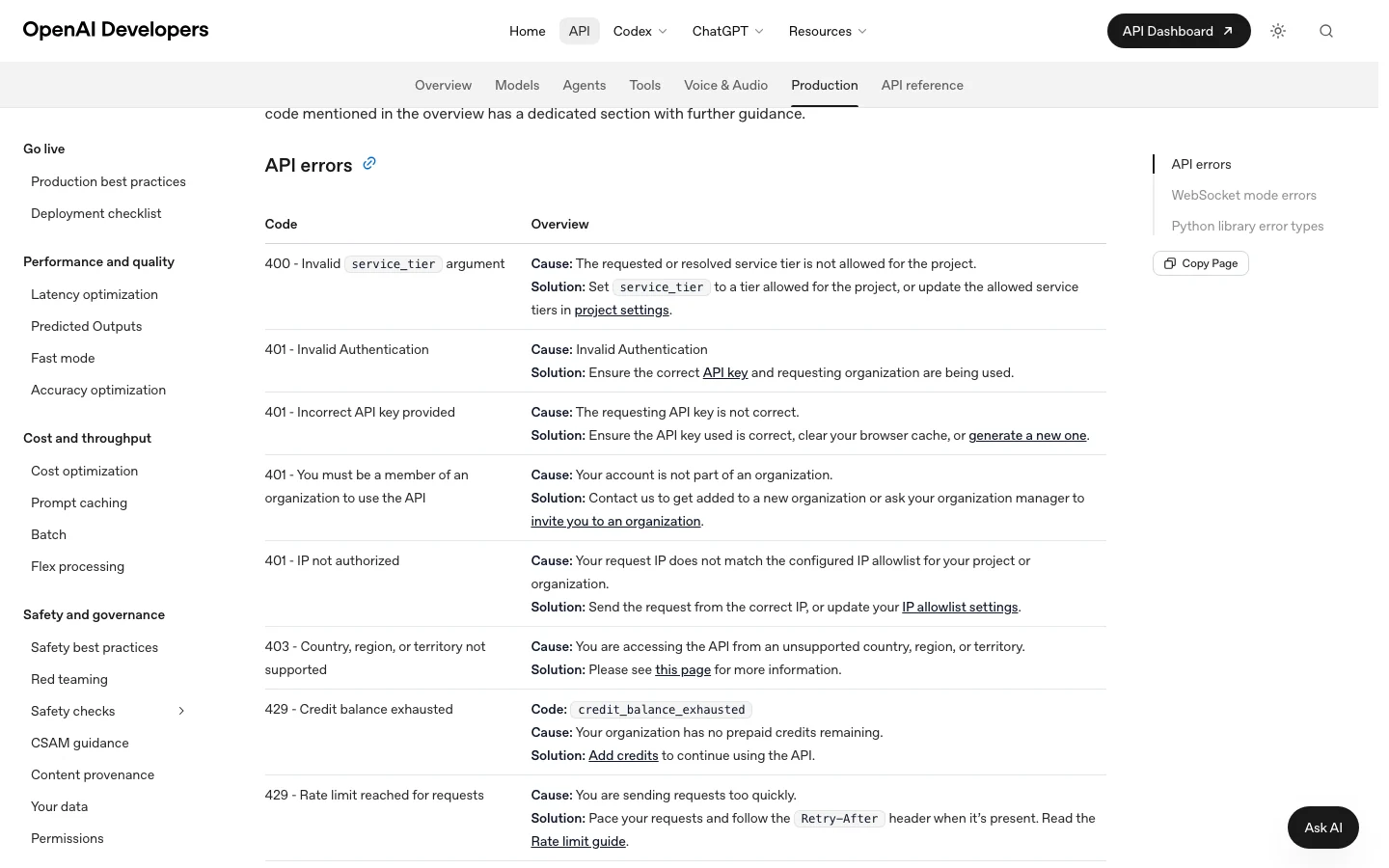 OpenAI documents several account and traffic conditions that can return 429. This screenshot establishes the ambiguity of the status code; it does not establish what happened at an unnamed relay or buyer account.
That distinction changes the meaning of the group discussion. A personal script sending requests too quickly, a team sharing one key and hitting a project cap, and a production workflow exhausting TPM at peak time can all produce similar complaints. TPM means tokens per minute, one of the throughput dimensions providers may limit. The messages look alike, but the money, responsibility, and purchasing structure behind them may have nothing in common.
A 429 therefore tells us what happened to one call. It does not tell us what an organization is preparing to do next. Treating the status code itself as demand hides the more consequential change: whether someone inside the organization has begun to take ownership of the failure.
Enterprise demand appears when constraints begin to interlock
There is no magic keyword for enterprise demand. It resembles a system of constraints tightening around a problem.
The first change is usually technical specificity. The conversation moves beyond “the API is slow” and names the model, project, time window, traffic shape, or response body. RPM, TPM, concurrency, workspace, or a particular account scope enters the discussion. RPM means requests per minute. These details do not prove a purchase will happen, but they show that the problem exists inside an observable system rather than only as a vague complaint.
Anthropic’s API error documentation makes the same ambiguity visible. A 429 rate_limit_error can result from an organization rate limit, a monthly tier spend cap, or a Claude Code workspace spend limit. Anthropic also documents acceleration limits, which can apply when usage grows sharply rather than gradually.
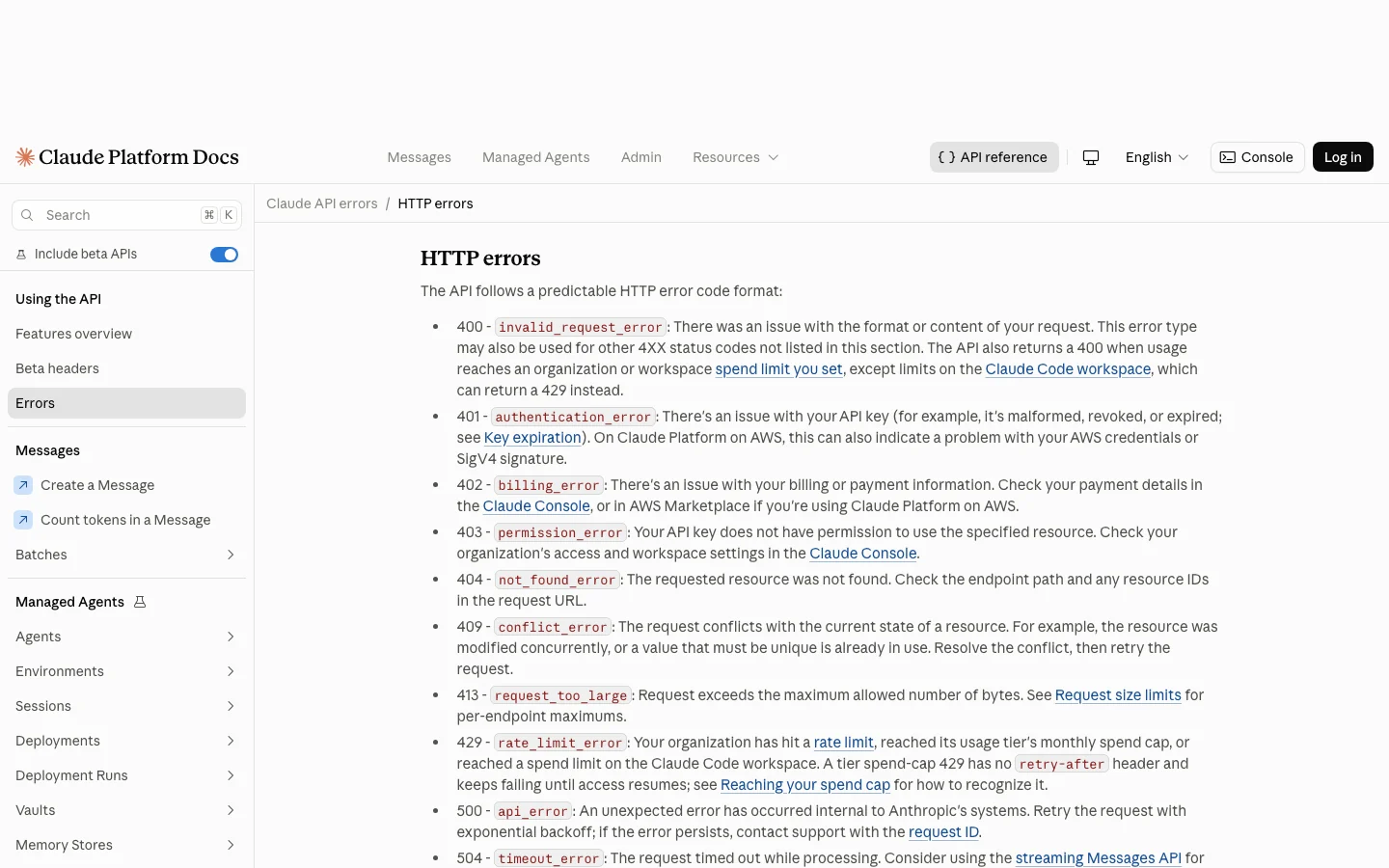 Anthropic puts rate, monthly spend, and workspace limits in the same 429 context. The response content, account scope, and traffic history are needed to narrow the cause.
The next change is that the failure becomes tied to a business obligation. “The overnight batch did not finish” is different from “customers will not receive their reports this morning.” “The endpoint is unstable” is different from “the feature launches Wednesday and its error rate is covered by our customer SLA.” An SLA is a service-level agreement: it defines availability or service obligations. Once an API failure affects delivery, revenue, a contract, or a launch window, the API has become part of the company’s external promise.
Organizational constraints then become visible. A legal billing entity, invoice requirements, a monthly ceiling, data-region restrictions, key isolation, log retention, or a security review may sound less urgent than “everything is down.” They are closer to the real enterprise problem. They show that model access now touches finance, compliance, and internal governance instead of living only inside one developer’s experiment.
The final change is the appearance of costly, partially irreversible work. The team begins organizing error records, assigning a test window, separating production and test keys, moving a slice of traffic, or asking the incumbent to document its upstream and SLA. Emotion can disappear in five minutes. Testing and migration consume engineering, finance, and procurement time. Demand becomes more mature when the organization is willing to spend coordination effort on uncertainty.
Demand is a narrowing trajectory, not a single message
Consider this representative composite sequence across eight days:
Monday, engineer: “Claude keeps returning 429 at peak time. The backup domain behaves the same way.”
Thursday, platform lead: “We found that both domains use the same account quota. What we need is a genuinely independent second path.”
The following Tuesday, business owner: “We will send 5% of traffic through the alternative this week. Finance needs invoicing to the Hong Kong entity, and we will decide by month-end whether to retain two suppliers.”
The first message may still describe a temporary fault. The second turns “another endpoint” into a question about supply independence. The third introduces test cost, payment conditions, and a decision date. Even then, it would be wrong to claim that a purchase is certain. What has changed is that an emotional incident has become a choice the organization is defining.
This is where Telegram creates persistent misreadings. Engineers, founders, channel partners, and peers may contribute at different times. Advertising, forwarded posts, and ordinary chat separate the important fragments. Searching for “429” finds the first message. Searching for “invoice” may find the third. Neither search shows whether both belong to the same issue.
The same structure appears in supplier reviews after a model supply-chain security incident and in 429 disputes around Web3 RPC services. The triggers differ, but the commercial question is similar: has the fault entered a shared discussion about accountability, budget, and an alternative path?
“Backup domain” is really a question about supply-chain structure
The phrase “the main endpoint and backup domain failed together” matters because it forces the industry to ask a more basic question: what, exactly, is being backed up?
Two domains may share an account, credential set, quota pool, gateway, region, or even the same client retry logic. A different hostname proves a different entrance, nothing more. Meaningful redundancy requires the dependencies to be explicit. After failure, did the request actually reach a different provider or independently provisioned capacity? Can the successful path be identified in the response and logs? Do data handling, cost, and accountability still satisfy the buyer’s requirements after the switch?
Cloudflare AI Gateway’s fallback documentation provides a clear cross-provider example. A request can proceed from Workers AI to OpenAI after an error or configured timeout, and the cf-aig-step response header identifies which step ultimately processed it.
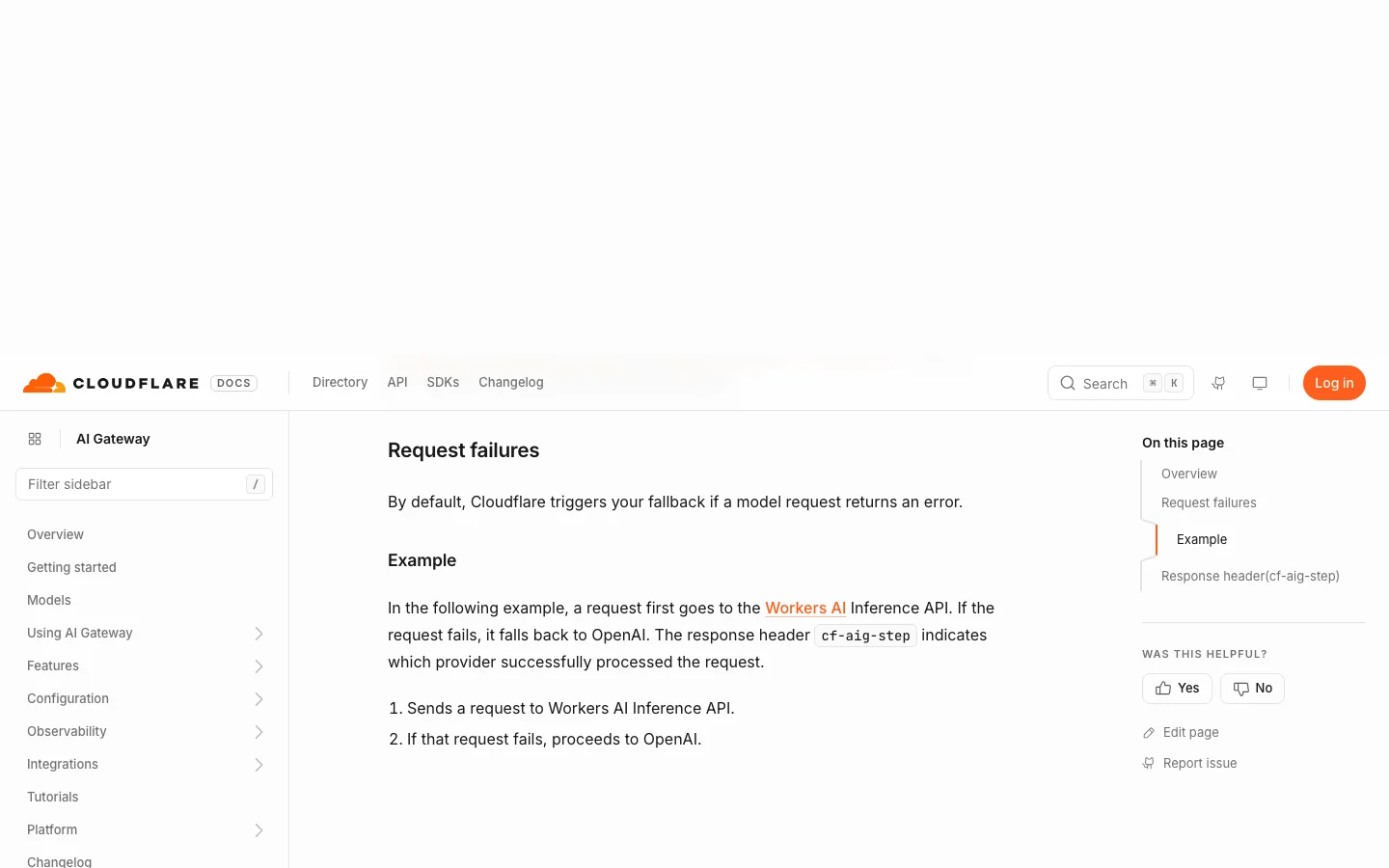 Cloudflare’s example shows that verifiable fallback makes the successful step explicit. It does not prove that any two commercial domains represent independent supply paths.
If two endpoints fail at the same moment with similar responses, shared infrastructure is a hypothesis, not a diagnosis. Actual independence has to be established from accounts, credentials, quotas, gateways, regions, routing, and error records.
This is also where competition among AI API services is changing. In an earlier market, “one more address” could sound like differentiation. Once model calls sit inside production, buyers care more about independent failure domains, explainable capacity, controllable billing, and responsibility when something breaks. Price remains important, but price alone can no longer describe the value of a route.
Telegram’s value is time, not keyword volume
High-noise channels have no shortage of alerts. The scarce capability is being able to return several days later and recover who said what, in which context, what preceded it, and which new constraints appeared afterward.
TOP Prospect is best understood as that information layer. A user deliberately connects Telegram groups they are authorized to access and process. The system preserves a candidate message with its source, timestamp, and surrounding context, making it possible to place separated fragments back on one timeline. Its value is not declaring a buyer whenever “429” appears. It is making it possible to examine whether error detail, business impact, path independence, and budget conditions are converging.
The boundary matters. TOP Prospect does not read unselected groups or private chats, contact group members automatically, or confirm a writer’s employer, budget, technical diagnosis, or purchasing authority. Software can preserve the history of how demand formed. People still have to decide whether the fragments concern the same organization and problem, and whether establishing contact is appropriate.
Seen this way, Telegram is valuable to AI API services not because it contains the largest possible number of “need a route” messages. It is a live record of market friction: rate, cost, redundancy, compliance, and accountability continually collide. A team that can see how those constraints combine is closer to understanding what the market is beginning to pay for.
The scarce asset is the context in which demand forms
A 429 complaint is easy to capture and just as easy to overvalue. Enterprise demand becomes visible when an isolated technical failure is surrounded by business consequences, organizational rules, and migration work.
That leads to a more useful market judgment: commercial signals in AI API services do not become stronger simply because a keyword appears more often. They become clearer as the relationships among constraints become explicit. When model, traffic, responsibility, budget, legal entity, and date begin pointing to the same problem, demand acquires a recognizable shape.
FAQ
Why does a 429 not prove that an enterprise is switching AI API providers?
Because 429 is a technical result, not commercial intent. OpenAI and Anthropic both document multiple rate, credit, spend, or usage conditions that can return 429. More context is required to know whether the problem has entered an internal evaluation or procurement process.
What is the earliest sign that enterprise AI API demand is forming?
The constraints become specific: which model and workload are affected, who owns the failure, what budget or compliance conditions apply, and whether the organization has started spending time on testing or migration.
If the main API and backup domain fail together, do they share an upstream?
Not necessarily. A shared account, credential, quota pool, gateway, region, or client retry policy could produce similar behavior. Independence must be verified from actual routing, accounts, and error records.
Why is a sequence of Telegram discussions more useful than one message?
Enterprise demand is often completed by different roles at different times. An engineer describes the fault, a business owner explains the impact, and finance or procurement adds budget and contract conditions. The timeline shows whether those constraints are converging.
Can TOP Prospect automatically verify identity, budget, or purchasing authority?
No. TOP Prospect preserves messages, sources, timestamps, and context from Telegram groups the user deliberately connects and is authorized to process. Identity, budget, technical cause, and purchasing authority still require human verification.
Frequently asked questions
Why does a 429 not prove that an enterprise is switching AI API providers?
Because 429 is a technical result, not commercial intent. It may reflect request rate, depleted credit, an organization or project spend cap, or a shared quota. More context is required to know whether the issue has entered an internal evaluation or procurement process.
What is the earliest sign that enterprise AI API demand is forming?
The constraints become specific: which model and workload are affected, who owns the failure, what budget or compliance conditions apply, and whether the organization has started spending time on testing or migration.
If the main API and backup domain fail together, do they share an upstream?
Not necessarily. A shared account, credential, quota pool, gateway, region, or client retry policy could produce similar behavior. Independence must be verified from the actual routing, accounts, and error records.
Why is a sequence of Telegram discussions more useful than one message?
Enterprise demand is often completed by different roles at different times. An engineer describes the fault, a business owner explains the impact, and finance or procurement adds budget and contract conditions. The timeline shows whether those constraints are converging.
Can TOP Prospect automatically verify identity, budget, or purchasing authority?
No. TOP Prospect preserves messages, sources, timestamps, and context from Telegram groups the user deliberately connects and is authorized to process. Identity, budget, technical cause, and purchasing authority still require human verification.
Sources and further reading
This article is human-authored. TOP Prospect processes only Telegram groups the user has explicitly authorized and connected. Its output supports human sales judgement; it does not replace human decisions and does not automatically contact or message group members.
Market and risk discussion is supporting evidence
Top Prospect is primarily a Telegram lead-generation product. Market and risk discussion can add context to a candidate lead, but it does not become a verified incident, trend, or sales opportunity automatically.