Search "AI API" and you only find competitors? Buyers use a different set of words
Stop mass-joining groups. Use in-app search, AI search, Google and Bing to find AI API reseller buyers on Telegram, and judge a group before you join it.
Group names, member counts, alert volumes and elapsed times in this article are illustrative scenarios used to explain the screening method. They are not measured results.
In the AI API (application programming interface) reseller business there is one widespread misconception. The more groups you join, the more customers you find.
So a BD spends four hours a day searching Telegram for “AI API”, “developer” and “GPT”, applies to dozens of groups, and waits to be approved.
A week later the numbers look like this.
- 50 applications sent, 12 approved
- Of those 12, seven are dead, three are ad groups and two are full of competitors
- Exactly one has real developers in it
- In that one they post three ads and get removed
Four hours a day across seven days is 28 hours, and the customer count is still zero.
The problem is not effort. It is method.
Joining groups is not the goal. Finding customers is. Precise group search and mass joining are not in the same league.
One. Why mass joining is bound to fail
1. Three hard limits inside Telegram search
When you type “AI API” into the Telegram search box, all you get is this.
- Groups whose name contains the keyword (many good groups are called “Developer Hub” or “Tech Talk”, and they never show up)
- No activity indicator (you cannot tell a dead group from a busy one)
- No language, member count or verification data (you find out it is a Russian-language group with 50 members only after you join)
The result is two hours of searching, 20 groups found, 15 applications sent, five approved, and one that turns out to be worth anything.
2. The “volume first” strategy runs out of returns
Say you join 100 groups.
- For the first ten, you can still read the messages one by one
- By 30, you are already missing important threads
- At 100, you cannot read them at all and fall back on keyword alerts
Keyword alerts have one flaw. They tell you that a message contains a word. They do not tell you whether it is a real need.
So you get 200 “AI API” alerts a day. 180 are ads, 15 are from competitors, four are individual developers looking for free service, and one is a genuine enterprise requirement.
To find that one real requirement you spent 28 hours.
3. Removal risk. You call it promotion, the owner calls it spam
In the 2026 Telegram ecosystem, group owners have zero tolerance for BDs who post ads.
The moment you join, you post this.
“We offer stable AI API access at a good price. DM me.”
The owner removes you on the spot and marks you as spam.
Why? Because you brought nothing of value. You only took.
BDs who do find customers in groups work differently.
- Search first, join later: only join groups where real developers are talking
- Read before you speak: see what the group is discussing and find the actual pain point
- Give value before you make contact: not “we sell API access” but “here is how to deal with 429 errors”
Precise group search comes before all of it.
Two. What precise group search means
The core logic is simple. You are not looking for every group. You are looking for the right group.
The right group has three marks.
- Real target customers in it (not a dead group, an ad group or a competitors’ club)
- Substantive business discussion (not small talk, stickers and filler)
- Observable public signals (not a private group or one behind an approval gate)
How do you find groups like that?
The search groups feature in Top Prospect offers four search entries. Each one solves a different problem.
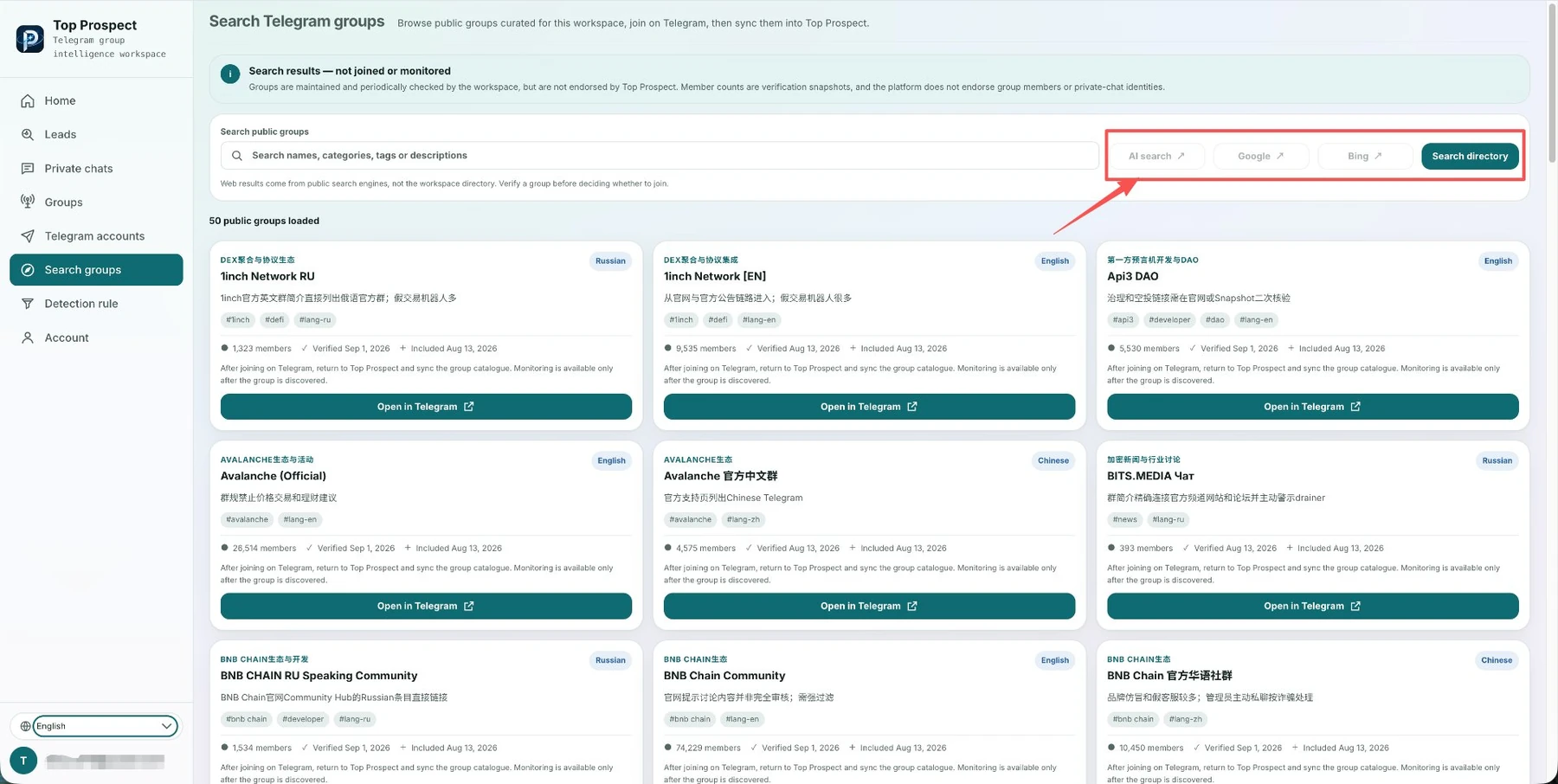 The screenshot above is the search groups page in Top Prospect. Four entries sit to the right of the search box, and below them are the public groups already in the index, each card carrying its member count, last verified date and inclusion date.
Entry one. In-app search, for groups already indexed
The point of in-app search is this. It screens out the groups that are obviously not worth your time.
When you search “AI API” in Top Prospect, what comes back is not every group containing those words.
- Indexed groups (Top Prospect has already collected and checked them)
- Tagged groups (#ai-api, #developer, #lang-en and so on)
- Groups with activity data (member count, last verified time, date indexed)
A result card looks like this.
AI Developer Community [EN]
#ai-api #developer #lang-en
9,535 members · Verified Sep 10, 2026 · Indexed Aug 12, 2026
High activity, mostly technical discussion
What that tells you.
- Nearly ten thousand members, so not a dead group
- Recently active, so it is still alive
- Language is English, not Russian or Chinese
- The description flags the quality so you know the risk up front
The value of in-app search is that you do not have to apply and join to find out. You can see which groups are worth the application.
Entry two. AI search, for describing your target customer in plain language
In-app search only covers groups that are already indexed. What if you want a narrower slice, such as:
- groups discussing GPT-6 API rate limits
- groups covering AI API failover routing
- private groups for enterprise AI application developers
That is where AI search comes in.
AI search lets you describe the group you want in natural language instead of keywords.
You can type something like this.
“I want developer groups discussing AI API rate limits, 429 errors and failover routing. English preferred, at least 1,000 members, no ad groups.”
AI search works out the intent and returns matching groups.
The value of AI search is that it reads your business requirement rather than matching words. When you say “rate limit”, it knows you mean a technical discussion group and not a group selling accounts.
Entry three. Google and Bing, for what sits outside
In-app search and AI search only reach groups Top Prospect has indexed. Telegram has tens of thousands of public groups and no index covers all of them.
That is what Google search and Bing search are for.
Click “Google” and the system opens a Google query with the terms already assembled: site:t.me "AI API" developer.
What comes back is pages under the Telegram domain, in other words links to public Telegram groups.
The value of Google search is that it reaches groups that exist but are not indexed yet.
The value of Bing search is that Bing indexes Telegram differently, and it sometimes surfaces a batch Google missed.
Two cautions for outside search.
- Top Prospect has not checked these groups, so you judge the quality yourself
- Once you find one, join it manually, then bring it back into Top Prospect to sync and turn on signal collection
Three. What precise group search changes. From trawling to targeting
Compare the two workflows.
Mass joining
- Time: four hours a day
- Groups joined in a week: 50
- Approval rate: about 20 to 25 percent
- Share of useful groups: about two percent
- Leads: luck dependent and impossible to keep steady
Precise group search
- Time: four hours a day (one hour filtering, three hours following up)
- Groups found in a week: 100 or more across the four entries
- Groups joined after filtering: 20 (only indexed, tagged and active ones)
- Approval rate: about 70 to 75 percent
- Share of useful groups: about 40 percent
- Leads: collected systematically, predictable and reusable
Where the difference sits
- Time efficiency: the same hours put in produce more groups worth joining, and you know before joining whether a group is worth it
- Lead quality: member count, language and last verified time are visible up front, so you walk into far fewer dead groups and ad groups
- Reusability: the method turns into a SOP, while mass joining starts from zero every time
Four. What the search groups feature is actually for
The search groups feature in Top Prospect is not there to hand you more groups. It is there to:
- Save you time: no more trawling Telegram and hoping
- Raise your hit rate: only apply to groups that actually contain customers
- Give you a system: turn random joining into a repeatable process
The only goal is to help you find customers.
If your team also runs AI API reseller, Web3 or cross-border B2B business inside the Telegram ecosystem, and you are spending hours a day mass joining groups, getting removed and seeing zero conversion, Top Prospect can locate and verify the right target groups for you through four search entries.
To see how Top Prospect turns group sourcing from guesswork into a repeatable system, visit topprospect.net.
Sources and further reading
How a Signal worth attention is found
See how Top Prospect finds and organizes Signals worth checking, keeps the original Telegram context, removes duplicates, and helps you decide what to review first. You decide whether to follow up and what to do next.