BankChain Has 39 Associations but No Technology Partner: The Messages That Change the Story
BankChain Alliance exists, but its network, technology partner, bank participants, and pilot do not. A banking-infrastructure partnerships lead should prioritize only the Telegram fragments that add one of those missing facts.
Signals to watch
- Thirty-nine state bankers associations formed a governance and ownership coalition before a technology partner was selected
- The Alliance targets a 2027 launch and describes interoperability, tokenized deposits, stablecoins, and automated settlement as planned directions rather than live services
- Association representation covers thousands of banks, but the Alliance explicitly says those banks are not individually committed unless separately indicated
- Technology partner selection, architecture, bank participation, pilot scope, and operating rules remain future public milestones
A banking-infrastructure partnerships lead can watch one BankChain announcement turn into three different Telegram claims within hours: “3,283 banks joined,” “the network launches in 2027,” and “community banks now have tokenized deposits.” All three overstate the reviewed sources.
The confirmed event is still important. On August 25, 2026, 39 state bankers associations formed BankChain Alliance before selecting a technology partner. The Alliance says it is targeting a 2027 launch and lists tokenized deposits, stablecoins, smart payments, automated settlement, and interoperability as intended directions.
The commercial judgment is specific: a BankChain message deserves higher priority only when it fills one of the project’s public blanks—technology partner, architecture, governance rule, named bank, pilot, operating control, or decision date. Association reach alone is context, not adoption.
Key takeaway
- The Alliance is formed; the reviewed sources do not establish a live network.
- The 3,283 banks and $21.8 trillion describe the associations’ represented footprint, not signed participants or committed assets.
- A target year is not an implementation date, and a possible capability is not a product.
- TOP Prospect can organize fragments from authorized connected Telegram groups; a person must verify the source, organization, authority, and status.
The official announcement image proves the association-level event and stated direction. It does not prove individual-bank commitments.
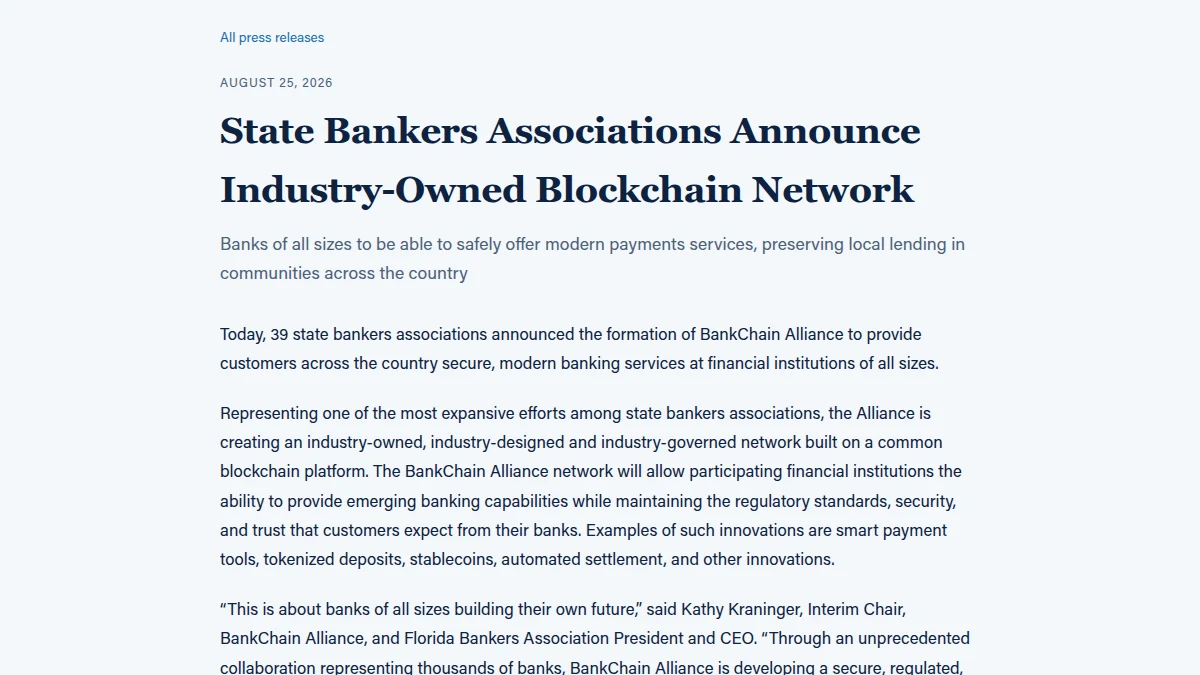 The August 25 release confirms that 39 associations announced the Alliance. It does not show a live network or committed banks. Source: BankChain Alliance.
One announcement contains six different states
A partnerships lead should tag each fragment by status before deciding who reviews it.
| Status on August 26, 2026 | What the official material supports |
|---|---|
| Completed | Thirty-nine state bankers associations formed BankChain Alliance. |
| In progress | The Alliance is selecting a technology partner. |
| Targeted | The Alliance is aiming for a 2027 launch. |
| Intended | Industry ownership, industry governance, and interoperability with other networks. |
| Possible | Tokenized deposits, stablecoins, smart payments, and automated settlement. |
| Not established | Selected chain, permission model, validators, custody, named bank pilots, production transactions, pricing, or regulatory approval. |
A message that says “BankChain launches in 2027” removes the word target. A message that says “BankChain supports tokenized deposits” removes the future design work. Those lost words are precisely where verification begins.
The second capture shows technology-partner selection as ongoing and 2027 as a target. It cannot guarantee that date.
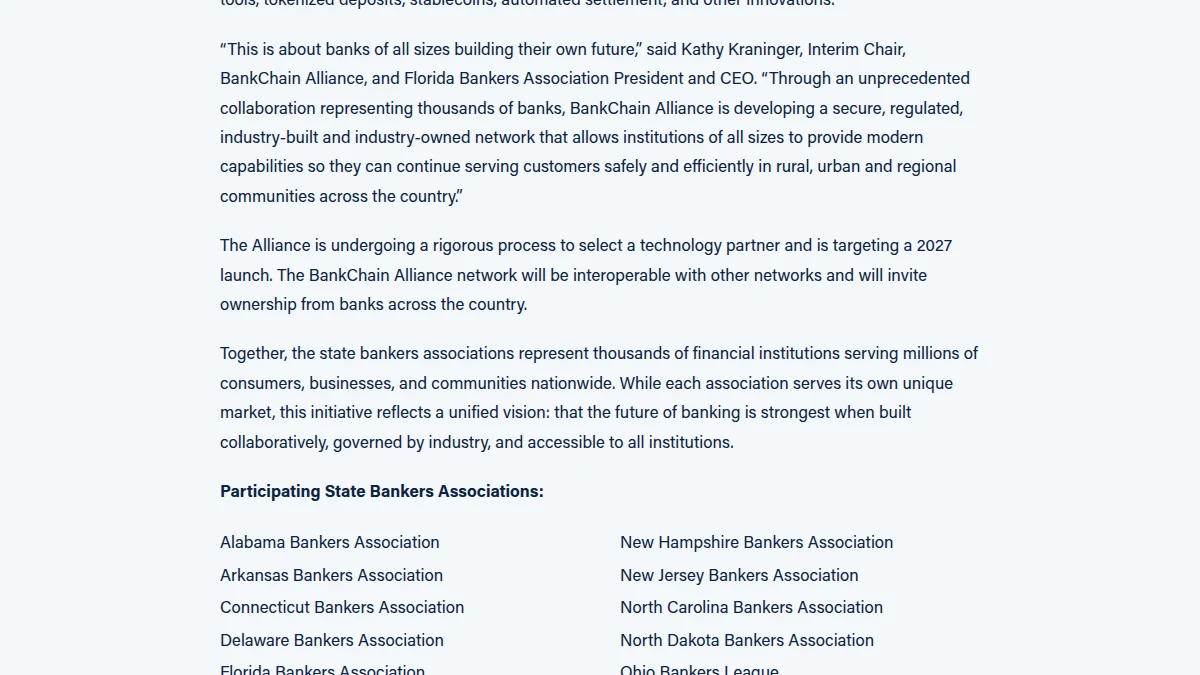 The public sequence is partner selection first and a target 2027 launch afterward. Source: BankChain Alliance.
Do not inherit the headline’s participant count
The Alliance About page displays 39 represented states, 3,283 banks, and $21.8 trillion in assets. It also says participation is by state bankers associations and that represented banks are not individually committed to or participating in the Alliance unless separately indicated.
That disclaimer must travel with the numbers. Without it, the message changes meaning.
- “39 associations formed the Alliance” is supported.
- “The associations represent 3,283 banks” is supported with the website’s current methodology.
- “3,283 banks joined BankChain” is not supported.
- “$21.8 trillion will move onto BankChain” is not supported.
For early partnership review, a named bank matters more than another map of association coverage. A message from an identified bank team discussing its role, system, or pilot would add evidence. A repost of the footprint would not.
The participant list in the release contains state associations, as the image shows. It is not a bank pilot roster.
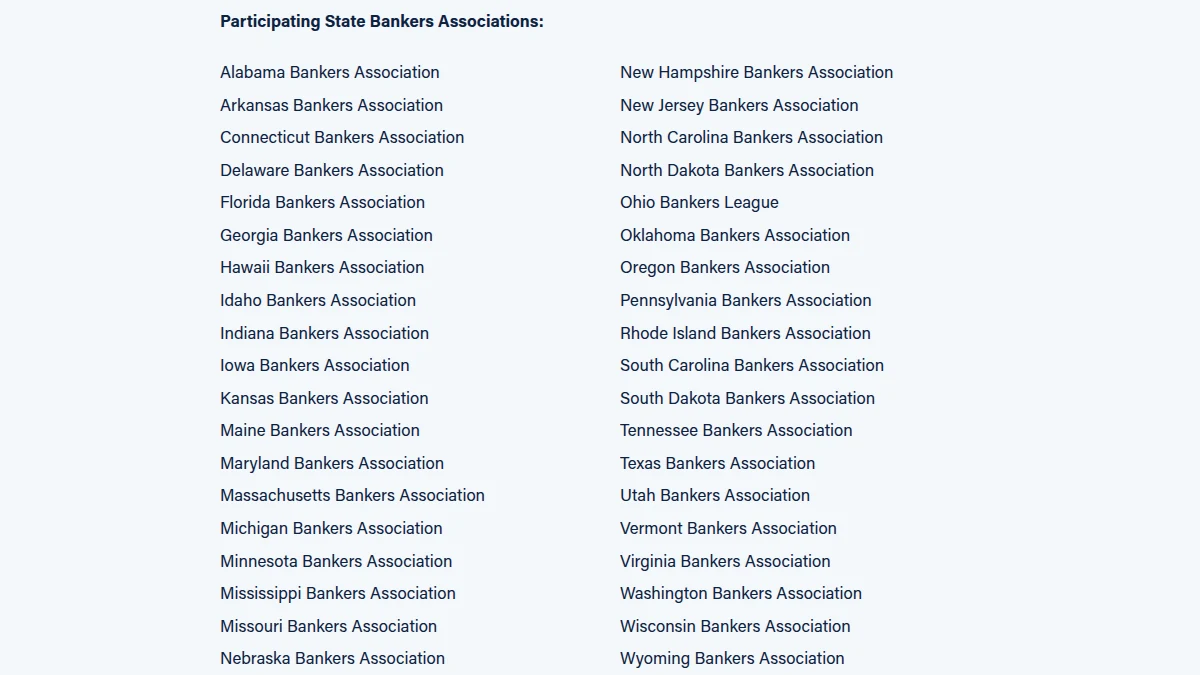 The named participants are associations. Individual-bank participation requires separate evidence. Source: BankChain Alliance.
Why the unnamed technology partner is the first strong Signal
The coalition formed before choosing technology. That sequence suggests the associations want to aggregate governance and bargaining power before a vendor defines the system.
For a partnerships lead, the first named technology partner will narrow multiple unknowns at once: likely ledger model, privacy boundary, integration approach, upgrade process, and vendor dependency. Even before a formal announcement, authorized group discussion may contain fragments such as “the architecture review has shortlisted two providers” or “core-banking integration is the gating item.”
A fragment like that is not proof. It does, however, name a process and dependency that can be checked. The next step is to find the original source, identify whether the author has authority to know, and compare it with an official update.
If a message mentions an application programming interface (API)—the documented way software systems exchange data—the useful question is not “does BankChain have an API?” The useful questions are which systems it connects, who owns the specification, what data crosses the boundary, and whether the interface is selected or merely proposed.
Tokenized deposits sharpen the implementation questions
BankChain’s glossary defines a tokenized deposit as a bank deposit represented on a blockchain while remaining a liability of the issuing bank. It defines a stablecoin as a token designed to hold stable value, commonly with reserves managed by an issuer.
That distinction explains why community banks care. A third-party payment token can move the customer’s balance outside the bank deposit relationship. A tokenized deposit aims to modernize transfer and settlement while preserving the issuing bank’s liability. This is the Alliance’s rationale, not a measured outcome.
Before treating a tokenized-deposit message as implementation evidence, record six unknowns:
- Which bank would issue the deposit representation?
- Is there one instrument per bank or a shared instrument?
- Which record controls if the blockchain and core-banking ledger disagree?
- How do two issuing banks transfer and finally settle value?
- Who owns identity, sanctions, fraud, and transaction monitoring?
- How are freezes, court orders, errors, reversals, and recovery handled?
A message that answers one question with a named owner is more valuable than a general claim that tokenized deposits are “coming.”
Rank the missing fact, not the excitement
The following ladder keeps a partnerships queue from filling with repeated press coverage.
| Telegram fragment | Current value | Human verification |
|---|---|---|
| “39 associations are building a blockchain” | Confirmed market context | Preserve official source; no adoption inference |
| “3,283 banks are on BankChain” | Misleading restatement | Attach the About-page disclaimer |
| “Technology partner selection is underway” | Confirmed process | Monitor official decision and criteria |
| “A named infrastructure provider is in architecture review” | Candidate partner Signal | Verify original author, provider, role, and independent support |
| “A named bank will pilot tokenized deposits in Q1” | Candidate implementation Signal | Verify bank identity, instrument, environment, authority, and date |
| “Core integration is blocking the pilot” | Candidate supplier need | Verify system, owner, scope, and decision window |
The last three can justify early review because they add a missing object. None should be turned into a confirmed deal from one group post.
TOP Prospect preserves the fragment, not the conclusion
TOP Prospect can continuously process only Telegram groups that the user intentionally connects and is authorized to access. For BankChain, it can retain the original message, source, timestamp, and surrounding context; group obvious reposts; and rank discussions that add partner, architecture, bank, pilot, or operating details.
It does not read private chats, enter unauthorized groups, identify anonymous accounts, inspect procurement, confirm a pilot, or contact anyone automatically. It cannot infer that an association’s members have joined, and it cannot prove that two handles represent the same institution.
The banking-infrastructure partnerships lead still checks the original message, the Telegram source-governance method, current BankChain pages, and any first-hand document. The product shortens the path to the fragment; it does not make the underlying claim true.
Industry ownership has a coordination price
Shared ownership can aggregate requirements, strengthen bargaining power, and give smaller banks influence over infrastructure rules. It can also slow decisions.
The 39 associations represent banks with different core processors, risk tolerances, state environments, and product priorities. A governance process that protects smaller institutions may take longer to change. A common network may reduce duplicate engineering while creating a common incident surface and a new vendor-replacement problem.
Banks can also use existing instant-payment rails, vendor-managed platforms, bilateral integrations, or tokenization services. Those options may launch sooner and have clearer accountability. BankChain has to show that collective control produces enough technical or economic value to justify another layer.
This trade-off also helps qualify messages. “Banks want control” is broad interest. “The governance rule for replacing the technology partner is blocking approval” is a specific implementation dependency.
The next BankChain update should remove a blank
BankChain is already a meaningful market Signal: 39 associations organized around infrastructure ownership before selecting technology. It is not evidence that 3,283 banks adopted a network.
For the partnerships lead, the next useful Telegram fragment will remove one blank from the public record—a named provider, architecture choice, governance rule, bank, pilot, control owner, or deadline. Preserve that addition and its source. Keep the association disclaimer attached. Then ask a person to verify it.
That is more disciplined than counting reposts, and it is much earlier than waiting for a fully formed request for proposal.
FAQ
Is the BankChain network live?
No live network is established by the reviewed sources. The Alliance says partner selection is underway and targets a 2027 launch.
Have 3,283 banks joined?
No. The number describes banks represented by participating associations. The About page explicitly excludes automatic individual commitment or participation.
Has BankChain selected a technology provider?
No selected provider or architecture appears in the reviewed announcement. Selection is described as ongoing.
Which BankChain message deserves early review?
One that adds a named provider, bank, system, pilot, governance dependency, owner, or date beyond the official announcement.
Organization and source status were reviewed on August 26, 2026. Partner, architecture, participation, pilots, and launch remain subject to future evidence.
Frequently asked questions
Is the BankChain network live?
No live production network is established by the reviewed announcement. The Alliance says it is selecting a technology partner and targeting a 2027 launch.
Have 3,283 banks joined BankChain?
No. The Alliance About page says participation is by state bankers associations and explicitly warns that represented banks are not individually committed or participating unless separately indicated.
Has BankChain chosen a blockchain or technology provider?
The August 25 announcement says a rigorous technology-partner selection process is underway. It does not name a selected partner or architecture.
Why do tokenized deposits matter in this announcement?
They would represent bank deposits on blockchain infrastructure while remaining liabilities of the issuing bank. The Alliance lists them as one possible capability, not as a launched BankChain product.
Sources and further reading
Market and risk discussion is supporting evidence
Top Prospect is primarily a Telegram lead-generation product. Market and risk discussion can add context to a candidate lead, but it does not become a verified incident, trend, or sales opportunity automatically.