After Google Cloud and SQD's Announcement, Schema and Cost Questions Matter More Than Reposts
The SQD partnership announcement is a market trigger. Concrete follow-on questions about BigQuery schema, completeness, cost, permissions, migration, or governance are the signals worth verifying.
Signals to watch
- BigQuery schema or chain coverage gap
- blockchain data completeness or freshness reconciliation
- query-cost and permission design
- migration or downstream governance requirement
“Need Polygon plus our merchant table in BigQuery—addresses are lowercase here?” “Preview is fine for a dashboard, but who reconciles missing blocks?” “We already run Google Cloud; need a rough daily-scan cost for eighteen months of history. No approval yet.” In authorised Web3 engineering, analytics and enterprise-cloud Telegram groups, these representative fragments are more useful than the fiftieth repost of the SQD and Google Cloud announcement. They are not verified buyer requests: the writer, company, authority, budget, deadline, data rights and current provider may all be unknown.
The commercial-research task is to preserve those unknowns while recognizing the implementation object. A partnership announcement can create work for blockchain-data, Google Cloud, data-engineering and governance providers. It does not prove that work exists. A message naming a chain, table, join, reconciliation, bill, permission or migration deserves human review because it can be checked; it still needs source and role verification.
Key takeaway
- The SQD announcement is a verified market trigger, not proof of downstream implementation demand.
- Google Cloud independently documents indexed blockchain data in BigQuery, but labels Blockchain Analytics Preview under Pre-GA terms.
- SQD’s “10 chains” and “6 cryptographic checks” are SQD claims; the Google pages reviewed do not independently repeat all of them.
- Stronger follow-on signals name an implementation object such as a schema gap, completeness check, query bill, permission boundary or migration dependency.
- Identity, authority, budget, procurement status and permission to engage must remain unknown until a person verifies them.
The first screenshot establishes the narrow fact: SQD published a dated partnership announcement naming Google Cloud on 24 August 2026. It does not establish a buyer, project, service level or completed implementation.
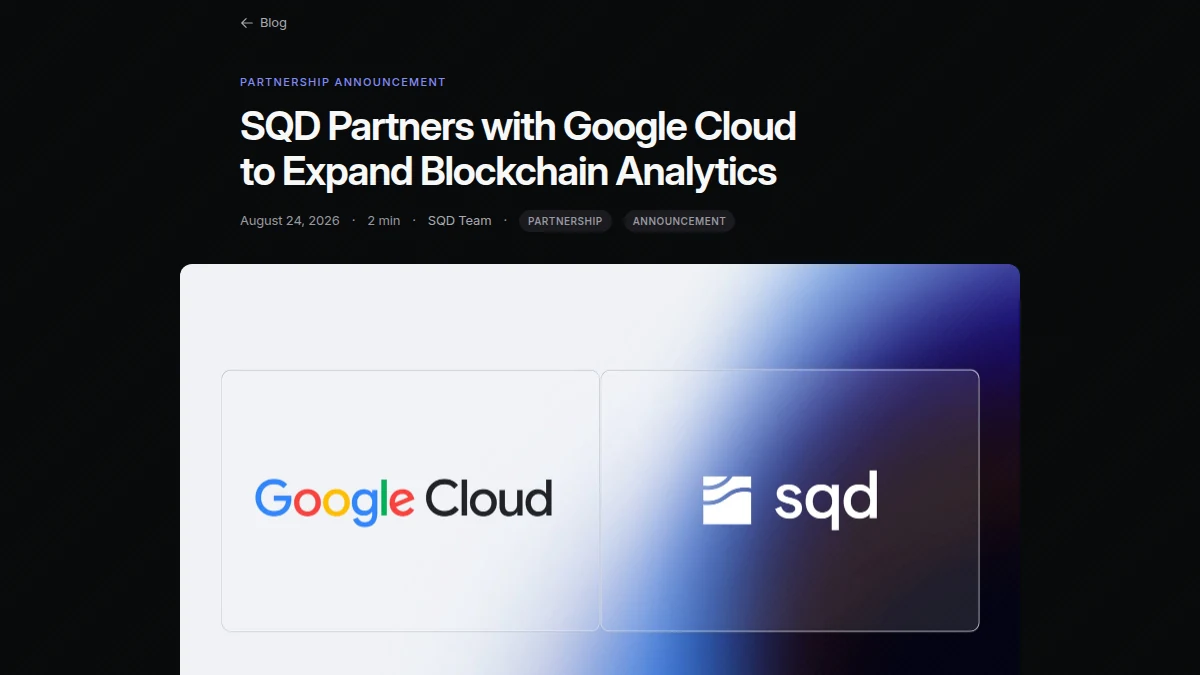 SQD’s page identifies the partnership announcement and its 24 August 2026 publication date. Source: SQD.
A repost, a technical question and an implementation signal are different
| Fragment | What it may mean | What it does not prove |
|---|---|---|
| “SQD is powering Google Cloud blockchain data now” | The announcement is circulating, perhaps with an overstated summary | Current scope, implementation status or any demand |
| “Does the dataset include decoded protocol events?” | Someone is comparing a documented table surface with a desired output | Company, workload, authority or intent to use an outside provider |
| “Our Ethereum address join drops mixed-case rows; need one normalization rule before the dashboard moves” | A concrete data-model and migration problem may exist | Budget, deadline, owner, materiality, approved project or vendor change |
The third fragment should move above the repost because it names a failing join and a downstream artifact. Yet it remains incomplete. The writer may be a developer experimenting personally, an employee without authority, a consultant promoting a method or someone quoting another team.
Providers also read the same fragment differently. A blockchain-data provider may look for chain and table coverage. A Google Cloud implementer may focus on BigQuery project design and cost controls. A data-engineering firm may focus on transformations and historical migration. A governance provider may focus on who can join public wallet records to internal customer data.
Keep SQD claims and Google documentation in separate columns
SQD says it partnered with Google Cloud to expand Google Cloud Web3 Blockchain Analytics and that SQD 360 contributes indexing and data pipelines. Its announcement displays “10 chains from genesis,” “6 cryptographic checks” and “Open public datasets.” It also places more chains, expanded capabilities and “agentic enhancement” on the roadmap.
The second capture supports attribution of those statements to SQD. It does not independently verify them through Google Cloud or turn roadmap items into current features.
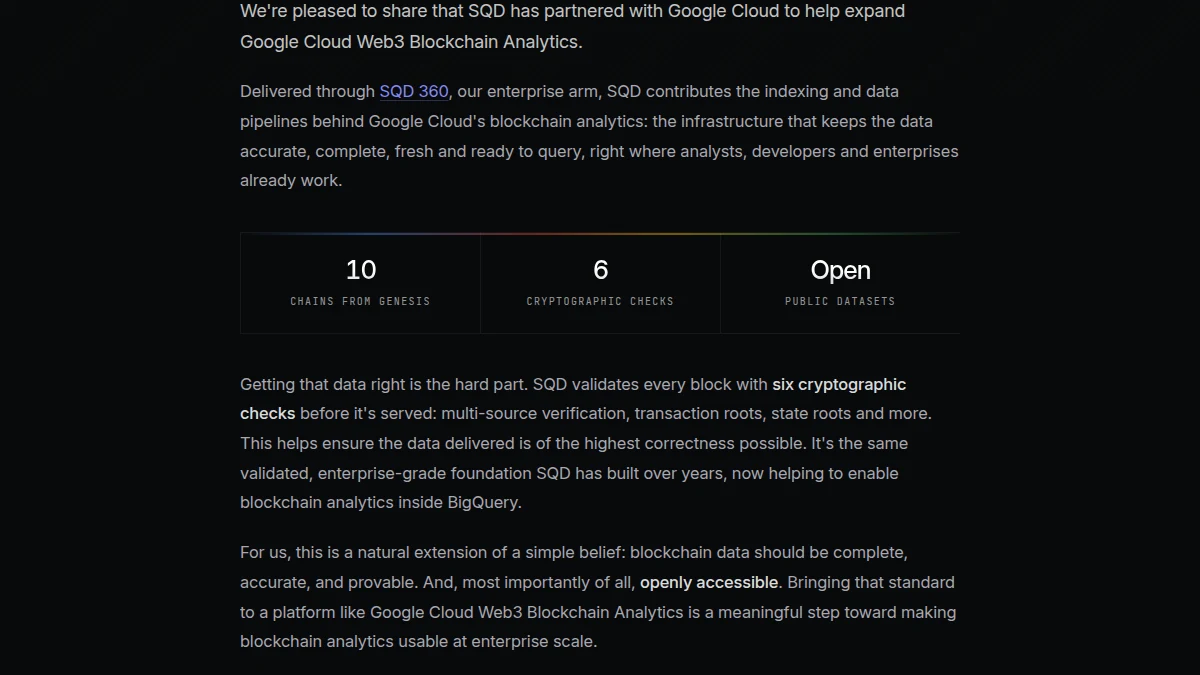 SQD presents “10 chains from genesis,” “6 cryptographic checks” and “open public datasets” in its partnership announcement. Source: SQD.
Google Cloud separately documents indexed blockchain data queried with Structured Query Language (SQL) in BigQuery. The overview describes full histories of blocks, transactions, logs and call traces for the documented Ethereum-compatible scope, as well as joins between on-chain and internal data. Google says users do not need to operate nodes or maintain an indexer for the documented datasets.
Those source layers have different dates. The Google pages reviewed were last updated on 11 August, thirteen days before SQD’s 24 August announcement. Documentation lag is possible but unconfirmed. The safe response to a message that combines both sources is to preserve the date gap and ask for the current support matrix, not to guess how the sources reconcile.
The first downstream object is often chain and schema coverage
On 26 August, Google’s schema page showed nine named dataset guides: Arbitrum One, Avalanche Contract Chain, Cronos Mainnet, Ethereum Goerli, Ethereum Mainnet, Fantom Opera, Optimism Mainnet, Polygon Mainnet and Tron Mainnet. Goerli was marked deprecated.
SQD’s announcement says “10 chains from genesis.” The nine documented guides should not be used to invent the tenth chain or claim that all ten are already documented. A useful follow-on fragment names the missing network or field: “Need Solana, is it in the current matrix?” or “Polygon table has transfers, but our model needs decoded events.” Even then, the writer’s project status remains unknown.
Schema differences create service work because multi-chain analysis is not a simple union of identical tables. Ethereum documentation includes account state, receipts, token transfers and traces, plus clustered materialized views designed to reduce scanned data for common address filters. Other datasets expose different combinations. Google also warns that addresses in several datasets are indexed in lowercase. A mixed-case join can silently miss rows unless both sides are normalized.
These details are valuable to a provider because they identify the work: coverage mapping, transformation, normalization, decoding or migration. They do not prove a contract.
Completeness, freshness and cost questions indicate different work
“Is the data accurate?” is too broad to route. More useful fragments separate three tests.
Completeness: “Our independent node shows 12 more transactions in the window—could be filter logic.” This could point to a reconciliation rule, a chain reorganization or a wrong query. It does not prove the source dataset is defective.
Freshness: “Dashboard is two hours behind during high activity; no production alert yet.” The missing facts include measurement method, expected threshold, chain finality and whether the product promises any update time.
Cost: “Query scanned 7 TB because partition filter disappeared.” Google says public-dataset storage is not charged to the customer, but BigQuery queries follow BigQuery pricing. The prerequisites include a billing account, a Google Cloud project and suitable Identity and Access Management (IAM) permissions. “Open public datasets” therefore does not mean free execution.
A provider should retain which object failed: reconciliation, update timing, query shape or cost control. Compressing them into “needs blockchain analytics” removes the information needed for human qualification.
Preview status changes how governance messages should be read
Google Cloud’s own overview provides the product-status evidence. It labels Blockchain Analytics Preview and subject to pre-general-availability (Pre-GA) terms, while confirming BigQuery SQL access.
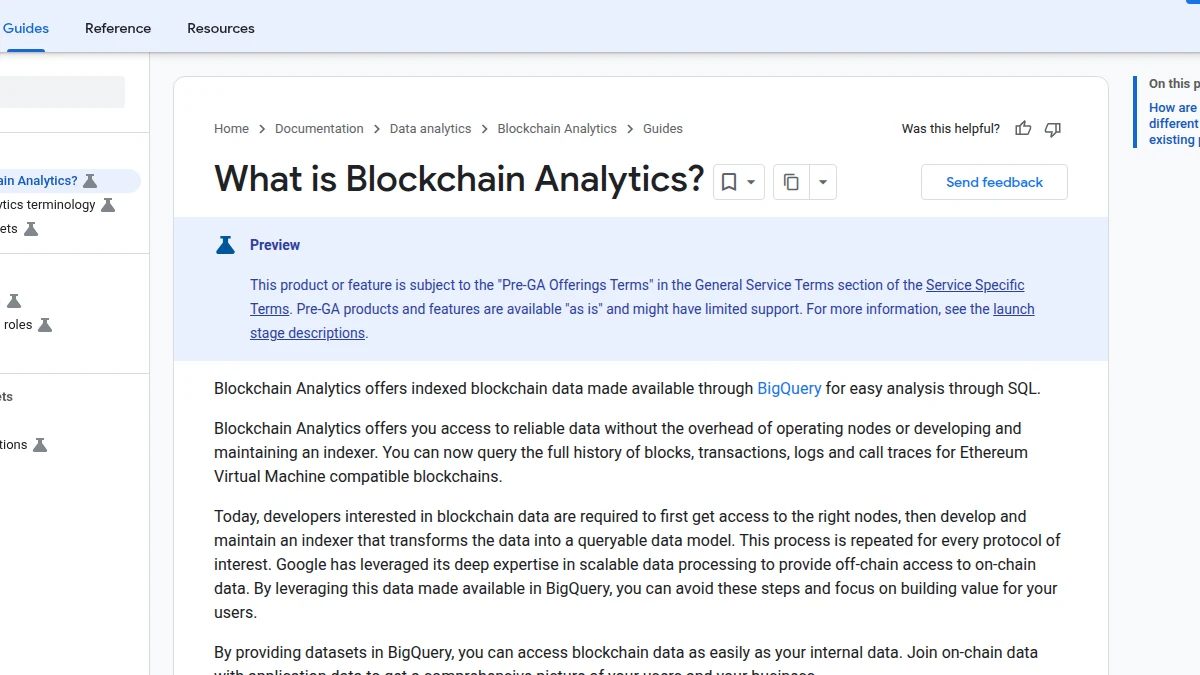 Google Cloud’s overview labels the product Preview and says indexed blockchain data is available through BigQuery for SQL analysis. Source: Google Cloud documentation.
Preview does not mean unusable. It means a message about production migration needs extra questions: what support applies, what happens if a dataset or schema changes, which workload can tolerate interruption, who owns fallback and whether sensitive internal data is being joined to public addresses.
A governance provider may see an earlier signal than a data vendor: “Only two analysts should link wallets to customer records, but the shared project is open to the whole team.” That fragment names an access boundary. It does not establish a breach or an approved remediation budget.
Human review should recover seven missing conditions
A reviewer should recover the original source; writer role; affected chain, table, query, pipeline, dashboard, permission, migration or governance record; observed evidence; timing; authority and source permission; and unknown commercial state. Budget, procurement, incumbent vendor and contact permission must not be inferred.
Across authorised Web3 engineering, analytics and enterprise-cloud groups, TOP Prospect can preserve the original message, source and time, collapse repeated announcement posts, group related fragments and rank them for human review. It cannot confirm SQD’s implementation, run a query, certify completeness, authenticate the writer, approve a project or contact anyone automatically.
An internal data team may fix an address join in an hour. A Preview dataset may be suitable for research but intentionally excluded from a production control. The company may already have a Google Cloud partner, or policy may prohibit sharing internal identifiers. Some messages will come from vendors creating demand around the announcement rather than users experiencing a problem.
The trade-off is deliberate. Requiring a complete procurement brief would miss early implementation changes. Treating every schema question as demand would create false positives. The defensible middle is a specific work object, preserved provenance and human verification of role, evidence, authority and timing.
FAQ
Does repeating the partnership announcement indicate demand?
No. A stronger fragment names a chain, table, join, reconciliation, bill, permission or migration dependency. It still does not prove a buyer or approved project.
Is Google Cloud Blockchain Analytics generally available?
The pages reviewed on 26 August 2026 label it Preview under Pre-GA terms. Production suitability depends on the workload, controls and current service terms.
Are SQD’s ten chains and six checks Google-confirmed facts?
They are statements in SQD’s announcement. The Google pages reviewed independently document BigQuery blockchain datasets but do not repeat every SQD figure.
The partnership is real, the documented BigQuery surface is real and the roadmap remains a roadmap. An implementation signal begins only when a fragment names work that can be checked—and it becomes commercially meaningful only after a person verifies the missing conditions.
Frequently asked questions
Does repeating the SQD and Google Cloud announcement indicate implementation demand?
No. A stronger signal names a chain, table, join, cost, permission, migration or governance problem, while the writer's identity, authority, budget and project status may remain unknown.
Is Google Cloud Blockchain Analytics generally available?
The documentation reviewed on 26 August 2026 labels it Preview and subject to Pre-GA terms.
Did Google independently document SQD's six cryptographic checks?
Not in the Google Cloud pages reviewed here. The six-check statement comes from SQD's 24 August announcement.
Sources and further reading
Market and risk discussion is supporting evidence
Top Prospect is primarily a Telegram lead-generation product. Market and risk discussion can add context to a candidate lead, but it does not become a verified incident, trend, or sales opportunity automatically.