I spent nothing and used AI to pick up 30 targeted cross-border payment groups on Telegram
An AI assistant returns a candidate list of 30 groups in eight minutes, and most of it is unusable. Three signals void a candidate on the spot, seven fields confirm the rest, and the groups that survive get read for three days before any rule is written.
Group names and sample dialogue in this article are illustrative. Shortlist and pool sizes are taken from actual operating records; the activity mix is an estimate.
On a Monday morning, the lead generation owner at a cross-border settlement provider opened an AI assistant and pasted in a paragraph. Find Telegram groups about cross-border payments, acquiring and settlement, preferably with a public content channel behind them, with links, descriptions and niche, thirty of them.
Eight minutes later he had the list. Thirty groups, each with a link, a description and a niche label, neatly formatted.
He started applying that same afternoon. A week later he had deleted 17 entries: nine groups had their last message two months earlier, four had been renamed or turned private and were unreachable, and the remaining four turned out to be nothing but ads.
Fewer than half of the 30 candidates were usable, and finding that out cost him a week.
The AI step was not the problem. It works from public information, it is fast, it is free, and it covers far more ground than manual searching. The problem is that it returns a shortlist, not a roster. The AI cannot see whether a group still has people talking today, and it cannot tell whether one has turned into an ad board.
What AI returns is a shortlist: three signals void a candidate
Do not start applying when the list arrives. Go through the 30 entries and strike out anything that meets these three.
Stale. The link works and the member count still looks fine, but the last message was two months ago. Nothing you post will get a reply.
Renamed or turned private. The AI worked from the group name at the time it crawled. After a rename the match no longer holds; after going private you cannot get in at all.
Already an ad board. Wall-to-wall “straight from the source” and “bulk discount”, or a stream of people exchanging contact cards. This one is hardest to spot, because the description will not tell you. Only the last few days of discussion will.
There is a fourth case worth naming separately: a competitor cluster. Every member is a payment, acquiring or settlement provider trading cards. It is not useless, since rate changes show up there early, but it does not belong in your lead pool. It provides market colour, not demand.
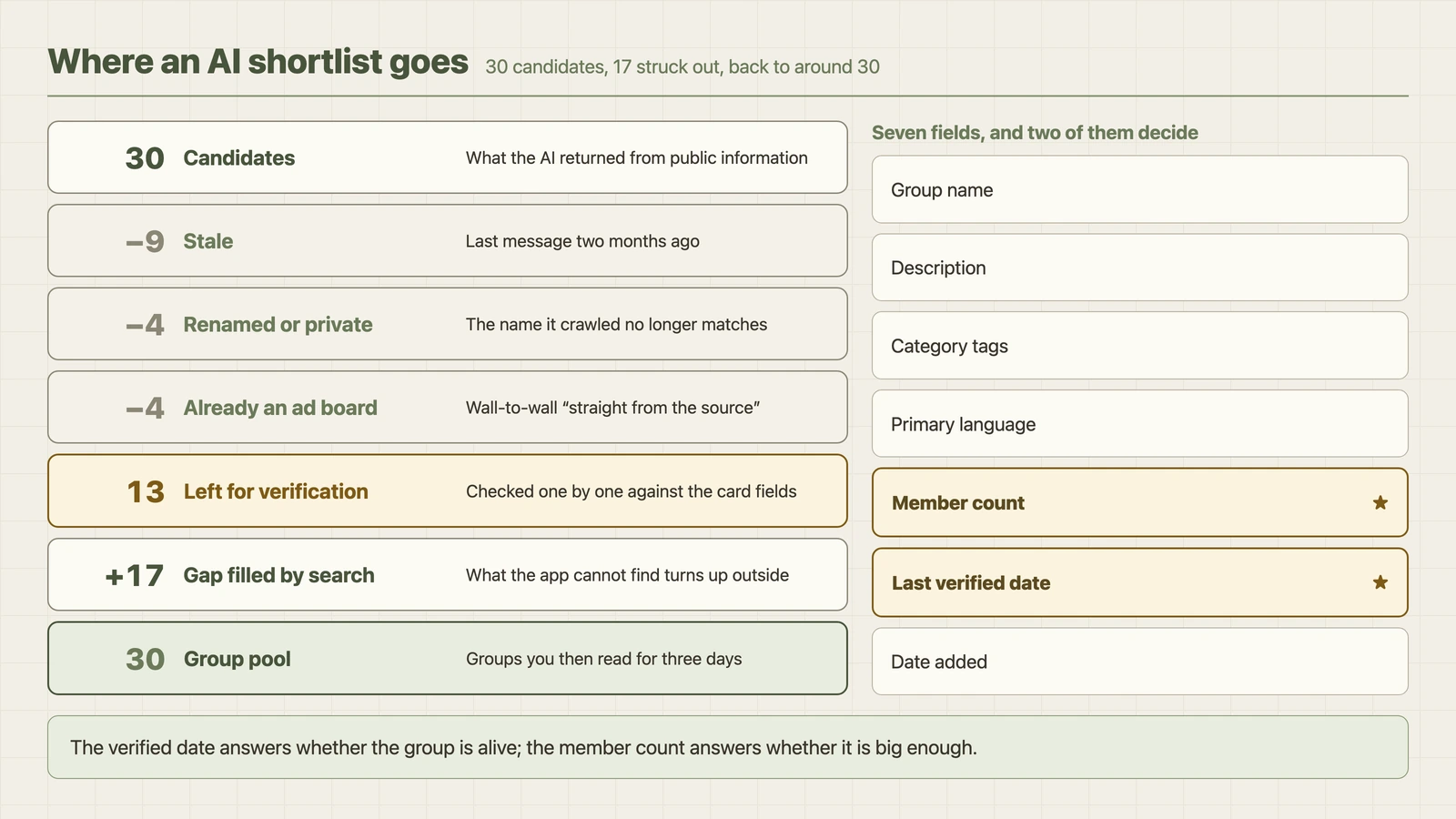 Where a shortlist goes: of 30 candidates, 9 were stale, 4 renamed or private and 4 already ad boards, leaving 13 for verification; on the right are the seven fields, and member count with the last verified date are the two that decide.
The shape of an AI list: sorted by niche, not by activity
Lists like this usually come back in five classes, each mapping to one buying scenario.
- Storefront and platform acquiring: decline rates, getting high-risk categories approved
- Cross-border settlement and local currency payout: multi-currency collection, settlement cycles, getting funds back
- Crypto off-ramp and payment cards: stablecoin off-ramping, whether a crypto card can be used at a specific merchant
- Payment APIs and aggregation gateways: which provider to use, how to integrate, how to bill subscriptions
- Virtual cards and subscription billing: cards for overseas cloud charges, stability of a card range
All five look relevant, but the list will not tell you which of them still has people in it. The AI sorts by words in the group name and description, not by how much the group talks. It ranks relevance, not activity.
That is why the next step is verification rather than a batch of join requests.
Seven fields to verify, and two that decide
In-app search in TOP Prospect does not return a string of group names. It returns a card with fields. The seven fields answer seven questions.
- Group name: is this the kind of group you are after
- Description: what the group is good for and what it is not
- Category tags: tags like #payment #checkout #lang-en; if they do not match, skip it
- Primary language: whether anyone will understand what you say in it
- Member count: whether it is worth writing a dedicated rule set for
- Last verified date: whether the group is still worth entering now
- Date added: how long it has been in the library; older entries tend to be steadier
Two are worth reading first: the last verified date answers “is it still alive”, and the member count answers “is it big enough”.
If the last verified date is on the early side, do not strike the group out immediately. Check whether the description and tags line up, and if they do, keep it, join, and read the last few days of messages yourself. Fields are a sieve, not a verdict.
One line on the card is easy to skip: a search result does not mean you have joined, and does not mean signal collection is switched on. In other words, joining and connecting are two separate things. You join in Telegram first, then sync the group across, and only then does the system start reading its public messages.
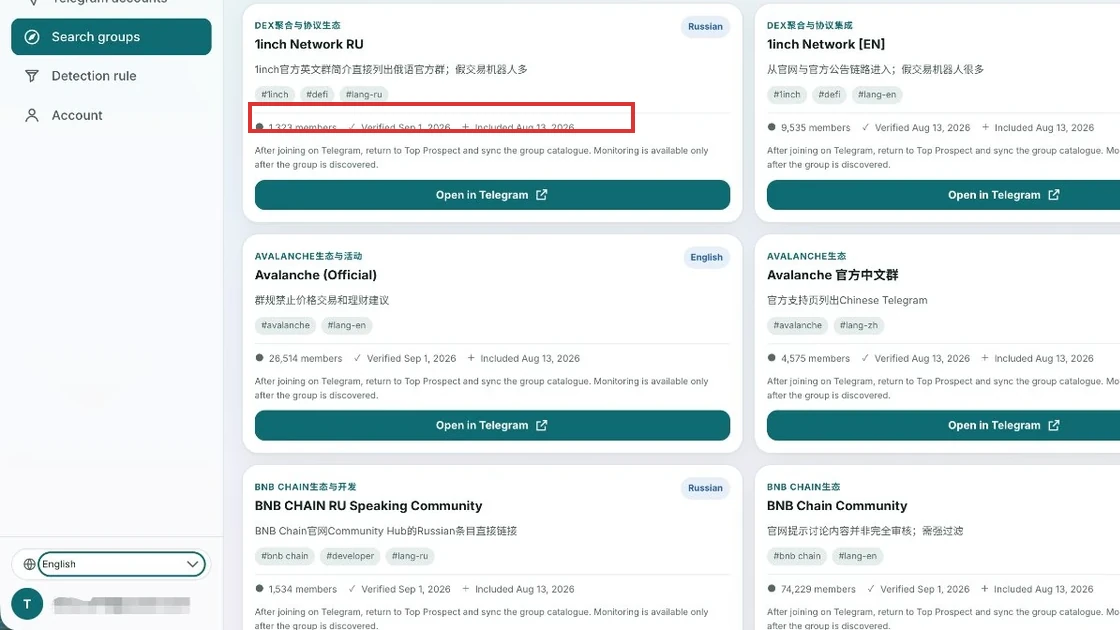 A group card from the TOP Prospect group search page. Member count, last verified date and the date added sit on one line, and the verified date is what tells you whether the group is still usable.
In-app search answers “is this group still there”, external search answers “what is missing”
Once the AI list is screened, run it through in-app search. With a name or a link in hand, search for it and see whether a card comes back. If it does, the group is listed and recently verified, and you can compare the fields directly. If it does not, the group is not in the library yet, and you will need to join it and sync it yourself.
The reverse also holds. In-app search cannot cover everything, since new groups are created on Telegram every day and those are not in the library. That is what the Google and Bing entries are for: the system pre-fills a site-limited query and returns public group links. Whatever in-app search cannot find often turns up here.
The point of this step is not to make the list longer. It is to put back the entries the list could not confirm. Thirty candidates in, seventeen struck out, thirteen left, and external search fills the gap back towards thirty.
Once the pool is set, read for three days before writing rules
With the pool at around thirty, do not rush into setting rules. Spend three days reading only: how people describe their problems, which words they use, and which hours of the day the group is busiest.
Two things are worth noting down in those three days: the words they use for their own problems, and which hours the group is loudest. The first goes into the includes, the second decides what time you open the list the next morning.
Three days later you will have the two things the first two rule lines need. Draw the includes from the wording they actually use, not from your own product name. For cross-border acquiring that usually means declines, checkout page blocked, budget top-up will not go through, withdrawal card will not link, needs itemised statements. Use the exclusions to remove what you do not need: part-time, order farming, free, tutorial, third-party registration, guaranteed approval. The trigger condition goes on the last line: the same account mentioning it twice within 24 hours, or a message collecting three or more replies, before it counts.
Reading without posting for three days has a second benefit. A group you enter without advertising will not remove you within ten minutes the way a posted hook will.
The time arithmetic: the pool takes under 40 minutes, the reading period does not count
The AI assistant step is eight minutes. Verifying thirty entries against seven fields, twenty minutes. Filling the gap with external search, ten minutes. Writing the rules, five. The pool takes under 40 minutes in total.
The three days after that are an observation period. Nobody needs to sit and watch; you read as you pass by.
Compare that with manual searching: four hours a day for a week, trawling, joining and messaging, covering twenty to thirty groups, and ending with a single-digit number of usable groups whose origin nobody can explain. The difference is not diligence. It is whether each group was judged once before you went in.
Judge the groups before you judge the people. Do it the other way round and half your time goes into groups that are already dead.
If your team works in cross-border payments, acquiring or settlement and already uses an AI assistant to find groups, start by running the list through those three void signals, then check what is left against the verification fields in the app. Most of the time you do not need new groups; removing what is already on the list is enough.
To see what the TOP Prospect group search page looks like, visit topprospect.net.
Sources and further reading
How a Signal worth attention is found
See how Top Prospect finds and organizes Signals worth checking, keeps the original Telegram context, removes duplicates, and helps you decide what to review first. You decide whether to follow up and what to do next.