His hook got no replies in 10 minutes, then he was removed from the group. The real sellers were never there
Getting removed for posting hooks and landing in groups full of competitors is not a copywriting problem, it is a pond problem. Judge a group before you join it.
Group names, member counts, invite counts and elapsed times in this article are illustrative scenarios used to explain the screening method. They are not measured results.
At eleven on a Friday night, a BD at a cross-border ecommerce ERP service provider posts this into a Telegram group.
“Just got a SOP working that cut ACOS by 20 percent. Anyone want to see it? 👇” (attached to a blurred screenshot of the numbers)
This is the hook play he learned online. No hard sell, just bait, and let sellers come to him.
He waits ten minutes.
Nothing.
He posts again.
“Put together a 2026 FBA inbound checklist. Drop a 1 if you want it.”
Still nothing.
Then the system shows one line. “You have been removed from this group.”
That is the seventeenth removal this week.
So what went wrong?
It is not that the hook was weak, and it is not that the product is bad. He is standing in the wrong place. The groups he joined are either full of competitors, where everyone posts hooks and nobody reads them, or dead, or simply without sellers in them.
The first step in finding customers is not how to bait the hook. It is where to drop it.
The groups that look like seller groups are traps
Search “Amazon seller” in the Telegram search bar and you get a wall of them.
- “Amazon Sellers Community” with 20,000 members
- “FBA Masters” with 15,000 members
- “E-commerce Experts” with 8,000 members
The numbers look good.
Then you get in and see the reality.
- The first group is 90 percent course sellers and review farmers advertising to each other.
- The second group’s most recent message is a “Good morning” from three months ago.
- The third is service providers sending each other press releases. The actual sellers muted it or left long ago.
Three days, 20 groups joined, not one real seller, and the hook landed on your own foot.
This is not a copywriting problem. It is an information gap. You cannot tell which groups are alive and which are real.
What a real seller group looks like
Here is a side-by-side.
A BD at a cross-border logistics company uses in-app search in Top Prospect and turns up this.
Amazon FBA Sellers [EN]
#amazon #fba #ecommerce #lang-en
12,340 members · Verified Sep 10, 2026 · Indexed Aug 12, 2026
Description: active seller discussion, heavy ad volume, filter it
He looks at the group’s public listing first, then reads through its recent messages.
- “FBA west coast inbound delays are brutal right now, anyone else?”
- “Looking for a reliable overseas warehouse, mostly oversized items.”
- “Our listing got pulled. Anyone have an appeal template?”
That is a real seller group. Real business discussion, real pain, real demand.
He applies and is approved three hours later. Inside, he does not post a hook. He replies to the west coast message.
“We hit the same west coast delay and moved to a different channel. Which port are you running through now?”
The other person messages him straight away. A week later that person forwards his logistics proposal to their procurement team.
The question is not how good the hook is. The question is whether there are fish in the pond.
How to find 200 ponds like this in three days
This is what the search groups feature in Top Prospect is for. It offers four search entries that turn group sourcing from guesswork into a process.
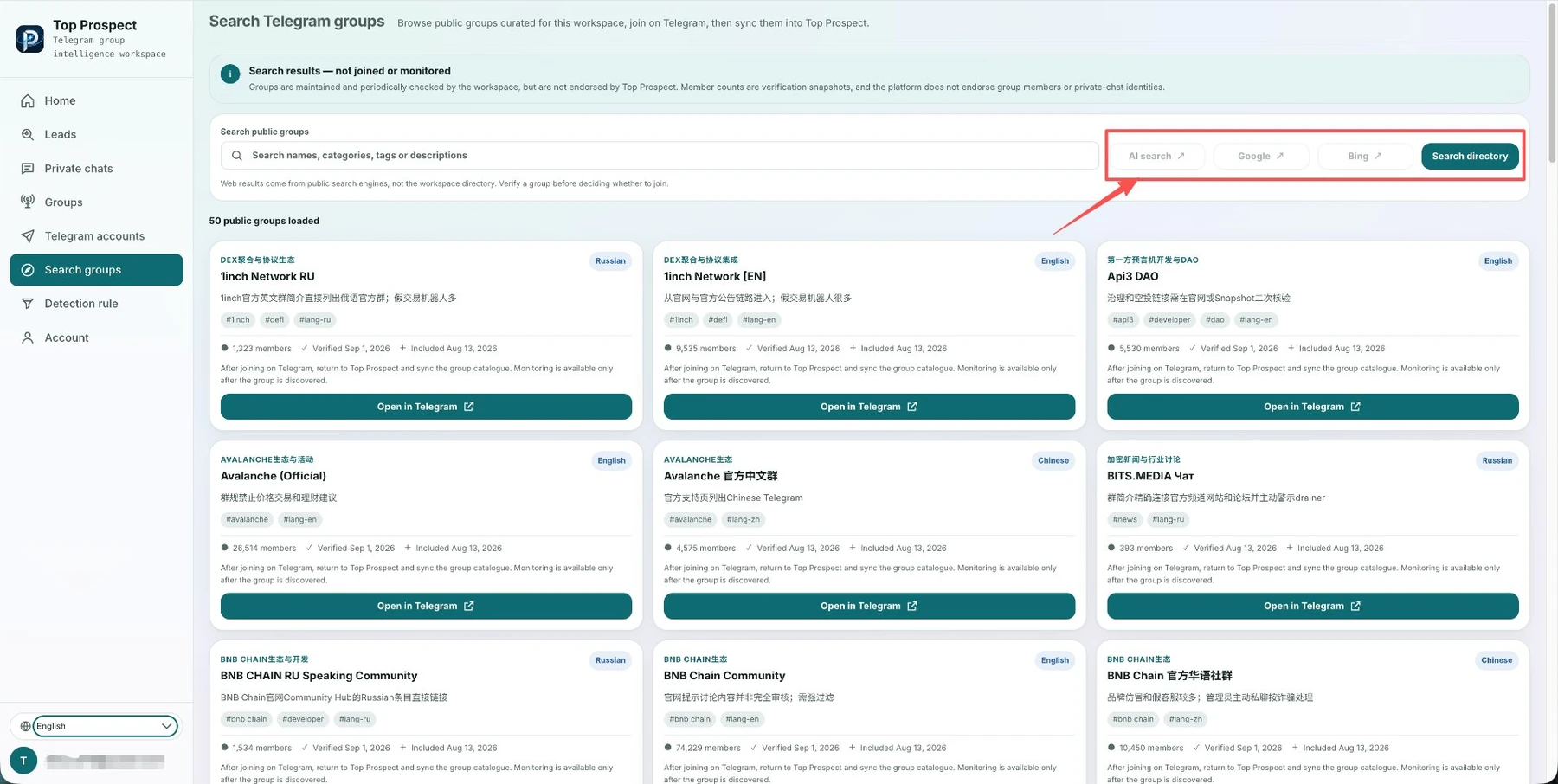 This is the search groups page in Top Prospect as well. Four entries line up to the right of the search box, and one screen down is the list of indexed public groups, each card showing how many members it has and when it was last verified.
1. In-app search. A map instead of blind applications
When you search “Amazon seller” in Top Prospect, what comes back is not a bare list of names but structured data with tags, member counts and activity.
You can filter by tag, language and activity.
- Language set to English, to match your target market
- Tags such as #amazon, #fba and #ecommerce
- Activity set to groups with movement in the past week, which rules out the dead ones
What it gives you: no more applying one by one to find out. The indexed groups are already separated out.
2. AI search. Finding groups whose names do not match
Plenty of good seller groups are not called “Amazon seller”. They are called “Q4 peak season sprint” or “cross-border money talk”. Keywords will never reach them.
That is the job of AI search. You describe the intent directly.
“I want seller groups discussing Amazon FBA inventory management and west coast warehouse loss claims. English preferred, no beginner groups.”
AI search is wired to an external semantic search engine. It reads what you are actually asking for instead of matching keywords. Groups whose names contain nothing relevant but whose discussion matches your requirement are exactly what it surfaces.
3. Google and Bing. Catching what the index missed
In-app search and AI search cover groups Top Prospect has already indexed. Telegram has tens of thousands of cross-border groups and some are too new to be in any index.
Click Google search and the system pre-fills the operator: site:t.me "Amazon seller" FBA.
Google returns links to public Telegram groups.
Bing search works the same way, but Bing indexes Telegram differently and regularly picks up groups Google missed.
What it gives you: once you find these outside groups, join them manually, then bring them back into Top Prospect to sync and turn on signal collection.
The efficiency ledger. From trawling to targeting
Two workflows over three days, side by side.
Mass joining, three days
- Time: four hours a day, twelve hours total
- Groups searched or joined: 20
- Approval rate: about 20 percent
- Useful groups: 0 to 1
- Leads: entirely luck dependent, unpredictable
Precise group search, three days
- Time: four hours a day, twelve hours total (one hour filtering, three hours following up)
- Groups found: 200 or more across the four entries
- Groups joined after filtering: 40 (only indexed, tagged and active ones)
- Approval rate: about 75 percent
- Useful groups: 30
- Leads: collected systematically, predictable and reusable
Where the difference sits
- Time efficiency: the same hours produce far more groups worth joining, and you know before joining whether a group is worth it
- Lead quality: member count, language and last verified time are visible up front, so you walk into far fewer dead groups and ad groups
- Reusability: the method turns into a team SOP, while mass joining makes the next person start over from the same mistakes
What the search groups feature is actually for
The search groups feature in Top Prospect is not there to hand you more groups. It is there to:
- Save you time: no more trawling Telegram and getting removed
- Raise your hit rate: only apply to groups with real customers and real discussion
- Give you a system: turn random joining into a repeatable process
The only goal is to help you find customers.
If your team sells into the Telegram ecosystem as a cross-border ecommerce service provider, whether that is ERP, logistics, payments or SaaS, and you are spending hours a day posting hooks, getting removed and seeing zero conversion, Top Prospect can locate and verify the right seller groups for you through four search entries.
To see how Top Prospect turns group sourcing from guesswork into a repeatable system, visit topprospect.net.
Sources and further reading
How a Signal worth attention is found
See how Top Prospect finds and organizes Signals worth checking, keeps the original Telegram context, removes duplicates, and helps you decide what to review first. You decide whether to follow up and what to do next.