Cybersecurity vendor prospecting: 8 emergency jobs sorted out of 4 in-group breach asks — copy the filter
Customers hit by a breach never publish a tender; they shout that a server looks wrong. Three of four in-group distress messages are real buying intent, and one question separates them from noise (illustrative example).
Consider two moves (illustrative example):
A security firm’s marketing lead posts an incident response service introduction in a technical group, credentials and case studies included. No replies.
The same afternoon, an e-commerce engineering lead posts: “Our server bill tripled overnight. Can anyone help me figure out what this machine is connecting to?” Three direct messages within twenty minutes, all from security vendors.
The difference? The service intro arrived when nobody in the group had an incident. The question arrived while someone did.
Emergency work isn’t negotiated into existence. It’s shouted aloud the moment a customer breaks. One security firm switched from posting service intros to watching for these requests, and closed 8 emergency jobs in a week (illustrative example). This article is about telling a genuine cry for help from a passing remark.
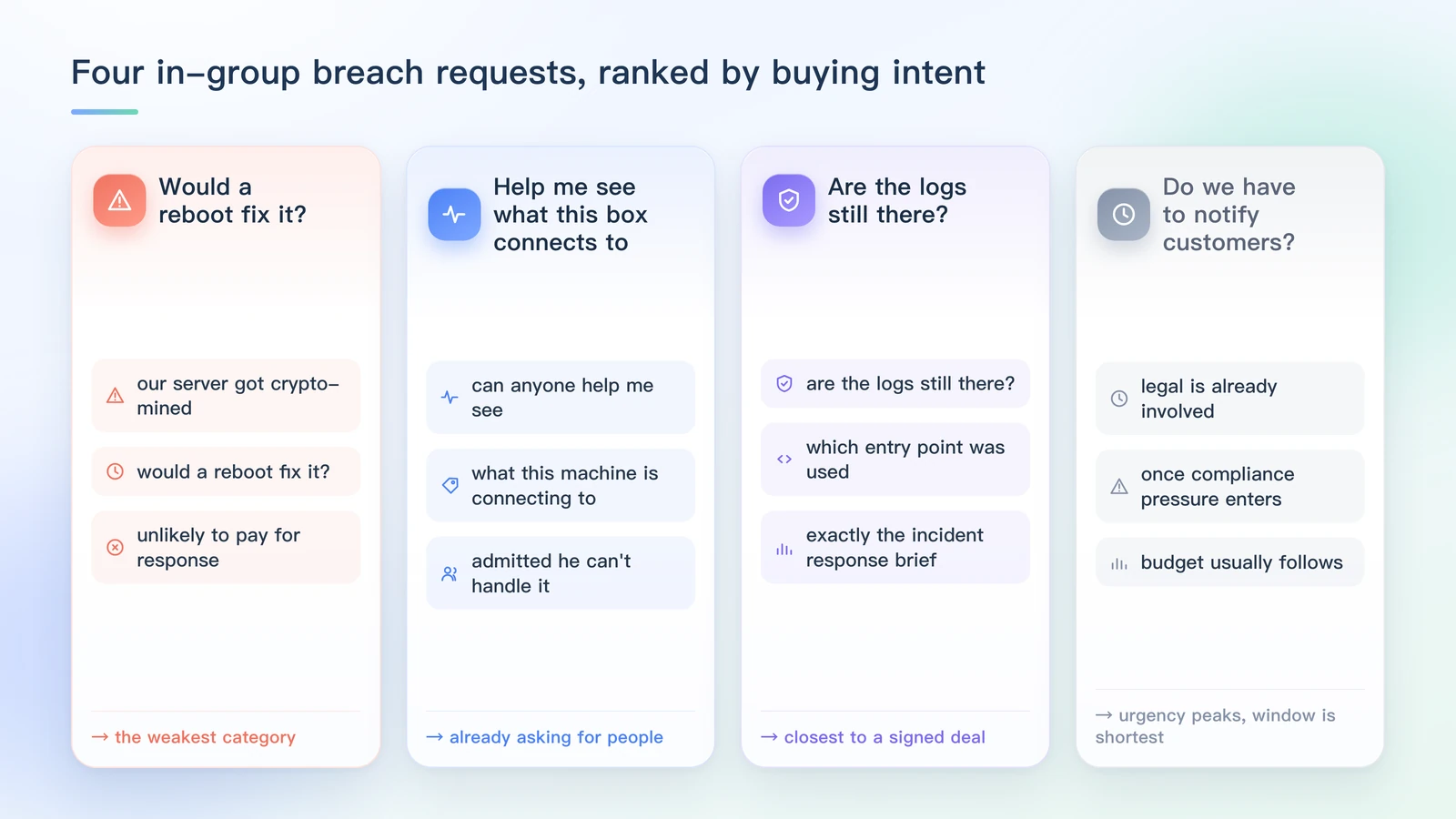
1. Four ways an incident gets described, and only three are buying intent
A customer’s first reaction after a breach is to find a person or a group, not a tender. But the same “we got breached” carries very different buying intent depending on how it’s phrased.
1. “Would a reboot fix it?”
“Our server got crypto-mined — would a reboot fix it?”
The weakest category. He is still working it out himself and is unlikely to pay for response. Don’t pitch yet; note the message and watch how he follows up.
2. “Can anyone help me see what this box is connecting to?”
“Can anyone help me see what this machine is connecting to?”
He is already asking for people, which means he has admitted he can’t handle it. Reply with something immediately actionable — which ports to check first, why not to delete files yet — and he will remember you.
3. “Are the logs still there? Can the attack path be reconstructed?”
“Are the logs still there? I want to know which entry point was used.”
This is the real dividing line. Asking about logs, attack paths and root-cause framing means he doesn’t want “clean it up”, he wants “tell me what happened”. That is exactly the incident response brief, and the closest thing to a signed deal.
4. “Do we have to notify customers? Legal is already involved”
“Data may have leaked. Do we have to notify customers? Legal is already involved.”
Once compliance pressure enters, budget usually follows. Urgency peaks and the window is shortest — after legal steps in, the customer starts judging whether you can deliver a report inside the deadline.
The test isn’t how big the incident is, it’s how deep the customer has asked. Asking whether a reboot is enough stops at layer one; asking about logs and root cause has already walked up to you.
2. Where breach signals surface
Affected customers don’t sit in “security vendor networking” groups — those are industry gatherings. They stay in their own circles (illustrative example): cross-border e-commerce engineering groups, independent-store operations groups, SaaS engineering groups, Web3 project groups and cloud provider user communities.
To find them, use Top Prospect. It turns search into four entries: AI search, Google, Bing and the built-in group library (currently showing 50 public groups loaded). AI search takes plain language, so you can type “Telegram groups where cross-border e-commerce engineering leads gather” without assembling keywords.
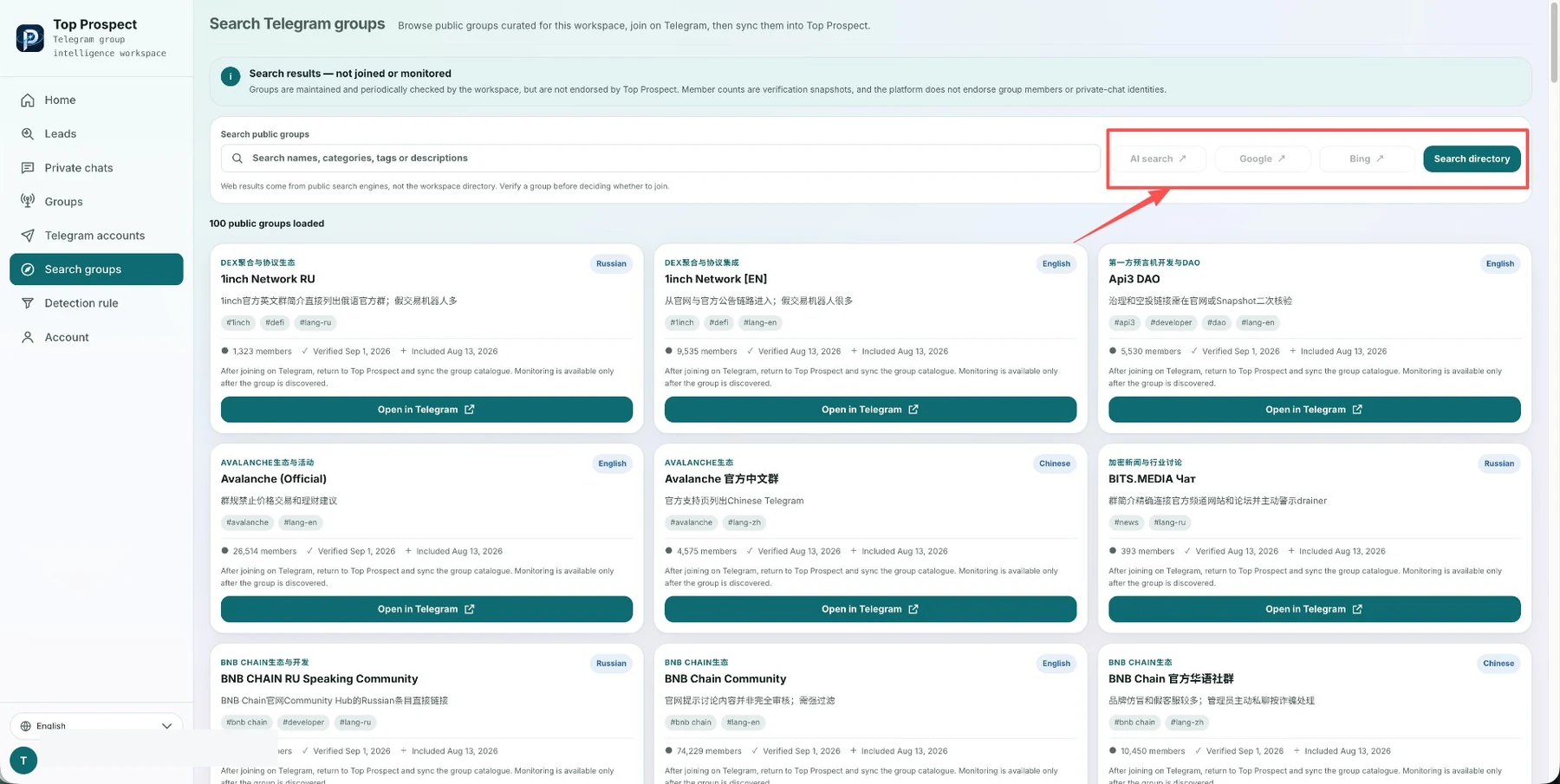
Each result card gives the group name, description, category tag, primary language, member count, last verified date and date added. Screen on two criteria: primary language has to match the coverage you can actually deliver (if you take English tickets, keep English groups), and member count should stay modest — in a technical group of a few hundred, people really do speak up when something breaks.
Don’t read a result as a membership. As the results page puts it, a match doesn’t mean the group has been joined, doesn’t mean collection is enabled, and isn’t an endorsement by the platform. Joining stays manual, one group at a time.
3. Turn breach requests into a rule — what 2 hours buys you
An active technical group runs several hundred messages a day, and nine out of ten are architecture debates, configuration questions and cloud-vendor complaints. Real requests are mixed in, and the window is short: from the first message to picking a vendor, a breached customer may only have a few hours.
Hand this step to recognition rules. Building one in Top Prospect doesn’t require expressions — it’s a conversation: are you looking for clients or suppliers, what do you provide, which clients matter most, what problems do they usually hit, what conditions matter most, and where are you targeting. An incident response team fills in: clients; compromise assessment and incident response; engineering leads asking about logs, attack paths and root cause; response speed as the priority; global.
Bind the rule to your groups and it runs on its own, with hits scored and listed. The Groups page also lets you set a check frequency per group, from 15 minutes to 12 hours, so technical groups run at the shortest interval and the rest relax.
Rules only surface the messages. They don’t decide whether this person is a real customer, and they don’t judge how severe the incident is — that stays human work, and it has to be done within two hours, because that’s how long the window lasts.
4. What your first message should do
With a top-scored request, your first message does exactly one thing: answer the question he is most anxious about. Someone who just got breached has no patience for a company introduction — he wants to know what to do now.
For a crypto-mining infection, give him the order of operations: isolate outbound traffic first, preserve evidence second, kill processes last. Get the order wrong and the evidence is gone.
For a suspected leak, ask how long logs are retained and whether auditing was ever enabled. Those two answers decide whether a report can exist inside the deadline.
Don’t quote a price in the first message. Emergency pricing only becomes discussable once you’ve proven you understand the problem in front of him.
Closing: What actually needs automating isn’t finding groups — it’s finding opportunities
Finding 100 Telegram groups does not mean finding 100 customers. What matters is this: continuously discovering the demand currently happening inside those groups. AI can widen your search quickly and surface more potential communities; Top Prospect turns those communities into a lead pool you can keep watching: find groups → verify → monitor → discover signals → human judgement → follow up That way BD doesn’t have to repeat searching, joining and scrolling every day, and can spend time on the parts that genuinely need a person — judging opportunities, making contact and moving deals forward. For B2B businesses in cross-border finance, AI APIs, Web3, SaaS and cross-border e-commerce, Telegram isn’t just another community channel. It can be an open market that keeps producing demand signals. What Top Prospect does is turn those scattered signals into opportunities you can follow up.
Frequently asked questions
Is 'our server got crypto-mined' a qualified lead?
It's a weak signal. What matters is what follows: if he asks whether rebooting is enough, he probably won't buy. If he asks about logs and attack paths, he is buying incident response.
Why does posting a service list in technical groups do nothing?
Someone who just got breached needs a person to catch him, not a capabilities deck. Answering his most urgent question first — are the logs still there, should we cut the network — beats any credential.
How many emergency messages show up per day?
Technical communities see scattered requests constantly, but only a minority carry buying intent. Manual scrolling misses and lags; turn 'are the logs still there' into a rule and read only the top-scored hits.
Sources and further reading
This article is human-authored. TOP Prospect processes only Telegram groups the user has explicitly authorized and connected. Its output supports human sales judgement; it does not replace human decisions and does not automatically contact or message group members.
How a Signal worth attention is found
See how Top Prospect finds and organizes Signals worth checking, keeps the original Telegram context, removes duplicates, and helps you decide what to review first. You decide whether to follow up and what to do next.