ASO agency prospecting: find 40 studios in 3 days off 4 stalled-keyword complaints — copy the search
After user-acquisition costs jumped 20%, studios decide to change ASO vendors in a group chat, not a tender. Four 'our keywords stalled' complaints hold the buying window, two weeks before any app-store ranking report shows it (illustrative example).
Consider two moves (illustrative example):
A mobile game studio watches user-acquisition costs climb 20% in two months and its ranking slip past 200 for the third day running. The person in charge asks a developer group: “Anyone know a solid ASO team?” Eleven direct messages arrive within two hours.
In the same group, an agency is still posting “traffic wanted, installs wanted, reviews wanted” three times a day. Nobody replies.
The difference? When the agency posted, the studio was not thinking about switching. When the studio asked, the buying window was already open.
Nobody negotiates a studio into changing ASO vendors. The studio says it out loud in a group first. One user-acquisition agency stopped blasting case studies and started searching groups for stuck keywords instead, screening 40 studios actively shopping for ASO help in 3 days (illustrative example). This article breaks down that single habit.
1. Studios never issue a tender, but they say these four things
Changing ASO vendors is a low-barrier decision. You don’t rebuild the product, but you do rerun keyword research and rewrite the store page. So a studio asks around before it commits.
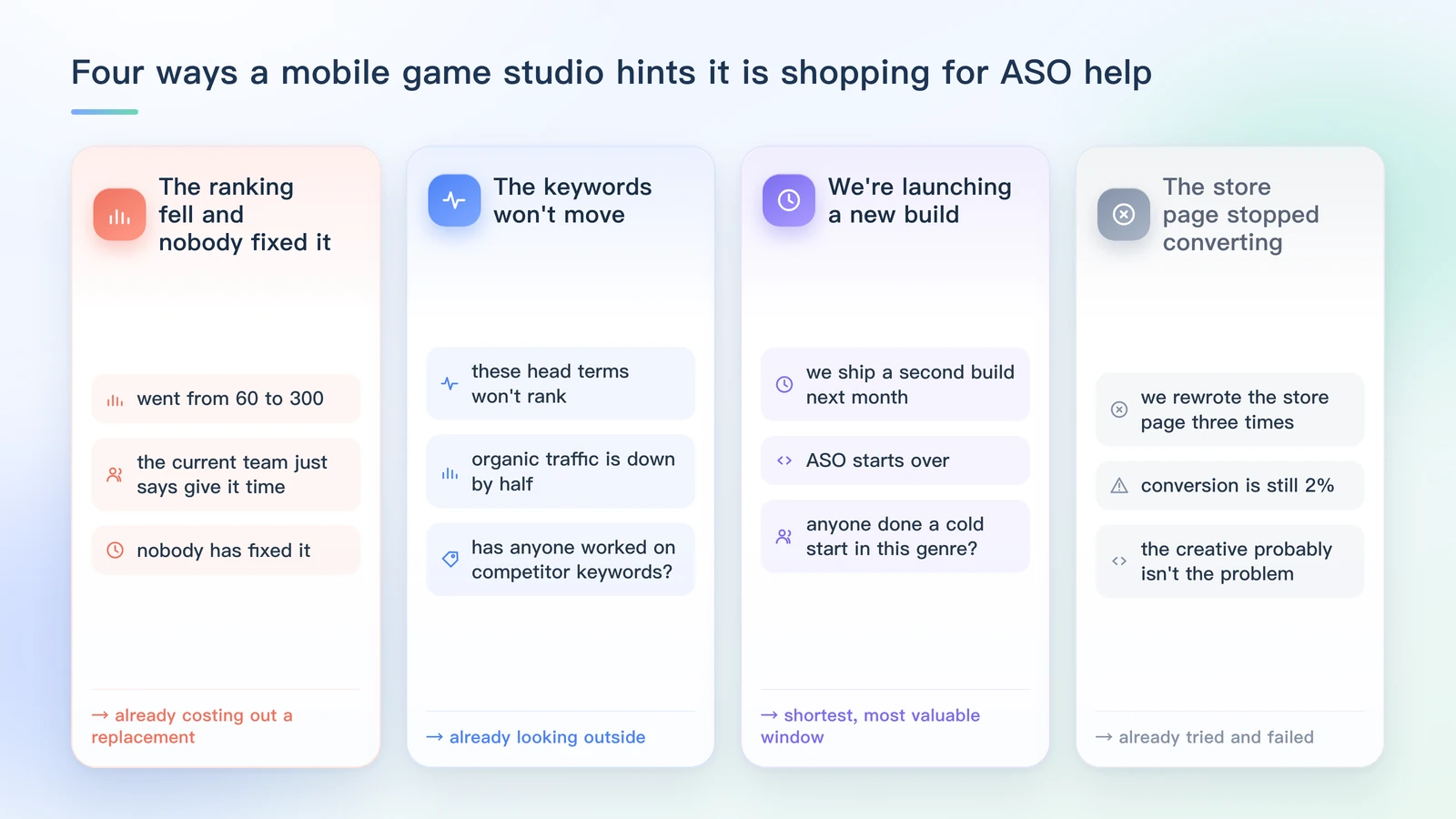
There are four ways it asks.
1. “The ranking fell three days ago and nobody has fixed it”
“Our ranking went from 60 to 300 and the current team just keeps saying give it time.”
The drop is the outcome; the tone is the signal. “Nobody has fixed it” means he is already costing out a replacement.
2. “The keywords won’t move”
“These head terms won’t rank, organic traffic is down by half — has anyone worked on competitor keywords?”
Keywords are where ASO lives or dies. The moment a studio asks who handles competitor or long-tail keywords, it is already looking outside.
3. “We’re launching a new build and starting from zero”
“We ship a second build next month and ASO starts over — anyone done a cold start in this genre?”
A launch date is a hard deadline. This window is the shortest and the most valuable: he doesn’t want advice, he wants someone who can stand up a keyword library before launch.
4. “The store page stopped converting”
“We rewrote the store page three times and conversion is still 2%. The creative probably isn’t the problem.”
The most common one. A studio only hands this out after several failed attempts of its own. What you’re taking on isn’t “rewrite our creative” — it’s “tell us where the problem actually is”.
All four share one trait: plain natural language, buried in chat history, with no brief, no purchase order and no email anywhere.
2. Where mobile game studios actually speak up
Studios don’t hang out in “go-global resource matchmaking” groups — those are agency conference rooms. They stay in their own circles (illustrative example): indie developer groups, developer discussion groups, genre groups (match-3, strategy, casual each have their own), and user-acquisition discussion groups.
To find them, use Top Prospect. It turns search into four entries: AI search, Google, Bing and the built-in group library (currently showing 50 public groups loaded). AI search takes plain language, so you can type “Telegram groups where Chinese mobile game developers gather” without assembling keywords.
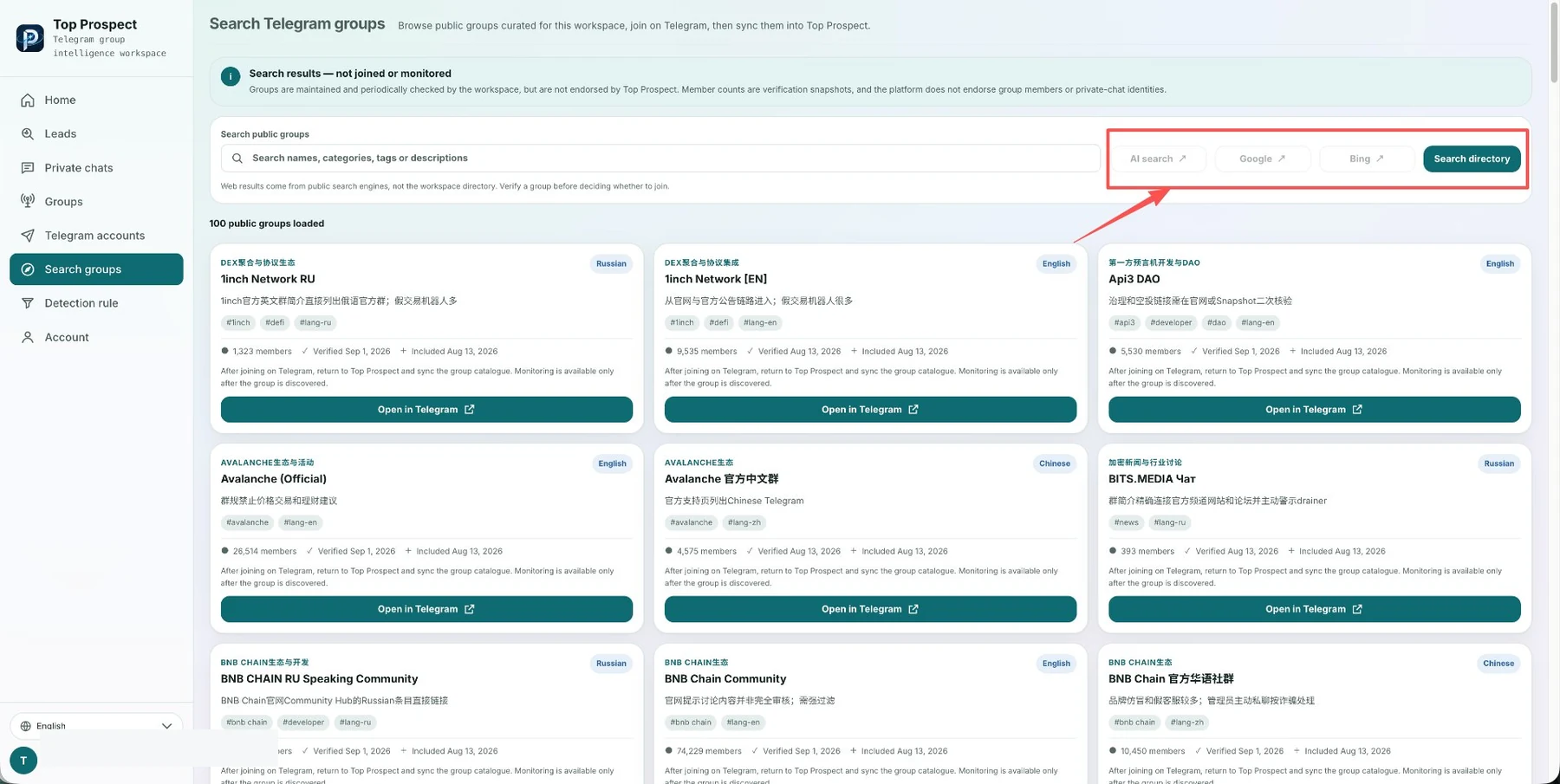
Each result card gives the group name, description, category tag, primary language, member count, last verified date and date added. Screen on two criteria only: primary language has to match your market (going after Western markets means keeping English groups), and member count should stay modest — a developer group of one or two hundred beats a ten-thousand-member firehose.
A hit in the list isn’t an added group. The results page says so plainly: a match doesn’t mean the group is joined, doesn’t mean collection is on, and isn’t a platform endorsement. Adding groups is still manual, one by one.
3. Turn “the keywords won’t move” into a rule
Adding groups is only the start. An active developer group runs several hundred messages a day, and nine out of ten are pleasantries, screenshots and noise. The real buying signals are mixed in. Manual monitoring dies two ways: you can’t keep up, or you quit on day three.
Hand this step to recognition rules. Building one in Top Prospect doesn’t require expressions — it’s a conversation: are you looking for clients or suppliers, what do you provide, which clients matter most, what problems do they usually run into, what conditions matter most, and where are you targeting. An ASO team fills in: clients; keyword optimization and store-page conversion; studios complaining about falling rankings, stuck keywords and new-build cold starts; launch timing as the priority; global.
Bind the rule to your groups and it runs on its own, with hits scored and listed. The Groups page also lets you set a check frequency per group, from 15 minutes to 12 hours, so core developer groups run at the shortest interval and the rest relax.
Rules are not magic. A top score only means “probably” — whether it’s a real opportunity and whether you should take it stays a human call. What the rule saves you is the time spent scrolling hundreds of messages, not the client conversation.
4. What the new rhythm looks like
The first three days can go like this (illustrative example):
Day one: search and screen groups. Keep 10 with a high concentration of mobile studios using the two criteria above, and join them one by one.
Day two: configure recognition rules for those groups, targeting falling rankings, stuck keywords and new-build cold starts.
Day three onward: review the hit list each morning and, for the top-scored studio, open with the thing he is complaining about — a ranking drop gets competitor-keyword coverage, a new build gets how to build a keyword library before launch.
Between “case studies nobody answers” and “40 studios hunting for ASO help in 3 days” the difference isn’t copywriting. It’s being present at the moment someone speaks up. The method is one move: swap the time you spend sending case studies and prices for searching groups, building rules and reading hits.
Closing: Stop treating Telegram as a “group-joining channel”
A lot of BD teams still approach Telegram like this: find groups → join groups → wait for clients to appear. The problem is that clients don’t show up just because you joined a group. What’s actually worth watching is the small daily movement inside those groups: someone starts looking for a supplier; someone asks about alternatives; someone complains about their current product; someone states an explicit purchasing need; someone is looking for an answer before their next decision. Those are the signals worth following. So instead of spending hours a day hunting for “more groups”, build a system that keeps finding demand signals for you. Groups are the doorway; signals are the leads. That is the step Top Prospect exists to solve.
Frequently asked questions
I sell user acquisition, not ASO. Does this apply to me?
The words differ, the mechanics don't. User acquisition reps watch for 'the numbers don't add up', 'the agency cut back', 'nobody can handle our scale'. ASO reps watch rankings, keywords and store-page conversion. Studios gather in the same groups — you just learn your own complaint.
Why does posting case studies and prices in developer groups get ignored?
Until a studio is ready to rebuild its keyword library, a case study is just an ad. Once someone asks who handles competitor keywords, he compares whoever answers his actual problem first — falling rankings get competitor-keyword coverage talk, a new build gets pre-launch keyword planning.
How much can one person realistically read?
Manual scanning doesn't scale, which is why most reps quit after three days. Hand the filtering to recognition rules, read only the top-scored hits, and the daily review stays under half an hour.
Sources and further reading
This article is human-authored. TOP Prospect processes only Telegram groups the user has explicitly authorized and connected. Its output supports human sales judgement; it does not replace human decisions and does not automatically contact or message group members.
How a Signal worth attention is found
See how Top Prospect finds and organizes Signals worth checking, keeps the original Telegram context, removes duplicates, and helps you decide what to review first. You decide whether to follow up and what to do next.