Freight forwarder sales: one search habit took my inquiries from 3 a week to 7 a day
Blasted rate sheets get read and ignored. The inquiries freight forwarder sales teams chase live in sellers' Telegram messages about rollovers, surging rates and tight space. One forwarder rep changed only his group-search habit and went from 3 inquiries a week to 7 a day (illustrative example).
Consider two moves (illustrative example):
One forwarder drops the same full-container rate sheet into a third seller group with a cheerful “reach out anytime.” Nobody replies.
Later that day, in the same group, a seller posts: “Carrier rolled our containers again and we’ll miss the launch date — anyone have backup space?” Seven replies underneath, most of them rival forwarders.
The difference? The replies showed up while the need was on the table. The rate sheet arrived when nobody was thinking about switching forwarders.
Inquiries are not “reached out to” into existence. Sellers say them out loud in groups. Some forwarders make exactly one change — from blasting rate sheets to searching and watching groups — and their inquiries go from 3 a week to 7 a day (illustrative example). Here is the whole playbook.
1. Sellers never announce they’re switching. They just talk about it
Switching forwarders is expensive: renegotiating rates, re-testing lanes, re-integrating. Nobody moves without pressure, and every moment of pressure produces a message.
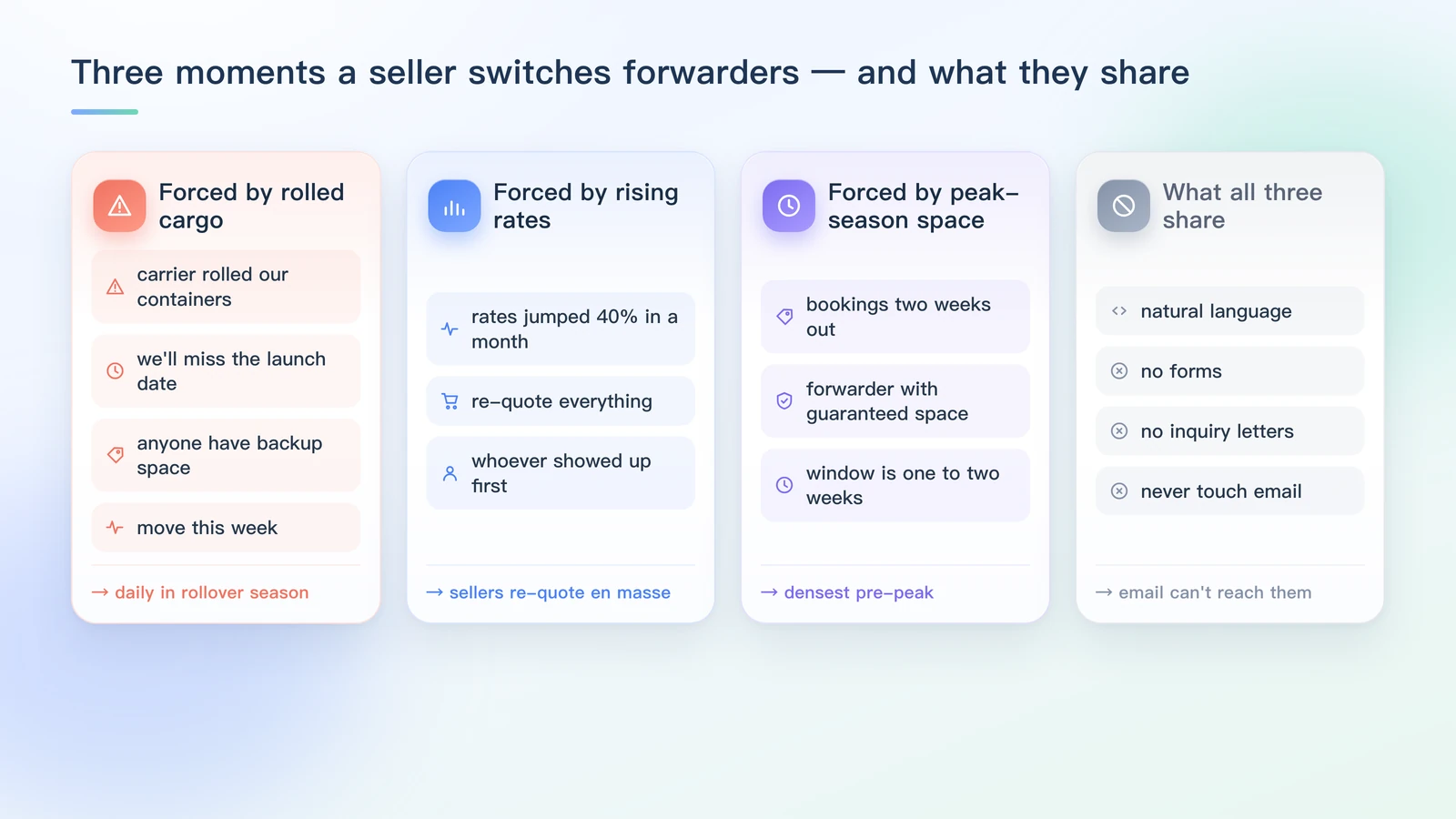
Three moments matter, and each one comes with its own script.
1. Forced by rolled cargo
“Carrier rolled our containers again and we’ll miss the launch date — anyone have backup space?”
In rollover season these messages appear daily. The seller doesn’t want the lowest rate right now; he wants this shipment to move this week. Whoever answers that sentence first wins the booking.
2. Forced by rising rates
“Lane rates jumped 40% in a month. Finance wants me to re-quote everything.”
When rates swing hard, sellers re-quote en masse. This is the one moment a rate sheet actually gets read — but he compares whoever showed up first, not whoever has the prettiest PDF.
3. Forced by peak-season space
“Bookings for next month are already two weeks out. Anyone know a forwarder with guaranteed space?”
Space complaints are the densest pre-peak switching signal. By the time a seller asks out loud, the window is often one to two weeks.
All three signals are natural language buried in chat history — no forms, no inquiry letters. That’s exactly why email marketing can’t reach them: they never touch email.
2. Search where the sellers actually are
Sellers don’t hang out in “logistics groups” — those belong to forwarders themselves. They gather in their own circles (illustrative example): Amazon seller groups, DTC (direct-to-consumer) brand groups, and category groups for furniture, small appliances, auto parts and so on.
Search these groups with Top Prospect. It runs four search entries in parallel: AI search, Google, Bing and an on-site group library (the library already loads 100 public groups). AI search takes plain sentences like “Telegram groups where cross-border sellers gather,” so there’s no keyword puzzle to solve.
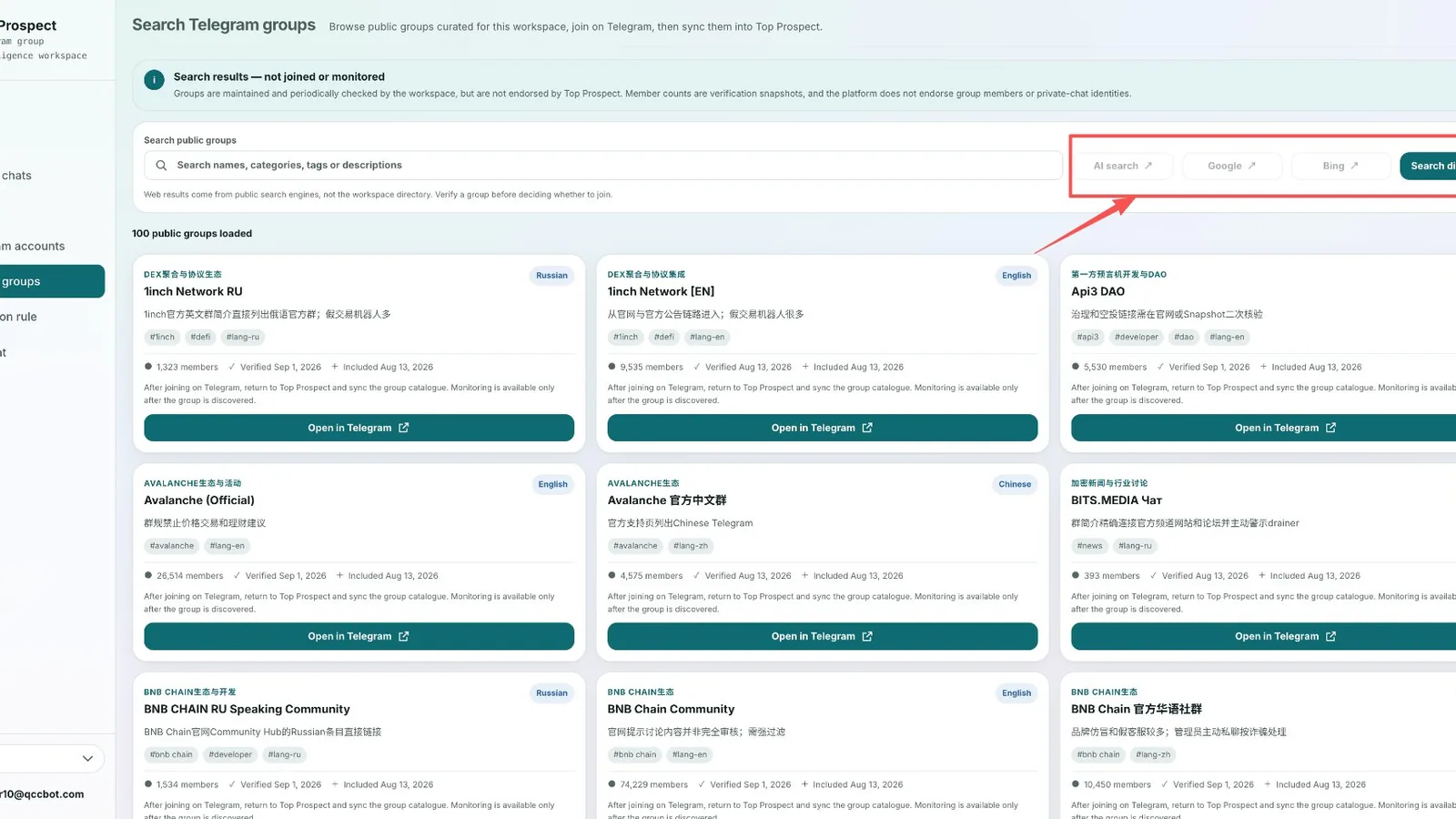
Each result card lists the group name, description, category tags, primary language, member count, last verification time and indexing time. Two filters matter: the primary language must match your lanes (English groups for US/EU trade), and don’t chase member counts — a 300-person seller group beats a 100,000-person water cooler every time.
Searching is not joining. The results page says it plainly: results don’t mean you’ve joined or that collection is enabled, and there’s no endorsement from the platform. You still join each group yourself. That step can’t be skipped, and shouldn’t be.
3. After joining dozens of groups, stop reading them by hand
Searching is step one. What actually moves the inquiry numbers is how you watch the groups afterwards.
An active seller group produces hundreds of messages a day, nine-tenths small talk and haul screenshots. Reading by hand has two failure modes: you drown, or you quit on day three.
Hand that job to recognition rules. In Top Prospect you don’t write expressions — a guided conversation asks: customers or suppliers? What do you sell? Which customers matter first? What problems do they usually hit? Which conditions matter most? Which regions? For an ocean-freight forwarder the answers are: customers; ocean freight and FCL (full container load); sellers complaining about rolled cargo, rate spikes and booking backlogs; transit reliability and space guarantee above all; US and EU lanes.
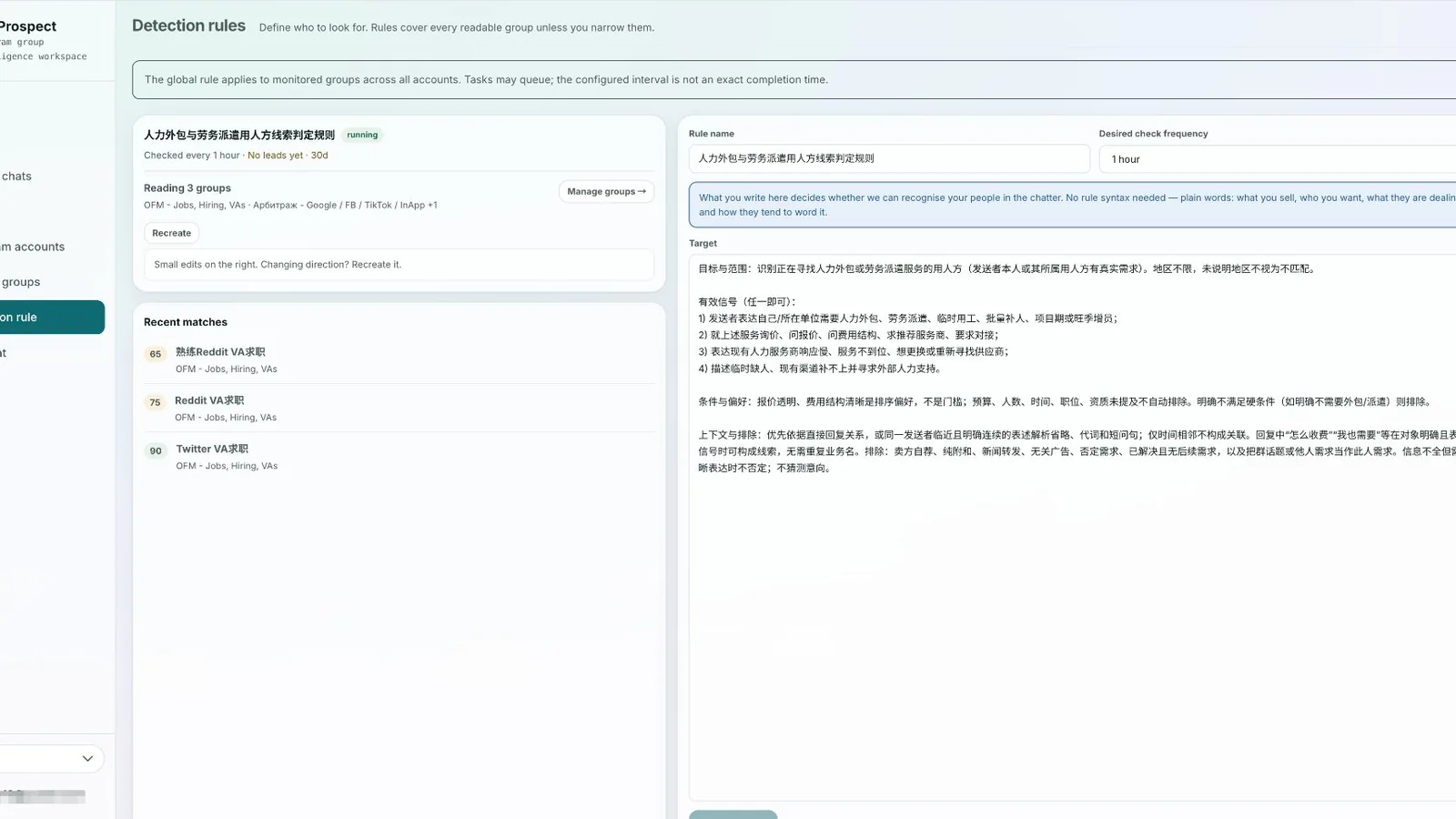
Once saved, the rule runs on the groups you bind it to, and hits land in a scored list. In group management you can also set a per-group check frequency from 15 minutes to 12 hours — peak-season core groups run at the shortest interval, the rest are relaxed.
Rules aren’t fortune-tellers. A top score means “worth a look”; whether it’s a real opportunity and what to quote is still human judgment. The tool saves you the reading, not the selling.
4. What the new rhythm looks like
Here is the three-day routine (illustrative example):
Day 1: search and filter groups, keep the 10 with the highest seller density, join them one by one.
Day 2: bind recognition rules to each group, watching for rollover, rate and space signals.
Day 3 onward: read the hit list every morning. For top-scored sellers, open with the exact problem they’re complaining about — backup space for rollovers, contract rates for spikes. No blasts, no rate-sheet openers.
The distance between 3 inquiries a week and 7 a day isn’t a script. It’s showing up the moment a seller speaks. The whole method is one habit: trade the time you spend blasting rate sheets for searching, setting rules, and reading hits.
Closing: let BD spend time on follow-ups, not scrolling
A BD’s most expensive resource isn’t the Telegram group. It’s time. If every day still burns hours on:
- searching for new groups
- verifying which groups are worth anything
- scrolling hundreds of history messages
- hunting keywords by hand
- copy-pasting potential leads
then the time actually spent talking to customers keeps shrinking. The saner split is to hand the repetitive part to the tool: AI finds the groups, Top Prospect builds the pool and monitors it, signals pinpoint the demand, humans judge and follow up. A tool shouldn’t decide “is this person a customer” for the BD. What it should do is: put the message worth reading in front of you at the right moment. That’s the problem automation was supposed to solve.
Frequently asked questions
I sell air freight and express consolidation, not ocean freight. Does this still work?
The method is identical; only the keywords and signals change. Air freight tracks urgency and deadlines, express tracks minimum volumes and rate programs. The seller groups are the same pools.
Why not just post my rate sheet in the group?
A seller who isn't switching forwarders reads it as spam. One who is switching compares whoever shows up first with an answer to his actual problem — rolled containers get backup space talk, rising rates get contract talk. Solve first, quote second.
How much time does monitoring take every day?
Manual reading doesn't scale, which is why most reps quit after three days. Hand the filtering to recognition rules and read only the top-scored hits; the daily review takes under half an hour.
Sources and further reading
This article is human-authored. TOP Prospect processes only Telegram groups the user has explicitly authorized and connected. Its output supports human sales judgement; it does not replace human decisions and does not automatically contact or message group members.
How a Signal worth attention is found
See how Top Prospect finds and organizes Signals worth checking, keeps the original Telegram context, removes duplicates, and helps you decide what to review first. You decide whether to follow up and what to do next.