Game UA agency clients aren't in networking groups: watch for 3 agency-switch complaints
In a 500-member overseas networking group, almost every "looking for traffic" post came from agencies themselves. Real budget lives in developer groups — three agency-switch signals, where they surface, and how to qualify before reaching out.
I counted one 500-member “overseas networking group” for a week: 23 messages containing “looking for traffic” or “looking for an agency”, of which 20 came from fellow agencies and 3 from middlemen relaying deals (illustrative example). Game teams with real budgets: zero.
They weren’t silent. They were in a group you don’t know about, complaining about their current agency.
1. Networking groups are the industry’s meeting room
The words “resources and networking” attract the supply side by design. Agencies looking for clients, service providers looking for clients, middlemen looking for both ends — everyone is searching, and the people paying are nowhere to be seen.
Game team leads don’t post budgets in networking groups. Buying media is a specific business: genre, geography, payment terms, data ownership — none of it belongs in front of a few hundred competitors. They prefer asking around privately in their own circles, or — when they’ve had enough — venting a few sentences in a developer group.
Those vents are exactly what a UA agency should be watching.
2. How clients actually talk: three agency-switch signals
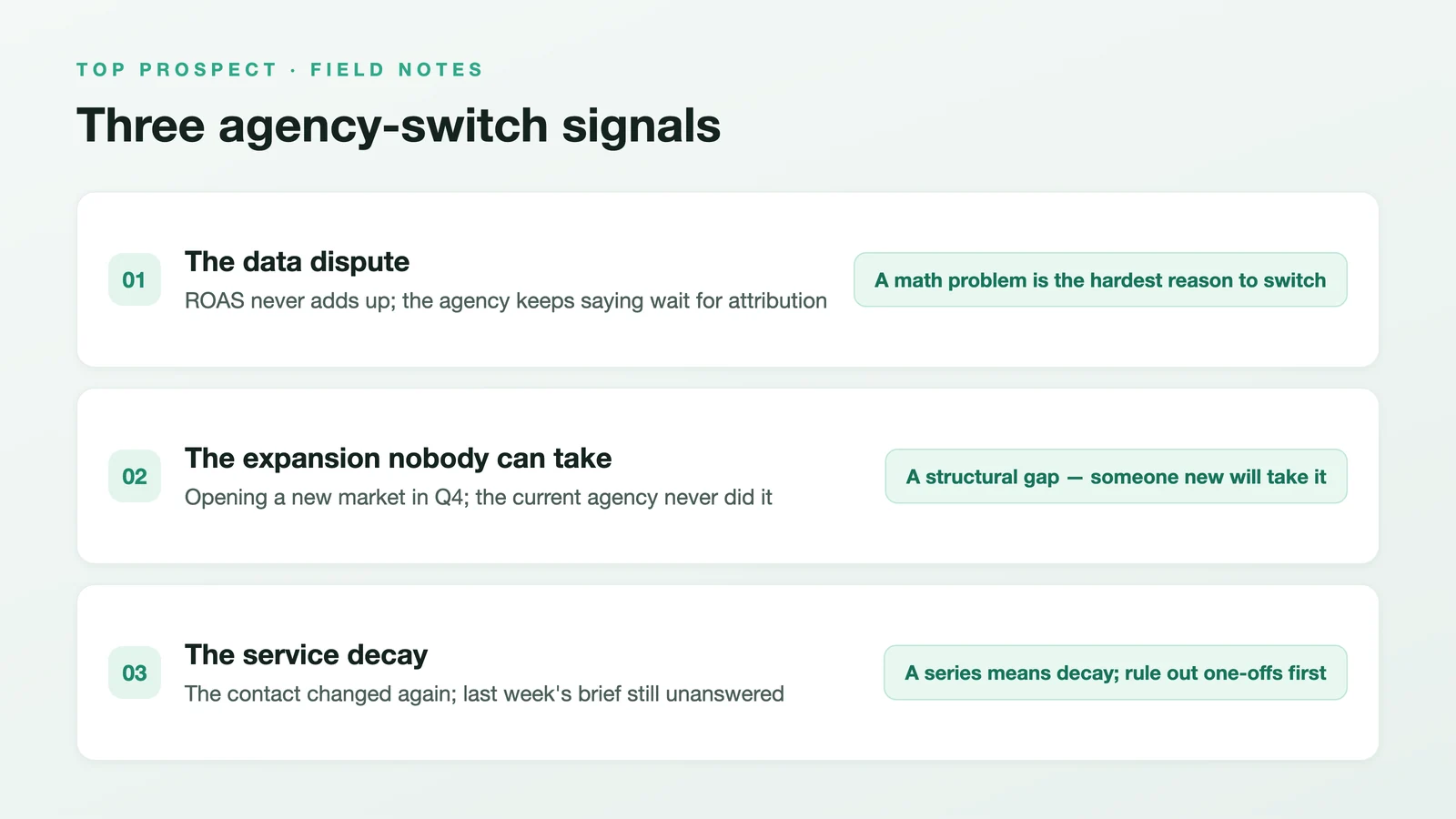
Signal 1: the data dispute
“ROAS (return on ad spend) never adds up, and the agency keeps saying wait for attribution (attribution: assigning conversion data to the right channel).”
Endless data fights mean the team cares about performance and the agency can’t explain the numbers. This is the hardest reason to switch: not a relationship problem, a math problem.
Signal 2: the expansion nobody can take
“We want to open Japan in Q4, but our current agency has never done it. Looking around.”
Wanting a new market your agency can’t serve is a structural gap — whether or not anyone gets replaced, someone new will take that market.
Signal 3: the service decay
“Our contact changed again. The creative brief from last week still has no reply.”
On its own it’s small; in a series it’s the precursor of a collapsed account team. When the people stop matching and responses slow down, the client is already auditioning your replacement in their head.
3. Where to watch for these signals
Game teams don’t gather in big industry groups; they gather in genre and identity groups (illustrative example): game-going-global team groups, genre groups (hyper-casual, SLG (strategy games), hybrid monetization each have their own), and indie game developer groups.
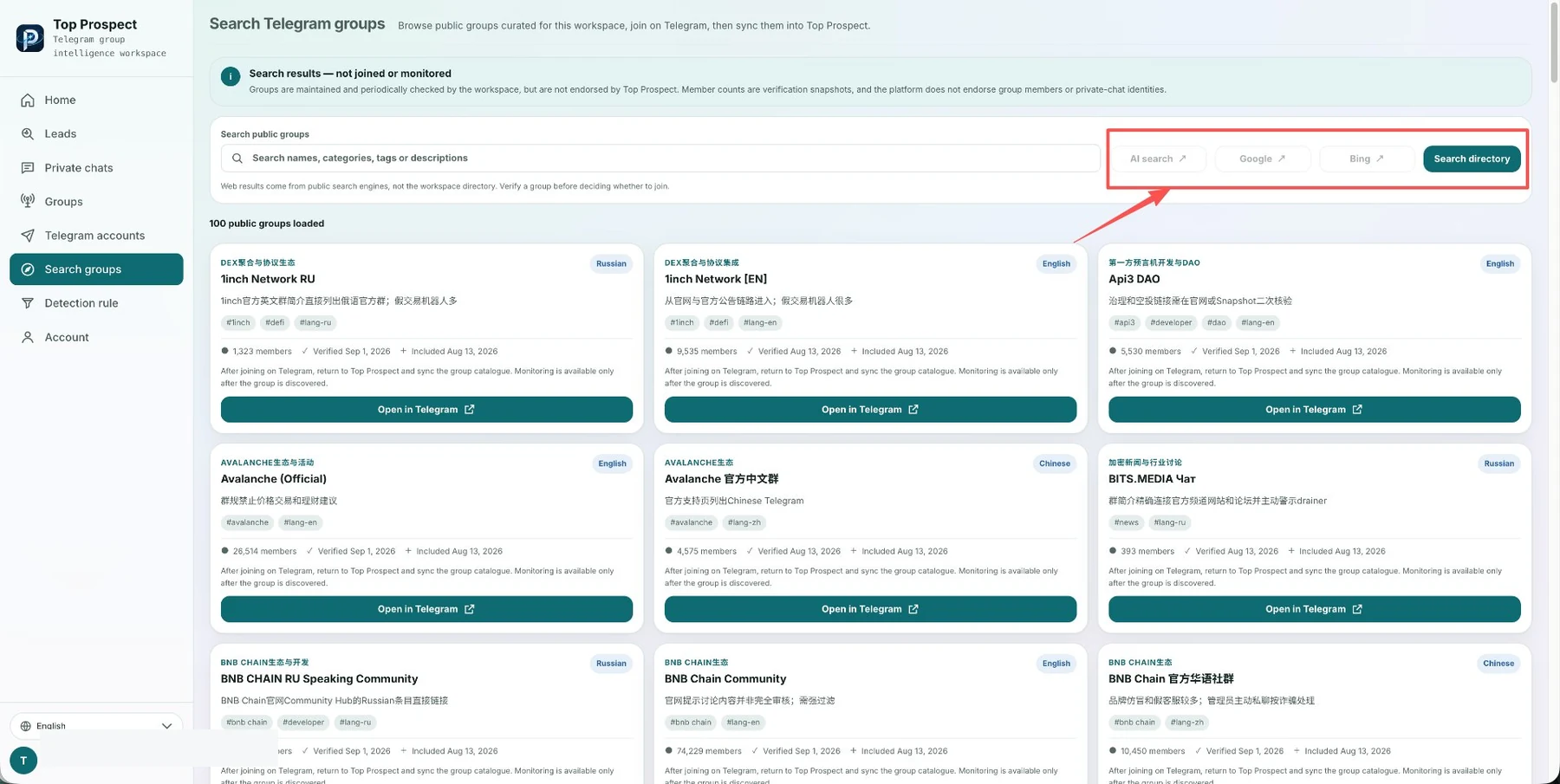
I search these groups with TOP Prospect: four search entries — AI search, Google, Bing, and the built-in group library (with 100 public groups loaded). Genre keywords beat broad ones: “hyper casual” and “indie game dev” come back far cleaner than “gaming”, which mostly returns player groups.
Filter by primary language and member count, then read each result card’s group name, description, category tags, last verified time, and indexed time to decide what enters the watch pool.
4. Three checks before making contact
When you spot an agency-switch signal, don’t DM yet. Scroll through this person’s posting history first:
- Product and scale: have they mentioned their game and volume, or is it all frustration with no facts
- Type of crack: data disputes and expansion gaps are structural and worth pursuing; service decay needs a check for one-off accidents first
- Who decides: is the poster the founder or the UA (user acquisition) lead — the former can sign on the spot, the latter needs three levels of internal buy-in first
Only after the three checks do you decide who to approach and how. And skip the rate card on first contact — respond to the thing they’re angry about: if they’re fighting over attribution, talk about how you handle data transparency.
Networking groups are the industry’s meeting room; developer groups are the client’s negotiation table. Funded game teams don’t look for agencies — they complain about their current one first. Whoever hears the complaint first hands over the plan first.
Frequently asked questions
Are networking groups really empty of clients?
Occasionally one shows up, but the weakest signals are the ones posted publicly with a budget attached — and those get swarmed by agencies. The better signals live in developer groups: funded teams don't look for agencies, they complain about their current one first, and then they switch.
How do I tell a game client from a fellow agency?
Look at the perspective: "our game" and "our user acquisition" means a client; "our clients" means a peer. Then check whether their posting history mentions product names, genre words, or budget — three hits and it's almost certainly a client.
If they never mention budget size, is it worth following up?
Check the signal type. Data disputes and expansion gaps usually sit behind teams with ongoing spend — worth following up even without a budget mentioned. "How do I start running ads" is a learning post; observe only. Budget size can be the first question after you make contact.
Sources and further reading
This article is human-authored. TOP Prospect processes only Telegram groups the user has explicitly authorized and connected. Its output supports human sales judgement; it does not replace human decisions and does not automatically contact or message group members.
How a Signal worth attention is found
See how Top Prospect finds and organizes Signals worth checking, keeps the original Telegram context, removes duplicates, and helps you decide what to review first. You decide whether to follow up and what to do next.