IDC customer renewal: don't wait for the satisfaction survey — 30 days of group watching renewed all 9, copy the routine
IDC customers don't tell satisfaction surveys they're leaving — they ask other people in technical groups. Three churn signals plus a 30-day routine that moves the warning ahead of the renewal conversation (illustrative example).
Consider two numbers (illustrative example):
An IDC (internet data center) customer success manager runs satisfaction calls a month before expiry. All 9 accounts due for renewal answer “satisfied”. A month later, 3 don’t renew.
In the same quarter, another rep does something different: he monitors the technical groups his accounts tend to appear in, and over 30 days finds 9 existing customers asking about delivery, comparing quotes or evaluating migrations. He handles each one early, and all 9 renew (illustrative example).
The difference? A survey asks for a conclusion. A group discussion is the process. A customer who is leaving says it somewhere else first, and tells you last.
1. Customers don’t tell satisfaction surveys — they tell groups
Existing-account churn is never overnight. Six months before expiry the account is already uncomfortable, but it won’t come to you — coming to you means admitting it picked wrong.
So it asks peers. And it asks three things.
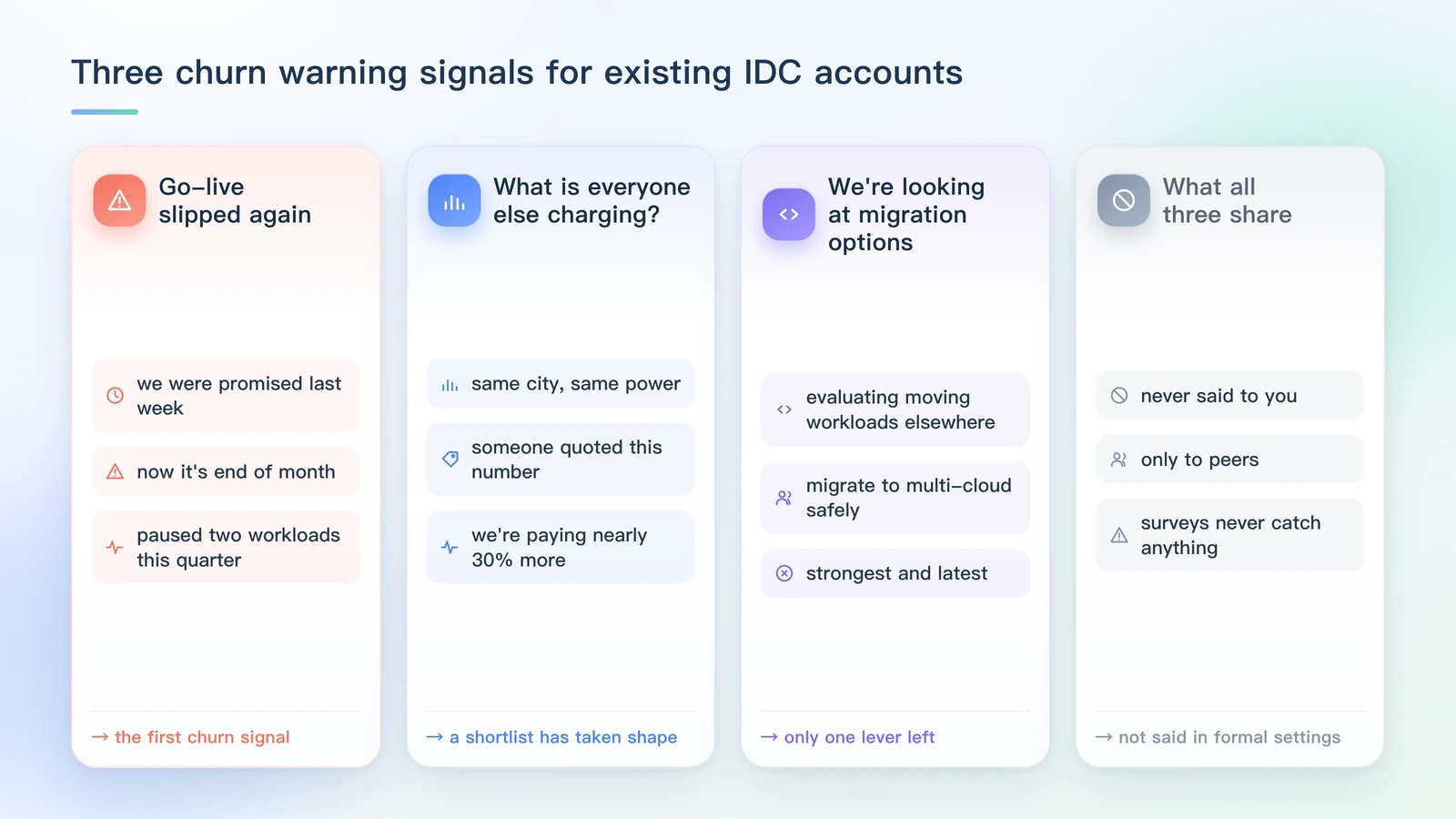
1. “Go-live slipped again”
“We were promised last week, now it’s end of month, and we’ve paused two workloads this quarter.”
A delivery complaint is the first churn signal and the easiest one to lose internally: support logs it, presales calls the customer difficult, and nobody raises it again. Meanwhile the customer has started doubting whether you can deliver at all.
2. “What is everyone else charging for the same spec?”
“Same city, same power, someone quoted this number — we’re paying nearly 30% more.”
Once a customer compares prices, a shortlist has taken shape. If you’re still talking service quality, they’re already costing out a migration — and that’s the value of this signal: it appears far earlier than a formal request for quote.
3. “We’re looking at migration options”
“We’re evaluating moving workloads elsewhere. How do you migrate to multi-cloud safely?”
A migration plan is the strongest signal and the latest one. At that point your only remaining lever is making the move painful, which is expensive. The first two signals are where the real money is.
All three share one trait: they’re never said to you, only to peers. That’s why satisfaction surveys never catch anything — customers don’t say these things in formal settings.
2. Where these messages land
Customers won’t complain in an “IDC networking” group — those are all vendors. They stay in their own circles (illustrative example): cross-border e-commerce engineering groups, SaaS engineering groups, AI application development groups, cloud-native communities and regional developer groups.
To find them, use Top Prospect. It turns search into four entries: AI search, Google, Bing and the built-in group library (currently showing 50 public groups loaded). AI search takes plain language, so you can type “Telegram groups where AI application teams gather” without assembling keywords.
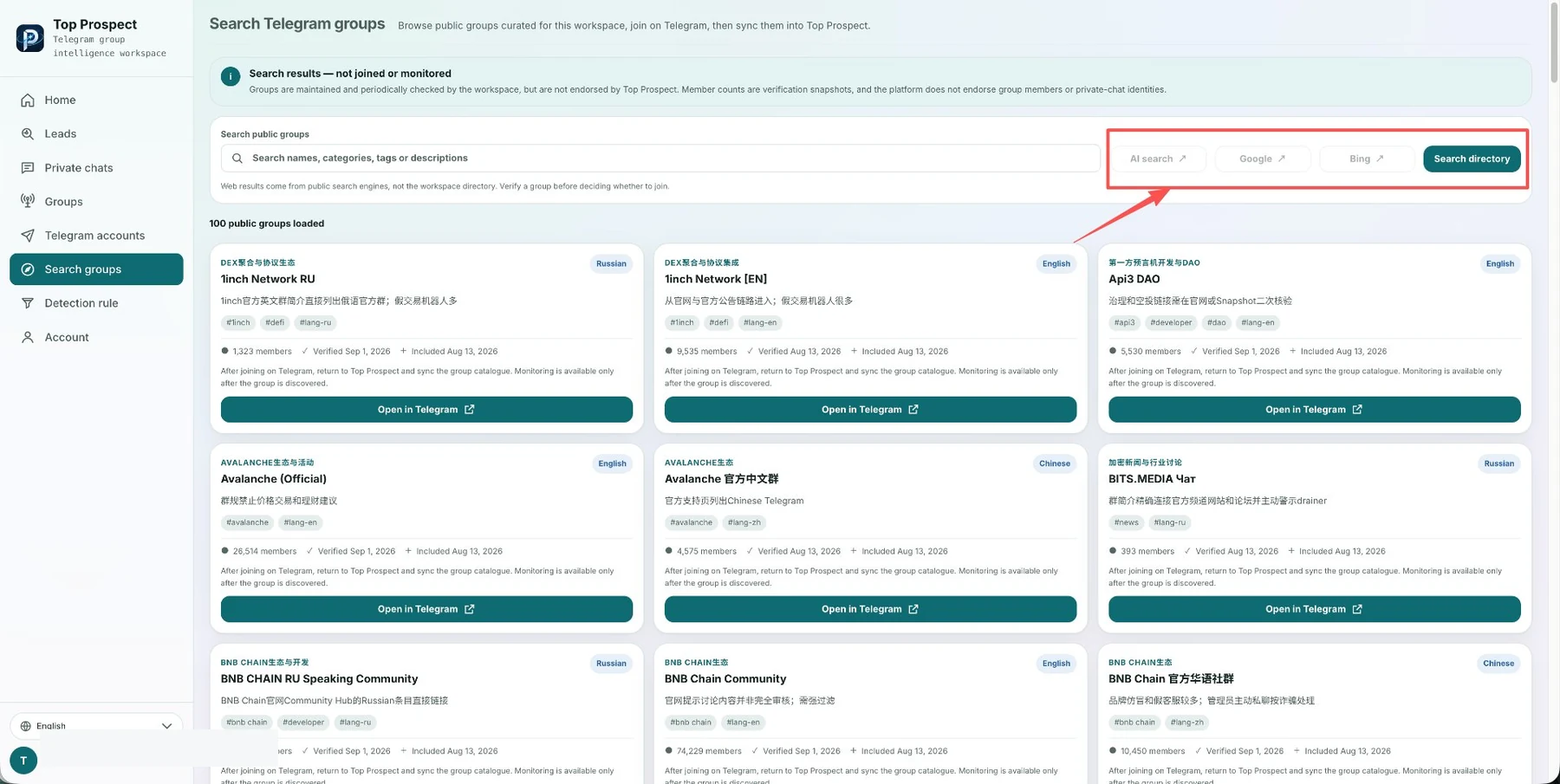
Each result card gives the group name, description, category tag, primary language, member count, last verified date and date added. Screen on two criteria: primary language should match where your facilities are (serving European accounts means keeping English and local-language groups), and member count should stay modest — in a technical group of a few hundred, people talk about real workloads.
Results are not memberships. The page is clear that a hit doesn’t mean the group is joined, doesn’t mean collection is enabled, and isn’t a platform endorsement. Joining remains a manual step, taken one group at a time.
3. Turn renewal risk into a rule
This step differs from prospecting: you’re not watching strangers, you’re watching accounts you already have. The group pool is built from your own account list, and the rules should be narrower.
Building one in Top Prospect doesn’t require expressions — it’s a conversation: are you looking for clients or suppliers, what do you provide, which clients matter most, what problems do they usually hit, what conditions matter most, and where are you targeting. An IDC customer success team fills in: clients; rack and cloud host delivery and renewal; organizations complaining about go-live delays, comparing quotes or evaluating migrations; delivery stability as priority; local and adjacent regions.
Bind the rule to your groups and it runs on its own, with hits scored and listed.
One step matters more than the rest: add your account names, project names and facility names to the monitored terms. A customer rarely signs his name when asking outside, but project names and facility locations are hard to hide. If a hit contains a project you recognize, that’s the message to handle today.
4. The 30-day routine
The cycle is longer than prospecting, but each week only asks for one thing (illustrative example):
Week 1: work backwards from your account list to the groups they’re likely to appear in. Find them, join them, build the rules.
Week 2: put account names, project names, facility names and common technical terms into monitoring. Run it for a full week and record rather than react.
Week 3: read the hits. Route delivery complaints straight to delivery and support with a required resolution date, and route price comparisons to presales so it can prepare a matching proposal.
Week 4: go into the renewal conversation carrying problems you have already fixed. Don’t talk discounts — talk about what you repaired for the account this month.
Those 9 renewals didn’t come from discounts. They came from knowing a month earlier where each account was uncomfortable. Renewals are not won at the negotiating table. They’re won by hearing those three sentences early.
Closing: Stop hunting for “customer groups” — hunt for customer signals
A group with 100,000 members does not mean your customers are in it. A group with 500 members might just have produced a message from someone looking for a supplier. So the thing worth optimizing in Telegram acquisition isn’t: how many groups have I joined? It’s: do I see the demand that’s happening right now, in time? AI helps you find more groups, Top Prospect keeps finding the signals, and the remaining judgement and conversation go to a real person. Moving from “finding groups” to “finding signals” is the real efficiency gain in Telegram B2B acquisition.
Frequently asked questions
A customer complains about delivery in a group. Does that mean churn?
Not necessarily, but it's the only place he says it plainly. Complaints filed with you have already been cleaned up; the group version is the raw one. Use it to fix delivery, and you'll have something to talk about at renewal.
Starting a month before expiry — is that early enough?
It's late. By the time a customer publicly asks what others charge for the same configuration, the shortlist usually exists. Push the warning window to 90 days so you can solve the problem before the comparison starts.
What a customer says in a group and what he writes in a survey don't match. Which do I trust?
The group. A survey is a formal setting and captures a conclusion; group discussion captures the process, and that's where the real blocker lives. Read both side by side and the turning point shows up earlier.
Sources and further reading
This article is human-authored. TOP Prospect processes only Telegram groups the user has explicitly authorized and connected. Its output supports human sales judgement; it does not replace human decisions and does not automatically contact or message group members.
How a Signal worth attention is found
See how Top Prospect finds and organizes Signals worth checking, keeps the original Telegram context, removes duplicates, and helps you decide what to review first. You decide whether to follow up and what to do next.