Tired of Watching Tender Boards? 18 Data-Center Expansion Signals a Week, Straight from Telegram Groups
Cold-emailing 300 companies from a list got zero replies. The new approach: in 3 days, tag 20 people actively discussing data-center procurement in Telegram groups. The keyword playbook IDC sales can copy today.
Let me start with the ugliest number I own.
At my last IDC (Internet Data Center) sales job I swept a list of 300 companies that “might need data-center capacity” and blasted cold emails. Replies: 0.
The list wasn’t bad. What the list didn’t have was one thing:
procurement timing.
Out of 300 companies, maybe 30 would actually buy racks, expand power, or change lines this year. But you don’t know which 30 — or which month their evaluation starts.
Telegram groups run the exact opposite way: with the right playbook, you can tag 20 people actively discussing procurement in 3 days (illustrative example). Here is the playbook, taken apart.
1. Why a company list can never catch the procurement window
A list tells you “this is an e-commerce company,” but data-center procurement is a windowed decision:
- Workloads grow, and power or racks give out first;
- An IP range gets blocked, forcing a move;
- A contract nears renewal, and procurement always shops around before signing.
When the window is closed, a hundred cold emails change nothing.
When the window is open, they won’t wait for you — they go ask people who have done it first.
The place they ask is industry groups.
2. The core move: stop searching “IDC”, search what stuck buyers type
This is the most counterintuitive part of the playbook.
Search “IDC” or “colocation” and you get industry groups — full of fellow salespeople.
Actual decision-makers describe their own problem:
Our racks only give us 4kW and we’re racking GPU boxes, that’s never going to fly. Which facilities are you all using for high density?
Our IP range got blocked. Re-range or migrate the whole thing — any routing recommendations?
Anyone know a facility with solid cross-region interconnect? Two of our workloads need low latency.
So the search terms should be grouped by the scenario where the buyer is stuck:
Power and density
high density / GPU-ready data center / power expansion / 4kW per rack / liquid cooling
Network and lines
IP range / blocked / BGP / dedicated line / cross-region interconnect
Procurement actions
data center comparison / migration / racking / colocation quote / rack pricing
Rotate the three groups and the buyer-to-noise ratio in your results changes completely.
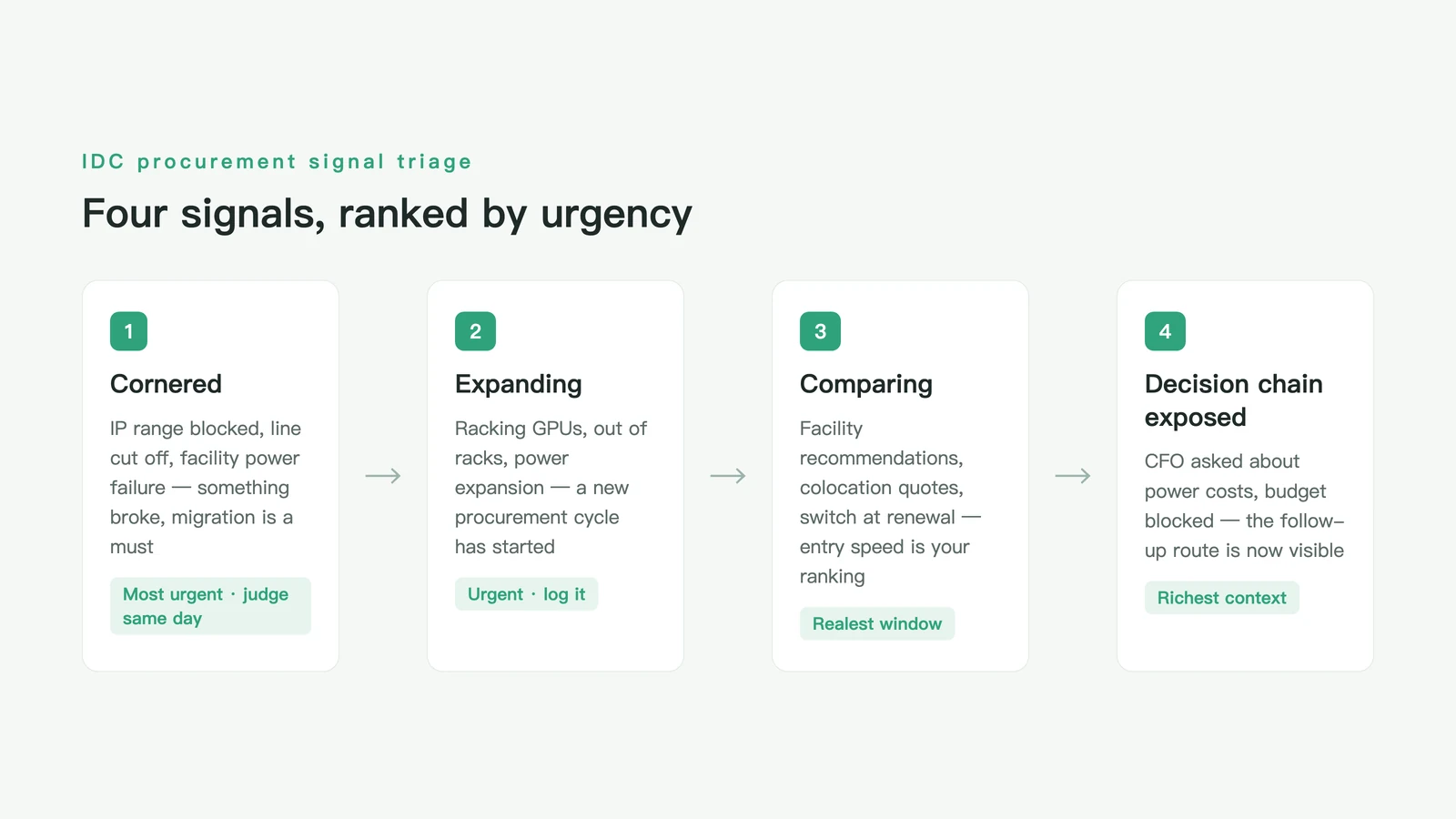
3. Four procurement signals to recognize on sight
Once the keywords surface groups, the value is in the messages. Four signals:
① Cornered
“IP range blocked”, “line cut off”, “facility power failure” — something already broke, migration is a necessity, and the buyer is looking for a way out.
② Expanding
“Racking GPUs”, “out of racks”, “need more power” — the business is growing, the current facility can’t hold it, a new procurement cycle is on the road.
③ Comparing
“Any facility recommendations?”, “colocation quote”, “should we switch at renewal?” — evaluation has started, and at this stage speed of entry is your ranking.
④ Decision-chain exposed
“The CFO asked about power costs”, “budget got pushed back” — one message reveals how many people sit on the decision chain, who to approach and who to route around.
Of the four, ① and ② are the most urgent, ③ is the realest window, ④ carries the most information.
4. The 3-day rhythm: build on day one, watch on day two, reach out on day three
The playbook is simple; the rhythm is the hard part:
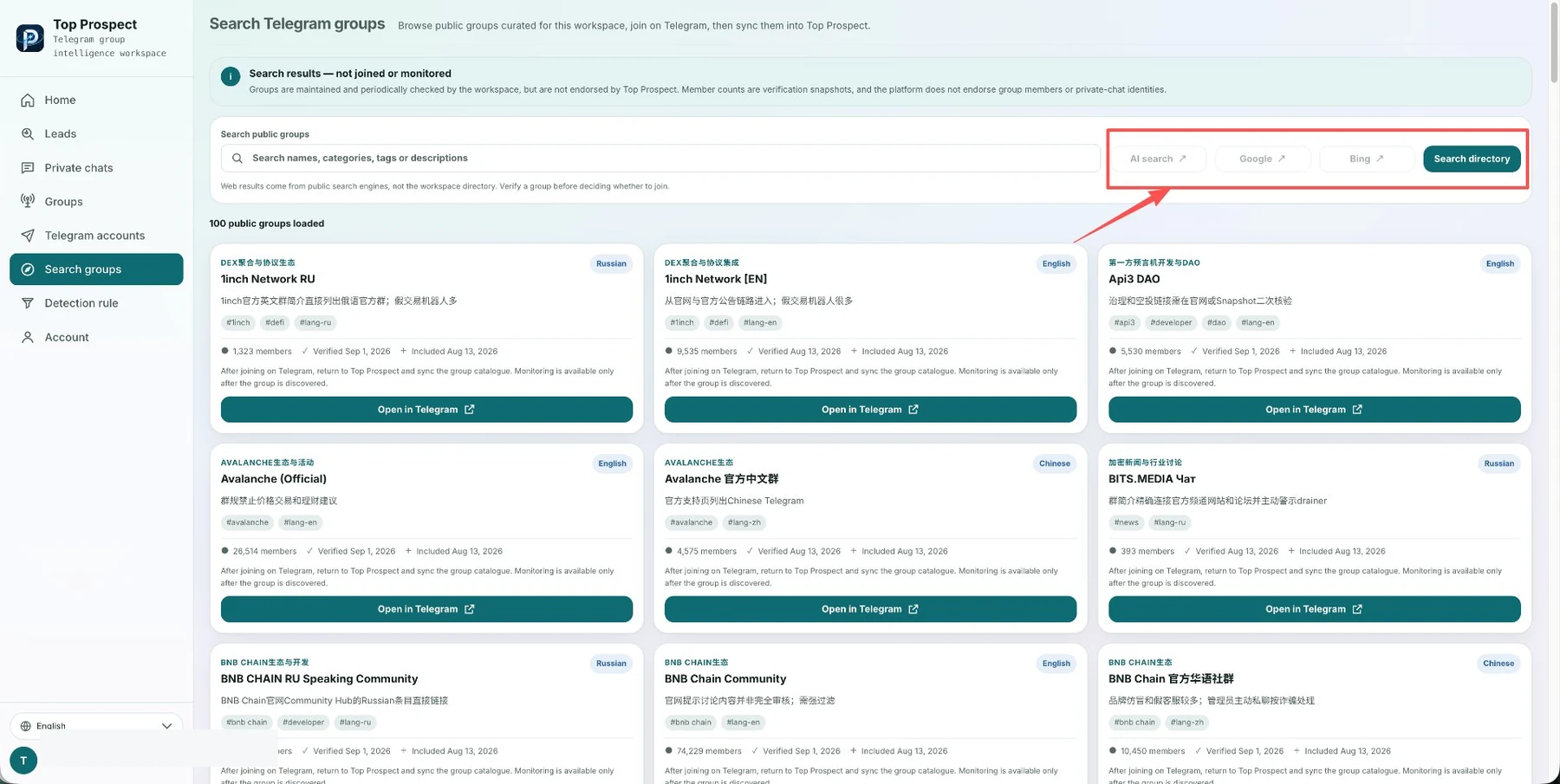
Day one: build the pool. Search Telegram groups with the keyword sets above. I use the group search page in TOP Prospect on Telegram: four entries — AI search, Google, Bing, and the built-in group library (with 100 public groups loaded). Each result card shows the fields you need: group name, description, category tags, primary language, member count, last verified time, and indexed time. Filter out irrelevant ones by category tags and primary language, keep ops, infrastructure, and going-global tech groups — 30 groups is a realistic day-one pool.
Day two: watch messages. With the pool ready, sweep it with the power, IP-range and comparison keyword sets, and tag every hit — who asked, about which scenario, whether a decision chain got exposed. The day’s output is a lead sheet with context, not a pile of group invites.
Day three: human judgment, then outreach. Judge each one: buyer or peer? How far open is the window? What should the first message say? Only then reach out — and the first sentence must answer the exact question they asked, not introduce your company.
Run that rhythm and tagging 20 decision-makers in 3 days is a realistic number (illustrative example).
5. The efficiency contrast: sweeping lists vs watching signals
Same week, two structures of output:
- Sweep a list: 300 companies → no idea who is in a buying window → blast → wait → 0 replies;
- Watch signals: 30 groups → a few dozen messages a day → 20 tagged buyers in procurement → outreach with context.
The first produces a list that gets thicker; the second produces a follow-up sheet that gets sharper. IDC has high deal sizes and long decision chains — timing beats volume every single time.
6. Final reminder: machines find, humans judge
Never skip the judgment step.
Whoever is talking might be a buyer’s ops lead, a fellow salesperson fishing, or a student. The tells are above: perspective, posting history, self-promo links. What TOP Prospect does is surface the groups and messages where procurement discussions are happening — whether to follow up, whom to approach, and what to say first stays a human decision.
In the list era you competed on list thickness. In the signal era you compete on proximity to the buying window. Opening 20 decision-makers in 3 days isn’t a pitch-craft upgrade — it’s a timing upgrade.
Frequently asked questions
Do people really discuss data-center procurement in Telegram groups?
The final decision never gets announced in a group, but the questions along the way do: how to expand power capacity, whether to re-IP after a block, which provider handles cross-region interconnect. Whoever asks those questions is mid-decision.
How do you tell a real buyer from a fellow salesperson?
Look at the perspective. Someone saying "our racks" or "our facility" is a peer; someone saying "our workloads won't fit and the cooling is maxed out" is a buyer. Then check their history for self-promotion links — links usually mean sales.
Why is 20 decision-makers in 3 days realistic?
Because keyword combinations narrow the field: you stop searching industry words like "IDC" and start searching the specific words buyers use when they are stuck. Once the field is right, it is a rhythm problem — day one build the pool, day two watch messages, day three reach out (illustrative example).
Sources and further reading
This article is human-authored. TOP Prospect processes only Telegram groups the user has explicitly authorized and connected. Its output supports human sales judgement; it does not replace human decisions and does not automatically contact or message group members.
How a Signal worth attention is found
See how Top Prospect finds and organizes Signals worth checking, keeps the original Telegram context, removes duplicates, and helps you decide what to review first. You decide whether to follow up and what to do next.