Influencer marketing agencies: 20 brands ready to book creators, zero ad spend
New deals for influencer marketing agencies don't have to come from referrals and expo badges. Brands post their creator-search messages in Telegram seller groups every day. One agency set up group search plus recognition rules and gathered 20 brands discussing creator budgets in three weeks (illustrative example).
Quick math first (illustrative example): fund two ad platforms targeting the keyword “influencer marketing agency,” and three months of spend equals half a BD hire’s salary, while the qualified conversations it produces can be counted on one hand.
Around the same time, in a cross-border e-commerce seller group, a brand posted: “Launching in the US next month — looking for a creator team with home & living experience, any recommendations?” Some agency saw the message that evening and reached out the same night — three days later they had the brief (illustrative example). Not from ads. From catching the exact words.
Brands’ creator-search messages are being posted in groups all day. Nobody was watching them for you — until you automate that part.
1. Learn the signals: three ways brands ask out loud
Brands with creator budgets don’t post purchase orders. They open in one of three ways, each pinned to a concrete situation.
1. Asking for recommendations
“Anyone worked with a solid TikTok creator agency? US market, home & living category, budget under $10k.”
Category, region and budget in one message — this is the hottest of the three. The need is already thought through; what’s missing is a name to call.
2. Complaining about the current agency
“Five creators booked last month: two missed deadlines, two faked their metrics. Worse ROI (return on investment) than our paid ads.”
Griping about the incumbent is the classic pre-switching signal. He isn’t shopping for price right now — he wants to hear how to not get burned twice.
3. Probing the market
“What are mid-tier US creators charging these days? How do CPS (cost per sale) deals compare with flat fees?”
Market questions mean a budget is forming. The deal is further out, but answering honestly now makes you the person he calls when the budget lands.
2. Why nobody caught these messages before
They were always catchable — just not by humans. The target brands scatter across dozens of seller and category groups, each producing hundreds of messages a day. Manual reading fails on day three.
Hand it to Top Prospect, in three steps:
Step one: search and build the pool. Four search entries run in parallel — AI search, Google, Bing and an on-site group library (the library already loads 100 public groups). AI search takes natural sentences like “Telegram groups where US e-commerce brands gather.” Results come back as cards with group name, description, category tags, primary language, member count, last verification time and indexing time. The keep-filter: primary language matches the target market, and precise 200–300 member groups beat giant ones.
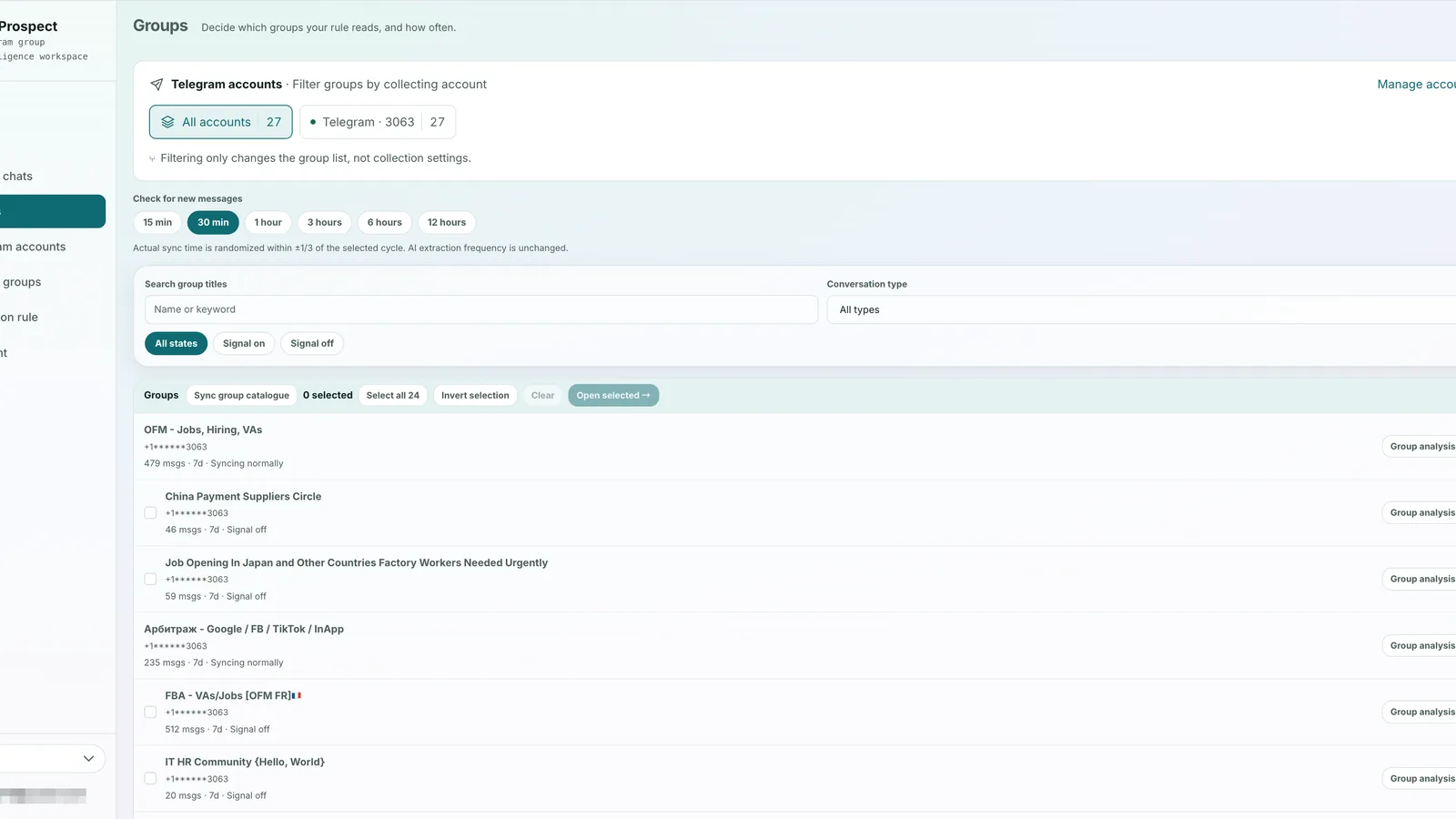
Step two: turn on collection. Each group gets its own check frequency, 15 minutes to 12 hours. Creator-search messages are time-sensitive, so core groups should run short intervals.
Step three: let the rules read the messages. Detection rules are built through a guided conversation: customers or suppliers? What do you offer? Which customers first? What problems do they hit? What conditions matter? Which regions? An influencer agency feeds it exactly the three signals above: brands asking for creator agencies, brands trashing their current campaigns, brands probing creator rates.
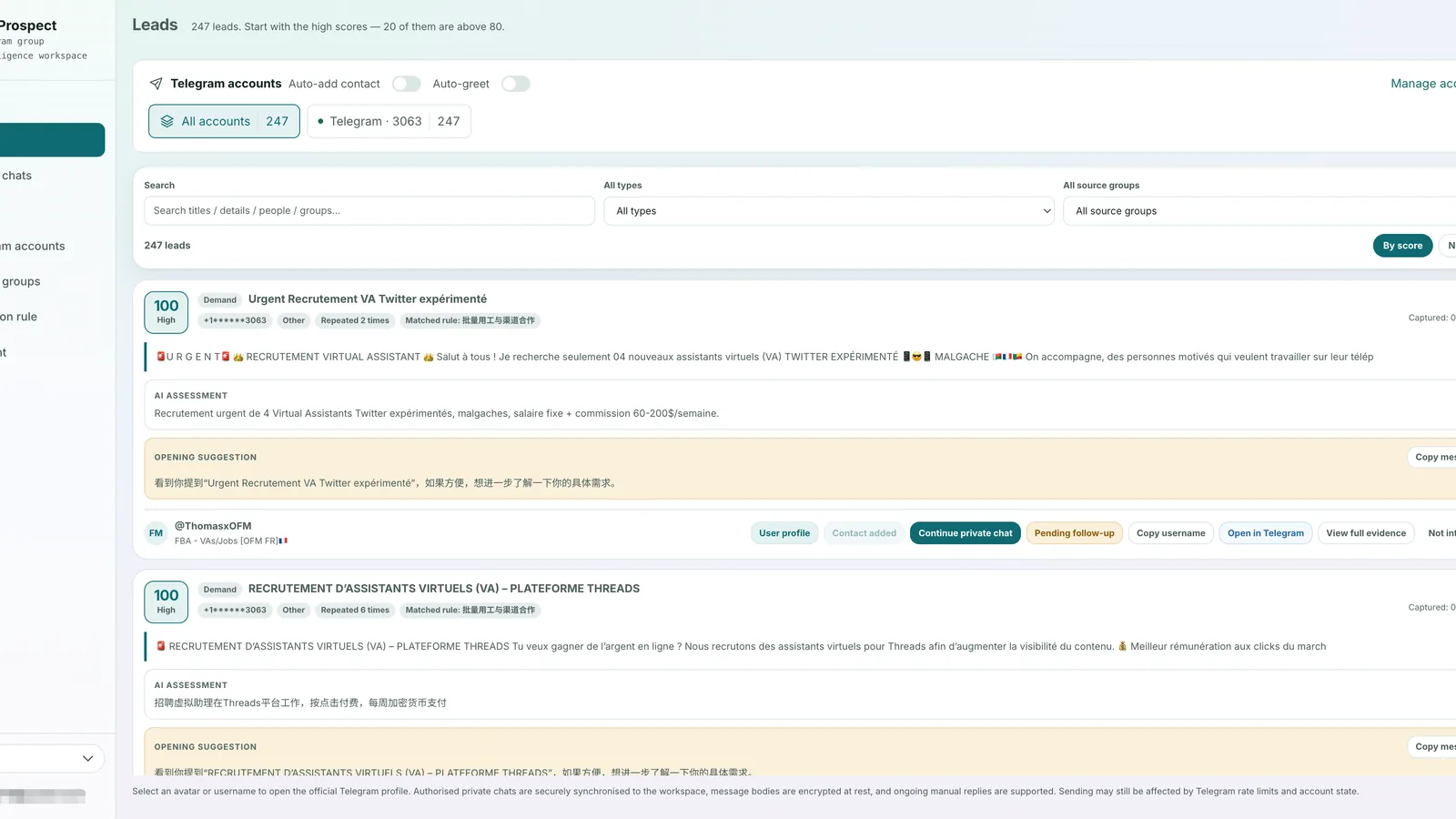
Hits don’t need me to scroll anything. Matching messages land in a scored lead list — who’s looking for creators, the original message, which group, what time. One screen.
3. How 20 brands piled up
Some agencies run this three-week cadence and reach 20 brands with creator budgets in play (illustrative example):
Week 1: searched, filtered and joined groups — 12 with high brand density. The keep-test is one glance: if the last ten messages include brands talking about products and launch plans, keep it.
Week 2: bound recognition rules to all of them, watching the three signal types. Scattered hits started landing.
Week 3: the hit list reached 20 brands with creator budgets in play (illustrative example). Added each one privately; 7 conversations reached the proposal stage, 2 signed for a first month.
Zero ad spend the whole way. The only cost was Top Prospect seats and credits — an order of magnitude below what ad accounts burn.
4. Three warnings
Don’t open with your agency deck. If a brand asks for rate benchmarks, work the numbers with him. If he’s ranting about faked metrics, explain how you verify performance. Solve first, pitch second.
Groups mature and rules need tuning. After two weeks, reread your hits: add exclusions for the misses, add phrasings for the gaps. Rules get sharper with use — that’s what separates this from manual scrolling.
Judgment stays yours. The highest-scoring hit is still a “maybe.” Whether it’s worth pursuing, how to open, what deal structure to propose — human work. The tool puts the message in front of you; winning it is on you.
Closing: turn one-off group searches into a running acquisition system
Traditional group searching is a one-off action. Today you search one batch, tomorrow another; today you finish reading, tomorrow you start from zero. A truly reusable Telegram acquisition flow looks like this:
build the group pool → monitor continuously → capture demand → recognize signals → human confirmation → follow up
AI expands the search range, Top Prospect captures the changes, BD handles the final judgment and the conversation. Which means acquisition stops depending on whether a BD had time to scroll Telegram today, and becomes a process that runs on its own. If your customers are already on Telegram, the question worth solving isn’t “how to join more groups,” but: how to notice the demand that’s happening right now, sooner.
Frequently asked questions
Do brands really ask for creators in public groups? Isn't this negotiated privately?
Mature brands run RFQs and agencies-of-record. But plenty of small and mid-size brands start with one message in a seller group asking whether anyone has worked with a solid creator agency. By the time they run a formal pitch, you're usually not on the list.
How much time does building 20 brands take?
The first three weeks are the heavy part: searching, filtering, joining and setting rules, about an hour a day (illustrative example). Once the pool runs, daily review and follow-up take under half an hour.
What's the right first message to a brand posting a need?
Not your agency deck. Answer the actual question: if he asks for US creator rate benchmarks, give him a real range and the standard deal structures for his category. Prove you understand his P&L before proposing anything.
Sources and further reading
This article is human-authored. TOP Prospect processes only Telegram groups the user has explicitly authorized and connected. Its output supports human sales judgement; it does not replace human decisions and does not automatically contact or message group members.
How a Signal worth attention is found
See how Top Prospect finds and organizes Signals worth checking, keeps the original Telegram context, removes duplicates, and helps you decide what to review first. You decide whether to follow up and what to do next.