Institutional Onchain Approval Workflow: A '3-Person Sign-Off' Means a Live Lead
Fast-blockchain news fills Telegram. A named treasury launch, approval threshold, wallet limitation, owner, and date reveal the message an institutional Web3 provider should notice.
- 01The short version
- 02A fast block does not approve a treasury transfer
- 03Read the message as a stuck payment, not a technology map
Signals to watch
- A team names a treasury transaction, asset, approval threshold, or destination rule that still requires manual work
- A current wallet, custody, policy, screening, or integration limitation prevents the intended workflow
- A security, treasury, compliance, or platform owner and a pilot or production date appear in the same discussion
At 9:10 on Monday morning, a fast-chain announcement is being forwarded through every institutional Web3 Telegram group you follow.
One person posts the latency chart. Another says banks will finally move everything onchain. A third starts arguing about finality.
Then a treasury operator writes:
“We plan to put our USDC treasury route into production in October. Security requires three approvers above $500,000, but our current wallet cannot apply a different threshold by destination.”
If you sell custody, wallet policy, compliance screening, or treasury integration, this is the message to save.
It names a real workflow, an amount, a control owner, a limitation in the current setup, and a production date. It may contain work. It still does not prove that the writer controls a budget or can invite an outside provider.
The company, operator, USDC route, October date, $500,000 threshold, three-person rule, and wallet limitation in this article are fictional representative examples. They are not customer quotations. The Aptos Labs and Fireblocks facts cited below come from real public sources.
The short version
- “This chain is fast” is news. It does not tell you who needs a supplier.
- “October production, USDC treasury, three approvals above $500,000, current wallet cannot route by destination” is specific enough to investigate.
- Aptos Labs’ sub-70ms statement concerns block time, not the complete time for an institution to approve, sign, screen, broadcast, finalize, and reconcile a transaction.
- Fireblocks documents approval, signing, policy, and screening as separate controls. Its timeout values are configurable product settings, not an industry average or evidence about the fictional team.
- The first sales reply should clarify the stopped step. It should not pitch “institutional infrastructure” in the abstract.
A fast block does not approve a treasury transfer
Aptos Labs wrote in December 2025 that its block times hovered below 70 milliseconds. The same article separately described improvements to validator finality latency and block time.
Those are network-performance claims. They do not mean an institutional transfer is approved and complete in 70 milliseconds.
Before a treasury transaction reaches the network, somebody may need to create it, check a policy, obtain approvals, sign it, and screen the destination. After broadcast, another system may still need to record and reconcile it.
The quoted phrase is about block time, not a complete institutional approval and settlement route.
This distinction matters to a seller because “the chain is fast” and “the treasury route is ready” are two different statements.
Read the message as a stuck payment, not a technology map
Return to the fictional message:
“USDC treasury route.”
That tells you what is moving and why the workflow exists.
“Three approvers above $500,000.”
That tells you the control: larger transfers need three people to approve. It does not yet tell you whether those three come from treasury, security, finance, or a shared approval group.
“The wallet cannot apply a different threshold by destination.”
That is the present limitation. Perhaps the team wants a stricter rule for a new market maker and a simpler rule for its own exchange account. Do not assume. Ask.
“Production in October.”
That gives the team a decision window. A date is useful only because it is attached to a real transaction route and a blocked rule.
You do not need to map five supplier categories before replying. You need to understand the one step that stops this payment.
Public documentation shows the controls are separate
Fireblocks documentation provides a useful reality check without proving anything about the fictional team.
Under two-tier authorization, approval happens before the initiator can sign. The authorization timeout can be configured to a minimum of five minutes, defaults to two hours, and can extend to 24 hours.
That does not mean institutions usually take five minutes or two hours. These are available settings in one documented product.
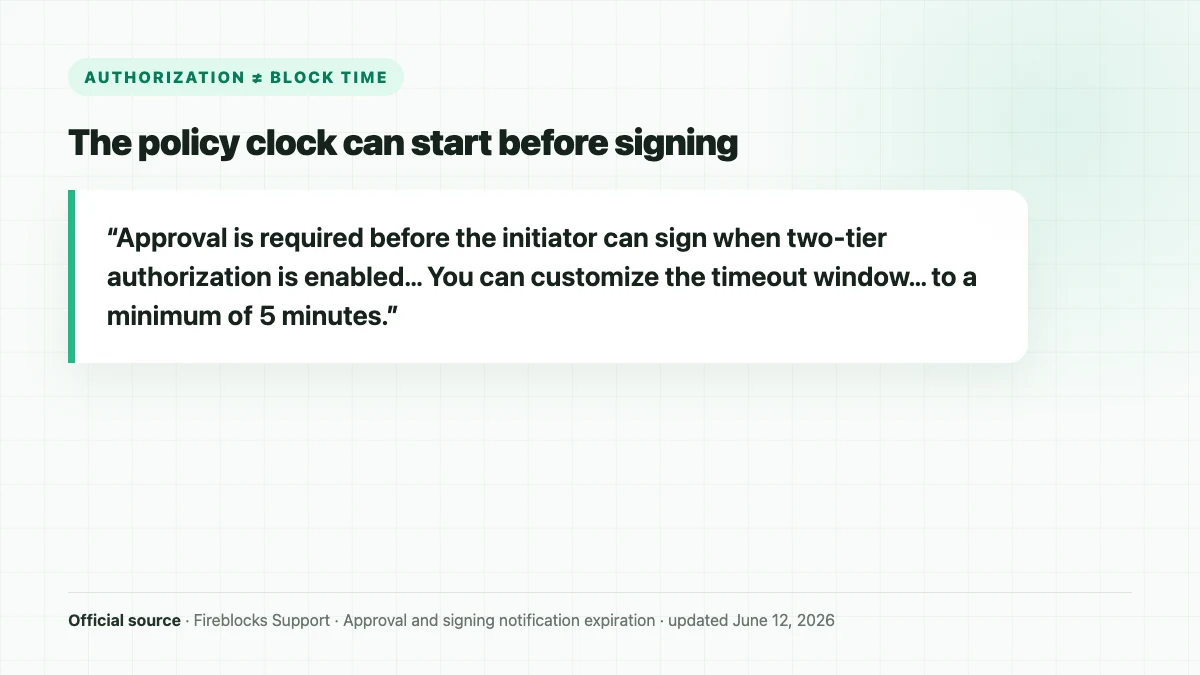
The five-minute figure is Fireblocks’ minimum configurable timeout, not an industry average and not proof that any unnamed institution uses it.
Fireblocks also documents approval groups, including an example in which three approvals are required from a group of six. Its policy rules can match details such as source, destination, initiator, blockchain, contract method, asset, and amount.
Those details explain why the fictional wallet limitation is commercially meaningful: the team is not saying “approvals feel slow.” It is saying the intended rule cannot be expressed in the current route.
Screening is separate again. Fireblocks documents incoming and outgoing transaction screening for risk analysis, anti-money-laundering and sanctions checks. Anti-money-laundering is often shortened to AML. A destination may be screened before a withdrawal is broadcast.
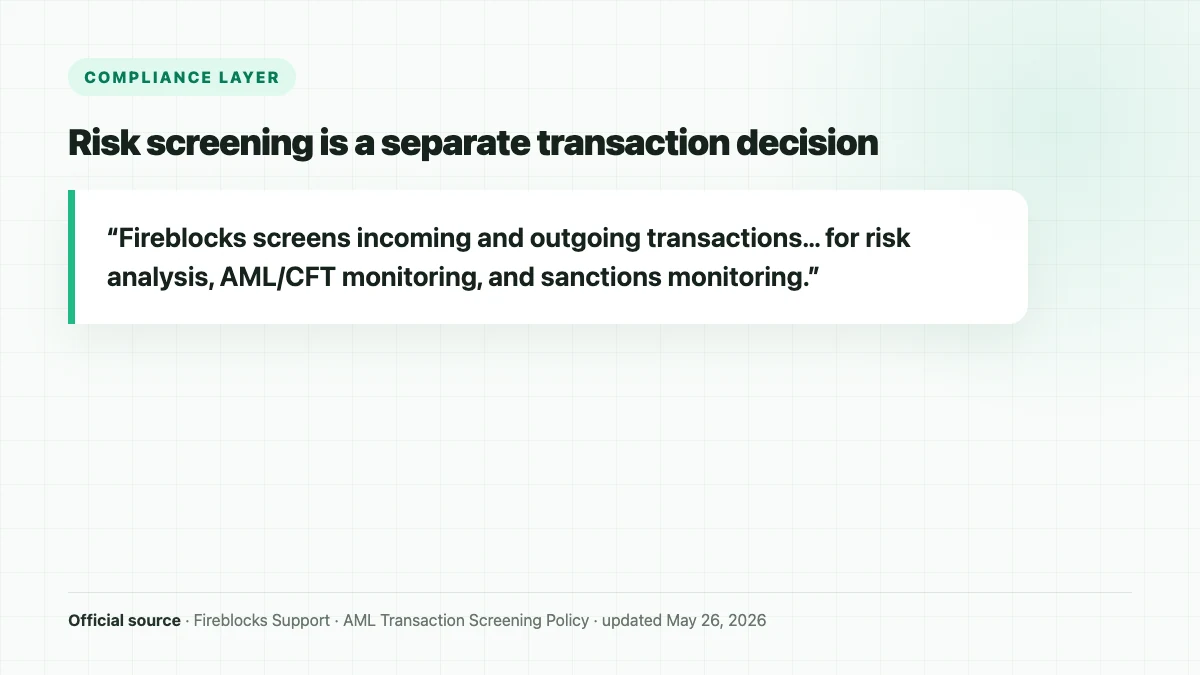
This documentation shows that screening can be a separate transaction decision. It does not establish the provider, policy, timing, or result used by an unnamed institution.
Three natural ways to continue the conversation
The first question should help the writer explain where the transaction stops.
When the approval rule cannot vary by destination
“Is the three-person rule meant for every transfer above $500,000, or only for specific counterparties?”
This separates a simple amount rule from a destination-and-amount policy. It also avoids claiming that your product is already the answer.
When the approval queue keeps expiring
“Does the transaction expire while people are approving it, or only after approval while it is waiting for a signer?”
Approval and signing are different steps. A team with a policy problem needs a different conversation from a team whose signer is unavailable.
When compliance delays the broadcast
“Is the destination screened before the approval request starts, or after the three approvers have already finished?”
If screening happens last, the team may be repeating work after a hold. If screening happens first, another part of the route may be causing the delay. Either answer is more useful than “Do you need compliance?”
These questions reveal sequence and ownership. They do not verify the speaker, institution, budget, permission to discuss the route, or authority to evaluate a vendor.
Messages that sound urgent but are still only discussion
“Banks need faster custody.”
Which bank, transaction, control, and date? Nothing here can be followed up responsibly.
“Does anyone support three-of-five approvals?”
This is closer, but it might be a product question, research, or an exam prompt. Read the surrounding messages before treating it as a project.
“Our October USDC launch is blocked because the security team wants different approval rules for two destinations, and the wallet cannot express them.”
Now there is a workflow, an owner, a current limitation, and a date. The next step is still verification, not an immediate proposal.
The difference is easy to miss when the group is moving quickly. The technical terms may look more important than the ordinary words: “our,” “blocked,” “current wallet,” and “October.” For sales, those ordinary words often carry the work.
How TOP Prospect keeps that sentence from disappearing
The useful details may arrive in different messages. One says “October production.” Another names the $500,000 rule. A reply explains that the current wallet cannot vary it by destination.
TOP Prospect can preserve matched messages with the authorized source, timestamp, nearby replies, and match reason so a salesperson can review the complete discussion. A search can include combinations such as:
USDC treasuryplusproductionorpilotthree approversplusaboveorthresholdcurrent walletpluscannotorunsupportedby destinationpluspolicyorapprovalscreeningpluswaiting,hold, orexpired
The product can help find and organize the conversation. It cannot read private chats, enter unauthorized groups, identify an anonymous writer, inspect the institution’s wallet, prove a budget, or contact anyone automatically.
A person still checks the participant, group rules, project facts, authority, and whether outreach is appropriate.
The work is hidden in the control that will not fit
Sub-70ms block time is an impressive network fact. It is not the lead.
“We go live in October, transfers above $500,000 need three approvers, and the current wallet cannot route the rule by destination” may be a lead because it describes a transaction the team cannot yet run as intended.
For a custody, wallet-policy, compliance, or treasury-integration seller, that sentence is much more useful than another hundred messages saying institutions are coming onchain.
Sources reviewed
- Aptos Labs: Laying the Groundwork for the Next Financial Internet
- Fireblocks: Approval and signing notification expiration
- Fireblocks: Approval groups
- Fireblocks: Policy rule parameters
- Fireblocks: AML Transaction Screening Policy
Source review completed on 31 August 2026. Product documentation is evidence of documented controls, not proof of any unnamed institution’s configuration, approval time, procurement, or intent.
Frequently asked questions
Does a sub-70ms block time mean an institutional transaction finishes in 70 milliseconds?
No. Aptos Labs described block times below 70 milliseconds. Approval, signing, screening, broadcast, finality, and reconciliation are separate steps and clocks.
Is a five-minute approval window an industry benchmark?
No. Five minutes is the documented minimum configurable authorization timeout in Fireblocks. The same documentation says the default is two hours and the maximum is 24 hours; those are product settings, not evidence of how long an unnamed institution takes.
Can TOP Prospect prove that a Telegram participant is an institutional buyer?
No. It can preserve matched discussions from groups the user is authorized to monitor. A person must verify identity, authority, project facts, group rules, budget, and whether outreach is appropriate.
Sources and further reading
How a Signal worth attention is found
See how Top Prospect finds and organizes Signals worth checking, keeps the original Telegram context, removes duplicates, and helps you decide what to review first. You decide whether to follow up and what to do next.