Warehousing sales prospecting: 25 shippers switching 3PLs won in 5 days off 3 complaints — all in one read
A seller switching warehouses won't publish a tender — he'll complain in a group. Three sentences map to three switching motives, plus a five-day routine a junior rep can run as-is (illustrative example).
Consider two moves (illustrative example):
A warehouse sales rep posts a storage price list in a seller group with a cheerful “get in touch for peak season”. A month passes with no interest.
In the same group, a seller posts: “Intake slipped to next week again, we’ll miss the campaign, and my current warehouse won’t guarantee peak capacity.” Nine replies underneath, six from overseas warehouse competitors.
The difference? The price list arrived before the seller was forced to move. The message arrived when he had started costing out a switch.
A warehouse switch isn’t sold into existence. It’s spoken out loud when a seller is pushed far enough. One rep turned this into a fixed routine and won over 25 sellers preparing to switch third-party logistics (3PL) providers in 5 days (illustrative example). This article is about recognizing the three sentences — and what a junior rep does on day one.
1. Before switching, a seller says these three things
Switching warehouses costs more than switching a supplier: inventory has to move, listings pause and account metrics have to settle again. So before acting, a seller says out loud what is wrong with the current provider.
Three motives, three sentences.
1. “Storage fees went up again this month — what are your rates?”
Cost pressure. He is holding a new quote against the old invoice, which means he is already comparing. These sellers care most about total cost, but won’t switch on price alone — he is also checking whether switching will stall his listings.
2. “Intake slipped to next week and we’ll miss the listing date”
Turnaround pressure. This is the most urgent and the easiest to win: he doesn’t want the lowest price, he wants to know when goods can go live. Whoever puts a turnaround commitment on the table first lands on the shortlist.
3. “I want to lock peak-season capacity and they won’t guarantee it”
Certainty pressure. The scarcest thing before peak season isn’t price, it’s whether your word holds. When the current provider won’t commit, the seller starts looking for one who will.
All three share one trait: none of them is “I want to switch” — each is “my current warehouse is making this painful”. The complaint is the first half; the second half is the need you can pick up.
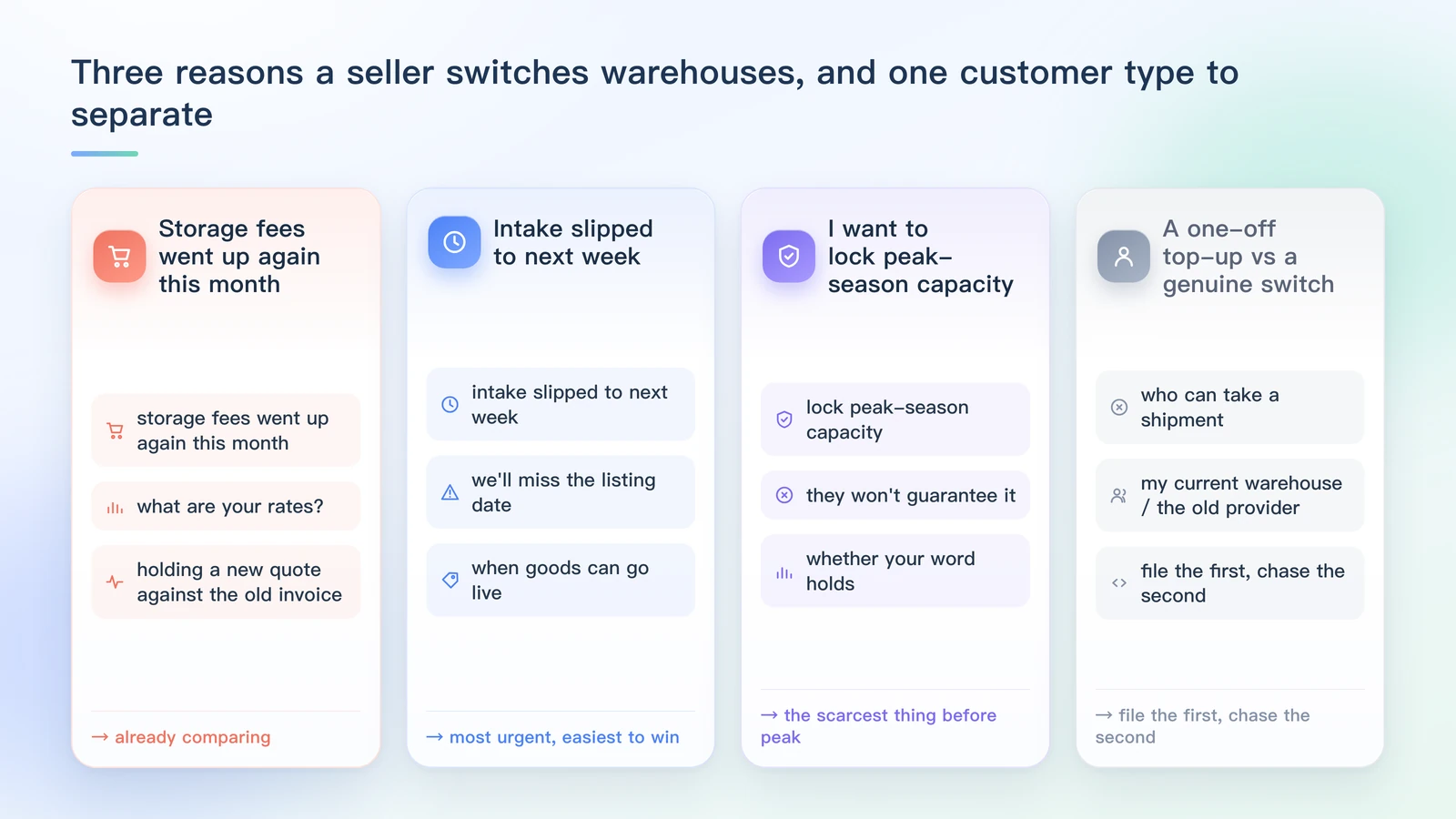
One more distinction matters: a one-off top-up and a genuine switch are different customers. Someone who only asks who can take a shipment usually needs space for one batch and leaves afterwards. Someone whose sentence includes “my current warehouse” or “the old provider” is genuinely comparing. File the first, chase the second the same day.
2. Where sellers actually ask
Sellers don’t sit in “overseas warehouse resource” groups — those are all competitors. They stay in their own circles (illustrative example): marketplace seller groups, independent-store seller groups, category groups (home, auto parts and small appliances each have their own) and platform seller communities.
To find them, use Top Prospect. It turns search into four entries: AI search, Google, Bing and the built-in group library (currently showing 50 public groups loaded). AI search takes plain language, so you can type “Telegram groups where US marketplace sellers gather” without assembling keywords.
Each result card gives the group name, description, category tag, primary language, member count, last verified date and date added. Screen on two criteria: primary language should match the regions your warehouses serve, and member count should stay modest — in an operations group of a few hundred, sellers are genuinely talking about their shipments.
Search results are not memberships. As the results page states, a result doesn’t mean the group has been joined, doesn’t mean collection is enabled, and isn’t a platform endorsement. Joining remains manual, one group at a time.
3. Turn the three sentences into a rule
Adding groups is only the start. An active seller group runs several hundred messages a day, and nine out of ten are order screenshots, shipping questions and platform policy talk. Switching signals are buried in between. Manual monitoring dies two ways: you can’t keep up, or you quit on day three.
Hand this step to recognition rules. Building one in Top Prospect doesn’t require expressions — it’s a conversation: are you looking for clients or suppliers, what do you provide, which clients matter most, what problems do they usually hit, what conditions matter most, and where are you targeting. A warehouse sales rep fills in: clients; US and European warehousing and fulfillment; sellers complaining about storage fee increases, intake delays and peak capacity they can’t secure; listing turnaround and capacity stability as priority; US East, US West, Europe.
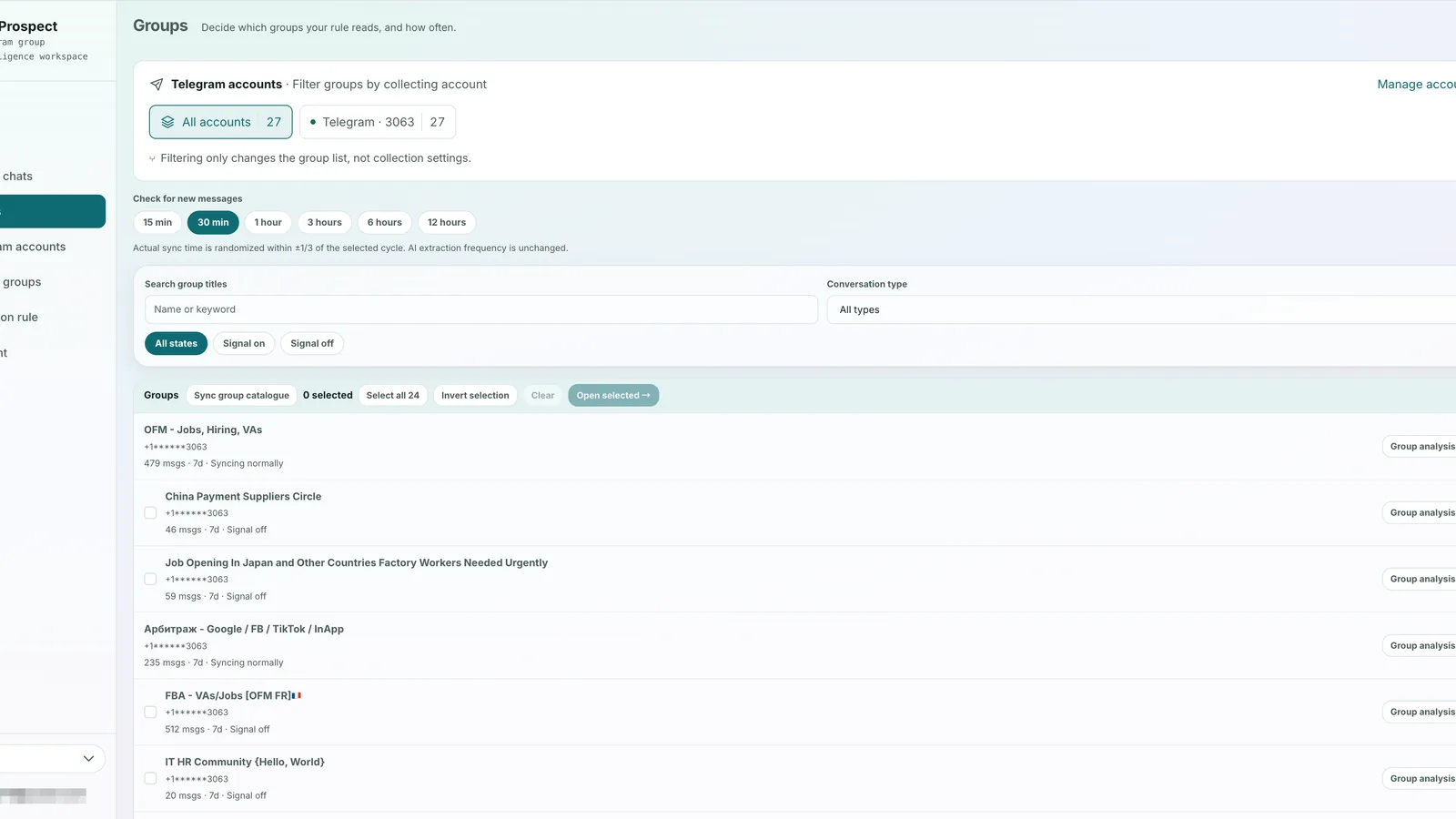
Bind the rule to your groups and it runs on its own, with hits scored and listed. The Groups page also lets you set a check frequency per group, from 15 minutes to 12 hours, so core seller groups run at the shortest interval and the rest relax. Note the interface states that actual sync times are randomized within ±⅓ of the selected interval and don’t affect AI extraction frequency — so the shortest setting isn’t real time, and important accounts still need scoring to surface first.
Rules are not magic. A top score only means “probably” — whether this seller has goods to move and genuinely plans to switch still takes opening the original message.
4. The five-day routine
A junior rep can run this as-is (illustrative example):
Day one: search and screen groups. Keep 10 with a high concentration of sellers using the two criteria above, and join them one by one.
Day two: configure recognition rules for those groups, targeting storage fee complaints, intake delays and capacity commitments.
Day three: read the first round of hits and pick only the ones containing “my current warehouse” or “the old provider”. Open with the thing he is complaining about — a fee increase gets a total-cost conversation, an intake delay gets a listing-date commitment.
Day four: send the sellers who engage a one-pager with three things only: warehouse locations, turnaround commitments, and how peak capacity is guaranteed. No price list.
Day five: book a video warehouse walkthrough, or hand over an executable listing schedule. This step turns “we talked” into “he remembers you”.
You never need to mass-message, and you never need to join irrelevant groups. The method is one move: swap the time you spend sending price lists for searching groups, building rules and reading hits.
Closing: Let BD spend their time following up
The scarcest resource for a BD isn’t Telegram groups — it’s time. If a few hours every day still go to:
- searching for new groups
- verifying whether a group is any use
- scrolling hundreds of historical messages
- manually hunting keywords
- copy-pasting potential leads
then time actually spent talking to customers keeps shrinking. The saner approach is to hand the repetitive front end to a tool: AI finds groups, Top Prospect builds the pool and monitors it, signals locate the demand, and a person judges and follows up. A tool shouldn’t decide for a BD whether “this person is a customer”. What it should do is: put the message worth reading in front of you at the right moment. That is the problem automation should actually be solving.
Frequently asked questions
A seller just asked who can take a shipment. Is that a switching signal?
Read the context. 'Who has space' alone is usually a one-off top-up. Once 'my current warehouse' or 'the old provider' enters the sentence, he is comparing. File the first for later; chase the second today.
Why does sending a storage price list convert so poorly?
What a seller is stuck on isn't price, it's whether goods list in time and whether peak capacity is guaranteed. Answer turnaround and capacity first and talk price in round two. Reverse that order and the quote is meaningless.
How early before peak season should I start watching?
The four to six weeks before peak season is the densest window, when sellers start working out capacity and listing dates. By the time someone asks publicly who has space, competitors are already quoting.
Sources and further reading
This article is human-authored. TOP Prospect processes only Telegram groups the user has explicitly authorized and connected. Its output supports human sales judgement; it does not replace human decisions and does not automatically contact or message group members.
How a Signal worth attention is found
See how Top Prospect finds and organizes Signals worth checking, keeps the original Telegram context, removes duplicates, and helps you decide what to review first. You decide whether to follow up and what to do next.