LayerZero ATLAS Is Not Live Yet: The Implementation Signals That Matter Next
ATLAS combines matching, clearing, settlement, and risk, but its Zero deployment is still pending. Here is how a Web3 infrastructure partnerships lead can separate copied claims from implementation evidence in authorized Telegram groups.
Signals to watch
- LayerZero places matching, clearing, settlement, and risk in one headless backend rather than in separate venue-owned systems
- Trading venues keep the frontend and distribution relationship while market creators and market makers occupy separate roles
- LayerZero ties venue fee rebates to volume and/or ZRO stake, making backend selection an economic and capital decision
- The product page says the Zero-backed deployment is coming later in 2026, so stated latency and throughput are not independent public-production results
A Web3 market-infrastructure partnerships lead may see three ATLAS fragments arrive in different authorized Telegram groups on the same morning: “p99 2.641 ms,” “venues keep up to 65%,” and “200,000 TPS.” The numbers look concrete enough to forward. They still do not show that a venue is integrating ATLAS, that a production network is live, or that anyone has accepted the published economics.
The useful judgment is narrower: ATLAS becomes a commercial Signal when a discussion adds an owned implementation detail to the official announcement—a named venue role, integration interface, test environment, operator, dependency, or decision date. Until then, the message is market context.
LayerZero announced ATLAS on August 25, 2026 as a headless exchange backend combining matching, clearing, settlement, and risk. Its product page still says the Zero-backed deployment is coming later in 2026. Every performance and economics figure below is therefore attributed to LayerZero, not presented as an independent production result.
Key takeaway
- The announcement is confirmed; public Zero-backed availability is still described as future.
- A copied benchmark is not an integration Signal. A named system, owner, environment, or deadline is.
- “Venue,” “market creator,” and “market maker” describe different commercial roles; mixing them produces bad partner routing.
- TOP Prospect can organize evidence from Telegram groups the user deliberately connects and is authorized to access, but a person must verify identity, status, and intent.
The announcement image establishes the product name, publisher, and date. It does not establish production use.
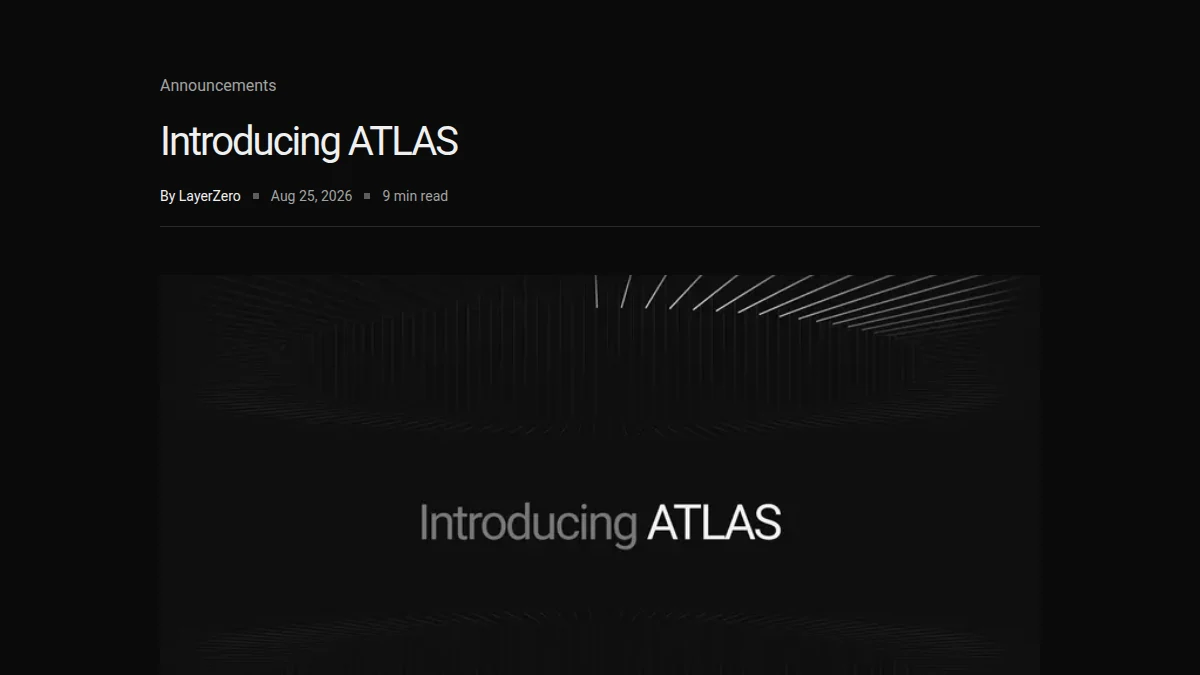 The official announcement confirms that LayerZero introduced ATLAS. It does not prove that the Zero-backed public deployment is live. Source: LayerZero.
Start with status, not speed
When an ATLAS message appears, the first question is not whether 2.641 milliseconds is fast. It is which stage the message can actually prove.
| Evidence state on August 26, 2026 | What can be said |
|---|---|
| Confirmed announcement | LayerZero introduced ATLAS as a headless backend for matching, clearing, settlement, and risk. |
| LayerZero-reported test | The company reports sub-millisecond median latency, p95 of 1.418 ms, p99 of 2.641 ms, and a product-page median of 965 microseconds. |
| Planned provisioning | LayerZero says the launch configuration is planned for 200,000 transactions per second. |
| Expected future setup | The company expects double-digit-microsecond latency for colocated deployments. |
| Not established by the reviewed sources | Independent production measurement, a named venue deployment, a public service level agreement (SLA), or a completed customer integration. |
A service level agreement (SLA) is a contractual commitment for matters such as availability, latency, support, or recovery. A benchmark in a launch post is not an SLA. That distinction matters when a group participant writes “we need this latency” but does not name the workload, contract, environment, or responsible team.
Three incomplete messages, three different review paths
The partnership lead should not wait for a perfect request. Real early evidence is usually incomplete. The missing field tells you what to verify next.
- “Can the matching events feed our risk system?” suggests an application programming interface (API)—the documented way two software systems exchange data—but it does not name the venue, environment, or delivery date.
- “We are modeling the 65% venue rebate” points to economics work, but does not show eligibility, expected volume, ZRO stake, or approval.
- “Zero is later this year; can we test before then?” contains a timing constraint, but the test scope, access route, and decision owner remain unknown.
These are not invented customer quotes; they are representative fragments showing how the official facts can become incomplete group discussion. A reviewer should preserve the original wording and source before adding any interpretation.
The core decision is the same for all three: did the new message add implementation evidence, or did it merely repeat LayerZero’s page?
Route the message by ATLAS role
LayerZero’s “headless” design means ATLAS has no consumer trading interface of its own. A trading venue owns the interface and distribution. A market creator defines a market. A market maker supplies liquidity. The backend performs the functions LayerZero groups as matching, clearing, settlement, and risk.
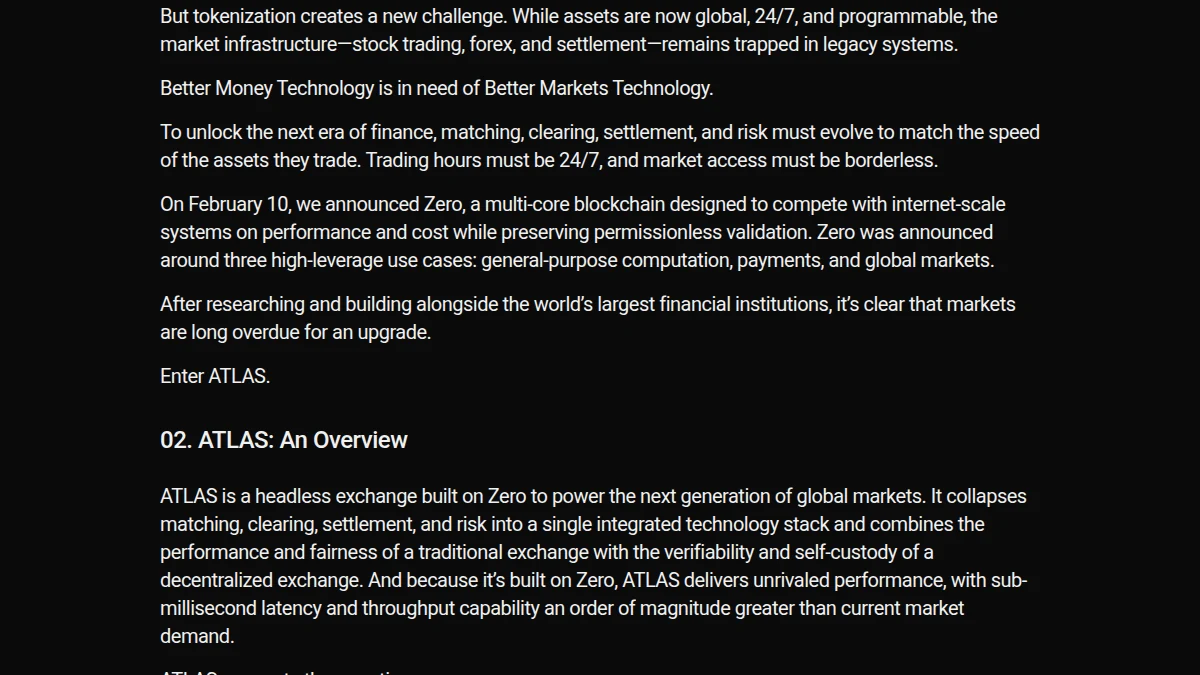 This capture supports LayerZero’s description of the architecture. It is first-party product evidence, not proof of an external venue deployment. Source: LayerZero ATLAS.
For a partnerships lead, the role changes the meaning of a message. A venue asking about branded frontend control is a distribution and integration discussion. A creator asking how a market is defined is a market-configuration discussion. A maker asking about order flow, inventory, or connectivity is a liquidity discussion. Sending all three to one generic “exchange lead” queue loses the owner and the next question.
Use five checks before raising priority:
- Identify which ATLAS role the message describes.
- Preserve the original group, author handle, timestamp, and surrounding thread.
- Name the system or process that would change: frontend, risk engine, market configuration, liquidity connection, or settlement.
- Separate LayerZero’s public claim from the participant’s own test or requirement.
- Record the human owner who will verify the statement and the date by which it matters.
The fifth check prevents a common failure: a technically interesting message sits in a queue with no one responsible for finding out whether it is real.
Treat performance as attributed evidence
LayerZero says its measured environment was designed to mirror a public deployment. That phrase is a useful limit, not a minor disclaimer. It says the test is intended to resemble production; it does not show an independently observed public workload.
The same applies to 200,000 transactions per second. The announcement describes planned launch provisioning, not a public result under a named traffic mix. Colocation latency is described as expected. The reviewed materials do not publish a third-party benchmark, duration, order distribution, failure rate, recovery test, or external service commitment.
A high-priority group message should narrow one of those unknowns. “We saw p99 under three milliseconds” is still weak if the author gives no environment or method. “Our risk adapter received the test feed in staging on 28 August, and the venue team must decide whether to continue by 2 September” is much stronger because it adds a system, observation, and decision window.
This is the judgment ATLAS requires from a market-infrastructure partnerships lead: not “is the number impressive?” but “what new evidence does this message contribute beyond the publisher’s number?”
Read the economics as a partner constraint
LayerZero publishes a venue rebate of 20% to 65%, based on volume and/or ZRO stake. After that rebate, the remaining economics are described as 25% to the market creator and 75% used for ZRO buy-and-burn.
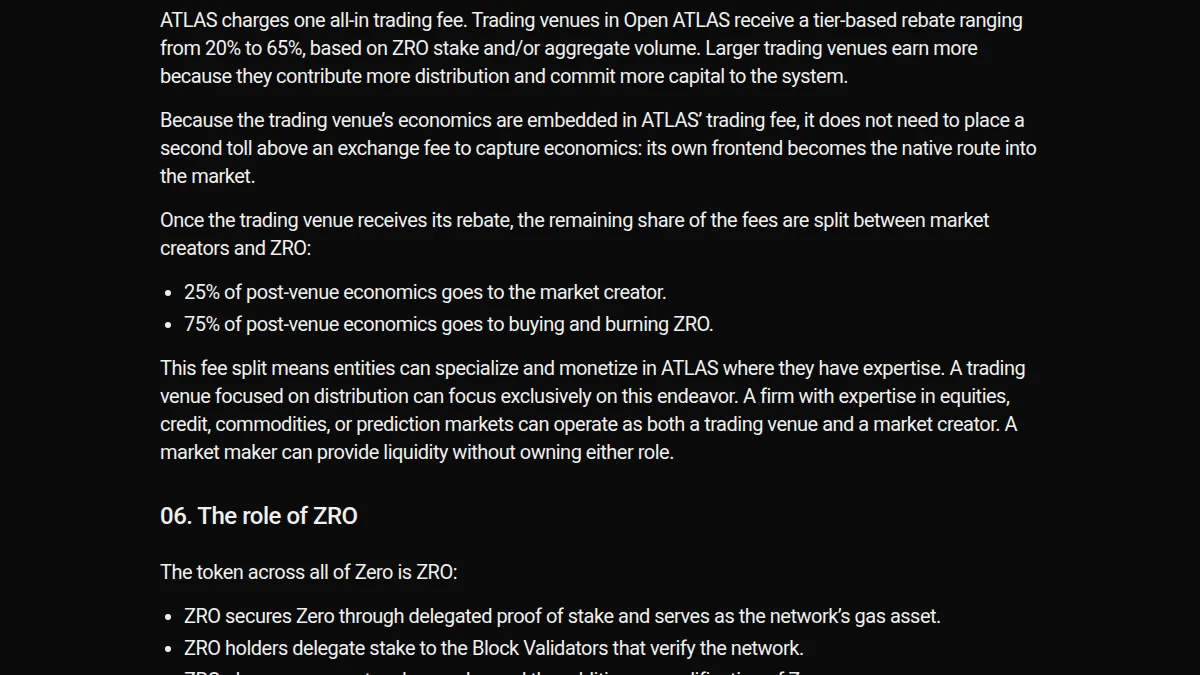 The image confirms LayerZero’s published formula. It does not prove that a venue has qualified for a tier or received a payment. Source: LayerZero ATLAS.
For partnership review, the formula creates concrete questions: which entity is the venue, who holds or stakes ZRO, how volume is measured, who is the market creator, and which agreement controls changes. A message that merely repeats “65%” deserves low priority. A message that names the entity modeling a tier, the volume assumption, and the contract decision deserves human review.
| Group fragment | What it establishes | What still needs verification |
|---|---|---|
| “ATLAS gives venues 65%” | A public maximum is being repeated | Eligibility, volume, stake, contract, recipient |
| “Our venue team is modeling the rebate” | A possible evaluation owner exists | Identity, approved project, inputs, decision date |
| “Market creator terms are blocking launch review” | A specific commercial dependency is claimed | Market, document, parties, authority, timing |
| “Maker connectivity test starts Thursday” | A named activity and date are claimed | Environment, operator, scope, observed result |
A single precise dependency is more useful than twenty reposts of the economics chart.
Where TOP Prospect fits—and where it stops
TOP Prospect can continuously process only the Telegram groups a user intentionally connects and is authorized to access. For an ATLAS topic, it can retain the original message, source, timestamp, and nearby context; merge obvious reposts; classify the likely venue, creator, or maker theme; and rank the discussion for a human reviewer.
The output is a candidate Signal, not fact certification. The product does not read private chats, enter groups the user has not authorized, identify an anonymous account, inspect an ATLAS deployment, verify a benchmark, or contact the poster automatically. It also cannot prove that two handles belong to the same company.
The partnerships lead still returns to the source, checks the official Telegram market-signal method, compares the fragment with LayerZero’s current pages, and decides whether to verify, monitor, or dismiss it. A high score means “review sooner,” not “adoption confirmed.”
The alternative may be better
A venue does not have to choose a shared headless backend. It can keep an existing centralized stack, buy components from established market-infrastructure vendors, or build specific matching and risk services itself. Those choices may provide clearer control, known operating history, existing compliance processes, or a better fit for a specialized market.
ATLAS offers a different boundary: the venue keeps interface and distribution while LayerZero proposes a common backend and published economics. That can reduce duplicate infrastructure, but it also concentrates important functions and introduces dependencies on availability, governance, integration, and ZRO-linked terms.
For the reader, this trade-off changes the Signal threshold. General interest in faster trading is not enough. Evidence becomes commercially relevant when a team names the function it might move, the alternative it is comparing, and the decision it must make.
The next useful message will be specific
ATLAS is a confirmed product announcement with detailed first-party claims. It is not yet independently demonstrated public market infrastructure on Zero.
For a Web3 market-infrastructure partnerships lead, the earliest useful Signal will not be another screenshot of “sub-ms.” It will be a fragment that adds an owner and an implementation object: a venue integrating a risk feed, a creator resolving market terms, a maker scheduling connectivity, or a team assigning a deadline to the economics.
Preserve the fragment. Attach the source. Keep LayerZero’s claim separate from the participant’s observation. Then let a person verify it. That is how an ATLAS headline becomes a reviewable commercial Signal without becoming an invented deal.
FAQ
Is ATLAS live in public production?
The reviewed product page says the Zero-backed deployment is coming later in 2026. LayerZero reports results from an environment intended to mirror public deployment, which is not independent public-production evidence.
What does “headless exchange” mean here?
ATLAS does not provide the consumer frontend. The venue owns interface and distribution while the backend handles the functions LayerZero describes as matching, clearing, settlement, and risk.
Which ATLAS message deserves priority?
A message that adds a named role, system, environment, test, dependency, owner, or decision date. A repost of a benchmark or rebate alone is market context.
Can TOP Prospect verify that an ATLAS project is real?
No. It can organize and rank evidence from authorized connected Telegram groups. A person must verify identity, project status, technical results, and commercial intent against original and authoritative sources.
Sources were reviewed on August 26, 2026. Availability, performance, economics, and deployments may change after publication.
Frequently asked questions
Is ATLAS live in public production?
The reviewed LayerZero product page labels the Zero-backed deployment as coming later in 2026. The announcement reports results from an environment intended to mirror public deployment, which is not the same as independently observed production operation.
What does headless exchange mean in ATLAS?
LayerZero says ATLAS has no consumer frontend. A trading venue owns the interface and distribution while using ATLAS for the underlying market engine.
Who participates in the ATLAS model?
LayerZero names trading venues, market creators, and market makers. Venues distribute the product, creators define markets, and makers provide liquidity.
Are the latency and throughput numbers independently verified?
No independent verification was located in the reviewed official materials. They are LayerZero-reported figures with limited public methodology and should remain attributed.
Sources and further reading
Market and risk discussion is supporting evidence
Top Prospect is primarily a Telegram lead-generation product. Market and risk discussion can add context to a candidate lead, but it does not become a verified incident, trend, or sales opportunity automatically.