“We Still Have 40 Devices to Check by Friday”: The Message a Wallet-Security Seller Should Notice
A security headline fills a Telegram group with noise. A device count, unfinished job, and Friday deadline reveal the message that may deserve a sales follow-up.
Signals to watch
- A team names a device count, missing version list, or specific wallet flow that still needs checking
- The message includes an unfinished job, a person responsible, or a deadline such as Friday or the next release window
- The team describes a practical obstacle such as old devices, failed transactions, or a limit on signing downtime
At 11:20 on a Tuesday morning, you open a Telegram group and find 300 unread messages.
Most people are talking about the same thing: a security researcher has disclosed a bug in Ledger’s Ethereum app. Links are being forwarded. People are arguing about whether hardware wallets are still safe. Someone posts “Update now” in capital letters.
Then two messages appear five minutes apart:
“Ledger has a vulnerability. Is every signature unsafe now?”
“We still have 40 signing devices to check. Nobody has a complete firmware and Ethereum app version list, and security wants it by Friday.”
If you sell wallet integration, security testing, device management, or upgrade support, which message deserves your attention?
The second one.
Not because it sounds more technical. It actually sounds less technical. It deserves attention because there is a real job hidden inside it: 40 devices need to be checked, the version list is missing, and somebody expects the work by Friday.
The first message is news chatter. The second may become work.
Every Telegram-style message and work scene in this article is fictional and representative. None is a quote from a Ledger customer. But the difference between them is exactly what a salesperson or BD sees every day: hundreds of people discussing an event, and perhaps one or two people revealing that the event has created a problem inside their company.
The headline is not the sales signal
The public facts matter, but you do not need to become a hardware-wallet engineer to understand them.
On 22 August, security researcher TestMachine described a way in which one transaction could be shown on the device while another was signed. The researcher made a broad claim about which devices were affected.
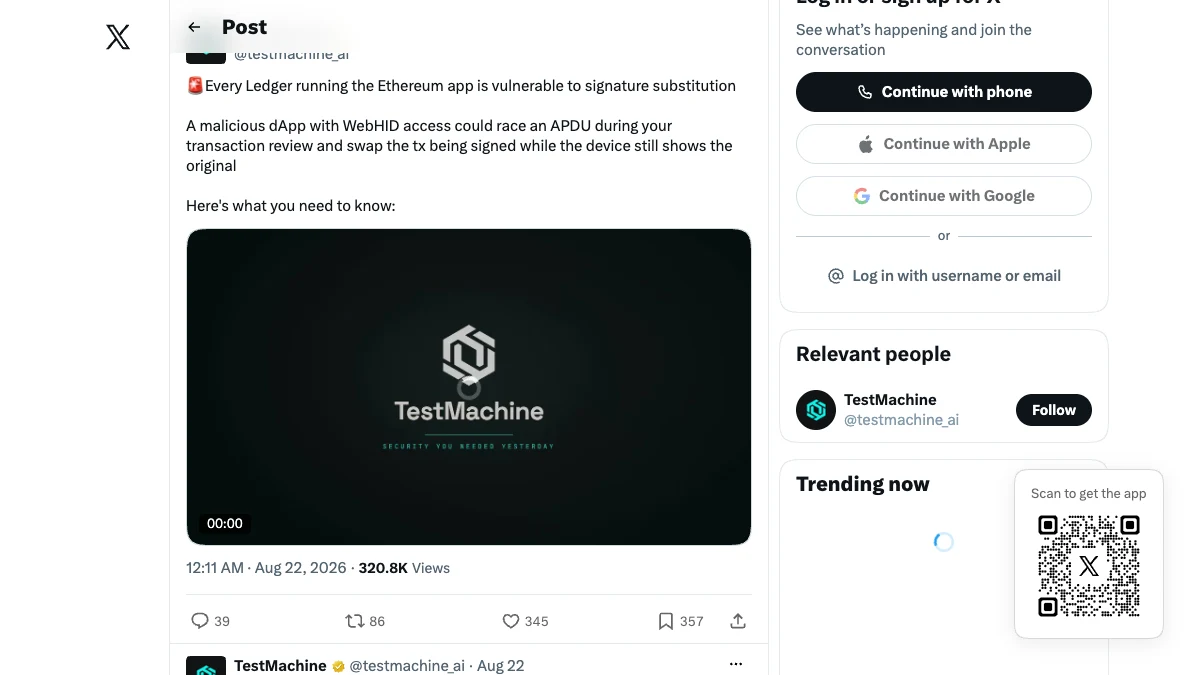 TestMachine’s description and broad statement about scope are the researcher’s claims.
Ledger’s response was narrower. The company confirmed a bug in certain clear-signing flows in its Ethereum app and said the bug had already been repaired on 12 August. Clear signing simply means the device shows transaction details in readable language before the user approves them.
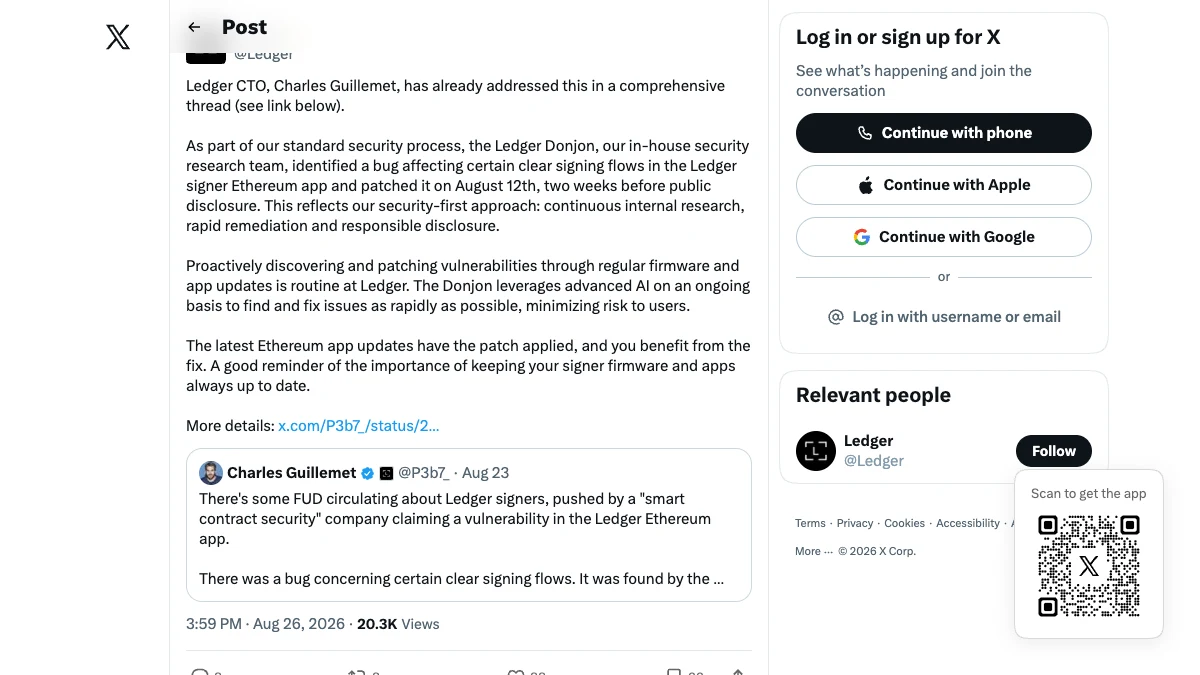 Ledger confirmed a limited bug and a prior fix; it did not say every device or every signature was affected.
That is enough background for a responsible sales conversation. Do not tell everyone using Ledger that they are vulnerable. Do not turn a researcher’s claim into a fear-based pitch. The useful question is much simpler:
Which teams now have work they cannot comfortably finish on their own?
Look for four ordinary details
You do not need a 20-point scoring system. When a news event takes over a group, look for four things people naturally mention when a problem has entered their working day.
1. A number
Compare these two messages:
“We use Ledger too.”
“We have 40 devices across Singapore and Dubai, and 13 of them have no version recorded.”
The first tells you almost nothing. The second gives the problem a size.
Numbers can be devices, users, wallets, transactions, offices, or failed tests. “Three customers reported it this morning” is more useful than “some users are complaining.” “Our six backup devices are still offline” is more useful than “the upgrade is messy.”
A number does not prove there is a budget. It does tell you that the writer is close enough to the work to see its shape.
2. An unfinished job
People with a real problem often use verbs such as “check,” “test,” “replace,” “upgrade,” “reproduce,” or “report.”
For example:
“We need to test Safe transactions again after the update.”
Safe is a popular multisignature wallet, meaning several people may need to approve a transaction. The writer is not merely discussing the news. Their team has something it must test before it can feel comfortable using the updated setup.
Another example:
“The app is updated, but contract calls still fail in our browser wallet.”
Now there may be an integration problem between the device, the browser wallet, and the application. You still do not know which part is broken, but you know somebody has tried the update and remains stuck.
3. A deadline
“We should look into this” can remain a group-chat thought forever.
“Security wants the device list by Friday” is different. So is “We cannot reopen withdrawals until the regression test passes” or “Our next release is Thursday at 18:00 UTC.”
A date changes how people buy help. Without a deadline, an internal team may put the work in its backlog. With a deadline, it may need an extra tester, a second pair of eyes, or somebody who has handled the upgrade before.
4. An obstacle
The most revealing sentence is often not “we need help.” It is a small complaint about why the work is hard:
“Two older devices will not upgrade directly.”
“Finance will not allow more than 30 minutes without signing capacity.”
“The person who set this up left last quarter.”
“We have the device list, but nobody knows which app version is installed.”
These sentences tell you why the team may not solve the problem with a link to the release notes. There is old hardware, an operating restriction, missing knowledge, or incomplete records.
The combination is what matters: a visible amount of work + an unfinished task + a time limit or obstacle.
Three messages worth saving
Imagine you monitor several wallet, custody, and Web3 infrastructure groups. These fictional examples show three different kinds of possible work.
“We need the version list by Friday”
This could become a device-inventory job. The team may need help finding which firmware and Ethereum app versions are installed, separating active devices from spares, and recording who owns each device.
Your first reply should not be “We can secure all 40 devices.” You do not know that they are insecure, and you do not know whether the writer is allowed to bring in an outside provider.
A better private message is:
“Saw your note about the 40-device list. Is the difficult part collecting the versions, or deciding which devices need an update before Friday?”
That question is easy to answer. It also helps the buyer tell you where the work is stuck.
“Safe and typed-message signing both need to be retested”
This could become a testing job. “Typed-message signing” refers to structured information a user sees before signing, such as an order or permission, rather than an unreadable string of data.
The valuable part of the message is not the terminology. It is that two real signing actions must pass again before the team can move forward.
You could ask:
“Are you rebuilding the test cases, or do you already have them and need someone to run the device and wallet combinations?”
Now you are learning whether they need test design, extra hands, or help with a failing integration.
“We can only take signing offline for 30 minutes”
This could become an upgrade-planning job. A treasury or custody team may need to update devices without leaving the company unable to approve transactions for hours.
The 30-minute limit is important because it connects a technical update to a business operation. It also suggests that somebody in finance or operations is involved, not only a person chatting about security news.
A useful question is:
“Do you already have a backup signer tested, or is keeping one signer available the part blocking the upgrade?”
Again, the goal is not to force a demo into the conversation. It is to find out whether there is a defined problem your team can actually solve.
What not to do when the group is nervous
A security story creates urgency, but it also makes bad outreach especially visible.
Do not copy the same “We noticed you may be affected” message to everyone who mentions Ledger. Some are individual users. Some already updated. Some are only forwarding the news. Some may use a different app or signing flow entirely.
Do not say version 1.22.2 is “the latest safe version.” Ledger’s public release for 1.22.2 mentions security fixes, but 1.22.3 was already available by the time of this research. The correct version is the one currently offered through Ledger’s official management software for that team’s setup.
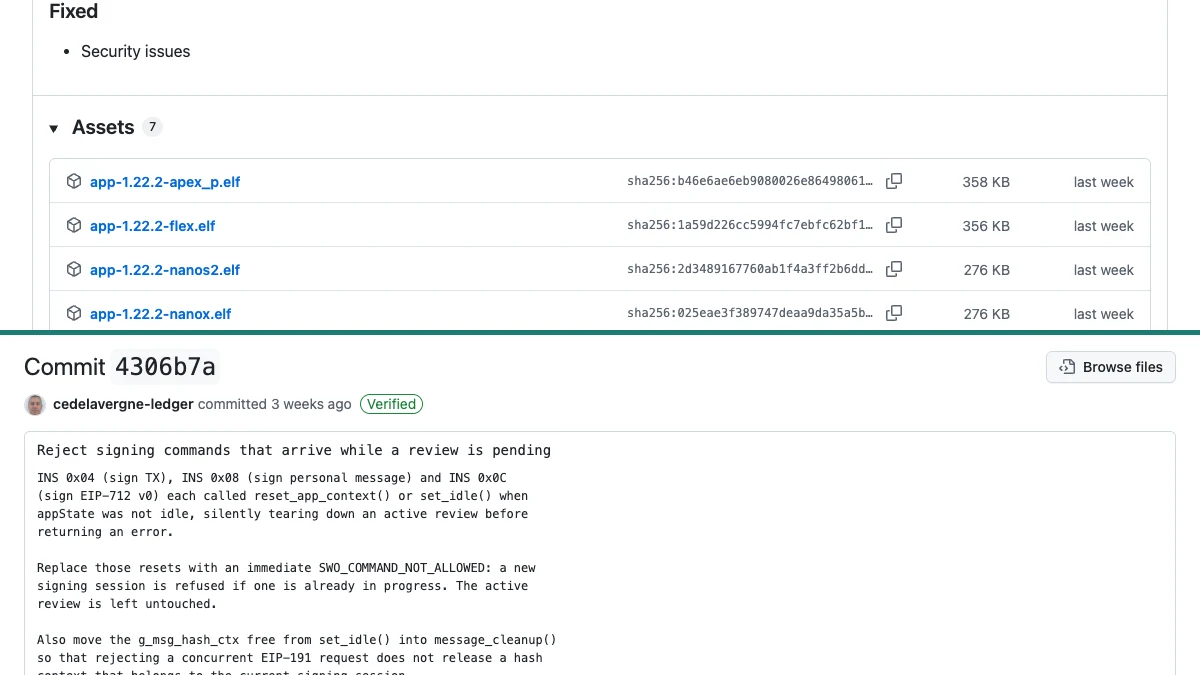 The public code and release record show a repair, but they do not provide a complete list of every affected version and signing action.
And do not open with the most frightening interpretation of the bug. Ledger confirmed certain clear-signing flows were affected; it did not say every Ledger device and every signature was unsafe. A buyer with technical knowledge will notice the exaggeration immediately.
How TOP Prospect fits into the morning routine
The hard part is rarely understanding one message after someone sends it to you. The hard part is noticing that message while it is buried among 300 others.
In TOP Prospect, a salesperson can monitor Telegram sources they are authorized to use and define the words and context worth reviewing. For this story, the obvious word “Ledger” is only the starting point. The useful messages often contain more practical language:
- “still on the old app”
- “need to check versions”
- “test before release”
- “cannot upgrade”
- “withdrawals still paused”
- “signing downtime”
TOP can retain the matched message with its source, time, and nearby conversation. That context matters. “Need to check versions” may be a general suggestion. “Maya, can you check all 40 before Friday?” is an assigned job.
Your review can therefore be simple:
- Ignore pure news forwarding and general arguments.
- Save messages that mention a number, task, deadline, or obstacle.
- Read the nearby conversation to see whether the writer is talking about their own team.
- Ask one short question about the missing detail.
TOP does not read the hardware device, confirm its installed version, prove the writer has a budget, or decide that a team is vulnerable. A person still verifies those facts. Its value here is making sure the one useful sentence is not lost in the morning flood.
The message to remember
When the next security story fills your Telegram groups, do not ask only, “Who is talking about it?”
Ask, “Who has just described work they now have to finish?”
“Ledger has a vulnerability” is a topic.
“We have 40 devices to check, nobody has the complete list, and security wants it by Friday” is a possible problem, owner, scope, and deadline in one message.
That is the message worth reading twice—and the one worth answering like a helpful person rather than an alarmed vendor.
Frequently asked questions
Did Ledger say every signature or every Ledger device was affected?
No. Ledger said the bug affected certain clear-signing flows in the Ledger signer Ethereum app. TestMachine made a broader claim, which should remain attributed to the researcher rather than presented as an agreed scope.
Is Ethereum app 1.22.2 the latest version?
It is the release whose public note says it fixed security issues, but version 1.22.3 was already published by this article's research date. Teams should use Ledger's official management software to check the current available app and firmware versions.
Can TOP Prospect verify that a device or signing path is safe after an update?
No. It can preserve matched Telegram messages and nearby context from authorized sources. Installed versions, device state, test results, identity, authority, and vendor access require direct human verification.
Sources and further reading
- TestMachine public disclosure
- Ledger official confirmation
- Ledger CTO update advice and bug confirmation
- LedgerHQ Ethereum app 1.22.1 release
- LedgerHQ Ethereum app 1.22.2 release
- LedgerHQ Ethereum app 1.22.3 release
- LedgerHQ comparison from Ethereum app 1.22.1 to 1.22.2
- LedgerHQ review-state signing-command fix
This article is human-authored. TOP Prospect processes only Telegram groups the user has explicitly authorized and connected. Its output supports human sales judgement; it does not replace human decisions and does not automatically contact or message group members.
How a Signal worth attention is found
See how Top Prospect finds and organizes Signals worth checking, keeps the original Telegram context, removes duplicates, and helps you decide what to review first. You decide whether to follow up and what to do next.