How do you find clients for cross-border payments? Stop staring at company lists — people in Telegram groups are looking for payment solutions right now
A company list tells you who might need payment services; Telegram discussions tell you who is solving a payment problem right now. From search keywords to five payment signal types to context-based judgment, a workflow that treats events as the unit of client acquisition.
If you work in cross-border payments, this acquisition routine should feel familiar:
Find company lists.
Find independent stores.
Find foreign trade companies.
Find e-commerce sellers.
Then:
Email → LinkedIn → WhatsApp → cold outreach.
This method still works, of course.
But one problem has always been there:
What you find is “a company that might need payment services”, not “someone who is looking for payment services right now”.
The difference between the two is actually huge.
A cross-border e-commerce company may have been using a certain payment channel all along.
You have its company name, website, email, and you may even know it probably has a fair number of overseas orders every month.
But you don’t know:
Whether it has any intention of switching payment providers right now.
And what often shows up in Telegram is a different kind of message:
“Stripe rejected me. What alternatives are there?”
“Is there a collection channel that supports a certain country?”
“Why has this payment provider been so slow lately?”
“Is there a payment solution suitable for high-risk businesses?”
“Who has used XXX acquiring?”
The value of this kind of information is not that it tells you:
“This person works at a cross-border e-commerce company.”
It’s that it may tell you:
“This person is solving a payment problem right now.”
That’s why I find client acquisition on Telegram interesting.
1. A traditional list tells you “who the client is”
Suppose you’re in cross-border payments.
Your target clients might include:
- Cross-border e-commerce
- Independent store sellers
- SaaS companies
- Game studios going global
- Digital product merchants
- Overseas service providers
- Cross-border trading companies
If you search the traditional way, you usually build a table like this:
| Company | Website | Country | Industry | Contact |
|---|---|---|---|---|
| Company A | xxx.com | UK | E-commerce | |
| Company B | xxx.com | US | SaaS | |
| Company C | xxx.com | Germany | E-commerce |
There’s a lot of information.
But one thing is missing:
Why contact them now?
You can only guess.
“They probably need cross-border collection.”
“They probably have payment needs.”
“Our solution probably fits their business.”
The problem is exactly this “probably”.
2. Information in Telegram works the other way around
The logic of Telegram communities is different.
Most people don’t show up as an “enterprise client”.
They show up as a person in the middle of solving a problem.
For example, a seller would never write in their LinkedIn profile:
“I am looking for a new payment provider.”
But when their payments hit a problem, they may go ask in an industry group:
“Anyone has experience with another payment provider?”
At that point, the information you get is different.
What you see is not just:
Who
But:
Who + What + Why + Now
That is:
Who is speaking What problem they are solving Why it needs solving Whether the need is happening right now
For BD, the last few pieces are often more worth investigating than a cold company list.
3. So I wouldn’t search for “cross-border payment clients” first
If I had to build a cross-border payment Telegram group pool from scratch, I would not just search:
Cross-border payment
I would widen the search.
For example:
Payments
Payment
Payment Gateway
Payment Provider
Payment Processing
Merchant Account
Cross-border e-commerce
E-commerce
Shopify
Dropshipping
DTC
Online Business
Going global
Business Owners
Digital Nomads
SaaS
Online Entrepreneurs
Problems
Stripe
PayPal
Chargeback
Payment Failed
Payment Solution
Because your clients don’t necessarily gather in:
“cross-border payment groups”
They are more likely to gather in:
“groups where people are actually doing cross-border business”.
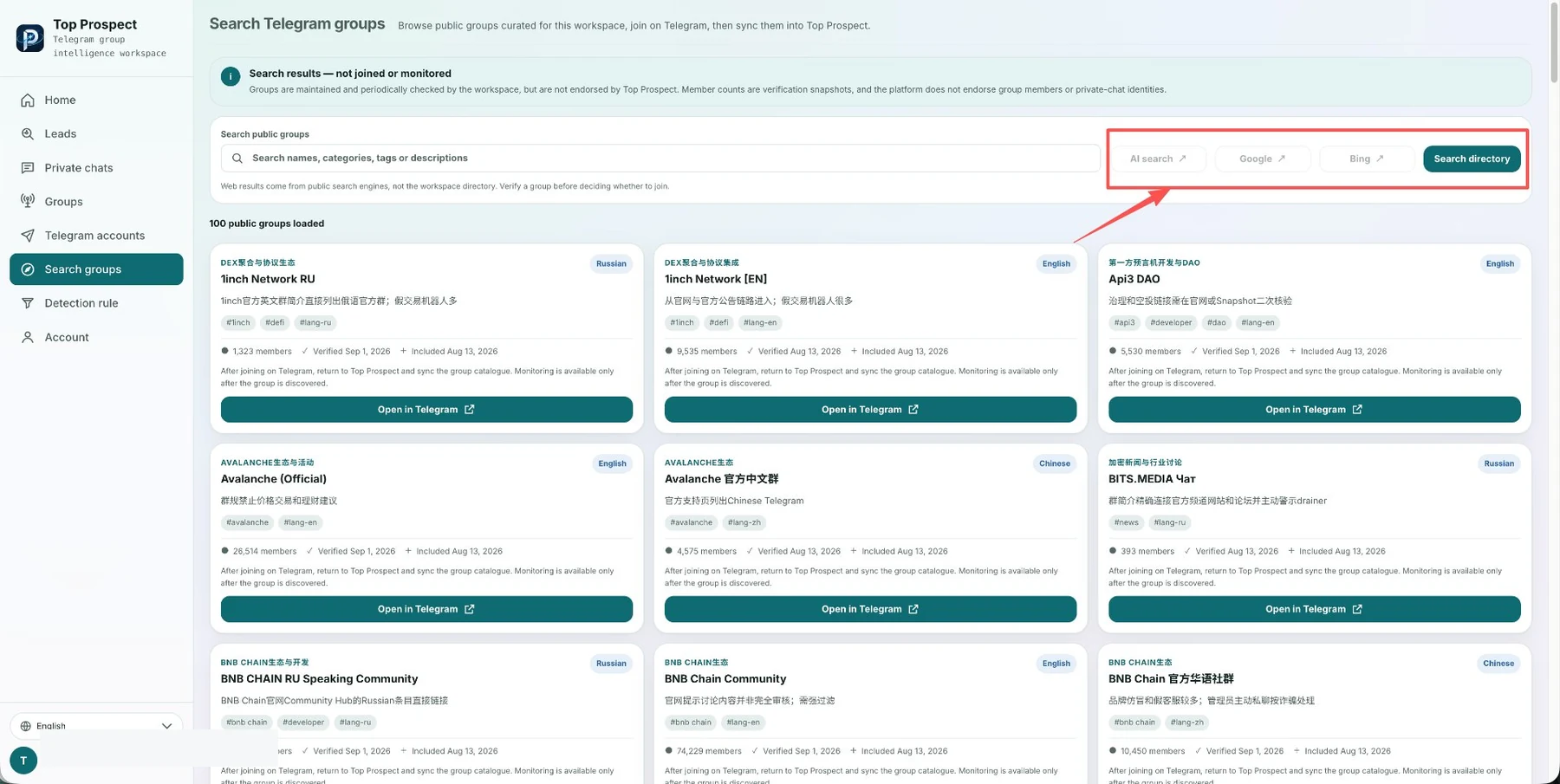
4. TOP Prospect’s group search solves exactly this problem
In TOP Prospect you can search Telegram public groups directly.
You can find different types of communities by keyword, then filter by the group information.
For example:
Payment
A batch of payment-related groups comes up.
Then search:
Shopify
Another batch of e-commerce seller communities.
Then search:
SaaS
Another batch of software founders.
Then put these groups into your own target community pool.
At that point, what you’re doing is not simply:
“finding groups.”
You’re building a:
map of where cross-border payment demand is likely to happen.
I think this mindset means more than simply chasing “how many groups I joined today”.
Figure 1: TOP Prospect’s “Search Telegram groups” page. Next to the search box there are four entries (AI search, Google, Bing, directory search); result cards show group name, description, category tags, primary language, member count, last verified date and inclusion date.
5. But one thing matters a lot: don’t charge at “Stripe”
This is a mistake many people make when doing client acquisition on Telegram.
Seeing:
Stripe
they conclude:
payment need.
Seeing:
PayPal
they conclude:
payment need.
Not necessarily at all.
When a person says:
“Stripe launched a new feature.”
versus when he says:
“Stripe rejected my account. What can I use instead?”
the business value is completely different.
So what really needs monitoring is not:
the brand name.
But:
brand name + problem + intent to act.
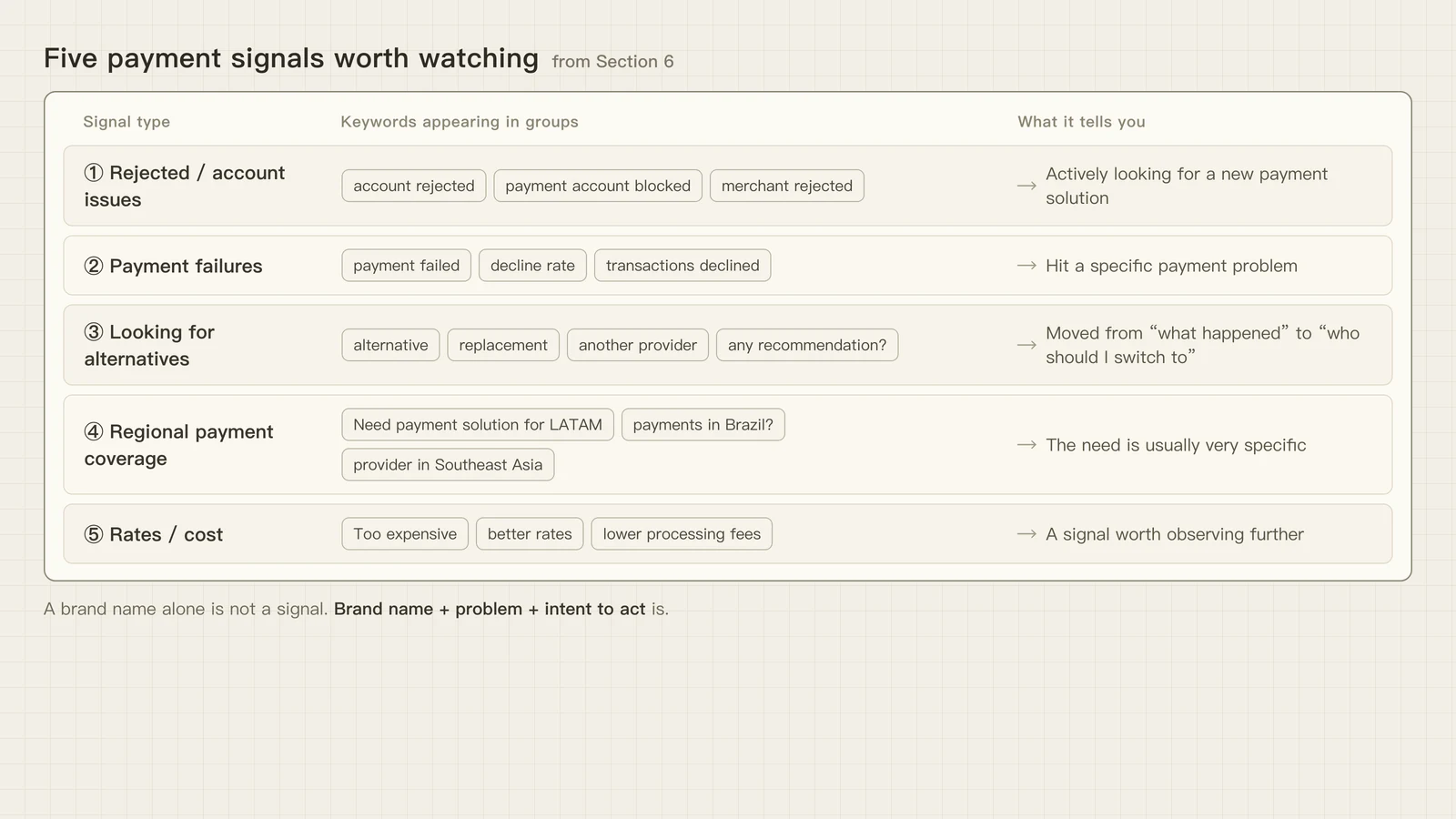
6. These are the payment signals I watch closely
If you’re in cross-border payments, you can start from a very simple classification of needs.
① Rejected / account issues
For example:
account rejected payment account blocked merchant rejected
Behind it may be:
actively looking for a new payment solution.
② Payment failures
For example:
payment failed decline rate transactions declined
The point is not “someone mentioned payment”.
It’s:
he ran into a specific payment problem.
③ Looking for alternatives
This type of signal is usually more direct:
alternative
replacement
another provider
any recommendation?
It means the discussion has moved from:
“what happened?”
To:
“who should I switch to?”
④ Looking for payment coverage in a specific region
For example:
Need payment solution for LATAM.
Anyone supports payments in Brazil?
Looking for a provider in Southeast Asia.
These discussions have another trait:
the need is usually very specific.
Region, business type, and payment method may already be on the table.
⑤ Rates / cost
For example:
Too expensive.
Anyone has better rates?
Looking for lower processing fees.
These discussions don’t necessarily turn into clients right away, but at minimum they are a signal worth observing further.
Figure 2: the keywords of the five payment signal types and what each of them tells you (taken from the text above).
7. The ones truly worth following up are the people whose “problem has already happened”
Put these two sentences side by side and the difference is easy to see.
A:
“Does anyone know good payment providers?”
B:
“Our current provider keeps declining transactions. We need another option.”
Both sentences are about payments.
But the second one carries much more complete information:
There is already a current provider
↓
An actual problem appeared
↓
Actively looking for an alternative
At that point, BD has a lot more to work with.
For example:
- What is his business?
- Which market?
- What payment methods?
- What is the problem?
- Which provider is he using now?
- Is there a clear need to switch?
So a signal is not:
“this person will definitely buy.”
It’s:
“a business event worth investigating has appeared here.”
Never mix these two concepts up.
8. A very practical method: add “context” to the signal
If all you see is:
“Anyone know another payment provider?”
that’s not enough.
Keep reading the context.
Maybe before it came:
“Our checkout conversion dropped.”
Then:
“Payments are getting declined.”
And then:
“Anyone know another provider?”
At that point what you’re looking at is no longer an isolated message.
It’s a complete chain of problems:
The business hits a problem
→
The payment step hits a problem
→
The current provider can’t meet the need
→
The search for an alternative begins
Only this kind of signal deserves to enter your manual judgment.
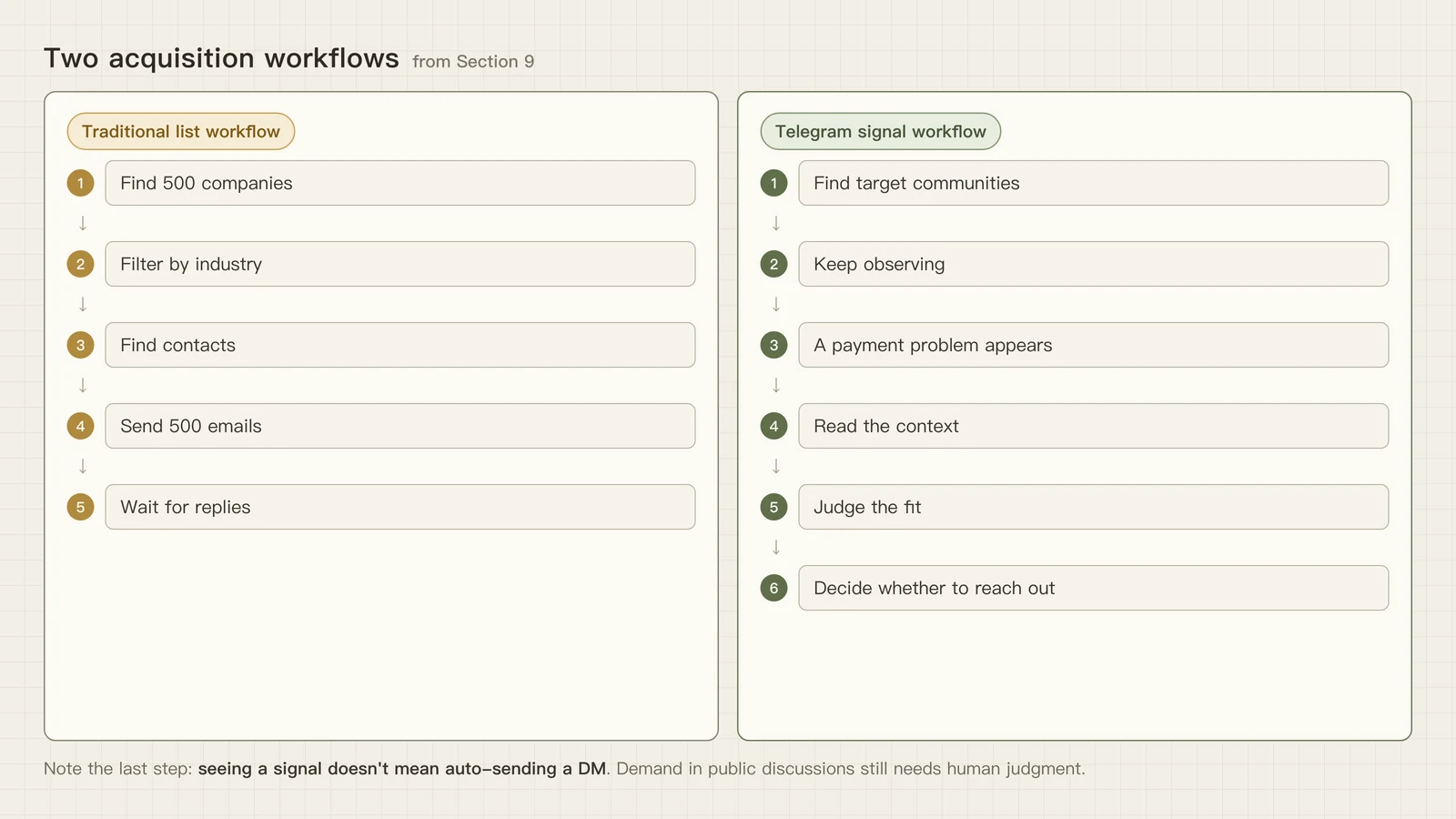
9. At this point, BD’s job actually gets simpler
The traditional way might be:
Find 500 companies ↓ Filter by industry ↓ Find contacts ↓ Send 500 emails ↓ Wait for replies
The Telegram signal approach is different:
Find target communities ↓ Keep observing ↓ A payment problem appears ↓ Read the context ↓ Judge whether it matches ↓ Decide whether to reach out
Notice the last step.
Seeing a signal does not mean automatically sending a private message.
Because demand in public discussions still needs human judgment.
Some of it is just discussion.
Some people are asking for advice.
Some may be peers.
Only some truly match your business.
What TOP Prospect does is:
help you find the things worth looking at first.
Whether to make contact, when, and how — that judgment stays with you.
Figure 3: a step-by-step comparison of the traditional list workflow and the Telegram signal workflow; the last step is judgment, not automated DMs.
10. Looked at another way, Telegram is more like a “demand radar”
If a traditional company list is:
an address book
then Telegram communities are more like:
a marketplace floor that keeps changing.
The address book tells you:
There are 1,000 cross-border e-commerce companies here.
But you don’t know which one ran into a payment problem today.
Telegram discussions may show you:
Today someone is looking for a Stripe alternative.
Today someone is asking about collection in Brazil.
Today someone is complaining about payment success rates.
Today someone is looking for a new Merchant Account.
This information doesn’t stick around.
Needs happen, and they disappear.
So client acquisition on Telegram works better as continuous work:
discover → judge → follow up
Not:
search once → export a list → blast it.
11. If I started today, here’s how I’d build a payment group pool
No need to make it complicated from day one.
Prepare a few groups of keywords first.
Payment
- Payment
- Payment Gateway
- Payment Provider
- Merchant
- Acquiring
E-commerce
- Shopify
- E-commerce
- DTC
- Dropshipping
Business
- SaaS
- Online Business
- Entrepreneurs
- Digital Business
Then search for related Telegram groups in TOP Prospect.
Once you find them, don’t rush to join everything.
First filter out the clearly irrelevant communities based on:
group topic, member count, language, description, verification info
What remains are the groups that truly overlap with your target clients.
That’s your first layer:
Community Pool
Then start watching:
in which groups are payment signals happening right now?
12. What this method really changes is the “unit of client acquisition”
Doing cross-border payment acquisition the old way, you were used to taking:
the company
as the unit of acquisition.
Find a company.
Research the company.
Find the contact.
Send the cold email.
But on Telegram the unit can change:
the event.
Not:
“this is a cross-border e-commerce company.”
But:
“this company/person is running into a payment problem.”
Not:
“he might need payment services.”
But:
“he is asking about payment providers.”
The change is tiny, but it directly changes how you find clients.
Closing: don’t look for “who might need it” — look for “who is looking right now”
Cross-border payments never lack potential clients.
The hard part is:
you don’t know when they start having the need.
So instead of spending every day expanding the company list, add a new observation angle to your acquisition channel:
Who is the client?
That matters, of course.
But there’s another question:
What is the client running into right now?
The value of Telegram is that masses of real discussions expose these problems directly.
TOP Prospect can first do the community discovery for you:
search Telegram groups → build a target community pool
Then shift your attention from “groups” to:
payment problems → demand signals → context → human judgment
What you end up with is not a bigger client list.
But a system:
a client acquisition approach that continuously discovers business needs as they happen.
Looking for client lists means finding “people who might need it”.
Looking for signals means finding “needs that are happening right now”.
Sources and further reading
This article is human-authored. TOP Prospect processes only Telegram groups the user has explicitly authorized and connected. Its output supports human sales judgement; it does not replace human decisions and does not automatically contact or message group members.
How a Signal worth attention is found
See how Top Prospect finds and organizes Signals worth checking, keeps the original Telegram context, removes duplicates, and helps you decide what to review first. You decide whether to follow up and what to do next.