Solana Transaction V1 Wallet Compatibility: 3 Batches Fail, Catch the Upgrade Order
A 4KB Solana upgrade announcement is news. A payout workaround, wallet parser failure, owner, and release freeze in one Telegram discussion may point to work worth a sales follow-up.
Signals to watch
- A team describes the transaction it currently splits because the old size ceiling is too small
- A wallet, RPC, or indexer fails on an actual v1 test instead of merely reposting the announcement
- A release owner and decision date appear in the same discussion as the current workaround
At 9:20 on Monday morning, a Solana developer group is already moving too fast to read.
Someone posts, “Transactions can be 4KB now.” Another person pastes the upgrade link. A third asks whether every app must migrate.
Then a payout-team engineer writes:
“Our weekly rewards go to more than 40 addresses. They do not fit in 1,232 bytes, so we split the run into three transactions.”
“We tried v1 locally, but the wallet parser sees 129 and throws ‘unsupported version.’ Friday is our release freeze.”
If you sell wallet engineering, RPC infrastructure, indexing, or Solana application development, this is the message to save.
It names the job the team is trying to finish, the workaround it uses today, the exact place testing fails, and a date. It may contain work. It still does not prove that the engineer controls a budget, wants an outside supplier, or is allowed to discuss the project.
The payout team, 40 addresses, three transactions, parser error, Friday freeze, and every participant in this article are fictional representative examples. They are not customer quotations. The Solana specifications and status cited below come from public primary sources.
The short version
- “Solana transactions can grow to 4,096 bytes” is news. It does not identify a buyer.
- “We split one weekly payout into three transactions, our wallet rejects v1, and Friday is the release freeze” is specific enough to investigate.
- Sending v1 is optional. A team that is happy with legacy or v0 transactions does not have to rewrite its sending path merely because v1 exists.
- Wallets, RPC services, indexers, and other systems that read transaction data do need to understand the new format when they encounter it.
- The first reply should ask what fails and who owns the fix, not open with a pitch about “next-generation Solana infrastructure.”
What 1,232 to 4,096 means in ordinary language
A Solana transaction is a package containing signatures, account addresses, and instructions. Until this upgrade, the complete package had to fit inside 1,232 bytes.
The Solana Foundation upgrade page raises that ceiling to 4,096 bytes, about 3.3 times the previous size.
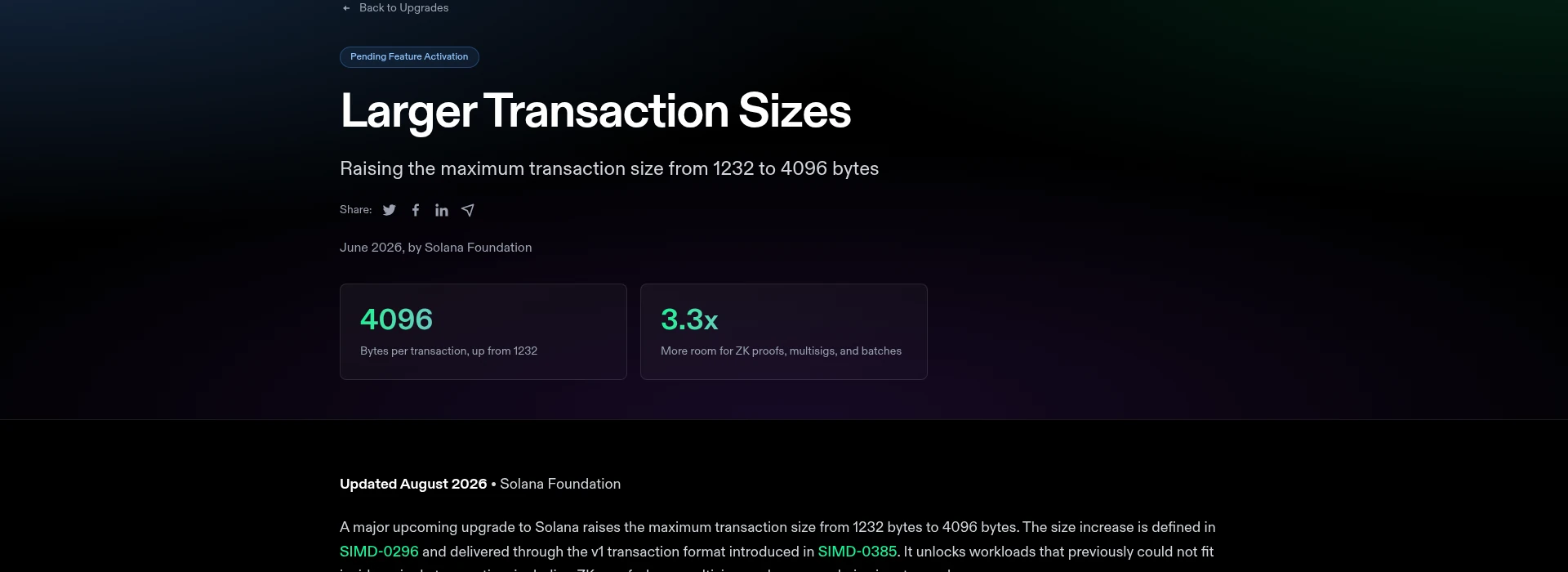
The official page shows the 1,232-to-4,096-byte increase and the 3.3x figure.
For the fictional payout team, the old limit creates a visible nuisance. Forty-plus addresses do not fit in its current transaction, so the team sends three. If the first succeeds and the second fails, somebody has to work out who was paid, what can be retried, and how to avoid paying the first group twice.
One larger transaction might reduce that splitting. “Might” matters. More room does not remove every compute limit, wallet limitation, or application-design problem. A group message cannot prove that v1 turns three transactions into one; the team has to test its actual payout.
That is enough technical context for a salesperson. You do not need to explain the complete binary layout before deciding whether the message deserves a closer look.
Why “129” is more useful than “we are watching v1”
The official format identifies v1 with decimal 129, written as hexadecimal 0x81. Hexadecimal is simply another way developers write a byte value.
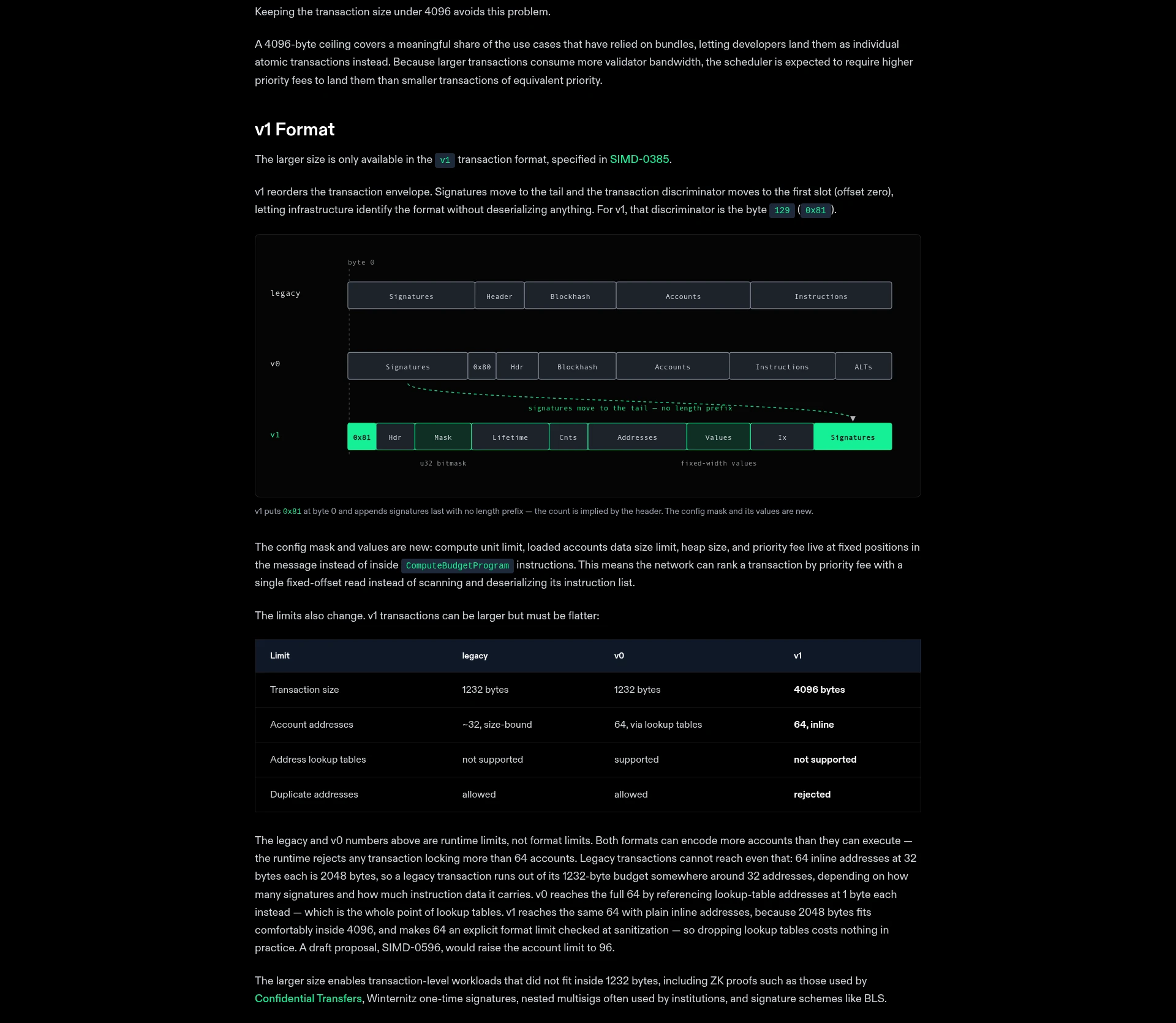
The official comparison shows 0x81—decimal 129—at the start of the v1 format.
Now compare two messages:
“We are watching v1 and will support it eventually.”
That is a roadmap statement. The team may already have the work covered.
“Our wallet parser sees 129 and returns ‘unsupported version’ in the local payout test.”
That describes a test somebody ran and a failure somebody can reproduce. The problem could be a small dependency update. It could be a custom parser buried in an old wallet. It could also be something the internal team will fix tomorrow without outside help.
The message is valuable because it gives you a sensible question, not because it proves a sale.
Read the group message as one stuck payout
Return to the fictional exchange.
“Weekly rewards go to more than 40 addresses”
This tells you the work is recurring. A weekly workaround costs attention every week, and a mistake can create a reconciliation problem.
It also tells you what not to assume. Forty is not a universal address limit. The amount that fits depends on the transaction’s signatures, accounts, and instructions. Ask about this team’s real transaction instead of turning one number into a Solana rule.
“We split the run into three transactions”
This is the current workaround. The useful sales question is not “Do you need v1?” It is “What goes wrong when one of the three transactions fails?”
The answer may reveal manual retries, duplicate-payment checks, a finance spreadsheet, or no meaningful pain at all. If the workaround already runs safely and cheaply, there may be no project.
“The wallet parser rejects 129”
This locates the failure. The payout construction may work, while the wallet that previews or signs it does not understand the new version.
Do not broaden that into “their whole wallet is incompatible.” The group message names one parser in one test. A useful follow-up separates the component that creates the transaction from the one that reads, displays, or signs it.
“Friday is our release freeze”
A release freeze is the point after which a team tries not to accept more code changes before shipping. It gives the discussion a decision window.
But a deadline without an owner is weak. Is the wallet team responsible? The payout engineer? A third-party signer? The next message should clarify who has to decide before Friday.
Sending v1 is optional; reading it is a separate problem
The Solana Foundation page makes an important distinction.
An application can keep sending legacy or v0 transactions. It only needs v1 when it chooses to use the new format, such as when a larger transaction solves a real problem.
A wallet, RPC service, indexer, explorer, or monitoring pipeline that reads transaction data faces a different question. Once v1 appears, it must recognize the format rather than reject or misread it.
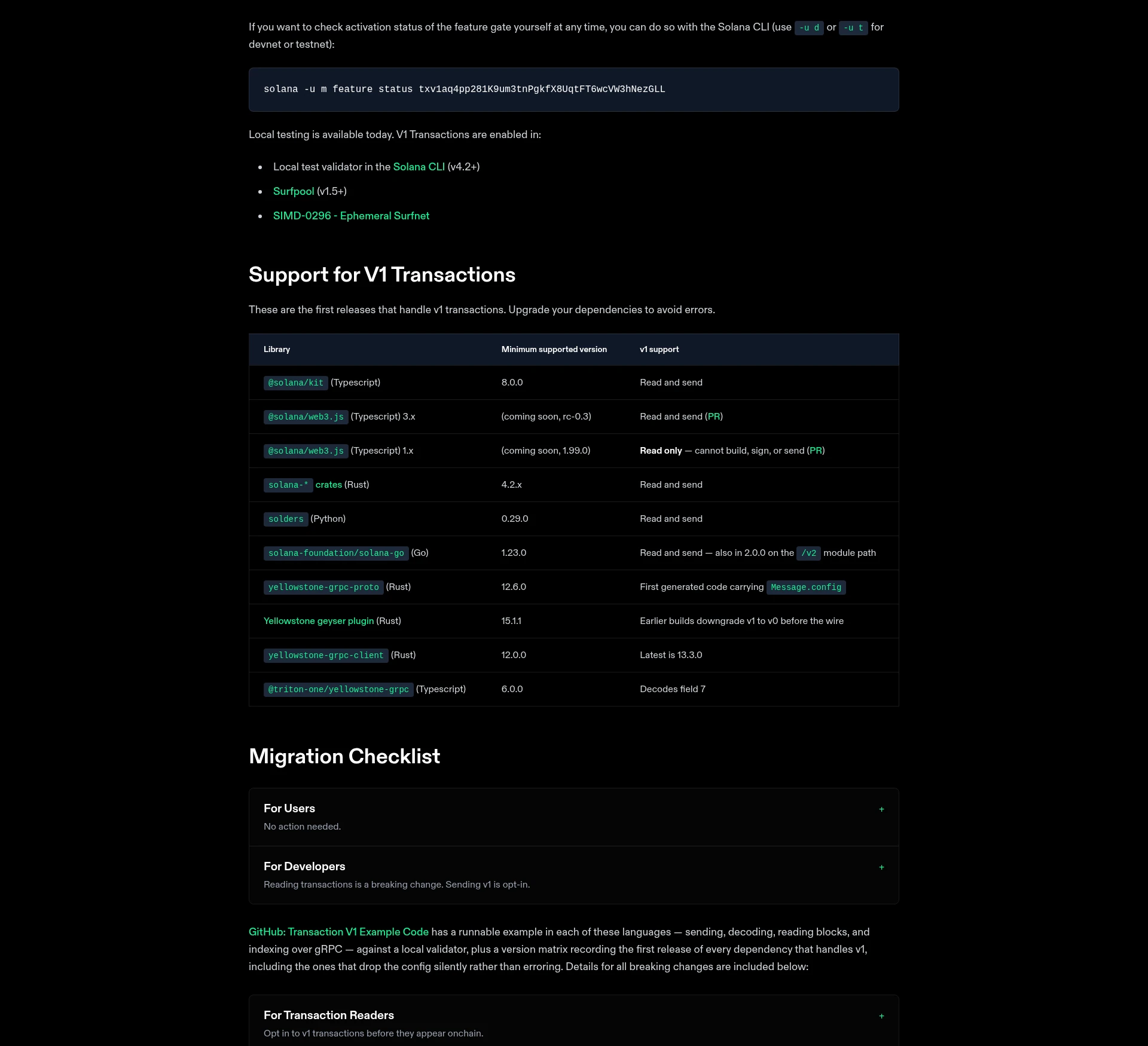
The official guidance treats reading compatibility as a breaking change and v1 sending as opt-in.
This is why “every Solana project must migrate” is a poor sales message. It is factually too broad and commercially unhelpful. The fictional payout application has a reason to test v1 because it already splits a transaction. Another app sending a simple transfer may have no reason to change its sender.
The public page reviewed on 1 September 2026 listed Testnet, Devnet, and Mainnet as not activated. It ties intended activation to Anza’s tentative Agave v4.2 release schedule. “Tentative” means the schedule can move. Local testing is not the same as Mainnet activation.
Three natural ways to continue the conversation
When the workaround is the important part:
“When one of the three payout transactions fails, do you retry that batch manually or does the tool work out which addresses are still unpaid?”
This reveals whether splitting creates a painful operating problem.
When the parser failure is the important part:
“Does the payout service create the v1 transaction successfully and only the signing wallet rejects 129, or does it fail earlier?”
This narrows the broken component without pretending you already know the fix.
When Friday is the important part:
“Before the freeze, are you deciding whether to ship the three-transaction workaround again, or whether to include v1 support in this release?”
This asks about a real decision. It is more natural than “What is your budget for wallet migration?”
All three questions belong to the fictional scene. Before any outreach, a salesperson still needs to check the writer’s identity, group rules, whether the project details are public, who owns the work, and whether outside help is welcome.
Do not turn a technical clue into a fake purchase signal
“Unsupported version” can sound urgent while being a one-line fix. A Friday date can refer to an internal test build, not a production launch. A fee question can be curiosity, not a budget discussion.
The official page says larger transactions are expected to require a higher priority fee than smaller ones at equivalent priority. It does not provide one universal price for a transaction near 4,096 bytes. A salesperson should not invent a savings estimate from the size increase.
The safe distinction is simple:
- A repost tells you what changed in Solana.
- A real test failure tells you which team and component may be affected.
- A workaround, owner, and date tell you whether the issue is connected to work happening now.
- Only direct verification tells you whether the team wants a provider.
How TOP Prospect keeps the useful reply from disappearing
The important facts may be spread across five messages. One engineer mentions 40 addresses. A reply explains the three-transaction split. Someone else pastes the parser error. The release owner adds “Friday freeze” ten minutes later.
TOP Prospect can preserve matched messages from Telegram groups and channels the user deliberately connects and is authorized to access. It can keep the source, time, nearby replies, and reason for the match together for human review.
A useful search does not need hundreds of technical keywords. Combinations such as these are easier to review:
payoutwithsplit,three transactions, orretryv1withunsupported,parser,129, or0x81walletwithlocal test,release, orfreeze1,232withaddresses,batch, ordoesn't fit
The product does not read private chats, enter unauthorized groups, identify an anonymous writer, inspect a wallet, prove budget or purchasing authority, or contact anyone automatically. It helps the salesperson avoid losing a useful conversation in the scroll; the salesperson still verifies the person, project, need, and appropriate next step.
“Solana transactions can be 4KB” is news.
“We still split 40 payout addresses into three transactions, the wallet rejects v1, and Friday is the freeze” may be work.
That is the sentence a Solana infrastructure salesperson should not let disappear.
Sources reviewed
Sources were reviewed on 1 September 2026. The fictional Telegram scene illustrates a reading method; it is not evidence of a real customer, project, budget, or supplier decision.
Frequently asked questions
Must every Solana application move to Transaction V1?
No. Sending v1 is opt-in. Teams can continue sending legacy or v0 transactions, while systems that read transaction data need to handle the new format once it becomes active.
Does the number 129 prove that a wallet has a commercial upgrade project?
No. Decimal 129, or 0x81, identifies the v1 version byte. A parser error shows a compatibility issue worth understanding; it does not prove budget, purchasing authority, or a need for an outside provider.
Is Transaction V1 active on Solana Mainnet?
The Solana Foundation status table reviewed on 1 September 2026 listed Testnet, Devnet, and Mainnet as not activated. Its activation timing follows the tentative Agave v4.2 release schedule and can change.
Sources and further reading
How a Signal worth attention is found
See how Top Prospect finds and organizes Signals worth checking, keeps the original Telegram context, removes duplicates, and helps you decide what to review first. You decide whether to follow up and what to do next.