Tectonic Price Manipulation Attack Oracle Risk: 4 Caps Before Wednesday = A Live Lead
A dramatic token price move creates endless oracle debate. A paused product, a specific risk document, and Wednesday's meeting reveal the message a Web3 security seller should notice.
Signals to watch
- Borrowing, deposits, or another real protocol function remains paused while a team completes a review
- Risk, security, engineering, governance, or legal requests a named output such as collateral caps, a price-source list, alert coverage, or a fund-flow report
- A committee meeting, reopening decision, monitoring window, or report deadline gives the work a date
By lunchtime, the same chart has appeared in every Web3 security group you follow.
One token shoots almost straight upward. People argue about price feeds, thin liquidity, collateral, and whether the network should have stopped. The loss figures get larger each time the story is forwarded.
Then these messages appear:
“Can a token this thin ever be safe as collateral?”
“Every lending protocol needs a new oracle after this.”
“Borrowing stays paused. Risk wants recommended collateral caps for four markets before Wednesday’s committee meeting.”
If you sell oracle infrastructure, protocol-risk reviews, monitoring, smart-contract security, or incident response, the third message is the one to read twice.
It names a real product function that is still closed, a document someone must produce, the team waiting for it, and the date when a decision will be made.
Every Telegram-style message, person, protocol, committee, and work scene in this article is fictional and representative. None is a customer quote. The cited Tectonic, Cronos, and TRM Labs statements are real public sources.
The biggest number is usually the least useful sales detail
After an incident, group conversations orbit the most dramatic facts: the token price, the amount borrowed, the funds that moved across chains.
Those facts explain why everyone is talking. They do not tell you who needs your service.
A seller needs a different set of details:
- What is still paused?
- What does somebody need to deliver?
- Who will use that work to make a decision?
- When does the decision happen?
“A token rose 100×” is a headline. “Borrowing remains paused until risk receives four collateral-cap recommendations on Wednesday” may be work.
What the public record actually says
On 30 August, Tectonic said it was investigating an incident and asked users not to interact with the protocol until it confirmed that doing so was safe. That first notice did not publish a root cause, affected-market list, or final loss figure.
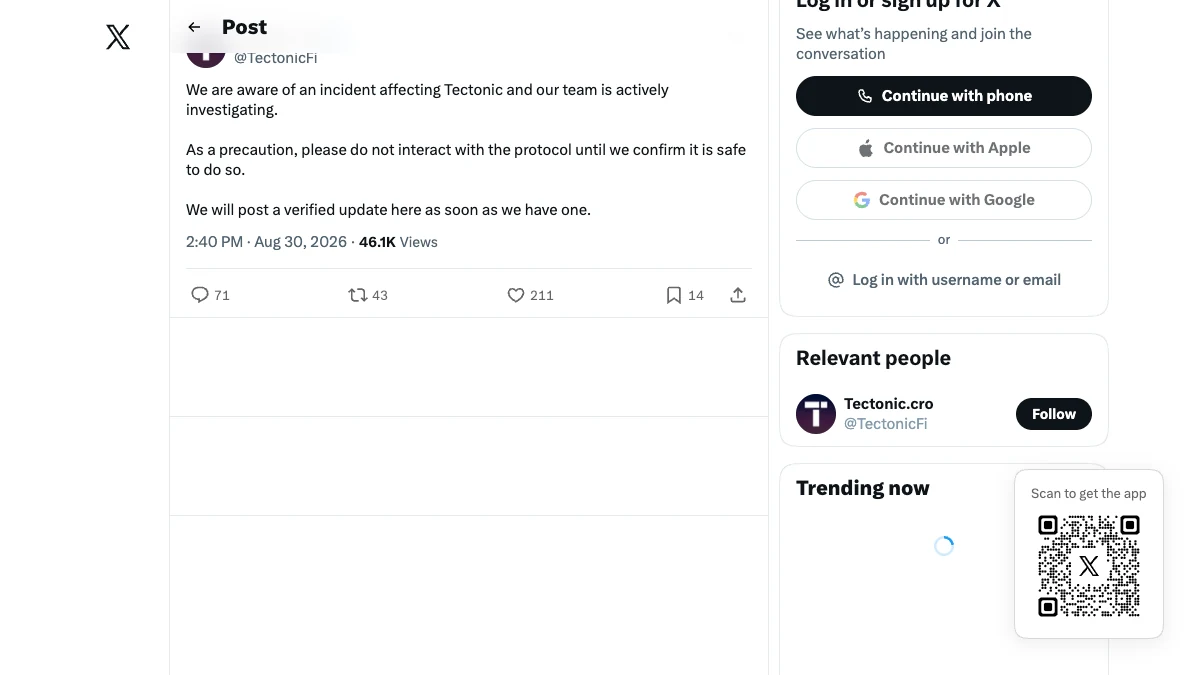 Tectonic’s first notice confirms an investigation and warning, not a final attack path or loss total.
Cronos Network said it halted the network because of an exploit affecting Tectonic. Its later restart notice said validators had taken an emergency consensus action, chain state was restored to before the exploit, and block production resumed. It also warned that protocols, RPC providers, explorers, and bridges could take longer to return.
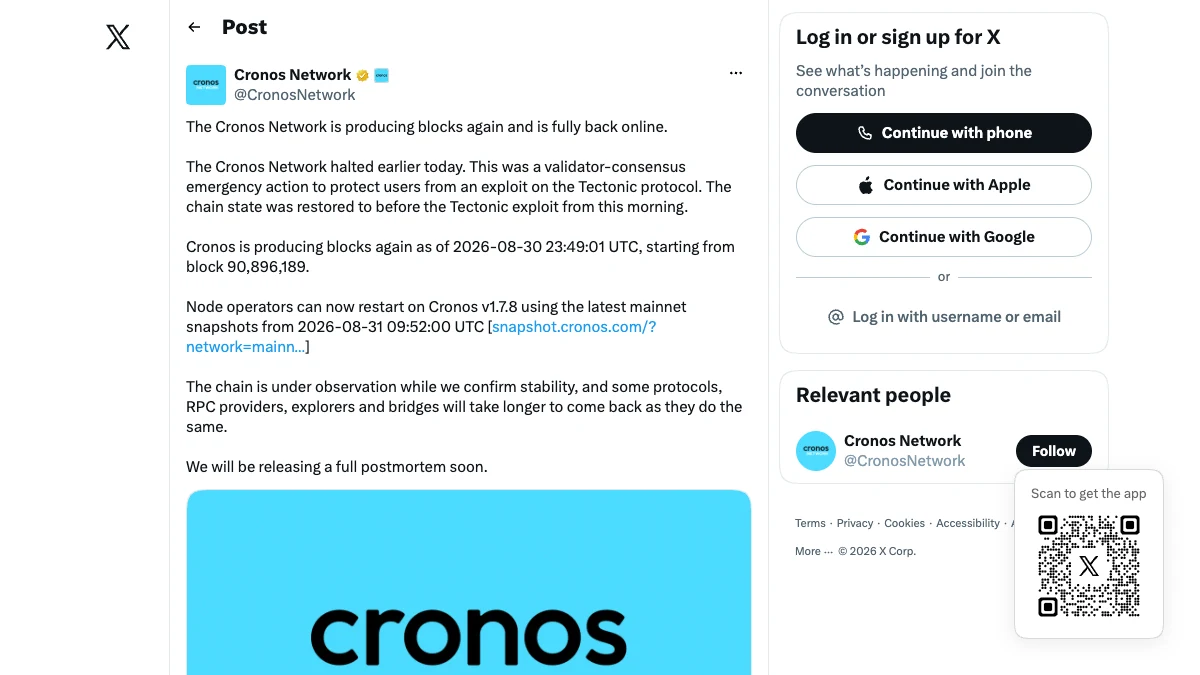 The chain producing blocks again did not mean every dependent service was ready.
Tectonic then said it would reopen in phases: withdrawals and loan repayment first, while borrowing and deposits remained paused.
TRM Labs provided an attributed chain-analysis account. It estimated that TONIC rose about 100× in roughly 20 minutes. TRM used an estimated USD 75 million borrowed figure while also noting a higher USD 119.5 million on-chain estimate. It said about USD 6 million reached Ethereum and much of the remaining on-Cronos state was reversed after the chain restoration.
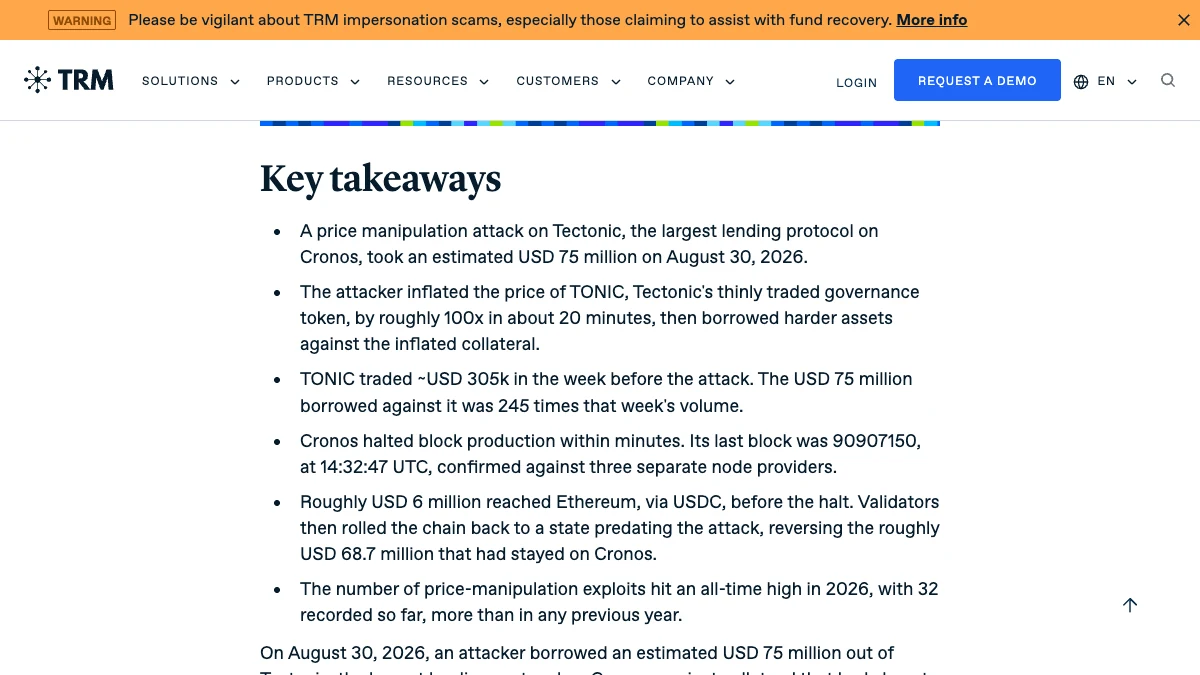 TRM’s numbers are analysis estimates, not a final Tectonic postmortem or an uncontested loss figure.
As of this article’s research on 1 September, the cited official updates did not contain a full postmortem. It would therefore be inaccurate to tell a prospect that one oracle component, contract bug, or risk parameter was the confirmed root cause.
Look for what remains closed
The official phased reopening gives a seller a useful clue: different protocol functions can return at different times.
That makes these fictional messages more informative than a general oracle debate:
“Withdrawals are available again, but borrowing remains disabled until the market review passes.”
“Deposits stay closed for three assets until we set new supply caps.”
“The chain is online, but our indexer has not reconciled the restored state.”
The closed function tells you what the team cannot do. It also gives you a way to check whether the problem is connected to the service you sell.
An oracle provider may be relevant to a price-source review. A risk adviser may help with collateral caps. A monitoring company may help observe price divergence before borrowing reopens. A tracing firm may follow cross-chain fund movement. None should claim it can solve all four jobs.
Look for the thing someone must hand over
“We need better security” is too vague to price, route, or answer.
A useful message names an output:
“Risk wants a list of every market’s price source, update interval, and backup source.”
“Governance needs proposed supply caps for four assets.”
“Security wants 48 hours of alerts before borrowing reopens.”
“Counsel needs a cross-chain flow report for these two receiver addresses.”
The terms are easier than they sound. A price source is where the protocol gets a market price. An update interval says how fresh that price should be. A supply cap limits how much of one asset the protocol accepts. A cross-chain flow report follows assets as they move between networks.
The important part is not the terminology. It is that somebody expects a list, recommendation, alert record, or report.
Look for the meeting, reopening, or deadline
A date turns “we should review this” into something a team may need help completing.
“The risk committee meets Wednesday.”
“Borrowing can reopen after 48 hours of clean monitoring.”
“Counsel needs the fund-flow report by 16:00 UTC.”
“The governance proposal freezes Friday.”
These dates mean different things. A committee meeting creates a decision window. A monitoring period creates an acceptance condition. A legal deadline creates a delivery time. A governance cutoff creates a publishing deadline.
Do not replace them with the incident date or the network restart time. Ask for the team’s own decision date.
Three useful first questions
Your first reply should make it easy for the other person to explain where the work is stuck.
When risk wants collateral-cap recommendations
“Are the four markets already chosen, or does the team also need help deciding which assets belong in the review before Wednesday?”
This tells you whether the request is a four-market calculation or a broader market-screening job.
When security wants monitoring before reopening
“Do you already know which price or liquidity change should trigger an alert, or is defining the thresholds part of the review?”
One team needs alert implementation. The other still needs the rule itself.
When somebody asks for fund tracing
“Are the receiver addresses and chains already confirmed, and who will use the report—security, an exchange, or counsel?”
That question helps reveal the evidence available, the report recipient, and whether the request is casual curiosity or authorized incident work.
None of these questions assumes that the writer controls a budget or may share protocol data. Those facts still need direct verification.
Do not diagnose the prospect from the headline
Avoid opening with “Your oracle is vulnerable.” The cited official notices had not published a complete root cause when this article was researched.
Do not repeat USD 75 million as the final confirmed loss. TRM called it an estimate of the amount borrowed and recorded another, higher estimate. It also separated funds that reached Ethereum from state later restored on Cronos.
Do not promise a rollback. Cronos described a validator-consensus emergency action on its network. That does not make rollback a routine or available remedy for another protocol.
And do not contact every person who mentions TONIC, oracles, or collateral. Most people are discussing the story. The useful message connects a paused function to a requested output, owner, and date.
How TOP Prospect helps find the decision hidden under the debate
In one authorized group, somebody writes “borrow remains paused.” In another, a risk contributor says “four cap recommendations before Wednesday.” A third message mentions the committee meeting.
TOP Prospect can preserve matched messages with their source, timestamp, and nearby discussion so a salesperson can decide whether the fragments belong to the same real review. Useful phrases go beyond the incident name:
- “stays paused”
- “before borrowing reopens”
- “risk committee”
- “need recommended caps”
- “48 hours of monitoring”
- “report by 16:00”
TOP cannot inspect a protocol’s contracts, verify its oracle design, calculate the loss, authenticate the writer, confirm budget, or grant access to incident data. A human still verifies those details and decides whether to follow up.
The goal is not to collect every opinion about a dramatic chart. It is to notice the sentence that contains work someone must finish.
“Can a thin token be collateral?” is a discussion.
“Borrowing stays paused, risk wants four collateral-cap recommendations, and the committee meets Wednesday” is a possible job.
Frequently asked questions
Does mentioning an oracle after the Tectonic incident show buying intent?
No. The discussion becomes commercially relevant when it names a protocol function that remains blocked, a specific work product, an owner, and a date.
Was USD 75 million the final confirmed loss?
No final first-party postmortem was available when this article was researched. TRM Labs used an estimated USD 75 million borrowed figure and also noted a higher on-chain estimate; it said about USD 6 million reached Ethereum while much of the on-Cronos state was restored.
Can TOP Prospect verify a protocol's oracle design or procurement authority?
No. It can preserve matched Telegram messages and context from authorized sources for human review. The protocol, architecture, identity, authority, budget, and vendor process must be verified directly.
Sources and further reading
This article is human-authored. TOP Prospect processes only Telegram groups the user has explicitly authorized and connected. Its output supports human sales judgement; it does not replace human decisions and does not automatically contact or message group members.
How a Signal worth attention is found
See how Top Prospect finds and organizes Signals worth checking, keeps the original Telegram context, removes duplicates, and helps you decide what to review first. You decide whether to follow up and what to do next.