How to Find B2B Customers on Telegram: 3 Prospecting Tips and Tools
Find B2B customers on Telegram by choosing relevant groups, reading demand in context, and asking useful questions before quoting. Learn where monitoring tools fit.
You open a Telegram group, spot “Does anyone supply this?”, and send your price list. No reply. Meanwhile, a quieter discussion about a failed payment or next week’s launch has moved out of view. Finding B2B customers on Telegram requires more than finding messages that mention your product category.
For a salesperson working across industry groups, the practical sequence is to choose relevant communities, look for specific business constraints, and ask a useful question before proposing a sale. Tools can help collect candidate discussions. They cannot establish a person’s purchasing authority or make an unwanted message welcome.
Key takeaway
- Group size is not proof that a community contains suitable buyers.
- A problem, usage figure, and deadline can justify earlier review, not automatic qualification.
- Follow up privately only when the recipient has invited or welcomed the conversation.
Tip 1: Find B2B customers on Telegram by choosing the right groups
Joining more groups can make the problem worse. A large general-purpose community may contain supplier advertising, repeated offers, and conversations unrelated to what you sell. A smaller group can be equally unhelpful if nobody discusses the problem your service addresses.
Look for communities around the actual work of your prospective customer: a developer community used by teams running production APIs, a cross-border commerce group discussing payment failures, or a specialist operations group where people compare suppliers. Use official community links where available, respect admission requirements, and read the rules before contributing. Do not treat a private invitation as permission to collect or distribute member information.
Review the discussions, not just the member count. Do participants describe what they are trying to do? Are questions answered with useful detail? Do the same problems recur? Are buyer requests distinguishable from supplier advertisements?
Start with a manageable shortlist—five to ten groups can be a practical trial size, not a conversion benchmark. After reviewing recent messages, keep sources that contain relevant conversations and remove those that mostly repeat advertisements. A technical discussion still does not prove that its author controls a budget.
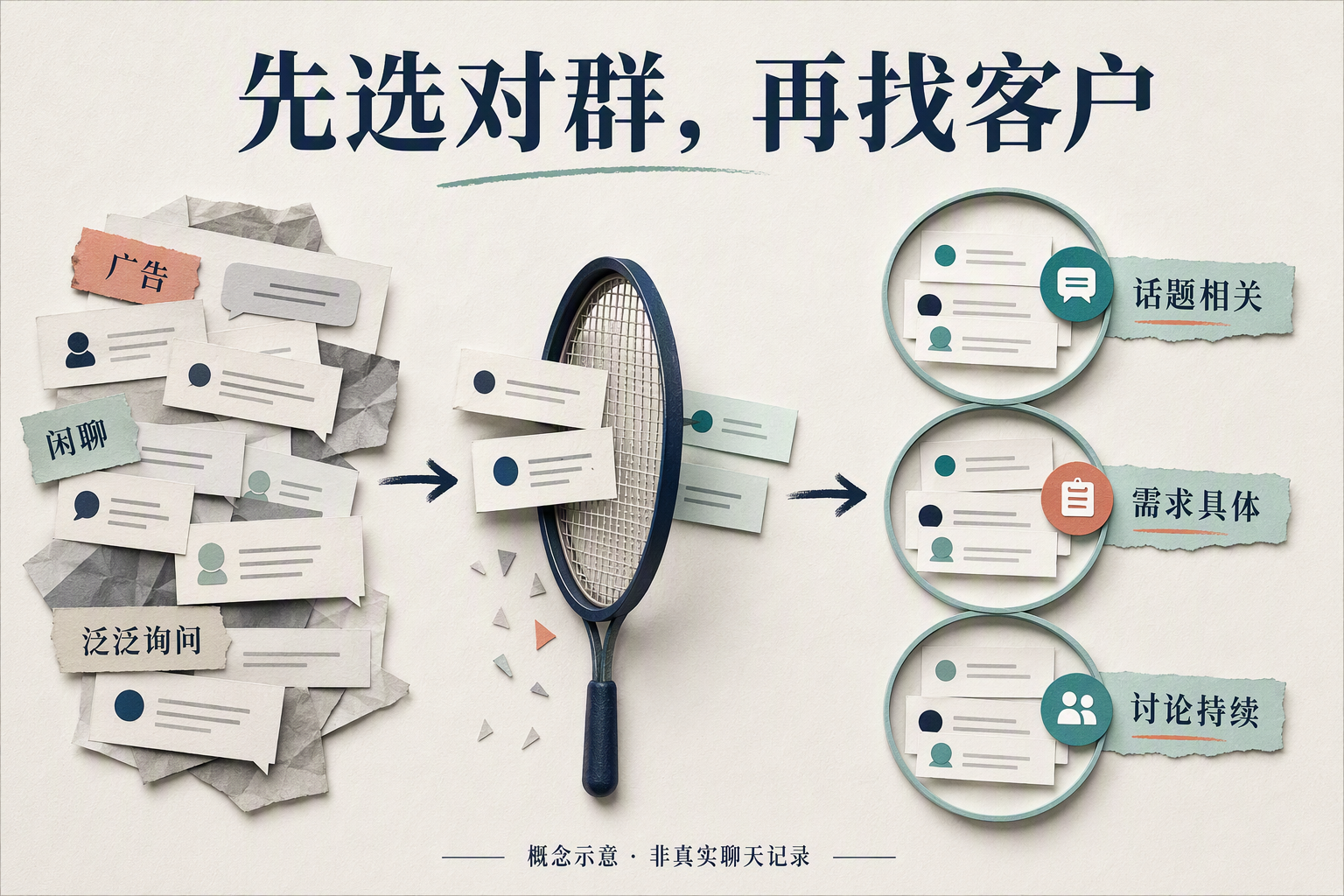
Concept illustration. The Chinese labels contrast ads, casual chat and vague questions with relevant topics, specific needs and ongoing discussion. This is not customer data.
Tip 2: Look for combinations of business constraints
“API,” “payments,” and “SaaS” are starting points for a search, not qualification criteria. A supplier advertisement, a job post, and a buyer request may all use the same words.
More useful details include:
- Usage or budget: “We spend $150 a day,” “20 people need access,” or “the monthly budget is being reviewed.” A stated figure remains unverified.
- A specific problem: “429 errors during peak hours,” “the invoice does not match usage,” or “the current service keeps failing.” A 429 response needs diagnosis against the provider’s rate, token and account limits; it does not by itself prove that switching suppliers is the answer.
- Timing: “We launch next Wednesday,” “the contract renews this month,” or “we need the invoice before closing the books.”
- Payment or contracting requirements: “Can you invoice our Hong Kong company?” or “We need costs separated by project.” These describe conditions to check, not proof of approved spending.
Read nearby messages before combining these details. The deadline may belong to one participant while the spending figure belongs to another. An old request may already have been resolved. A copied message can make one requirement look like several independent opportunities.
The useful conclusion is “review this discussion first,” not “this person is a verified buyer.” Keep the original source, message time, and unresolved questions with the candidate.
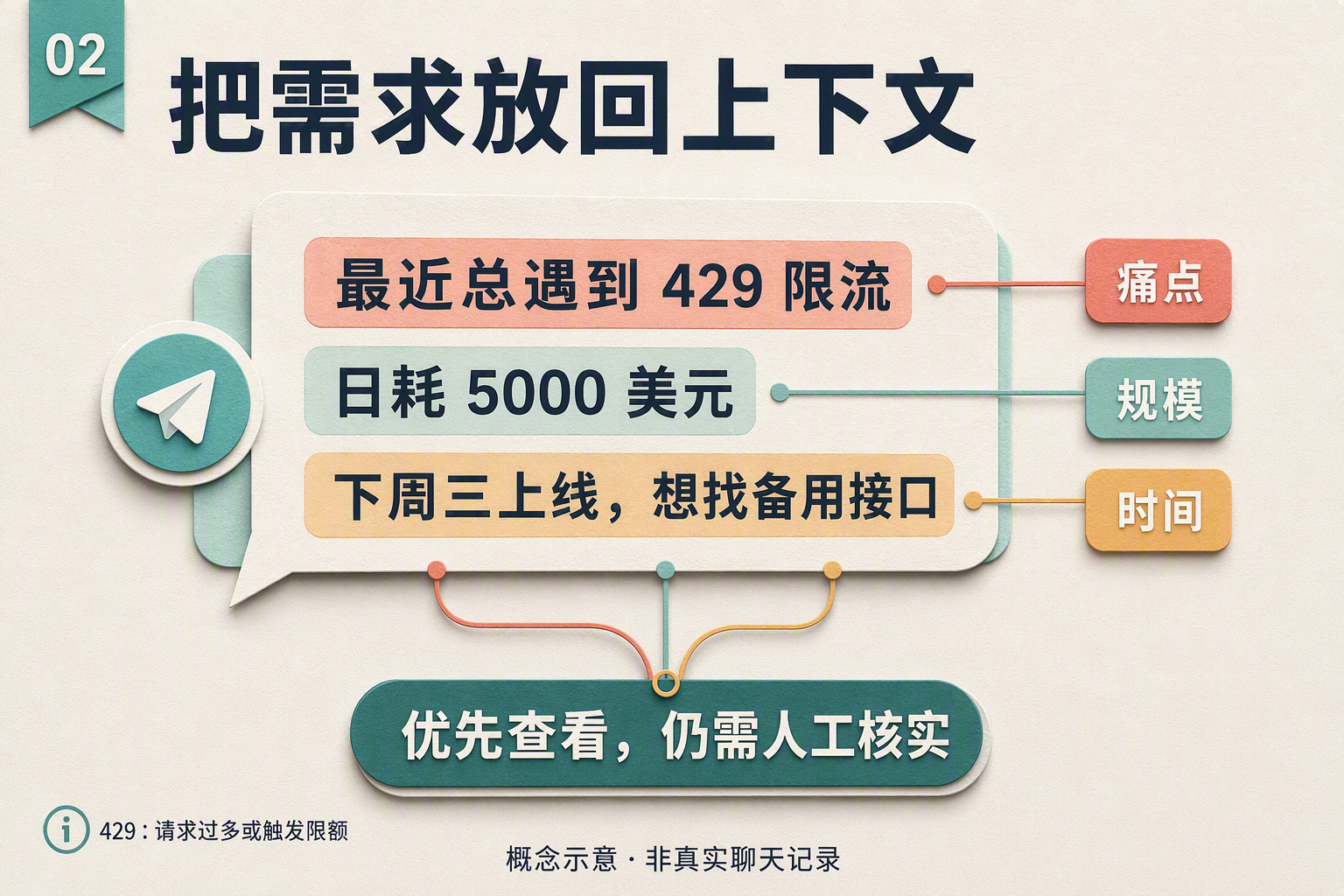
Illustrative message: 429 errors, $5,000 daily spend and a Wednesday launch. The bottom label says to review first but still verify manually. The quote and amount are hypothetical.
Tip 3: Diagnose before sending a quote
When someone describes a problem in a group, they may be looking for help rather than a sales conversation. A relevant answer should address what they asked, without pretending you already know the cause.
- Respond publicly when group rules permit. For a 429 discussion, ask which limit is being hit rather than immediately claiming that your service will fix it. Keep account credentials and sensitive logs out of the group.
- Continue privately when invited or welcomed. Ask one or two questions about the workload and the desired result. For example: “Which model is affected, and what is the peak request rate?” RPM means requests per minute. Do not send an unsolicited brochure merely because you share a group.
- Offer a relevant proposal or test once the need is clearer. Explain only capabilities you actually provide. Agree on what a test should establish, who will assess it, and whether purchasing approval is still needed.
Telegram’s Spam FAQ warns against contacting strangers who are not expecting your messages. An otherwise professional pitch can still be unwanted. A request for technical documentation is also not an invitation to send repeated sales follow-ups.

Concept workflow. The Chinese captions specify following group rules, waiting until the other person welcomes private contact, and clarifying the need before offering a test.
Where monitoring tools help
Manual review becomes difficult when useful discussions are spread across several active groups. You may remember seeing a complaint but not the message before it, the group it came from, or whether someone has already answered.
Top Prospect can support this part of the workflow. You connect your own Telegram account, select sources you are authorized to access, and configure the monitoring rules. The product filters and organizes candidate discussions, retains available original messages, source information and related context, and helps prioritize human review.
Source access alone is not permission for automated or AI processing. Check Telegram’s Content Licensing Terms, including the requirement for relevant users’ explicit, informed and ongoing consent for the specific content and context where an exception applies.
It does not automatically contact the speaker or verify that the person is a decision-maker. Context is limited to what is available through the selected, authorized sources; it is not a guarantee that every part of a conversation can be recovered. The privacy policy explains the connected-source scope and the limits of generated Signals.
For an occasional search in a small number of groups, Telegram search and a simple record of follow-ups may be enough. Telegram’s official FAQ describes search, replies and mentions. Do not confuse mention or reply notifications with a general built-in keyword-monitoring service.
Frequently asked questions
Are larger Telegram groups better for B2B prospecting?
Not necessarily. Evaluate relevant discussion, source quality and whether participants describe problems you can address. Neither size nor an entry requirement proves purchasing authority.
Can Telegram search replace a monitoring tool?
For a limited number of sources, manual search can be sufficient. Monitoring becomes useful when repeatedly finding and organizing relevant discussions is taking too much attention. Compare the effort of maintaining the tool with the review work it removes; do not assume automation is always needed.
Should I use an automatic reply bot to respond instantly?
Not as a default prospecting method. Relevance, group rules and recipient expectations matter more than response speed. An automated message can be unwanted even when it contains the right keyword.
Does Top Prospect add contacts or read private chats?
No. It does not automatically add or message contacts and does not read private chats. Sales qualification and relationship-building remain human tasks.
Spend the saved time on the conversation
The goal is not to accumulate the longest message list. It is to notice a relevant request, understand enough of its context, and decide whether a conversation is appropriate. Choose sources carefully, preserve the evidence, and ask before pitching. That gives your next follow-up a clear reason to exist.
How a Signal worth attention is found
See how Top Prospect finds and organizes Signals worth checking, keeps the original Telegram context, removes duplicates, and helps you decide what to review first. You decide whether to follow up and what to do next.