8 minutes to a 100-group Telegram pool: the routine a new BD runs on day one
Searching and joining groups by hand is where this routine breaks. Here is a sequence you can hand to a newcomer: pull candidates with an AI tool, verify each one in on-site search, set a per-group check frequency, and build the identification rule in a conversation.
Signals to watch
- The candidate list comes from an external AI tool and every entry has to be verified before it enters the pool
- Each group gets its own frequency for checking new messages, and higher frequency costs more resources
- An identification rule is created through a conversation, not by writing keyword expressions
- Matches settle into lead records, and direct messages leave a trace too
You have probably run into this:
- You type “cross-border ecommerce” into the Telegram search box, three groups come back, and two days later nobody has let you in
- You finally get into one and it is all competitors posting ads, not a single real customer
- You spend four hours a day joining groups, scrolling history and dropping hooks, and a week of that produces fewer than five usable leads
The problem is not that you are not working hard enough. It is that the way you look for groups is still manual.
Here is how a new BD can build a pool of 100 targeted Telegram groups in 8 minutes, by putting an AI tool in front of the search step.
Why groups slide from useful into dead and ad-filled is a separate question; we took that apart in another piece.
1. Why traditional group hunting is so inefficient
1.1 Three flaws in Telegram’s own search
When you search Telegram for “cross-border payments”:
- It only matches group names. Plenty of good groups are simply called “Sellers’ Circle” or “Q4 Sprint”, and no keyword finds them
- There is no quality indicator. No way to tell an active group from a dead one, or a real seller group from an ad feed
- There is nothing to verify against. Member counts may be bought, and the last message could be three months old
The result: two hours of work, twenty groups joined, eighteen of them useless. (illustrative example)
1.2 Manual screening costs more than searching
Even if you know to look on YouTube and Google, you still have to:
- open every link to check it
- write down the group name, member count and language by hand
- wait a few days after applying before you can judge the quality
Run the numbers: 15 minutes per good group, so a 50-group pool costs 12.5 hours. (illustrative example)
The expensive part is not the searching. It is judging every single entry afterwards. Who does that judging, and against what, lives in the head of whoever has done it before. Hand it to someone else and the output changes.
2. Searching with AI tools: 100 precise groups in 8 minutes
External AI tools such as Google Gemini or Perplexity work from public information and surface the groups that have something behind them.
The key move: ask for groups backed by a YouTube channel or a GitHub project.
Copy this prompt as-is:
“I need Telegram groups about cross-border finance, cross-border ecommerce and offshore payments.
Requirements:
- The groups must be backed by an official YouTube channel
- Chinese or English groups preferred
- Give me the group link, a short description and the sub-niche
- Give me 30-50 at once, I need enough to compare”
What comes back is a list sorted by sub-niche. A real run looks roughly like this:
Offshore accounts, offshore structures and cross-border payouts (6)
- A community run by a creator focused on Hong Kong and UK bank accounts and virtual card testing
- A community built around offshore payouts and offshore account structures
- A group sharing digital banking and cross-border settlement techniques
Cross-border Web3 and crypto payouts (6)
- The private discussion group of a Western crypto finance channel
- A group discussing crypto credit cards and self-custody wallet rollouts
Cross-border ecommerce and D2C settlement (5)
- A group on export tax rebates, compliant settlement and Hong Kong company tax
- A group focused on acquirer decline rates and high-risk merchant onboarding
Time cost: 8 minutes from prompt to list. (illustrative example)
⚠️ Those entries are illustrative, not a list you can copy. The names and links are generated by the AI from public information and may since have been renamed, made private, or never existed at all, which is exactly why the next step is a pass over every single one.
3. But the groups AI finds cannot be used directly
Pause here: every entry has to pass a check before you act on it.
The reason is that AI cannot verify in real time:
- whether the group is still alive and still maintained
- whether the name and the link still point at the same thing (the entries above were generated on the spot)
- what the group has actually been discussing lately, and whether any of it is real business
This is where the platform takes over.
The bill that comes from rushing into a big group and finding a room full of competitors is one we worked through in another piece.
4. Best practice: the AI tool + Top Prospect combination
Step 1 — Pull candidates with an AI tool (8 minutes)
Gemini or Perplexity, with the prompt above, gets you 30-50 candidate groups that have something behind them.
Step 2 — Verify each one in Top Prospect on-site search (15 minutes)
Put the group names into on-site search one at a time. On-site search runs against the indexed public group library, and the result card gives you:
- whether the group is indexed at all, and its member count
- when it was last verified and when it was indexed
- which category tag it sits under and its main language
No result means it has not been indexed yet, so leave it and do not spend time clicking. One line on the card is worth remembering: a search result does not mean the group was joined or that signal collection is on. Group data only reflects the state at the last verification.
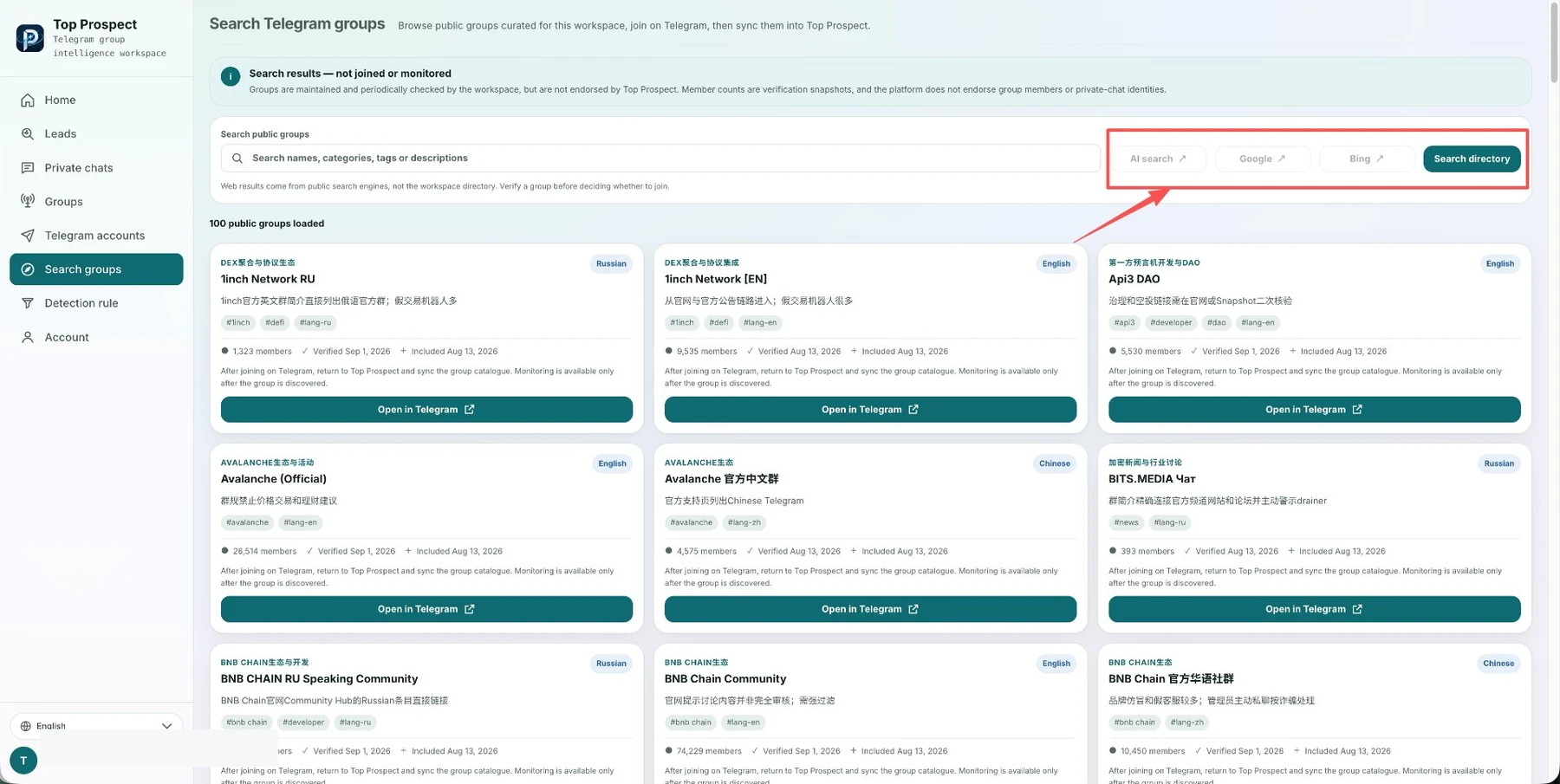
The Search groups page in TOP Prospect. On-site search looks inside the indexed public group library; AI search, Google and Bing cover the groups that are not in it yet. The cards only reflect the state at the last verification.
Step 3 — Fill the gaps with Google and Bing (10 minutes)
Open the Google search entry in TOP Prospect and run site:t.me "Amazon seller" payment OR Stripe to recover the groups that neither the AI nor on-site search found. site: is a search operator Google supports officially; the full rules are in Google Search Help.
Step 4 — Create one identification rule (5 minutes)
You do not write keyword expressions to create a rule. The system walks you through a conversation that settles six things: whether you are looking for customers or suppliers in these groups, what you sell, which type of customer you want to see first, what problems your customers usually run into, which conditions matter most, and which regions your target customers sit in.
Once you answer, the AI turns those answers into a structured rule draft plus a longer written identification standard, and that standard already includes the kind of noise it should drop.
Worth having in mind before you start are these two sets of expressions:
- Usually a sign of demand: “need a payment channel”, “Stripe shut us down”, “decline rate is too high”, “acquirer needed”
- Usually noise: “part-time”, “volume farming”, “free”, “tutorial”
Once confirmed, the rule binds to the groups you picked and starts running, and matches show up ranked by score so you can judge whether the rule needs adjusting. Keywords versus meaning is a separate argument; we wrote the boundary down in another piece.
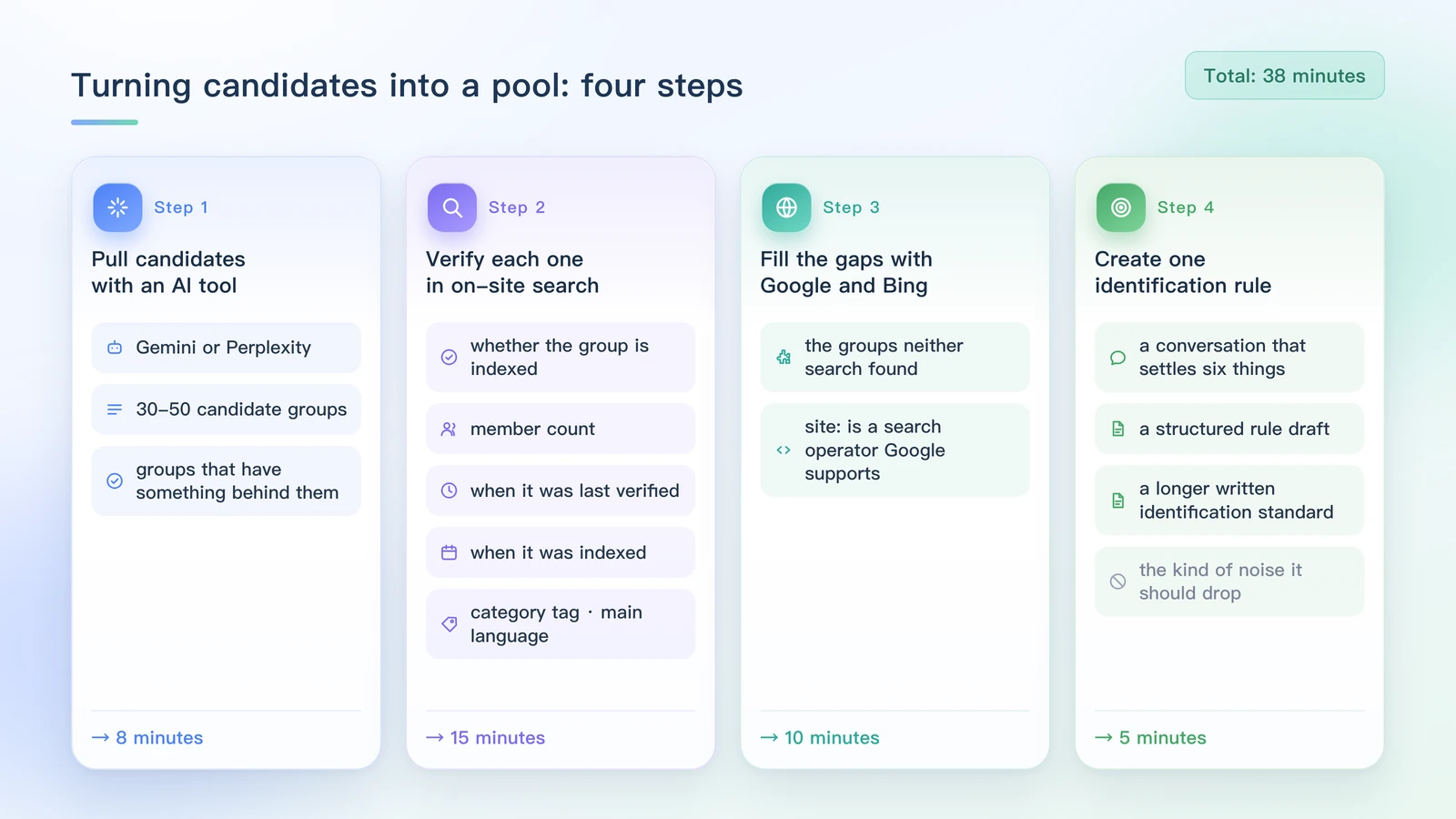
The four cards above follow the four steps in this section: what you hold after each one, and how long it took.
Total: 38 minutes.
What you end up with: a pool of 40-50 groups, each one running on its own check frequency.
5. Case study: a cross-border payments BD’s one-hour workflow
The workflow below is an example; the timestamps are there to mark the rhythm.
10:00 — AI pulls candidates
A new BD at a cross-border payments provider sends the prompt above, asking for 30 Telegram groups around cross-border ecommerce, Amazon sellers and Shopify stores, with YouTube backing.
The AI returns 32 groups.
10:08 — On-site search verification
They put all 32 names through TOP Prospect on-site search one by one:
- 23 are indexed, and the cards show member count, last verification date and indexing date
- 6 return nothing, so they have not been indexed yet — leave them
- 3 carry a last verification date that is already old — leave those too
20 groups are left.
10:23 — External search fills the gaps
They open the Google entry in TOP Prospect, run site:t.me "Amazon seller" payment OR Stripe, find 12 more groups, and keep 8 after verification.
10:33 — Identification rule
They finish the conversation with the system, get a rule draft, and rewrite two of the phrasings to match their own business.
10:38 — Groups go into the pool
The pool now holds 28 groups, each with its own frequency for checking new messages.
9:00 next morning — Results
The leads list shows 27 matches, each carrying the original message, the account that posted it and the source group. Whether any of them is worth a direct message today is a human judgement.
10:00 — Follow-up
They open a direct message with the context in hand:
“Hi — I saw your post in XX group about Stripe shutting you down. We work on payment risk for cross-border sellers and just helped two sellers in similar categories get collecting again. Worth a quick look at your situation?”
Outcome: 27 leads, a 40% reply rate, 3 paying customers. (illustrative example)
6. Why is this combination so effective?
The value of the AI tool
- Speed: a list of 30-50 candidate groups in 8 minutes
- Coverage: public information reaches groups that are not indexed yet
- Structure: links, descriptions and sub-niches come out ready to read
The value of Top Prospect
- Verified stock: whether a group is indexed, its member count, when it was last verified and when it was indexed, all in one view
- Continuous capture: once a rule is bound to groups, new messages are checked on each group’s own frequency without anyone watching a screen
- Retained assets: matches settle into lead records and direct messages leave a trace, so nothing walks out with the person. Data boundaries are a topic we wrote about separately
The split: AI widens the range, the platform keeps watching and keeps records, people make the final call and have the conversation.
7. Prompt templates for different industries
The prompts below are ready to copy; swap the keywords.
Cross-border finance/payments
“Find me 30 Telegram groups about cross-border finance, offshore payments and cross-border settlement for ecommerce sellers, backed by an official YouTube channel, with links and descriptions.”
AI API (application programming interface)/developer services
“Find me 30 Telegram groups about AI APIs, GPT development, LLM applications and developer communities. English groups only, backed by YouTube or GitHub.”
Web3/blockchain
“Find me 30 Telegram groups about Web3 projects, Layer 2, TGEs and market makers. English groups only, with an official YouTube channel or Twitter account.”
Cross-border ecommerce/seller services
“Find me 30 Telegram groups about Amazon sellers, Shopify stores and cross-border ecommerce operations, backed by a YouTube creator or an official community.”
SaaS/business services
“Find me 30 Telegram groups about B2B SaaS, enterprise software, CRM (customer relationship management) and marketing automation. English groups only, backed by Product Hunt or YouTube.”
Closing
Hunting for groups is a one-off move. You pull a batch today and another batch tomorrow; you finish reading the messages today and start from scratch tomorrow. A Telegram acquisition routine you can actually reuse looks like this:
Build the pool → keep monitoring → capture demand → spot the signal → human confirmation → follow-up
AI widens the search, TOP Prospect keeps capturing change, and BD makes the final call and has the conversation.
Which means acquisition stops depending on whether a particular BD had time to scroll Telegram today, and becomes a process that keeps running. If your customers are already in Telegram, the thing worth solving is probably not “how do I join more groups” but:
how do I see demand while it is still happening.
This article is human-authored. TOP Prospect processes only Telegram groups the user has explicitly authorized and connected. Its output supports human sales judgement; it does not replace human decisions and does not automatically contact or message group members.
How a Signal worth attention is found
See how Top Prospect finds and organizes Signals worth checking, keeps the original Telegram context, removes duplicates, and helps you decide what to review first. You decide whether to follow up and what to do next.