Two Reps Collided on the Same Telegram Lead and Undercut Each Other. We Lost 30% of the Margin: How Overseas Teams Should Govern Lead Assets
A postmortem of a real management failure: ten salespeople prospecting from personal Telegram accounts, two of them working the same DTC founder in the same group, each dropping the price by 15 percent, until the client walked to a competitor. The article breaks down three systemic holes in personal-account prospecting and lays out the SOP that turns leads from private property into company assets.

Signals to watch
- The founder of a large DTC brand posting more than ten thousand orders a day complained in a cross-border ecommerce group that ERP data sync was lagging and asked for alternatives
- Rep A and Rep B each DMed that founder from a personal account, and neither filed a timely or unambiguous record in the company CRM
- The founder mentioned in passing that Rep B had quoted 15 percent lower than Rep A, after which each escalated for a special discount and threw in free services
- The client read the internal chaos and opaque pricing as unprofessional and moved to a competitor, costing the company both the order and internal trust
In overseas business development, Telegram has long been an indispensable acquisition channel. But for many managers, letting salespeople roam the groups freely from personal Telegram accounts is where the disaster starts.
If you are searching for what to do about duplicate leads colliding, or how overseas companies should set CRM rules, this article uses one real management postmortem to show you the enormous risk hidden in the personal-account black box, and offers a standardized way to turn private resources into company assets.
What Happened: An “Internal Stampede” That Should Never Have Happened
A few months ago one of our cross-border SaaS clients (anonymised here as Company X) went through a painful lesson.
Company X had a ten-person sales team, and everyone was encouraged to hunt for leads in Telegram’s cross-border ecommerce groups. One day the founder of a large DTC brand, shipping more than ten thousand orders a day, complained in a group that the existing ERP system was lagging on data sync, and asked whether there was a better alternative.
Rep A (a veteran) saw the message and immediately DMed the founder from a personal account, establishing first contact.
Rep B (a new hire) was in the same group, saw the same message, also DMed the founder from a personal account, and sent over the product brochure.
Because both were using personal accounts, and neither filed a timely record in the company CRM (or filed something too vague, like “a client from some cross-border group”), the system never triggered a duplicate-lead warning.
A few days later the dramatic and fatal moment arrived: while talking with Rep A, the founder mentioned offhand, “Your colleague Rep B reached out to me too, and his quote is 15 percent lower than yours.”
Rep A panicked. To save the key-account order about to close, he immediately asked his director for a special discount, giving away another 15 percent on top of the floor price. And when Rep B learned that A was also working the account, he hinted that half a year of free service could be included.
The final result:
The client noticed the chaos inside Company X and the extreme opacity of its pricing, grew seriously doubtful about the company’s professionalism, and eventually chose a competitor. Company X not only lost the order but also triggered a serious internal trust crisis and infighting. Had that collision never happened, the order would have closed comfortably at a normal margin.

Diagram: two people followed up the same client from their own private accounts, so the undercutting was colleagues bidding against colleagues, and the price was paid in margin and in client trust; the figures and numbers in this image are illustrative, not a real record.
Why Personal Telegram Prospecting Is a Black Box
The root cause of this failure was not the personal ethics of Rep A or Rep B. It was an outdated management model. Prospecting from personal accounts on Telegram leaves three fatal systemic holes:
- Leads become private property and never accumulate as assets: salespeople join groups and add contacts from personal accounts, and those group resources and client relationships belong to the individual in both legal and practical terms. The moment a rep resigns, all they have to do is take their phone, and every bit of the company’s earlier investment resets to zero.
- Information silos make collisions very likely: without unified capture and deduplication, it is a near certainty that several reps will blind-snipe the same client in the same high-value group.
- An opaque process makes management powerless: managers cannot know which groups a rep joined today, which clients they talked to, or what stage the follow-up has reached. Every bit of progress lives in the rep’s head or in private chat logs, impossible to assess and impossible to support.

Diagram: the problem with personal-account prospecting is not anyone’s motives but three structural gaps — resources locked inside individual phones, no deduplication between leads, and a process managers cannot see; the elements in this image are illustrative, not a real record.
Rebuilding the Rules: A Standardized Lead-Asset SOP
To stop this from happening again, overseas teams have to upgrade from guerrilla mode to professional-army mode, and put a strict lead-asset SOP in place:
Step one: one single intake, no more untamed growth
Make it explicit that reps may not add strangers from unregistered personal accounts inside core business groups. Every lead sourced from Telegram’s public groups must first enter the company’s single lead pool.
Step two: mandatory deduplication and assignment
Build deduplication rules based on company domain, contact email or Telegram ID, or the specific business scenario. When a lead enters the system it is compared automatically. If it already exists, the records merge; if it is genuinely new, it is assigned automatically to the right rep by region, industry, or a rotation rule.
Step three: full-lifecycle status transparency
Once a lead is assigned, its status must be updated in the system (initial contact, needs diagnosis, quoted, won or lost). Managers can check the health of the pipeline at any time and step in at the sticking points, instead of discovering a lost order at the end of the month.
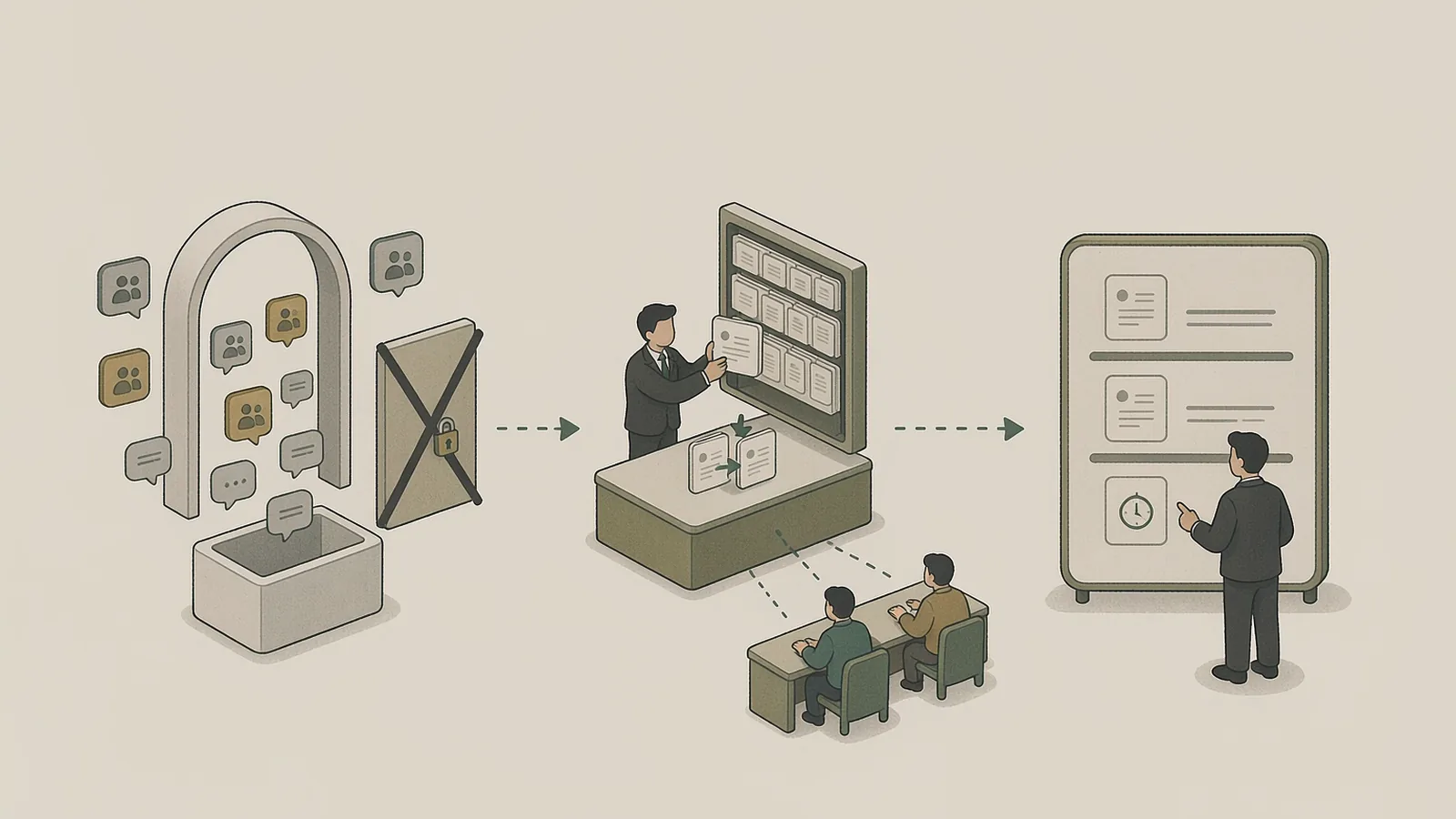
Diagram: stopping collisions depends on three institutional gates — a single intake, deduplication plus an explicit owner on entry, and a visible status at every stage — not on reps remembering to tell each other; the elements in this image are illustrative, not a real record.
Putting It to Work: A Team-Level “Lead Capture Network”
Rules need tooling to become real. A traditional CRM is good at managing contacts you have already added on WeChat or Telegram, but it is usually helpless on the harder question of how to capture the initial lead from a sea of group chatter in a disciplined way.
That is the core value of Top Prospect (Top商业线索) as team-level infrastructure. It changes where lead capture starts:
- From a personal radar to team-wide capture: the company configures Top Prospect once, connects the designated work accounts, and selects every target group. It stops being one rep’s private prospecting tool and becomes the company’s shared lead capture device.
- Automatic deduplication and a shared pool: when a high-value signal appears in a group (a system slowdown, a request to migrate, a healthy budget), Top Prospect extracts it and pushes it into the team’s shared lead pool. The system records the source group and the original context automatically, so no rep can quietly hold it back.
- Structured status tracking: once a lead is assigned to Rep A, its status becomes in progress. If Rep B tries to enter the same Telegram ID or company name, the system immediately says the lead is already held by Rep A, which closes off duplicate-lead undercutting at the physical level.
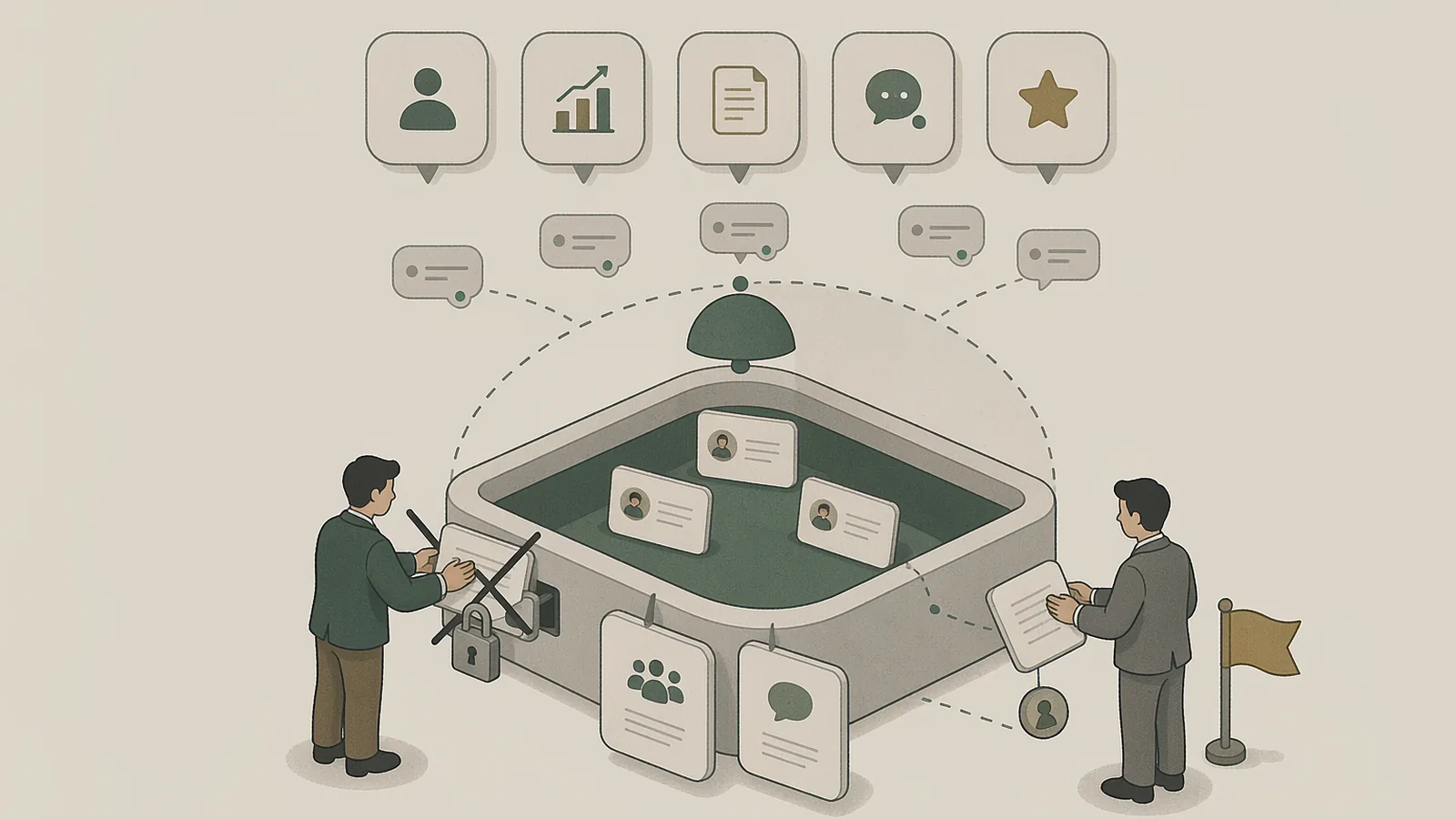
Diagram: moving intake from personal accounts to one company-wide capture device means a single Telegram ID can have exactly one owner, so collisions are blocked at the point of entry; the elements in this image are illustrative, not a real record.
To be clear, Top Prospect will not message groups on your behalf, and it will not judge a client’s purchase intent for you. It does one thing: it captures high-value fragments of public discussion with high fidelity and folds them into your company’s management process in structured form. The real conversations, negotiations, and closed deals still come from your professional sales team.
In Closing
In overseas business, Telegram is a gold mine, but without a disciplined way of extracting it, it also becomes a black hole that swallows margin.
Duplicate leads undercutting each other is only the tip of the iceberg that personal-account black-box management creates. Genuinely mature teams do not pin their acquisition hopes on a rep’s personal diligence and moral self-discipline. They build a standardized SOP and bring in infrastructure like Top Prospect, so that every group conversation turns into a company digital asset that can be tracked, reused, and accumulated.
Discipline is the precondition for scaling.
This article is human-authored. TOP Prospect processes only Telegram groups the user has explicitly authorized and connected. Its output supports human sales judgement; it does not replace human decisions and does not automatically contact or message group members.
How a Signal worth attention is found
See how Top Prospect finds and organizes Signals worth checking, keeps the original Telegram context, removes duplicates, and helps you decide what to review first. You decide whether to follow up and what to do next.