US last-mile carriers: when sellers complain about delays, don't just reply "normal transit time"
Peak-season delay complaints are the densest prospecting window for last-mile carriers. Three shipper types switching carriers right now, the Telegram groups they post in, and the four numbers to collect before quoting.
Two weeks before Black Friday last year, I was still doing it the old way: exported 2,000 seller emails and blasted out a peak-season transit-time sheet. 3 replies, one of them an unsubscribe (illustrative example).
Around the same time, someone in a seller group posted: “UPS (United Parcel Service) delays again — the bad reviews are all landing on our logistics.” Forty-plus replies underneath, all sellers in the same boat, several posting their own stalled tracking numbers. Not one of them was waiting for my transit-time sheet.
What they were waiting for was a carrier that could actually fix the problem.
1. The delay season is the last-mile carrier’s window
Shippers don’t switch carriers in normal times — not because they’re satisfied, but because switching costs: renegotiating rates, retesting routes, re-integrating systems. Without enough pain, nobody moves.
A delay turns that pain into ledger numbers: bad reviews, refunds, store-rating drops. The switching window at that moment is one to two weeks — once the season passes, slow sales bury the pain, and everyone goes back to “let’s endure it a bit longer”.
The same transit-time sheet nobody reads in the off-season becomes a lifeline in the delay season — if it reaches the right person. The only question is whether you know who is hurting right now.
2. Three shipper types switching carriers right now
1. Marketplace sellers: stuck at intake
“FBA (Fulfillment by Amazon) intake is queued out to next week again, and they cut my storage limits.”
Intake queues and storage caps push marketplace sellers toward backup warehouses and direct truck delivery. The signal is queue complaints; the real need is “the goods can’t stop moving”.
2. DTC (direct-to-consumer brand) sellers: stuck on reviews
“An order due two days ago is still in transit, and the bad review is already up.”
For DTC sellers, reviews tie directly to logistics. They don’t care about saving twenty cents — they care about delivery certainty. Whoever can commit to a promise takes next season’s volume.
3. Bulk and heavy-goods sellers: stuck on the bill
“This month’s dimensional-weight billing is higher than the product value. Anyone charging by actual weight?”
Bulk sellers losing money to dimensional weight actively comparison-shop in groups. They’re the easiest to open a conversation with — and the fiercest price shoppers, so do the math before you quote.
3. Where you hear these complaints
Sellers don’t sit in “logistics exchange groups” on Telegram — those belong to forwarders and fellow carriers. They gather in their own groups (illustrative example): Amazon seller groups, independent-site seller groups, and category seller groups (furniture, fitness gear, and home goods each have their own).
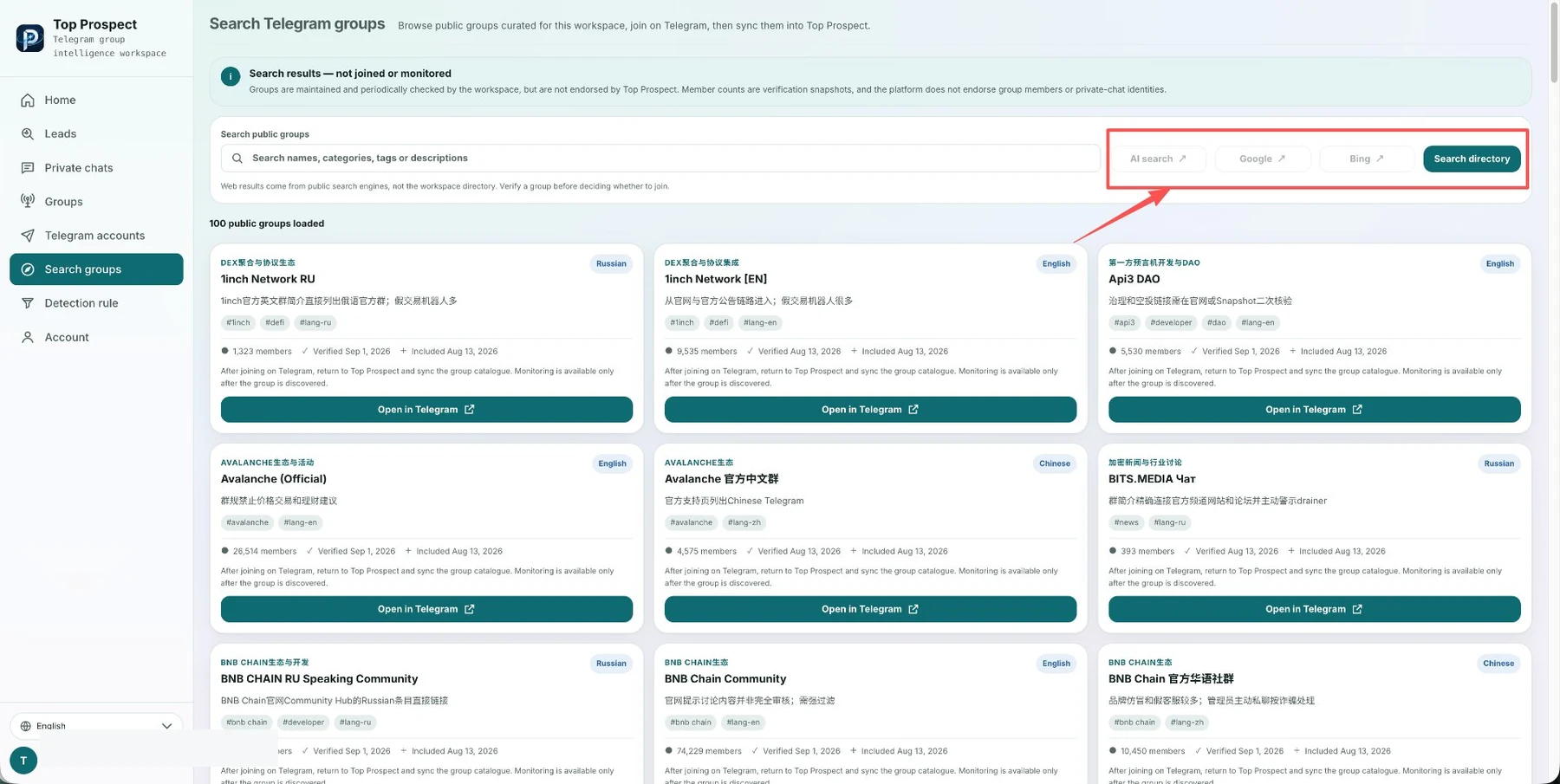
I search these groups with TOP Prospect: four search entries — AI search, Google, Bing, and the built-in group library (with 100 public groups loaded). Category keywords beat industry keywords: “amazon seller” returns seller groups; “logistics” returns us.
Filter by primary language and member count, then read each result card’s group name, description, category tags, last verified time, and indexed time, keeping the groups dense with sellers.
4. Before quoting, collect these four numbers
See a delay complaint, and don’t fire off a rate card. Last-mile quotes are calculated — miss one number and you’re guessing:
- Daily order volume and peaks — decides which price tier you can offer
- Which warehouse ships to which states — decides the route and the delivery promise you can make
- Category and dimensional weight — decides billing by dimensional or actual weight; for bulk items the whole algorithm changes
- Current carrier’s pricing and promises — decides whether your angle is price, speed, or certainty
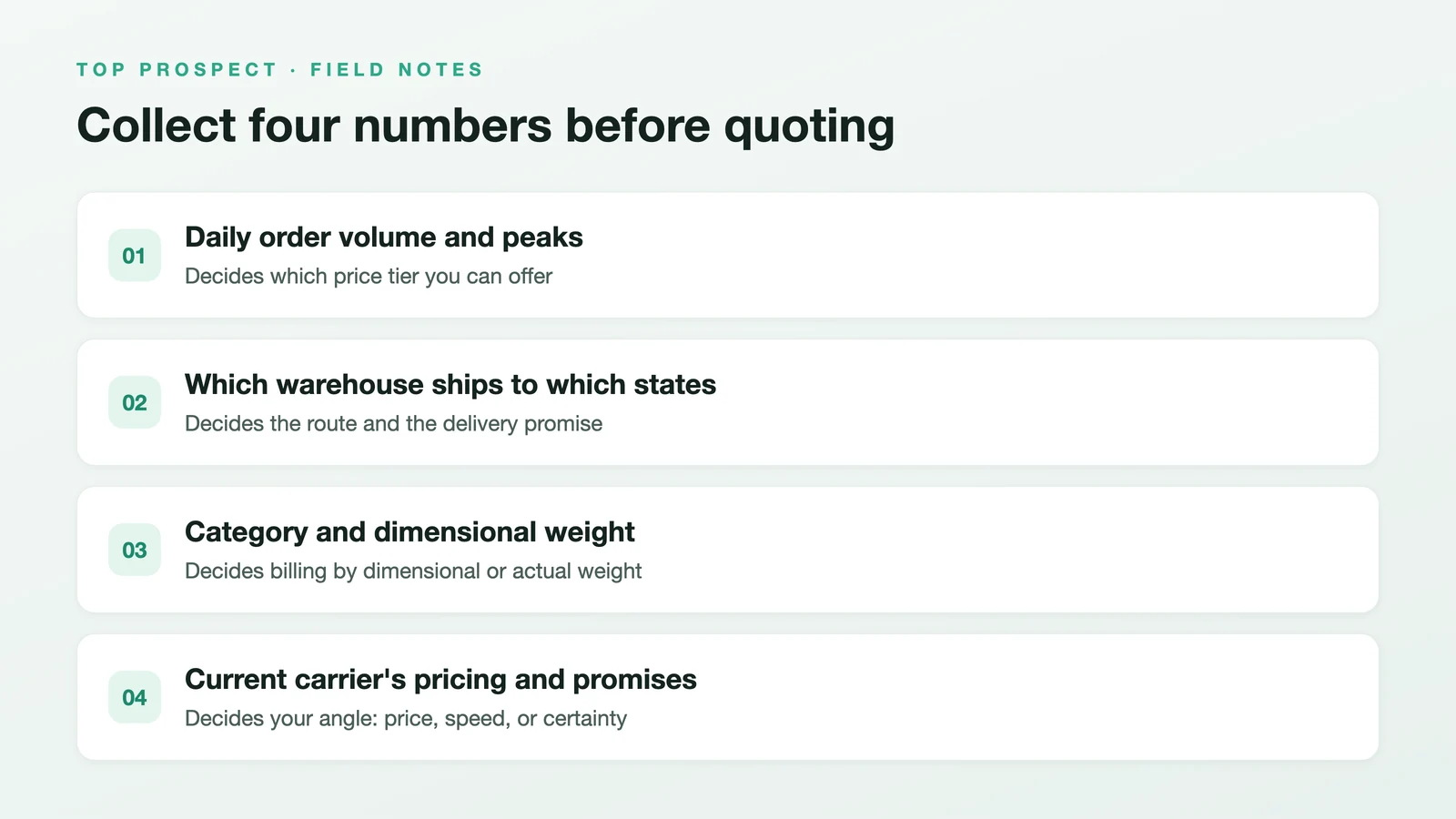
With all four collected, your quote is a plan. Without them, your quote is one row on their comparison sheet.
5. Be the person solving the problem before being the person quoting
When sellers are venting about delays in a group, two people annoy them most: the one replying “normal transit time”, and the one opening with a rock-bottom price. What they wait for is the person who asks first: “which warehouse do you ship from, and to which states?”
A lead list finds shippers who might switch carriers someday. A complaint thread finds shippers switching carriers right now. The peak-season window is one to two weeks — a pool built today beats one built on Black Friday by an entire season.
Frequently asked questions
Does this work outside the delay season?
Yes, just with lower signal density. In the off-season shipper complaints center on pricing and lost parcels, and the switching window is less urgent — but the group pool is the same one. Build it now and it's ready for peak season.
Why not just quote a lower price right away?
Because the shipper's biggest fear in that moment isn't price — it's switching again and hitting delays again. A quote without order volume, routes, and the current carrier's promises is just another line in their comparison sheet. Collect the four numbers first, then talk price.
How do I avoid being taken for a competitor poaching clients?
Don't open with a quote. Respond to the thing they're complaining about: if they're stuck in warehouse intake queues, talk backup warehousing; if bad reviews are piling onto their logistics, talk delivery certainty. Helping solve a problem and undercutting on price are two poses the group can tell apart instantly.
Sources and further reading
This article is human-authored. TOP Prospect processes only Telegram groups the user has explicitly authorized and connected. Its output supports human sales judgement; it does not replace human decisions and does not automatically contact or message group members.
How a Signal worth attention is found
See how Top Prospect finds and organizes Signals worth checking, keeps the original Telegram context, removes duplicates, and helps you decide what to review first. You decide whether to follow up and what to do next.