USD1 Is Now Native on Canton: Why Institutional Networks Want More Than Bridged Tokens
Canton says USD1 is now natively issued on its network. Here is what native issuance changes for settlement, what it does not prove, and which implementation discussions matter next.
Signals to watch
- A wallet, custodian, or venue asks for the exact native asset identifier and supported operations
- A tokenized-asset workflow needs an on-network dollar leg for atomic settlement
- A team asks who controls minting, redemption, transfer rules, privacy, or compliance obligations
- Multiple independent implementation discussions appear after the official announcement
On 25 August 2026, Canton Network announced that World Liberty Financial’s dollar stablecoin, USD1, is now natively issued on Canton. The phrase is easy to flatten into “another chain added another stablecoin.” That misses the decision hiding inside it.
A bridged token begins somewhere else and arrives as a representation created by a bridge or transfer system. A natively issued token is created and managed inside the destination network’s own asset model. For an institutional network, that distinction affects who controls issuance and redemption, which wallets and custodians can support the asset, how a cash leg can settle against a tokenized security, and which privacy or transfer rules apply.
It does not prove that every Canton application already supports USD1. It does not establish liquidity, fees, redemption times, jurisdictional availability, or independent reserve verification. The announcement confirms a new settlement asset; implementation evidence still has to follow.
Key takeaway
- Canton officially announced native USD1 issuance on 25 August 2026.
- “Native” describes where the asset is issued and governed; it does not mean universal application support.
- The immediate market change is a new dollar leg that can be designed into Canton-based asset settlement.
- Wallet, custody, mint/redeem, liquidity, compliance, and production support remain separate questions.
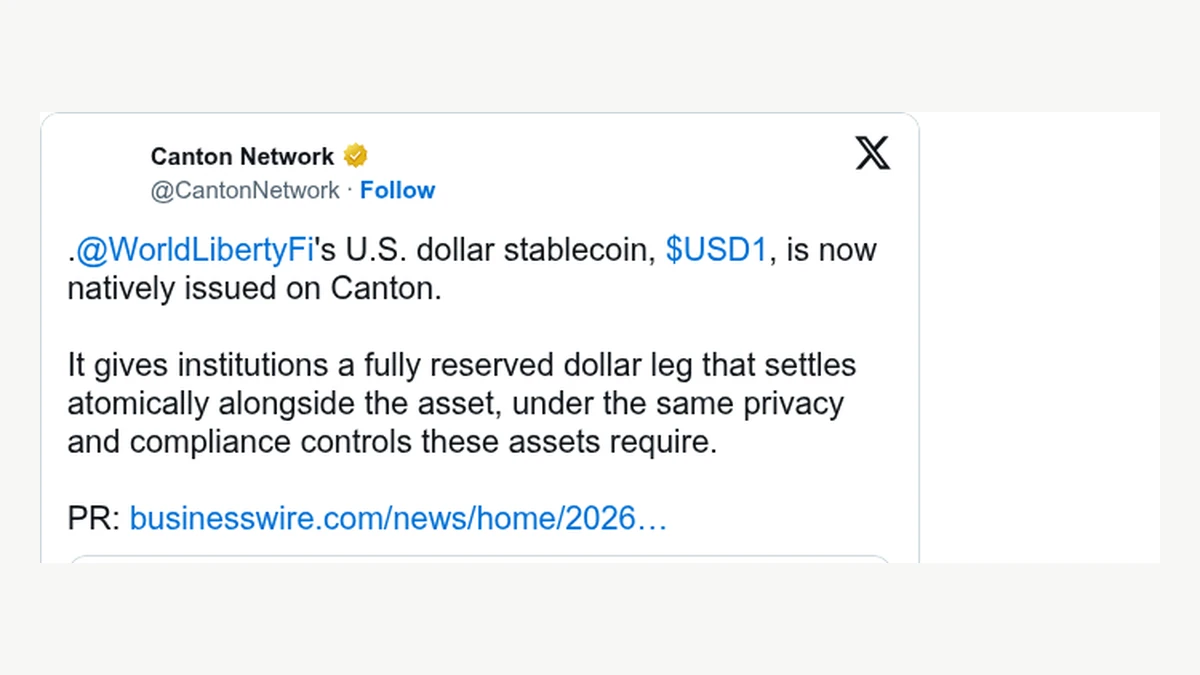
Canton’s 25 August announcement confirms native issuance and the intended dollar-settlement role. It does not claim universal wallet, custody, or redemption support.
Native and bridged are not two labels for the same route
Suppose a tokenized treasury asset lives on Network A, while the dollars intended to buy it live on Network B. A bridge can lock or otherwise account for the asset on B and issue a representation on A. The buyer can then use the representation inside A’s applications.
That route can work, but the representation inherits more than the dollar asset’s name. It also inherits the bridge design, the bridge operator or validator assumptions, the mint-and-burn process, liquidity on each side, and the operational procedure for returning to the original asset. The network hosting the representation may not control the full lifecycle.
Native issuance starts from a different place. The issuer creates the asset within the destination network’s token standard and operating model. Minting, redemption, transfers, permissions, wallet representation, and settlement can be built around that network’s rules rather than around an external representation.
The word “native” still needs a specification. A serious integration team will ask for the exact package or asset identifier, supported operations, issuer and administrator roles, redemption route, wallet and custodian coverage, and the conditions under which a transfer can be accepted or rejected. Without those details, “native” is a confirmed launch state, not a finished integration brief.
That is the first useful reading of the USD1 announcement: Canton now has an issuer-backed USD1 asset on the network. The next question is not “Is USD1 on Canton?” It is “Which parts of the lifecycle can our application support today?”
The cash leg is the practical reason this matters
Tokenized assets need something to settle against. If a fund token, bond, repo position, or other real-world asset changes ownership, the other side of the transaction usually needs a cash-like asset. When the security and cash legs sit in different systems, teams must coordinate timing, reconcile two records, and manage the possibility that one side completes before the other.
Canton’s announcement says native USD1 gives institutions a dollar leg that can settle atomically alongside an asset. Atomic settlement means the two on-network transfers are linked: either both complete under the transaction’s conditions, or neither does. The useful promise is not speed by itself. It is reducing the gap in which the asset moved but the payment did not, or the payment moved while delivery remained unresolved.
Canton’s CIP-56 guide describes its token standard as supporting multi-step transfers and atomic delivery-versus-payment, often shortened to DvP. It also describes privacy-preserving balance and transaction management and interoperability among compliant wallets and applications.
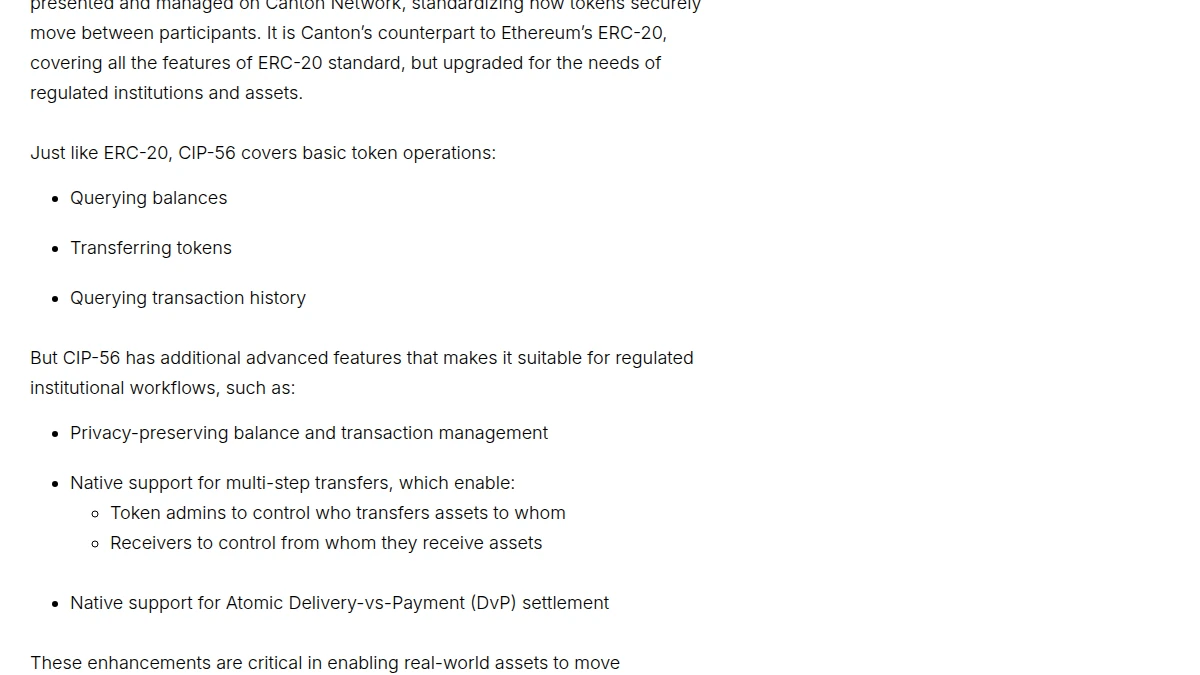
The CIP-56 guide supports the platform-level claims about privacy controls, multi-step transfers, and atomic DvP; it is not evidence that a particular USD1 integration is already live.
Those are platform claims from Canton’s own documentation. They explain why a native dollar asset is strategically useful, but they do not show that a particular USD1 trade, custodian, venue, or redemption route has been tested in production. Atomicity covers the linked on-network transaction. It does not remove issuer risk, custodian risk, liquidity risk, legal enforceability, sanctions obligations, operational mistakes, or off-network banking dependencies.
This boundary matters because “atomic” often gets repeated as if it means “risk-free.” It does not. It gives the settlement design a cleaner failure rule for two digital legs. The rest of the operating model remains.
Privacy and compliance still belong to named participants
Canton positions its network around need-to-know privacy: transaction information can be shared with the parties and authorities that require it rather than broadcast in full to every observer. Its stablecoin materials connect that model to treasury, B2B payments, financing, and tokenized-asset settlement.
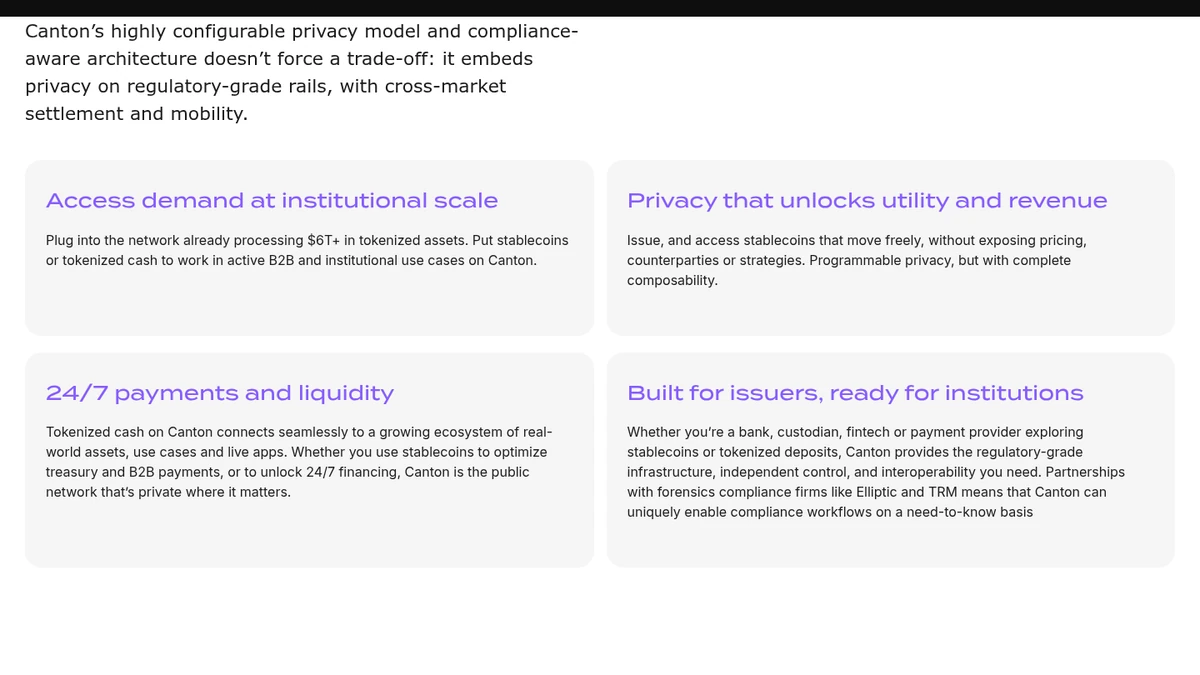
Canton’s stablecoin page frames privacy, institutional access, 24/7 payments, and issuer support as separate parts of the operating model. Each still needs to be verified for the intended participant and route.
Native USD1 can participate in that network model, according to the announcement. But “under the same privacy and compliance controls” should not be read as a transferable compliance certificate.
An issuer still defines issuance and redemption conditions. A wallet or custodian still decides what it supports and how it controls keys. A venue still applies participant rules. Each regulated entity still has obligations tied to its role and jurisdiction. Privacy controls determine who can see transaction data; they do not decide whether the underlying activity is lawful or whether every participant has completed the correct checks.
For an integration review, four questions are more useful than the word “compliant”:
- Which participant can see which fields before, during, and after settlement?
- Who can restrict, pause, reject, or reverse an asset action, and under what rule?
- Which records can the issuer, custodian, venue, auditor, and regulator retrieve?
- Which obligations remain off-network, including onboarding, sanctions screening, reserve reporting, and fiat redemption?
The official sources reviewed here do not answer all four for every USD1 workflow. That is not a flaw in a launch announcement. It is simply where the announcement ends and implementation work begins.
The market Signal appears after the headline
For business-development and partnerships teams at custody, wallet, tokenization, settlement, analytics, and compliance providers, the official announcement is context. It is not, on its own, a customer request.
The commercially useful change appears in the discussions that follow. A tokenized-asset venue asks whether its existing wallet can hold the native package. A custodian asks for transfer-event and reporting support. A treasury team wants to know how minting and redemption fit its banking cut-offs. A liquidity provider asks which markets will quote the pair. An application team tries to replace a bridged cash leg without rebuilding its settlement flow.
These questions may surface across authorized Canton ecosystem, institutional DeFi, custody, stablecoin, and tokenization groups before anyone publishes an RFP or partner page. They will rarely arrive as a complete procurement brief. One group may mention wallet support; another may discuss atomic DvP; a third may ask about reporting. The value comes from connecting independent implementation questions to the same confirmed market event without pretending the people or organizations are identical.
TOP Prospect can filter, merge, deduplicate, classify, and rank discussions from groups a user deliberately connects and is authorized to access. A candidate Signal can retain the original message, source, time, summary, ranking reason, and cross-group support so a person can decide whether the discussion is technical curiosity, ecosystem planning, or a real supplier decision. It cannot identify an anonymous participant, prove two accounts belong to one company, read private chats, contact anyone, or certify a commercial opportunity.
The review order should rise when a discussion moves from the asset name to an owned implementation object: a named wallet, custody policy, settlement workflow, reporting requirement, launch environment, or decision date. Repeated celebration of the announcement is reach. Repeated questions about who must change what are market work.
A readiness check for USD1 integrations
Before treating “native on Canton” as deployable, separate five evidence layers.
| Evidence layer | What would count | What it would not prove |
|---|---|---|
| Network announcement | Official Canton and issuer confirmation of native issuance | Support in a specific wallet, venue, or custodian |
| Asset specification | Exact identifier, roles, supported operations, transfer rules | Liquidity or operational readiness |
| Application support | Documented integration plus a controlled test in the intended environment | Redemption, production capacity, or legal availability |
| Operating route | Named mint/redeem, custody, reconciliation, monitoring, and incident owners | Independent reserve assurance or market depth |
| Production evidence | Successful transactions under the intended controls and service conditions | Universal suitability for every jurisdiction or workflow |
The reviewed sources clearly satisfy the first layer. Canton’s CIP-56 material helps explain the asset-standard layer in general. The remaining layers depend on the exact issuer, wallet, custodian, venue, participant, and operating environment.
This is also why a single screenshot of USD1 in an interface is weak evidence. It may prove that a label rendered. It does not prove that issuance, transfer, settlement, reporting, and redemption all work under the intended controls.
What the announcement changes now
The announcement closes one question and opens several better ones.
USD1 is no longer merely a hypothetical dollar asset for Canton-based workflows; Canton says it is natively issued on the network. Teams designing tokenized-asset settlement can now evaluate a named issuer-backed option instead of speaking only about a future cash leg.
But a native asset is infrastructure, not automatic distribution. Its practical reach will be determined by the wallets, custodians, venues, liquidity providers, treasury systems, analytics pipelines, and compliance processes that support it. Those integrations will not all appear at once, and a network announcement should not be stretched to imply that they did.
The next meaningful evidence will be specific: an exact integration, a supported operation, a controlled settlement, a mint-or-redeem route, or a named production service. Until then, the disciplined conclusion is narrow.
USD1 being native on Canton changes the available settlement design. It does not remove the work required to make that design usable.
Sources reviewed
- Canton Network’s official USD1 announcement, 25 August 2026
- Canton’s guide to the CIP-56 token standard
- Canton’s stablecoin payments overview
Source review completed on 26 August 2026. The Business Wire link distributed with the announcement was treated as a company press release, not independent verification.
Frequently asked questions
Does native issuance mean USD1 is automatically supported by every Canton application?
No. Native issuance establishes the asset on the network, but each wallet, custodian, venue, or application may still need its own technical, operational, legal, and commercial integration.
Does atomic settlement eliminate settlement risk?
It can make the exchange of two on-network assets conditional on both legs completing together. It does not eliminate issuer, custody, liquidity, legal, operational, or counterparty risk outside that transaction.
Does the announcement independently verify USD1 reserves?
No. Canton describes USD1 as fully reserved, but the sources reviewed for this article do not constitute an independent reserve attestation.
Sources and further reading
- Canton Network official announcement: USD1 is natively issued on Canton (25 August 2026)
- Canton Network: What is CIP-56? A Guide to Canton’s Token Standard
- Canton Network: Private stablecoin payments on public blockchain
- Company press release linked by Canton: World Liberty Financial launches USD1 on Canton
Market and risk discussion is supporting evidence
Top Prospect is primarily a Telegram lead-generation product. Market and risk discussion can add context to a candidate lead, but it does not become a verified incident, trend, or sales opportunity automatically.