Web3 growth agency prospecting: no group inventory needed — 100 project groups in the directory on day one
A two-person studio started with no groups at all and got invited into five in its first month, two of them usable (illustrative example). The in-workspace directory returns public groups with readable verification dates, so newcomers do not need contacts first.
“What groups do you have?”
“None.”
“So how do you find projects?”
“We wait to be invited.”
That conversation (illustrative example) happened between the two partners of a newly formed Web3 growth studio. Their first month they were invited into five project groups, two of them usable; the rest were airdrop links and peers swapping contacts.
What blocked them was not skill. It was the premise that groups have to be handed to you. The in-workspace directory on Top Prospect holds 100 indexed public groups you can page through the same day — no waiting for someone to remember you.
1. Where newcomers get stuck
When people say Web3 runs on contacts, what they usually mean is that they are stuck at this step: having no groups.
First, group inventory sits with a small number of people. Most active groups in the space were built by early participants, and who gets in is a human decision. Trading favours for invites means your speed depends on when someone remembers you.
Second, groups you are invited into reflect someone else’s judgement. The person who invited you is running his own business, and his groups are not necessarily where your buyers are. Finding no projects in them does not mean you are not trying.
Third, the easiest route costs the most. Buying a group list or joining generic groups in bulk looks fastest, but everything afterwards is built on an uncertain pool. When the pool is dirty, nobody trusts the rule hits that come out of it.
2. Groups in the directory are not the same as groups found elsewhere
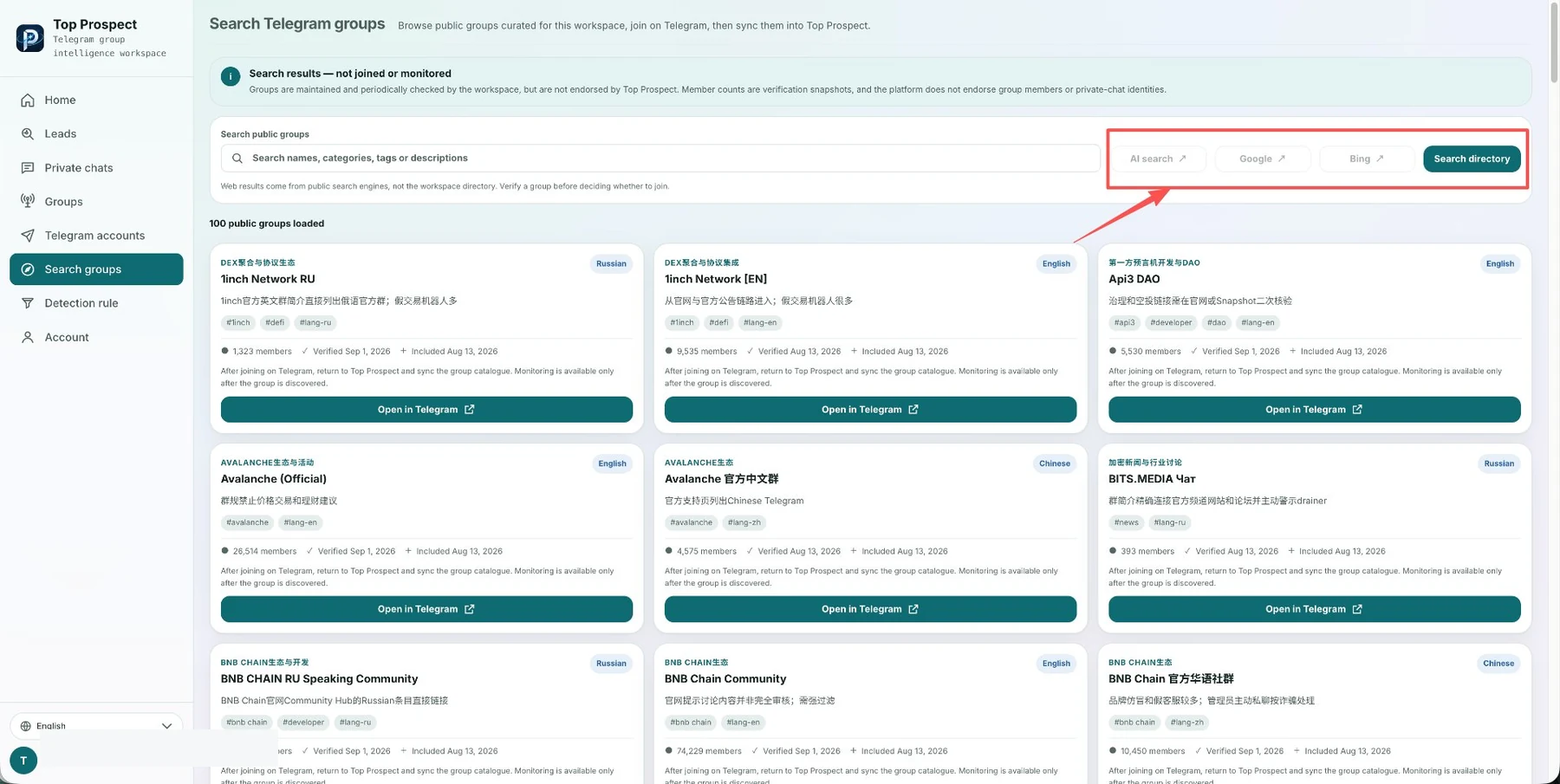
The Search groups page carries four entries, and in-workspace search is the only one that reads inside the library. It currently reports 100 public groups loaded.
What “indexed” means
In-workspace search returns public groups the workspace has already indexed. Indexed carries two meanings: the group’s public information entered the catalogue, and someone has periodically confirmed it still exists.
Those two facts are printed directly on the result card: the last verification date and the inclusion date.
Web results carry no such record. The page says so plainly: web results come from public search engines, not the workspace directory, so verify a group before deciding whether to join. The difference is not which side has better groups; it is how much checkable information arrives with the group.
The same notice also draws the boundary: groups are maintained and periodically checked by the workspace, but are not endorsed by Top Prospect, and member counts are verification snapshots. Being indexed answers “is this group worth my time”. It does not answer “is this person a real project.”
3. Between finding a group and using it, there is one more step
This is the step newcomers skip most often.
You join groups on Telegram, come back and find your in-workspace list empty, and conclude the product does not work. What actually happened is that the sync was never done.
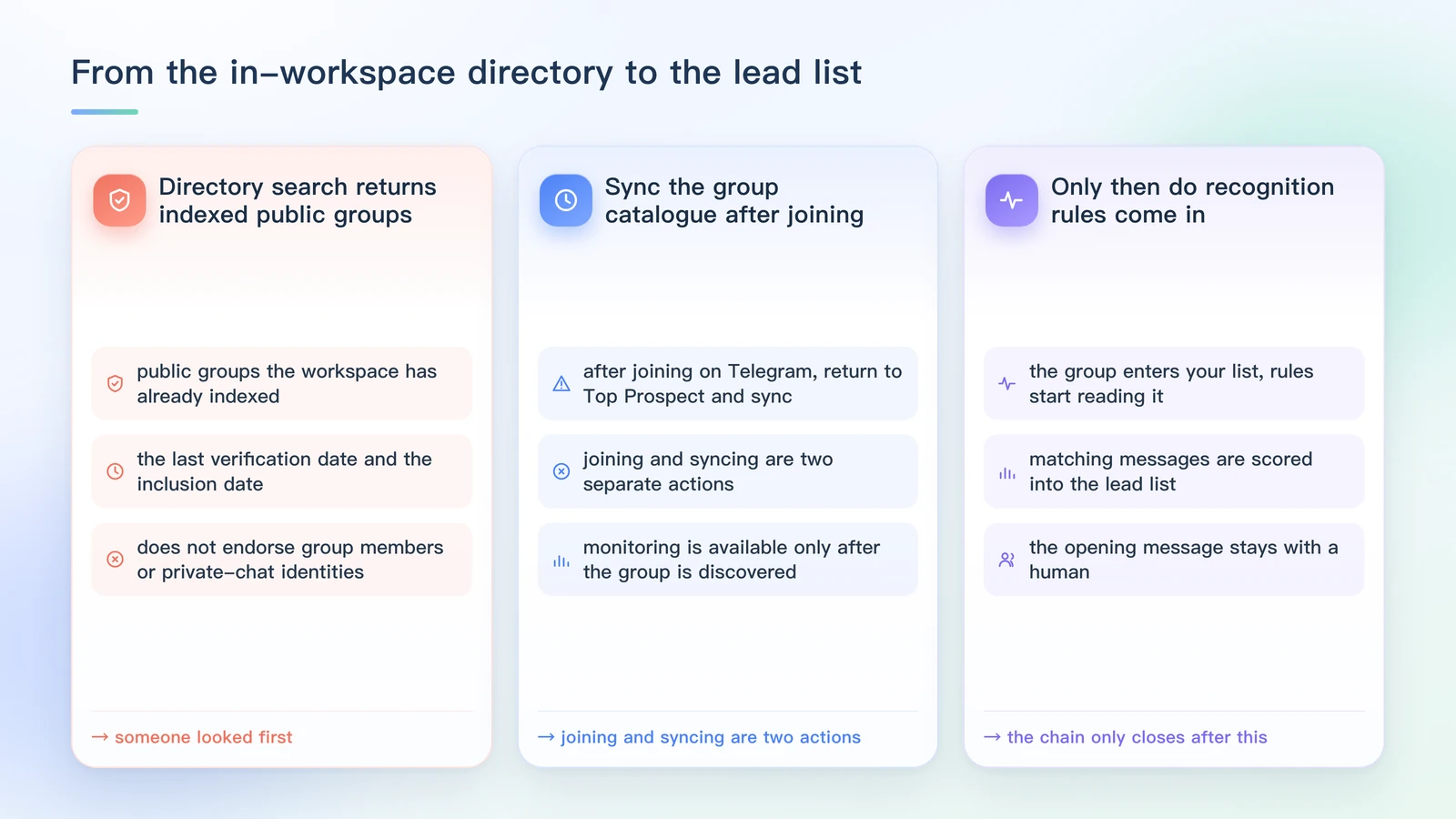
The interface states it in as many words: after joining on Telegram, return to Top Prospect and sync the group catalogue. Monitoring is available only after the group is discovered.
Joining and syncing are two actions. Do only the first and the workspace does not know the group exists, which means no recognition rule can be attached to it.
The chain only closes after the sync: the group enters your list, rules start reading it, and matching messages are scored into the lead list. From that moment you have one place to open every morning, instead of one more group to scroll manually.
4. How to run week one
The rhythm can go like this (illustrative example):
Day one: build the candidate pool. Run three sets of phrases through in-workspace search: project types (chains, layer-twos, decentralised finance), chain names, and trade slang. Three sets in, the public groups you can page through that day usually run into the dozens.
Day two: filter. Start with the last verification date and inclusion date and remove the obviously unmaintained. Then check primary language and keep the market you actually sell into. Finally look at member count without chasing size.
Day three: join and sync. Join each group on Telegram, then return to the workspace and sync the catalogue one by one, confirming every group appears in your list.
Day four: build rules. What a growth agency should watch is narrow: who is doing a community cold start, who is asking whether anyone handles growth, who mentions pre-launch preparation. Write those into a recognition rule.
Day five onward: read the hit list once a day. A high score means suspected, nothing more. Judgement and the opening message stay with a human.
A week in, the groups you hold were found by you, with conditions you set and sources you can trace — and no longer depend on who is willing to invite you.
Conclusion: if you look for customers on Telegram every day
You have probably noticed: the hard part was never finding a Telegram group. The hard part is finding the few messages that genuinely matter, out of hundreds of groups and millions of posts. That is the problem Top Prospect exists to solve. You can start by building a first group pool with AI search, then use Top Prospect to keep verifying, monitoring and capturing demand signals. Together they form one workflow: discover communities → build a group pool → capture signals → judge by hand → follow up commercially You do not have to change how you sell, and you do not have to let AI make the final call. It just means less time finding information and more time on the opportunities actually worth handling. Explore Top Prospect
Frequently asked questions
Are the groups in the directory just groups other people already joined?
No. Being indexed means the group's public information entered the workspace catalogue and has been periodically checked since, which is why the card carries an inclusion date and a last verification date. It means someone looked first, not that someone already took the opportunities.
I joined groups on Telegram — why is my in-workspace list still empty?
The sync step is missing. The interface states: after joining on Telegram, return to Top Prospect and sync the group catalogue. Monitoring is available only after the group is discovered. Joining and syncing are two separate actions, and doing only the first leaves the workspace unaware the group exists.
Will searching the directory return too few groups to be useful?
It depends on your phrases. At the start, search project types, chain names and trade slang once each, and the public groups you can page through that day usually run into the dozens — enough for a long time. Widen the vocabulary after this batch produces results, not before.
Sources and further reading
This article is human-authored. TOP Prospect processes only Telegram groups the user has explicitly authorized and connected. Its output supports human sales judgement; it does not replace human decisions and does not automatically contact or message group members.
How a Signal worth attention is found
See how Top Prospect finds and organizes Signals worth checking, keeps the original Telegram context, removes duplicates, and helps you decide what to review first. You decide whether to follow up and what to do next.