How cross-border payment providers find 30 high-intent merchant leads in one night with Top Prospect
A keyword alert fires 200 times a night and one of them comes from someone actually buying. Swap industry words for four kinds of wording that describe a situation, add a trigger condition, and the morning list becomes worth following.
Group names and sample dialogue in this article are illustrative. Alert counts and lead counts are taken from actual operating records; the composition of the alerts is an estimate.
Shortly before eleven on a Friday night, a BD at a cross-border acquiring provider saw the same sentence in three groups at once.
“Anyone have a stable channel? Stripe started declining yesterday.”
He screenshotted it, dropped it in his to-do list, and planned to deal with it in the morning. The next day he spent twenty minutes scrolling back to the message, then opening the sender’s history to check whether the person was really buying. By the time he had a first sentence ready, the reply was: “already talking to someone.”
That night he received 200 keyword alerts. One of them came from someone actually buying.
Of the rest, 180 were competitors exchanging business cards, 15 were people selling courses and tools, and 4 were beginners asking how to register a Stripe account. Exactly one described a specific payment that had just broken, and he missed it.
The problem is not effort. He had set payment, acquiring, Stripe and settlement as keywords. The problem is that a keyword matches a word, not who is saying it, who they are saying it to, or when it happened.
Two hundred alerts in one night, and 180 of them are competitors swapping cards
Take the 200 apart first. Which class the loss falls into decides which step you change.
Competitor pitches (180) Providers posting channel lists, rate cards and contact details. Every keyword fires, and no word list can stop them.
Courses and tools (15) Training, agency services, bulk-messaging software. They come with prices and contact details.
Beginner questions (4) “Can an individual open Stripe?” “How do I link a withdrawal card?” Payment words, no buying signal.
Real demand (1) Describing something that already happened or is about to: declines started yesterday, the new storefront launches next month, the budget top-up will not go through.
Exclusions remove much of the first two classes. The third needs a role judgement. The dividing line is not vocabulary, it is where the speaker stands: competitors are pitching themselves, beginners are asking about basics, and only the fourth class is describing their own situation.
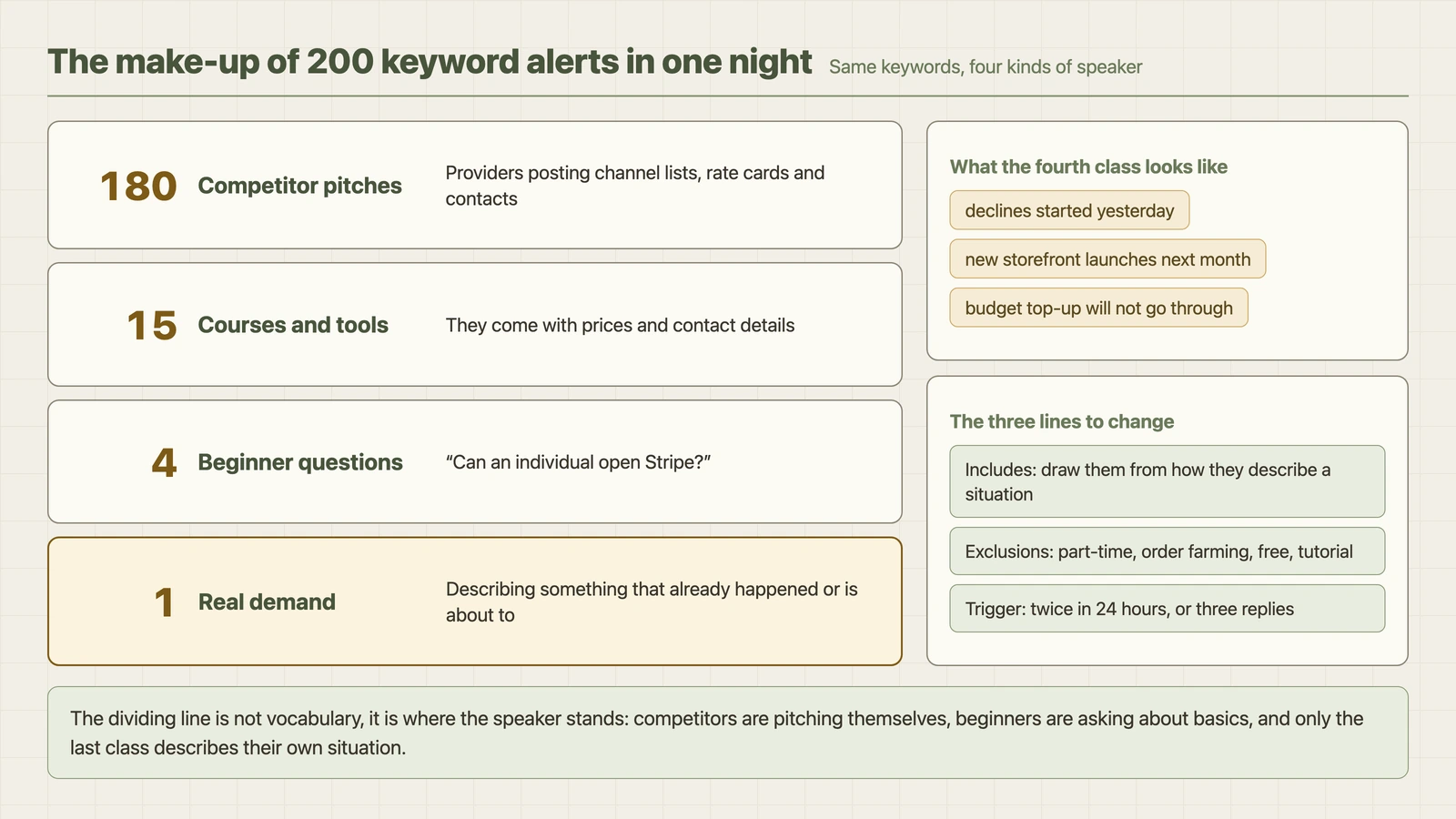 The figure splits a night of alerts by who is speaking: 180 competitor pitches, 15 courses and tools, 4 beginner questions and 1 piece of real demand, with the fourth class’s typical wording and the three rule lines on the right.
Keywords remove ads, not conversations that already ended
Two more classes slip through, and no word list will ever fix them.
The first is history that has already been resolved. “Looking for a channel” followed by “found one, thanks” hits your keywords twice, and it is a finished conversation. Push it to a salesperson and their first sentence will be wrong.
The second is grey-market and ad traffic. “Straight from the source”, “bulk discount”, “guaranteed channel” are all payment words, but there is no merchant behind them.
Both require context: how many times the same thing has been raised in the group, whether anyone replied, and whether the person replying is the same person talking to themselves. Seen one message at a time, you will classify both as leads fairly often.
So the first move is not adding or removing words. It is changing what you judge by.
Translate “what I sell” into “what has to happen before they speak”
Payment BDs set keywords from their own product name. Those words are fine, but they are industry words, and competitors use them too.
Someone actually buying talks about what just happened to them. Put the two sides of the same subject next to each other:
What you and your competitors say
- Payment channel, acquiring, settlement, risk control, chargebacks, channel stability
What the other side says
- Symptom wording: declines started yesterday, checkout page blocked by risk rules, budget top-up will not go through, withdrawal card will not link
- Timing wording: launches next month, needs to be live this week, has to be replaced before peak season
- Compliance wording: needs itemised statements, needs to clear review, needs to show transaction flow
- Role wording: my boss asked me to check, our finance team wants, the client is chasing us
What the four have in common: only a specific person, at a specific moment, dealing with a specific problem, says them. No competitor says “declines started yesterday on me”, because they are not the one collecting money.
Two or three words from each class, mixed together, is enough. Quantity is not the point. Every word should point at a purchase that is happening now.
Three lines are enough: includes, exclusions, and what counts as a message
Top Prospect’s detection rules are three lines.
Line one, includes. Take a few words from each of the four classes above.
Line two, exclusions. Part-time, order farming, free, tutorial, third-party registration, guaranteed approval.
Line three, the trigger condition. This is the line people skip, and it does more for tomorrow’s list than the other two. With only the first two lines you will get the same sentence posted three times in one group by one account. Write it as: the same account mentions it twice or more within 24 hours, or the message collects three or more replies. The first filters out monologues, the second means someone else in the group is engaging, so it is worth a look first.
In-app search fills the group pool first, AI search covers the groups whose names do not match
No rule finds anything if the groups are wrong.
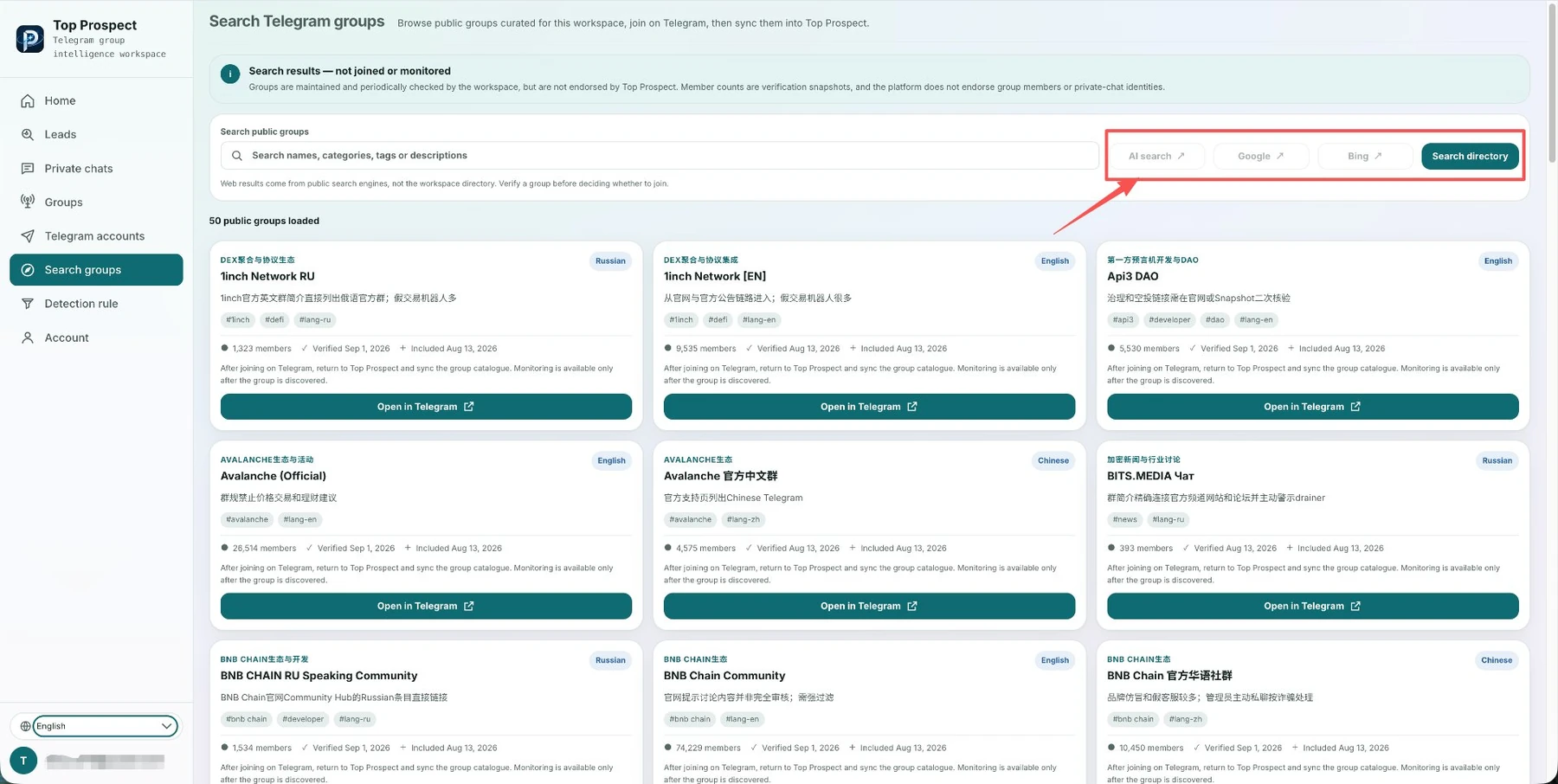 This is the TOP Prospect group search page. Four entries sit in a row to the right of the search box; below them are the public groups already in the library, each card showing member count, last verified date and the date it was added.
In-app search returns public groups that are already listed and recently verified, and the card shows member count, category tags and primary language, which is enough to decide whether a group is worth entering. AI search suits groups whose names carry no industry words: describe your business intent in one sentence and it matches against what is discussed. Google and Bing are for new groups that are not in the library yet.
Once the pool reaches around 50 groups, the discussion volume behind it can carry the next morning’s list.
What the system should keep overnight is context, not alerts
Once the rules are set, the system takes over. It reads public messages across those groups, and every match is stored with the original message, the sender and the surrounding conversation. What you open in the morning is a prepared entry, not a “new message in some group” notification.
The difference is whether the morning is spent filtering or deciding. Filtering is manual labour. Deciding is the part that needs you.
Four checks in the morning before you decide who to message
Open the list and go through these four in order.
- Read the sender’s history. Long-running questions of the same kind, or a single appearance on this one message. The first is more likely real demand; the second is often traffic generation.
- See whether the thread went anywhere. Someone replied, the question was followed up. That beats a message standing alone.
- Look at the source groups. The same need appearing in several groups means the person is searching everywhere, and the response window is shorter.
- Check the time. Something posted at ten last night and something posted at four in the morning need completely different openings.
Take the ones that pass all four first. The ones where only the time looks good can wait until the afternoon.
That morning the list held 32 entries, and 30 of them were worth following the same day.
Open with their own sentence, not your business card
Do not send “Hi, we do payments”. Quote the sentence they posted last night.
“Saw your message last night about Stripe declining since yesterday. We work on cross-border acquiring, and this usually starts with the decline code and the settlement cycle. If it helps, fifteen minutes to go through it together.”
What they see is their own sentence, not your pitch. That one line separates you from the five people who posted in the group before you.
What the list looks like when you open it in the morning depends on whose voice you wrote into the rules the night before. Keywords are the entrance, not the criterion.
If your team works in cross-border payments, acquiring or settlement and you are also trawling dozens of groups behind keyword alerts, start by changing only the third line: swap industry words for wording that describes a situation, add a trigger condition, and see whether tomorrow morning’s list gets shorter and sharper.
To see how the TOP Prospect group search and detection rules work together, visit topprospect.net.
Sources and further reading
How a Signal worth attention is found
See how Top Prospect finds and organizes Signals worth checking, keeps the original Telegram context, removes duplicates, and helps you decide what to review first. You decide whether to follow up and what to do next.