Telegram Ads agency prospecting: never open 300 groups one by one — filter by category and language, 40 in two days
Opening groups one at a time got through 130 in two weeks and closed nothing (illustrative example). The category tag and primary language already sit on every result card; use them first and the pool drops to dozens.
Three hundred groups. About two minutes to read each one well enough to judge it.
300 x 2 = 600 minutes. Ten hours. That is before notes and deliberation.
One team reselling Telegram ad placements actually paid that bill: entering a new market, they opened groups one at a time, read the description, skimmed recent messages and decided whether brands were inside. Two weeks in they had opened 130 and closed nothing (illustrative example).
The same 300 groups took another agency two days. They did not read faster; they changed the order — filter by category tag to match the business type, then by primary language to match the market, keep 40 of the 300, and within two weeks they were talking to six brands preparing to test a new channel.
1. Flipping 300 groups by hand never finishes
The problem with reading one by one is not diligence, it is arithmetic.
First, the cost per group does not come down. Opening a group, reading its description, deciding whether brands are inside, then skimming a few messages to confirm takes at least two minutes. Three hundred groups is ten hours of pure reading, before notes and judgement.
Second, your standard drifts as you read. After twenty irrelevant groups in a row, people start keeping the marginal ones, because admitting the previous twenty minutes were wasted is unpleasant. The further you go, the worse the survivors get.
Third, the order itself is wrong. Reading content first and thinking about categories second means rebuilding your judgement from scratch for every new group. And the category is already printed on the card.
Fourth, flipping groups consumes the same working hours as everything else. Entering a new market usually comes with time pressure, and two weeks spent flipping means two weeks without talking to a single client. Flipping is the front end of filtering, it produces no revenue, and it has to be compressed whenever possible.
2. Before you filter, decide which brands you want
A placement agency’s clients are not “all brands”. They are brands preparing to move budget into a new channel. These brands have two observable traits:
They already advertise somewhere else. A brand that has never run online campaigns will not suddenly ask about Telegram Ads. The people who ask already run advertising, user acquisition or growth, so they gather in the communities built around those topics.
They have a defined regional market. Advertising splits along language and geography by nature, and people selling into Europe and North America barely share a group with people selling into the CIS.
Settle those two and the order of the two passes settles itself: match the business type by category first, then match the market by language.
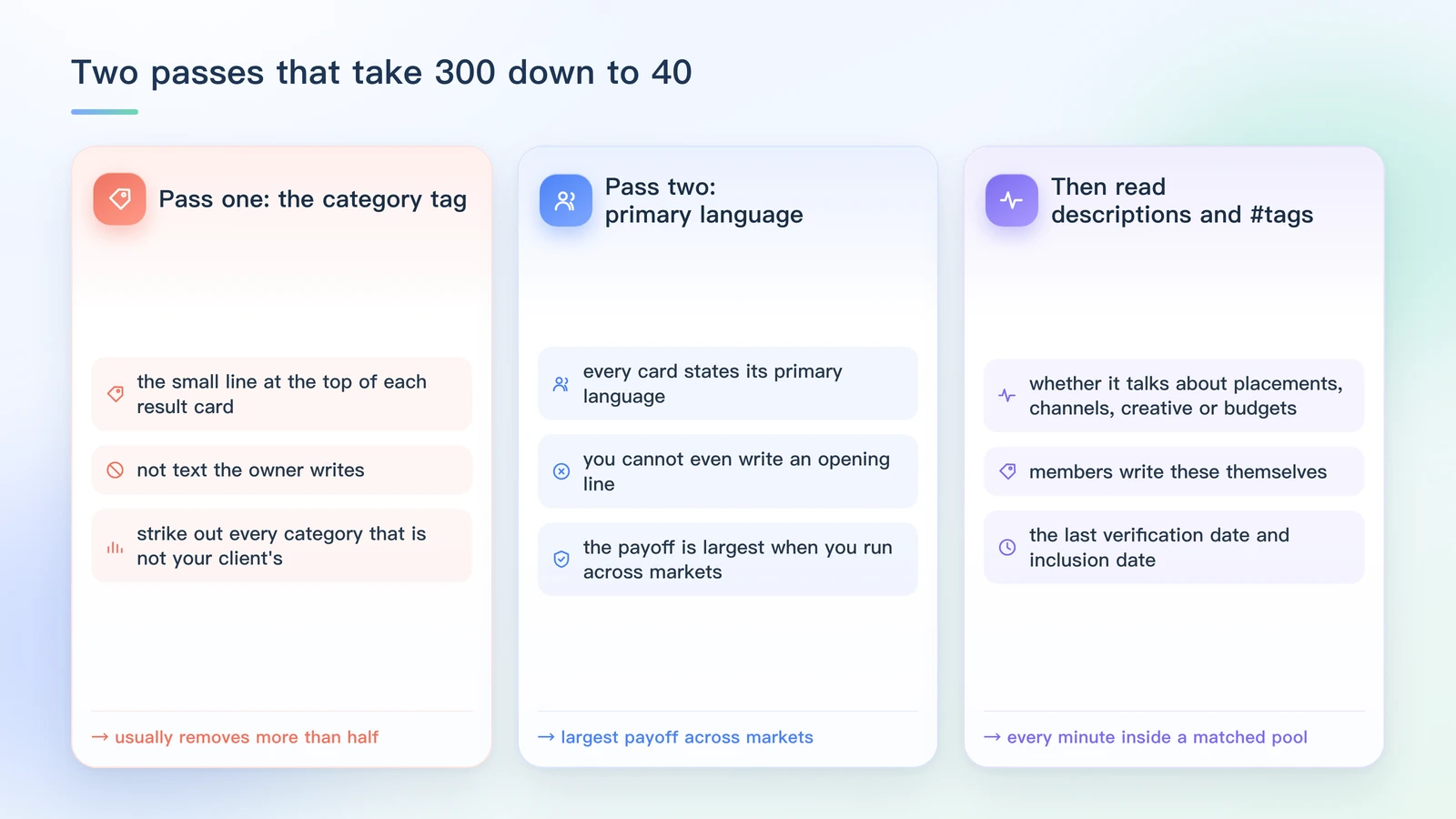
3. Two passes, 300 down to 40
Both passes happen before you open a single group, and both use fields the card already shows.
Pass one: the category tag
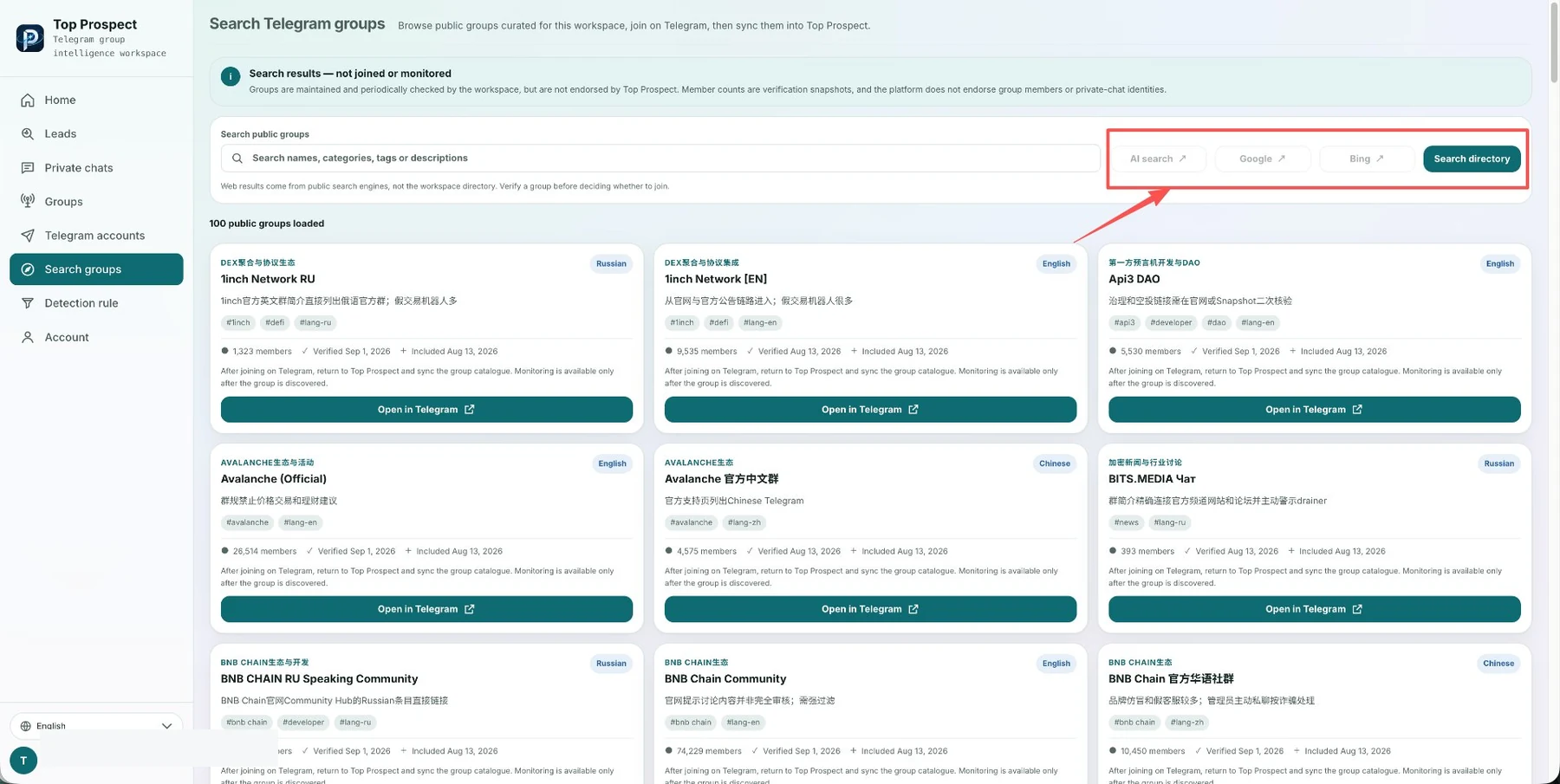
The small line at the top of each result card is the category tag. It is the field the workspace assigns to the group, not text the owner writes, so it resists copywriting polish.
The move is direct: strike out every category that is not your client’s.
If you sell brand placements, keep advertising, growth marketing and direct-to-consumer operations, and remove game redemption, airdrop and volume farming outright. This pass usually removes more than half the candidates (illustrative example) without reading any content at all.
Pass two: primary language
Every card states its primary language. Selling into an English market, keep English groups; selling into a Russian market, keep Russian groups; set the rest aside.
The payoff is largest when you run across markets. The same “brand” is two different clients in the two languages, with different budgets, available channels and decision paths. Mixed together you cannot even write an opening line; split apart, each side gets a stable script.
4. After filtering, read descriptions and #tags
Only the few dozen survivors are worth opening one by one. At that point every minute you spend is inside a matched pool.
Read them in this order:
What the description discusses. Whether it talks about placements, channels, creative or budgets matters far more than the group name.
The #tags. Members write these themselves, so whether they use your trade’s vocabulary is obvious at a glance.
The last verification date and inclusion date. These tell you whether the group is still running and worth attaching to long-term monitoring.
Member count. Do not chase size. A few-hundred-member vertical group is often likelier to surface a real placement need than a general chat with tens of thousands.
While reading, note two things: which channel the group currently discusses, and whether peers have already piled in. The first helps you write an opening line; the second tells you how crowded the group is. After a page of notes you will find the groups worth watching long term number around a dozen.
Once you pick one, follow the flow: join on Telegram, return to sync the group catalogue, then attach a recognition rule watching placement-related phrasing. At that point you are working a filtered pool instead of three hundred unknown groups.
Conclusion: the filters you set are your customer profile, drawn in advance
Three hundred groups create no value on their own. They are raw material. What decides the outcome is which conditions you split them by — the category tells you what business these groups are in, and the primary language tells you what it costs to talk to them. The moment those conditions are fixed, your customer profile is fixed too: the groups you show up in, in the language you show up in, are where your customers are. The rest is process: put the survivors into a pool, leave the monitoring on, and wait for the day someone asks for a quote, looks for an alternative channel or complains about their current agency. That is the signal worth following. Filtering well beats finding more. Top Prospect does not make the call for you here; what it does is make “run the conditions over them” happen on its own, every day.
Frequently asked questions
Why are the category tag and primary language more reliable than the group name?
Because neither is written by the group owner. The category tag is a field the workspace assigns to each group, and primary language follows from what members actually discuss, so neither is shaped by the urge to be found by search. Group names and descriptions are written by the owner, and that is where the exaggeration lives.
Can a Russian-language group serve clients in an English-speaking market?
It can, but handle the two separately. The same 'brand' is a different client in an English group and a Russian group — different budget size, different channels available, different decision path. Mix them and you cannot even write a first sentence; split them and each side gets its own script.
After two passes only a few dozen groups remain. Is that too few?
A few dozen is what survives filtering, out of several hundred at the start. A placement agency does not need hundreds of groups to close clients; a few dozen matched groups watched consistently for two weeks will produce more than three hundred generic ones.
Sources and further reading
This article is human-authored. TOP Prospect processes only Telegram groups the user has explicitly authorized and connected. Its output supports human sales judgement; it does not replace human decisions and does not automatically contact or message group members.
How a Signal worth attention is found
See how Top Prospect finds and organizes Signals worth checking, keeps the original Telegram context, removes duplicates, and helps you decide what to review first. You decide whether to follow up and what to do next.