"Our broadcast conversion halved" — pursue that message, or let it go?
People who complain about falling conversion in operator groups are not stuck in the same place. Some cannot get messages delivered, some get replies nobody picks up, and some keep blasting the same script at everyone. Knowing which layer they are stuck in tells you whether the message is worth your time.

Signals to watch
- The complaint carries scale: send volume, number of accounts, the exact number it fell to
- Support headcount, seat allocation, multi-account message aggregation, or double-touched leads come up
- Missing customer tags, dormant-contact handling, or segmented copy reveal a gap in the follow-up motion
- A switch date, a trial request, a payment route, or a named decision maker appears
On a Wednesday afternoon, someone in a cross-border e-commerce operator group typed a single line: “Our broadcast conversion went from 3% to 0.6%. Is the account dead?”
The message sat there for less than ten minutes before two ad drops and a sticker pushed it off the screen. Most people scroll past. Operator groups complain about conversion every day, and after a while it all blurs together.
If you sell broadcast tooling, Telegram CRMs, or marketing automation, that line deserves a second look. Because “conversion halved” means three completely different things depending on who is saying it. One person genuinely cannot get messages out. Another gets replies that nobody picks up. A third keeps firing the same script at everyone on the list. Those are three different buyers, and they need three different opening lines.
Key takeaway
- When you see “our conversion dropped,” look for scale first. Send volume, account count, and the exact number it fell to mean you are talking to someone who runs the operation. “Conversion is bad” usually means the thought ended there.
- Split the sentence into three layers: delivery (the message never arrived), handoff (it arrived and nobody picked it up), and segmentation (everyone got the same script). Only the last two normally mean a system purchase.
- Ask one question at a time. “How many support people do you have, and how are conversations assigned?” gets you further than a price list.
- Delivery is the layer people misjudge most. Bans and deliverability sound urgent, but the sender often just wants a tool that survives, not a new CRM. For the broader test of who is genuinely in-market, compare against how to read buying intent in Telegram groups.
The same sentence, three different problems
A private-domain operation is really a four-stage chain: accounts get the message out (delivery), a human picks up the reply (handoff), the reply gets tagged and worked differently depending on who it is (segmentation), and only then comes revenue.
Conversion rate sits at the very end of that chain. When it drops, something upstream broke, but the number itself never tells you which stage. That is why an identical “3% to 0.6%” can come from completely different situations.
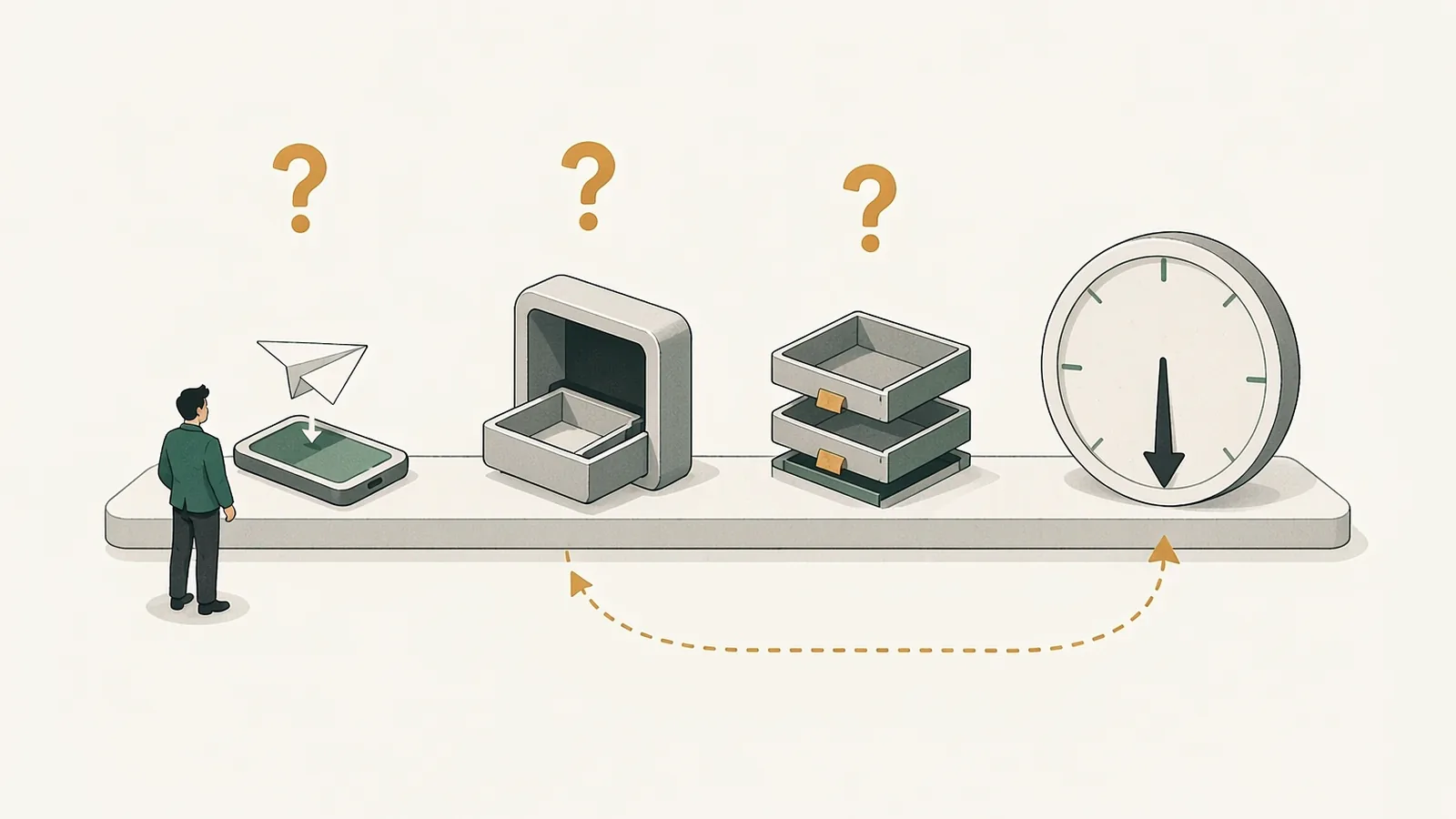
Diagram: conversion rate is the number at the very end of the chain. When it drops, one of the earlier stages broke; the number itself does not say which one.
Layer one: the message never arrived
The tell here is delivery language: “It says sent, but nobody replies,” “new accounts get limited after two days,” “the customer says they never got it.”
The vocabulary clusters around accounts and reach: bans, throttling, account warm-up, account age and weight, multi-account matrices. Teams running bulk broadcasts usually operate a pool of accounts, and accounts have a lifespan. Jumping from a handful of messages a day to several hundred is exactly the pattern platforms watch for, and Telegram’s limits on bulk sending are laid out in its Spam FAQ.
This layer sounds the most urgent, and it is the easiest to misread. “Banned” feels like an incident with a budget attached. In practice the opposite is often true: the sender may just be hunting for the next cheap broadcast script and a fresh batch of accounts. A team that actually wants a system tends to volunteer something else in the same breath, such as how accounts are divided, who manages them, and who picks up replies once messages are out.
Layer two: the message arrived and nobody picked it up
This layer reads like an operations description rather than an incident: “Messages go out fine, support just cannot keep up,” “two people already messaged the same customer,” “someone asked for pricing and by the time we replied they were gone.”
The role signals here are dense: support agents, seats, conversation routing, message aggregation, double-touched leads, lead ownership. A team that grows from three accounts to fifteen, and from one person answering to a shift rotation, hits a new problem. DMs are scattered across accounts, and nobody knows who is working which customer. Conversion falls not because fewer leads arrive, but because the ones that arrive are never caught.
This is the layer closest to a purchase, for a blunt reason. Accounts can be rebought and copy can be rewritten, but “who can see which customer, and how conversations get assigned” does not survive manual tracking. They are talking about conversion rate; what they are actually describing is a way for several people to share one customer base.

Diagram: replies live in different accounts, and one customer can be worked by two people at the same time while another is left waiting. Conversations in the image are illustrative, not real customer records.
Layer three: everyone got the same script
This layer is the quietest and the hardest to notice from the inside. It sounds like: “We sent five thousand and got roughly the same replies,” “they add us and then go silent,” “returning customers stopped buying.”
What is missing is motion. No tags, no pool of dormant contacts, no variation in copy by segment. The whole list receives one identical broadcast. The first round does something; by the third round it reads as noise. Operators talk about dormant contacts, the people who added the account and never responded, and about how to pull them out separately and what to send them.
Whether this layer buys depends on team size. One person running private-domain sales can get by on memory and handwritten notes. Once the customer base reaches a few thousand and support reaches three people, tagging and segmentation stop being nice to have and become the tooling everyone depends on.
One question tells you which layer you are in
You do not need a questionnaire. One question is usually enough. The order matters:
- Ask about scale first. “How many accounts are sending, and roughly how many messages a day?” A specific answer with numbers means you are talking to someone who does the work. A vague answer means you can keep them on a watch list.
- Then ask about handoff. “Once a customer replies, does a fixed person handle it, or does whoever sees it reply?” If they start describing support headcount, shift patterns, lead ownership, or two people working the same lead, you are already in a buying conversation.
- Ask about timing last. “When do you want this in place?” A concrete date, a willingness to trial, or a mention of paying through the company account is what earns a slot in your follow-up order.
If the sender only ever asks which tool avoids bans, they are in layer one. One answer is enough; do not invest more. For how to pick groups and open a conversation in the first place, see finding customers in Telegram industry groups.
Where manual monitoring breaks down
The logic above is not complicated. Executing it is, because operator groups move too fast.
A vendor BD typically sits in a dozen or several dozen groups, with well over a thousand messages a day mixing tool ads, stickers, peer promotion, and the occasional real business complaint. The line about conversion halving can be buried within three minutes. By the time you think to scroll back, the context is gone: what time it was posted, whether anyone followed up asking how many support staff they have, and whether it is the same person who posted something similar three days ago.
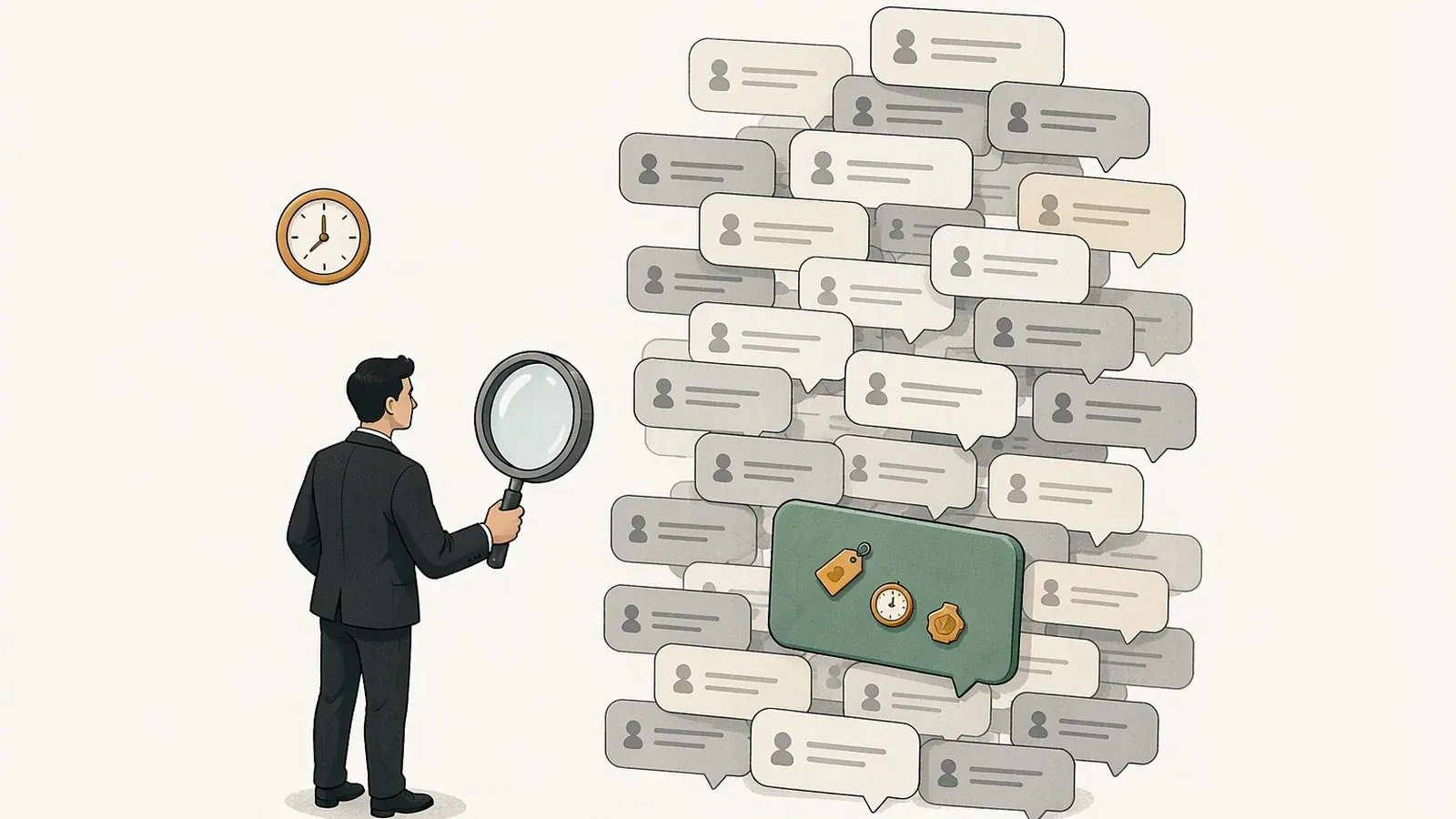
Diagram: operator groups move fast enough that a discussion carrying real business conditions is pushed out of sight within minutes. Conversations in the image are illustrative, not real group records.
This is why broadcast and CRM teams often add a light assistant to the daily workflow. With TOP Prospect, once you connect groups you already have access to, it keeps a record of the public discussion in those groups and surfaces the threads that carry business conditions such as send volume, support headcount, tagging gaps, or dates, together with the original message, the source group, and the surrounding replies, as candidate records to verify. It ranks them so you know which one to open first. It does not decide for you whether the sender is a real team or a solo operator, and it does not decide how to open the conversation. That part stays yours.
FAQ
Someone says the account is dead and they just need a tool that does not get banned. Worth pursuing?
Treat it as a delivery-layer question first. Ask how many accounts they run, how much they send per day, and whether messages are being throttled or never arriving. If all they care about is a cheaper tool that survives, they are shopping for a replacement, not for a system.
How do I tell whether they actually run a team, rather than doing everything alone?
Listen for roles. Support allocation, who already contacted a given customer, and two people working the same lead all point to a team. “I send it myself” and “can I get a script” point to one person.
They mixed conversion, bans, and overwhelmed support in one message. Which one do I pick up?
Pick up what happened after the message was delivered. Delivery problems ease when the tool changes; handoff and segmentation problems are the ones that require buying a system, which is where a conversation about your product actually starts.
Frequently asked questions
Someone says the account is dead and they just need a tool that does not get banned. Worth pursuing?
Treat it as a delivery-layer question first. Ask how many accounts they run, how much they send per day, and whether messages are being throttled or never arriving. If all they care about is a cheaper tool that survives, they are shopping for a replacement, not for a system.
How do I tell whether they actually run a team, rather than doing everything alone?
Listen for roles. Support allocation, who already contacted a given customer, and two people working the same lead all point to a team. I send it myself and can I get a script point to one person.
They mixed conversion, bans, and overwhelmed support in one message. Which one do I pick up?
Pick up what happened after the message was delivered. Delivery problems ease when the tool changes; handoff and segmentation problems are the ones that require buying a system, which is where a conversation about your product actually starts.
Sources and further reading
This article is human-authored. TOP Prospect processes only Telegram groups the user has explicitly authorized and connected. Its output supports human sales judgement; it does not replace human decisions and does not automatically contact or message group members.
How a Signal worth attention is found
See how Top Prospect finds and organizes Signals worth checking, keeps the original Telegram context, removes duplicates, and helps you decide what to review first. You decide whether to follow up and what to do next.