Telegram CRM: Do You Need Customer Chat Management or Group Prospecting?
Choosing a Telegram CRM? Compare customer chat management with finding potential buyers in groups, and see where Telegram Business, Kommo and Top Prospect fit.
- 01What should a Telegram CRM actually do for you?
- 02When customer chat management is the right choice
- 03Could Telegram Business be enough without another CRM?
Signals to watch
- An incoming customer chat and a purchase-related discussion in an industry group require different tool capabilities.
- Top Prospect helps surface candidate demand discussions; it is not a shared private-chat inbox or an automatic CRM connector.
- Check a tool against the message source you actually need before comparing its contact or automation features.
If customers already message you on Telegram and replies get lost between salespeople, a Telegram CRM or shared customer inbox is the category to evaluate. If nobody has contacted you yet and you spend the morning looking for buyers in industry groups, a better inbox does not solve the missing first conversation. You need a way to discover relevant discussions before deciding whom to approach.
For a B2B salesperson, those problems can feel identical: “Telegram is a mess; I need a tool.” The difference is where the message starts. Top Prospect fits the group-discovery task. It is not a replacement for a CRM that handles customer conversations, quotations and deal progress.
Key takeaway
- Choose customer-chat management when the work is answering and tracking people who have already contacted your business.
- Choose group prospecting when the work is finding relevant demand discussions that your team has not yet evaluated.
- A tool’s ability to receive Telegram messages does not, by itself, establish that it discovers buyers in industry groups.
- Top Prospect prepares candidate discussions for people to review; contacting the person and managing the sale remain separate work.
What should a Telegram CRM actually do for you?
Start with the last Telegram task you failed to finish, not a list of features. Was it an unanswered customer question? A colleague who could not find the quotation? Or a request in an industry group that disappeared before you read it?
CRM means customer relationship management. In a Telegram sales workflow, it can hold a contact, conversation history, responsible salesperson and next activity. A shared inbox emphasizes receiving and replying to conversations as a team. Some products combine those functions; others connect Telegram to a CRM you already use.
Group prospecting starts earlier. The person might be discussing a problem with peers rather than asking your company for help. Their message could be relevant to your service, but it is not automatically an inquiry addressed to you.
| Your actual problem | What to evaluate | What to check in a demonstration |
|---|---|---|
| Customers message your business and replies are missed | Telegram-enabled CRM or shared inbox | Which account or bot receives the message, who can reply, and whether the reply remains visible to colleagues |
| You repeatedly send the same information yourself | Telegram Business features | Whether quick replies and chat organization cover your personal workflow |
| Potential buyers discuss problems in industry groups you already use | Group-demand discovery | Selected source coverage, relevance of the discussion, original context and human review |
| A buyer has replied and a quotation needs follow-up | Your sales CRM | Contact owner, last conversation, agreed next action and actual deal stage |
This is a comparison of jobs, not a claim that every vendor belongs in exactly one box. A product may cover more than one. Ask it to demonstrate the particular source and action you need, rather than treating the label “Telegram CRM” as a complete specification.
When customer chat management is the right choice
Kommo’s Telegram integration gives a concrete example. Its official page describes creating leads from incoming chats, replying inside a lead card and preserving chat history in the CRM. Its published connection steps use a Telegram bot and an API token, the credential connecting that bot to Kommo.
That is relevant when someone arrives through your business’s Telegram contact route and your team needs to handle the conversation. It does not establish that the integration can read every conversation in a salesperson’s personal account or discover demand across unrelated groups.
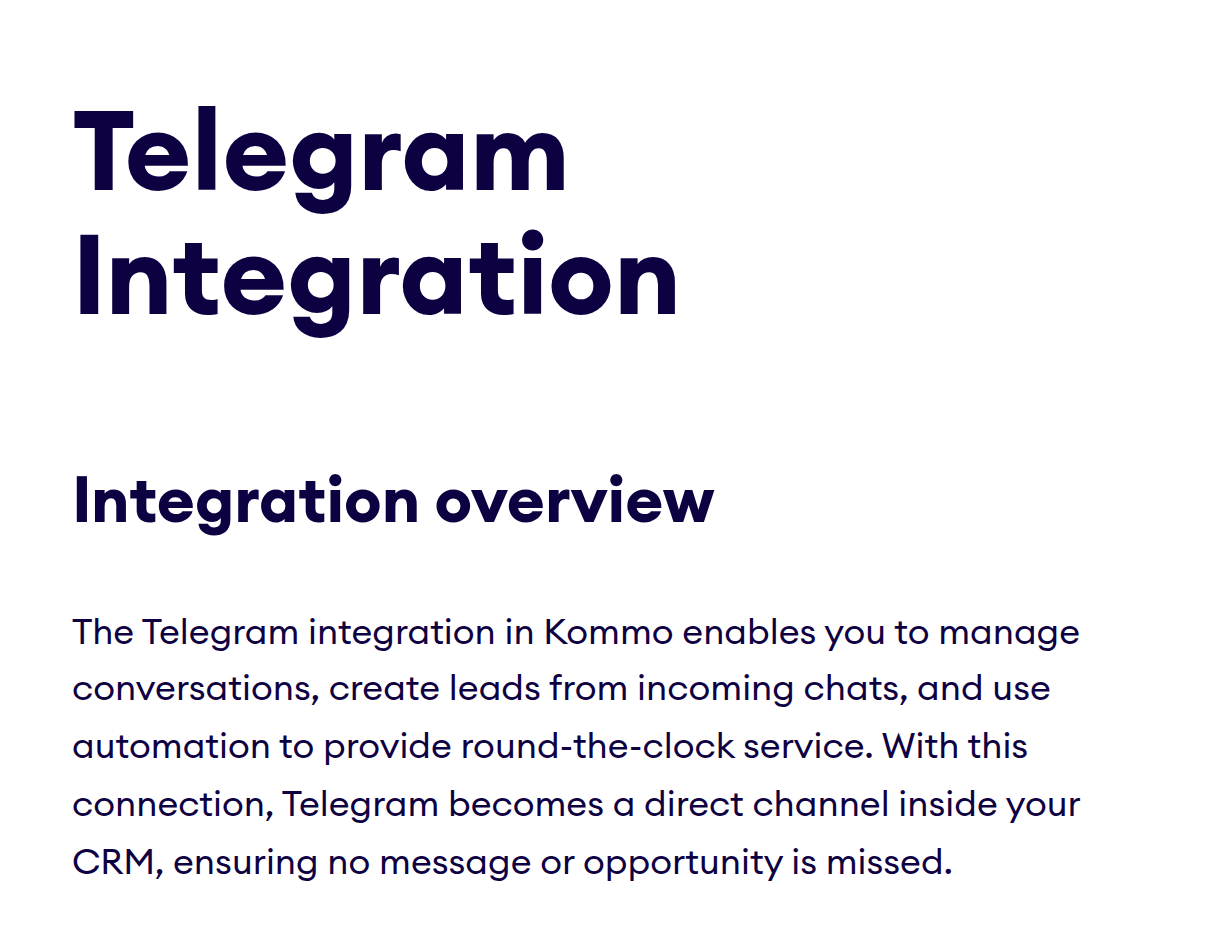 Source: Kommo’s integration page, captured September 8, 2026. The relevant wording is “incoming chats”; this is vendor documentation, not a test of its performance.
Consider an illustrative API-provider sales team. A developer has already asked them for a quotation. One salesperson checks capacity while another handles the commercial terms. Their problem is knowing what was promised and who owes the next answer. Reading more industry groups would add prospects without resolving that handoff.
For this team, a useful trial starts with a test inquiry through the intended Telegram entry point. Can the person responsible find it? Can they see the previous reply? Can they record the agreed next action? Those questions are more relevant than how many industry keywords a prospecting tool can match.
Before connecting anything, establish whether the vendor uses a bot, a personal-account connection or another supported route. Do not assume a bot integration reproduces a personal inbox. Also check the access and consent requirements for the content you intend to process. An account’s ability to view a conversation is not a blanket permission to store or analyze it with another service.
Could Telegram Business be enough without another CRM?
If you work alone and mainly repeat the same replies, start by checking the features already available in Telegram Business. Telegram’s official launch description covers quick replies, greeting and away messages, chat labels, chat links and connected bots. It is dated March 31, 2024; it is not a current pricing quotation.
Quick replies are especially concrete. You prepare information that customers regularly request, then insert it into a conversation. Telegram’s description explicitly says this feature works in private chats, not groups.
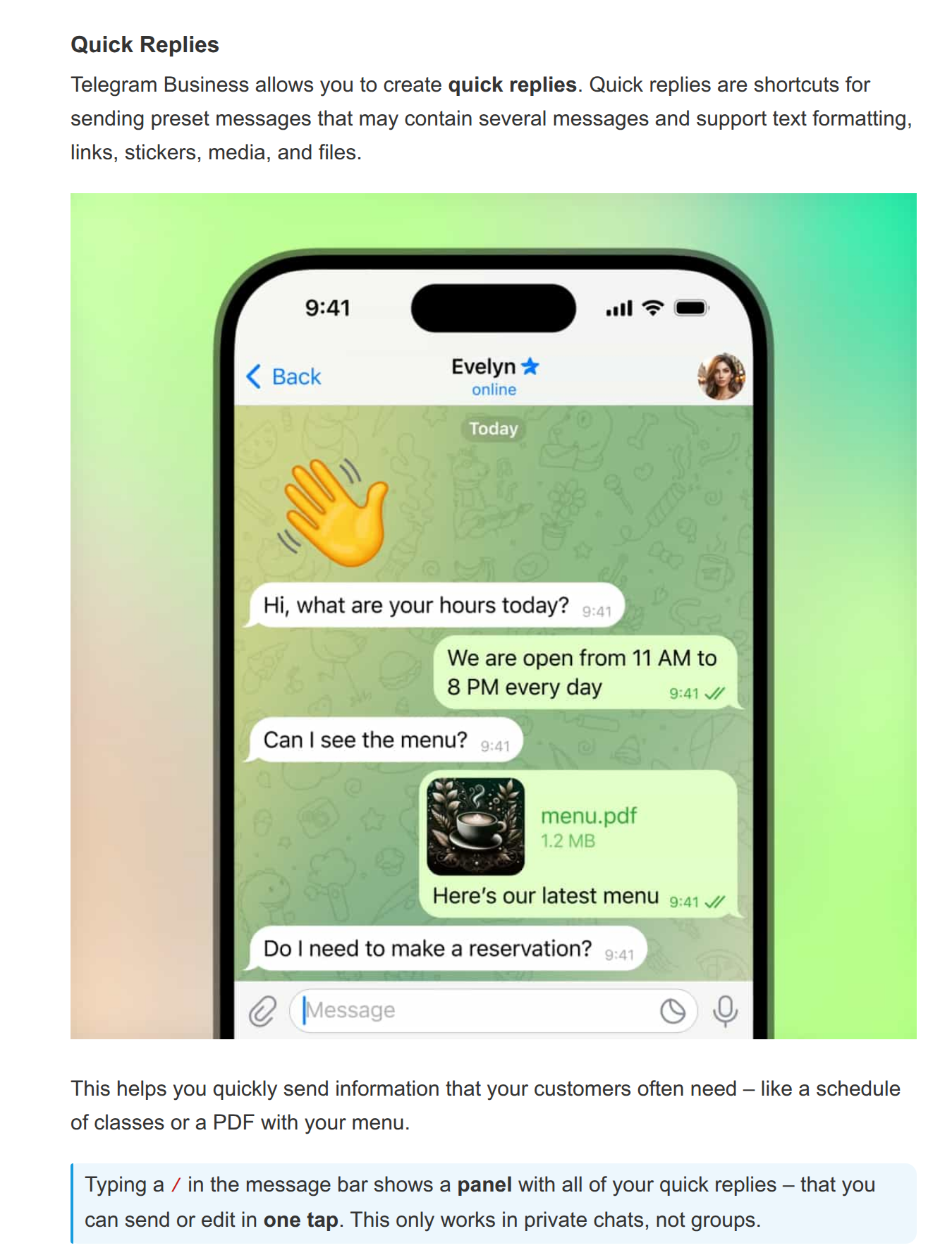 Source: Introducing Telegram Business, captured September 8, 2026. The private-chat restriction explains why quick replies and group prospecting solve different tasks.
For example, sending the same onboarding document to customers is a reply problem. Preparing that answer may save repetitive work without introducing a second customer database. Finding a company that needs your onboarding service is a different problem; no saved answer tells you who is discussing it elsewhere.
The point to reconsider a CRM is when a conversation needs more organization than your current arrangement provides. Perhaps another salesperson has to take over, or a quotation and follow-up date need to be tracked together. Evaluate that missing capability directly. More software is not automatically better if the unanswered question is still “where will the next buyer come from?”
When the missing piece is finding buyers in Telegram groups
An API seller may already belong to developer communities but struggle to separate buyer discussions from provider advertisements. In an illustrative example, “Stable API, every model, DM for prices” is a supplier’s offer. “Our production calls hit the limit; can someone support a test before Friday?” is a discussion worth examining. Neither a username nor a keyword match settles whether the second person can buy.
This is where Top Prospect’s Telegram demand-discovery workflow fits. Users connect their Telegram account, select relevant groups within their permitted scope and describe the discussions they want to find. Top organizes candidate discussions with their source and context, reduces duplicates and supplies AI-assisted prioritization for human review.
The useful output is not a fabricated contact record with an assumed budget. It is a discussion you can read and evaluate: what was asked, where it appeared, why it matches your service and what remains unanswered.
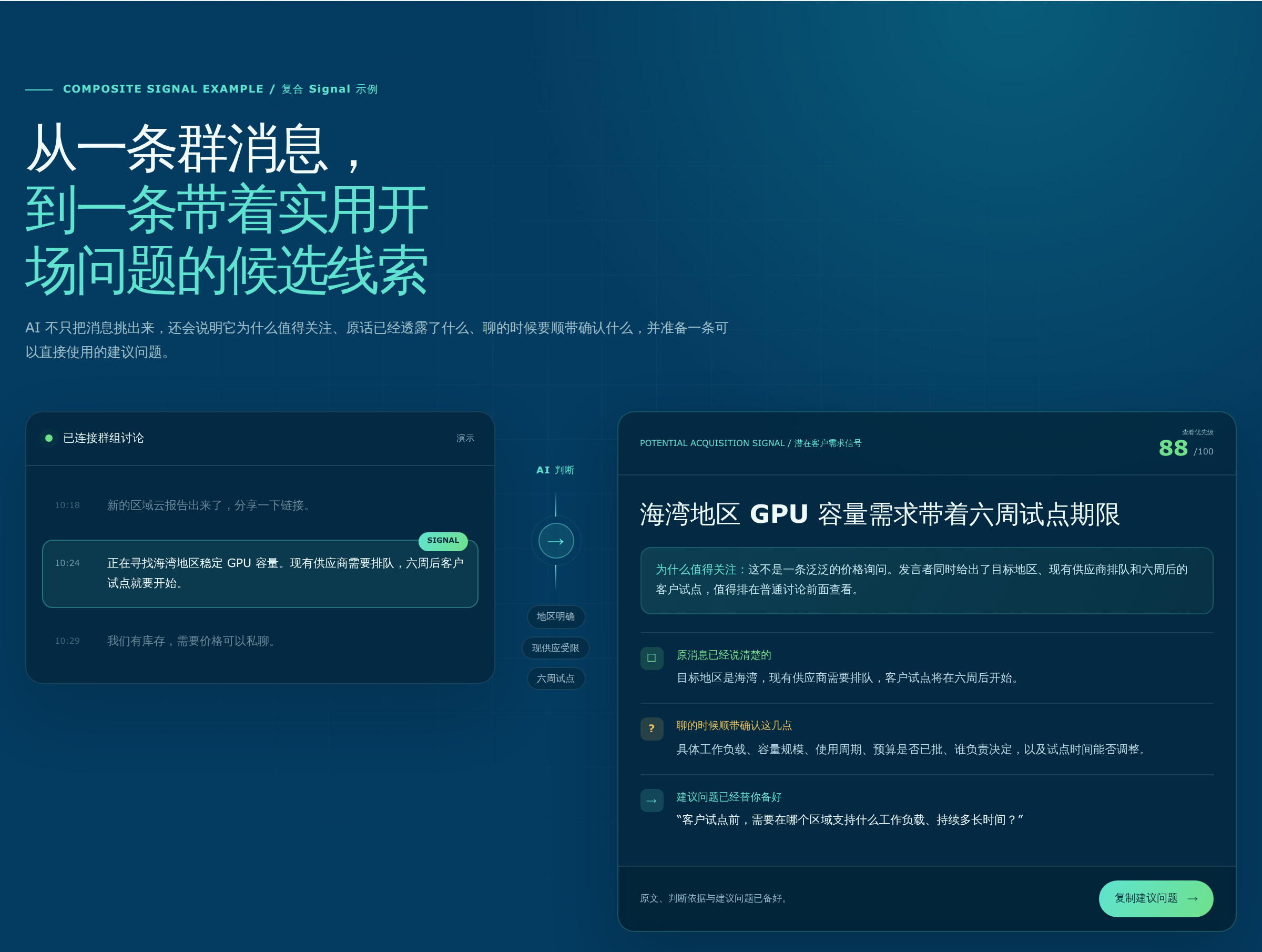 Source: Top Prospect’s Chinese product demonstration, captured September 8, 2026. This is a composite illustration, not a customer conversation or measured result. The displayed score is demonstration data, not a probability of purchase.
Top does not read one-to-one private chats or automatically contact participants. If your requirement is “let three salespeople answer my customer messages in one inbox,” it is not the appropriate replacement for that inbox. If it is “help me find relevant demand in the groups I have selected,” you can open Top Prospect and evaluate that discovery task.
For the initial evaluation, use an industry you can actually serve. An API provider can describe the model, workload or support problem it wants to find and the supplier promotions it wants to exclude. A warehouse provider would use different examples. Review the resulting conversations yourself; an attractive score cannot establish a budget that the sender never mentioned.
How do you move a useful discussion into customer follow-up?
Keep the discovery decision and the sales record separate. Once you have reviewed a discussion and decided there is an appropriate next step, record only the information needed for that step in your existing CRM. This is a manual workflow, not a claim that Top automatically synchronizes with Kommo or another CRM.
A short handoff can preserve the original message reference, the stated problem, unanswered questions and the person responsible for checking them. Suppose the source says a team wants to test a backup API before Friday. Save that statement, not “enterprise buyer ready to switch.” The latter adds a company classification, authority and purchasing decision that the discussion may not support.
If the person later replies to your appropriate outreach, the conversation has changed. You now have information addressed to your team. The CRM can track what they actually confirmed, the quotation you sent and the next action you agreed. Keeping the source reference helps a colleague understand how the conversation started without copying an entire group’s unrelated history.
No one needs to guess which stage comes first. Use group prospecting to find discussions worth reviewing. Use customer-chat management to handle conversations addressed to your business. Use the CRM to keep the resulting sales work organized.
Before buying a Telegram CRM, finish this sentence: “The message I keep missing is ___.” If it is a customer’s reply, test an inbox. If it is a potential buyer’s question in an industry group, test Top’s candidate-discovery workflow. Choose against that missing message, not against the longest feature list.
Frequently asked questions
What is a Telegram CRM?
Usually it is a CRM or customer-conversation system connected to Telegram, used to manage chats, contacts, owners and follow-up. Ask whether the specific integration uses a bot or another supported account connection, and which messages that method covers. Do not assume the same access in every product.
Can a Telegram CRM find new customers in groups?
Only if the specific product offers appropriate group-discovery capabilities and the required permissions are in place. Receiving incoming bot messages is not the same as finding purchase-related discussions in selected industry groups. Top Prospect serves the latter task, with human review.
Can Top Prospect replace my CRM or reply to customers?
No. Top Prospect organizes candidate discussions from selected Telegram groups for human review. It does not read one-to-one private chats or automatically message participants. Use your customer-conversation or CRM system for replies, quotes and deal progress.
Does Top Prospect automatically sync leads to Kommo or another CRM?
This article has not verified a native Top Prospect CRM connector. The handoff described here is manual: review the discussion, then record the relevant source, need, owner and next step in your existing CRM where appropriate. Do not assume automatic synchronization.
Sources and further reading
How a Signal worth attention is found
See how Top Prospect finds and organizes Signals worth checking, keeps the original Telegram context, removes duplicates, and helps you decide what to review first. You decide whether to follow up and what to do next.