Virtual number leads: find 60 developer buyers in 10 minutes, starting on day one
Virtual number buyers don't hang out in number reseller groups — they hang out in developer and testing communities. A day-one playbook: keyword selection, four search entries, and telling one-time buyers from recurring ones.
In my first month selling virtual numbers, I did three things: bought a list of app developers, exported 800 email addresses, and blasted a cold-email campaign. I got 2 replies (illustrative example): one asked if I was selling data, the other asked me to stop writing.
Around the same time, in a reseller group I was sitting in, someone posted “any US numbers, stable volume” — and five vendors jumped in with quotes. I was sixth.
It took me a while to see the obvious: virtual number buyers almost never speak in number groups.
1. Why “number groups” yield no customers
A number group usually contains three kinds of people: resellers, middlemen, and old buyers who already have supply and only show up to squeeze prices.
The people burning numbers every day — app developers, testing teams, overseas operations teams — don’t go looking for a “virtual number group” when a problem hits. They hang out in their own industry groups and ask in passing:
“anyone knows a reliable US number provider for app testing?”
That one sentence in a developer group is worth more than ten inquiries in a number group, because in a number group you wait for inquiries, while in a developer group you see the first ten minutes of demand happening.
2. First, tell one-time buyers from recurring customers
Not everyone asking for numbers is worth following up. The recurring buyers cluster into three types (illustrative example):
- App developers: multi-region registration-flow testing before launch, numbers consumed continuously, every week
- Overseas operations teams: social media matrices and store backends that need stable login verification — switching numbers means rebuilding their working environment
- QA (quality assurance) teams: regression testing needs fresh numbers every run, because used numbers contaminate test results
Their questions have a tell: they don’t ask “how much per number”, they ask “is this country stable”, “can I get a monthly plan”, “what happens to pricing at volume”. One-time buyers care about this one number; recurring customers care about the next three months.
3. Hands-on: build a developer group pool in 10 minutes
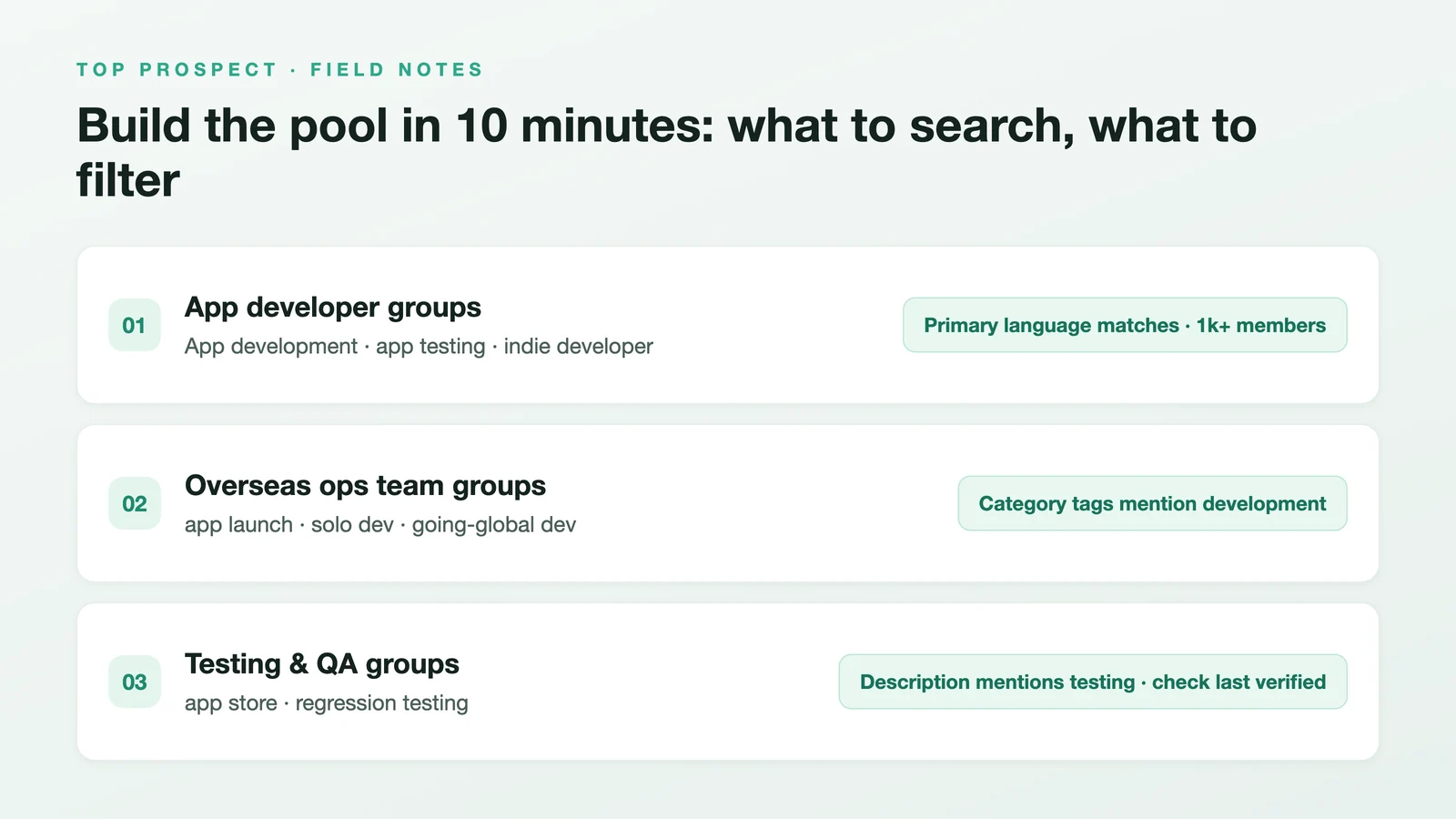
Step one is finding the right place on Telegram. I use the group search page in TOP Prospect: four search entries — AI search, Google, Bing, and the built-in group library (with 100 public groups loaded). Don’t search “virtual number” — that returns resellers again. Use these four sets:
- App development / app testing
- indie developer / solo dev
- app launch / app store
- overseas developer communities
After the search, filter by primary language and member count, then look at each result card’s group name, description, category tags, last verified time, and indexed time to decide which groups are worth observing.
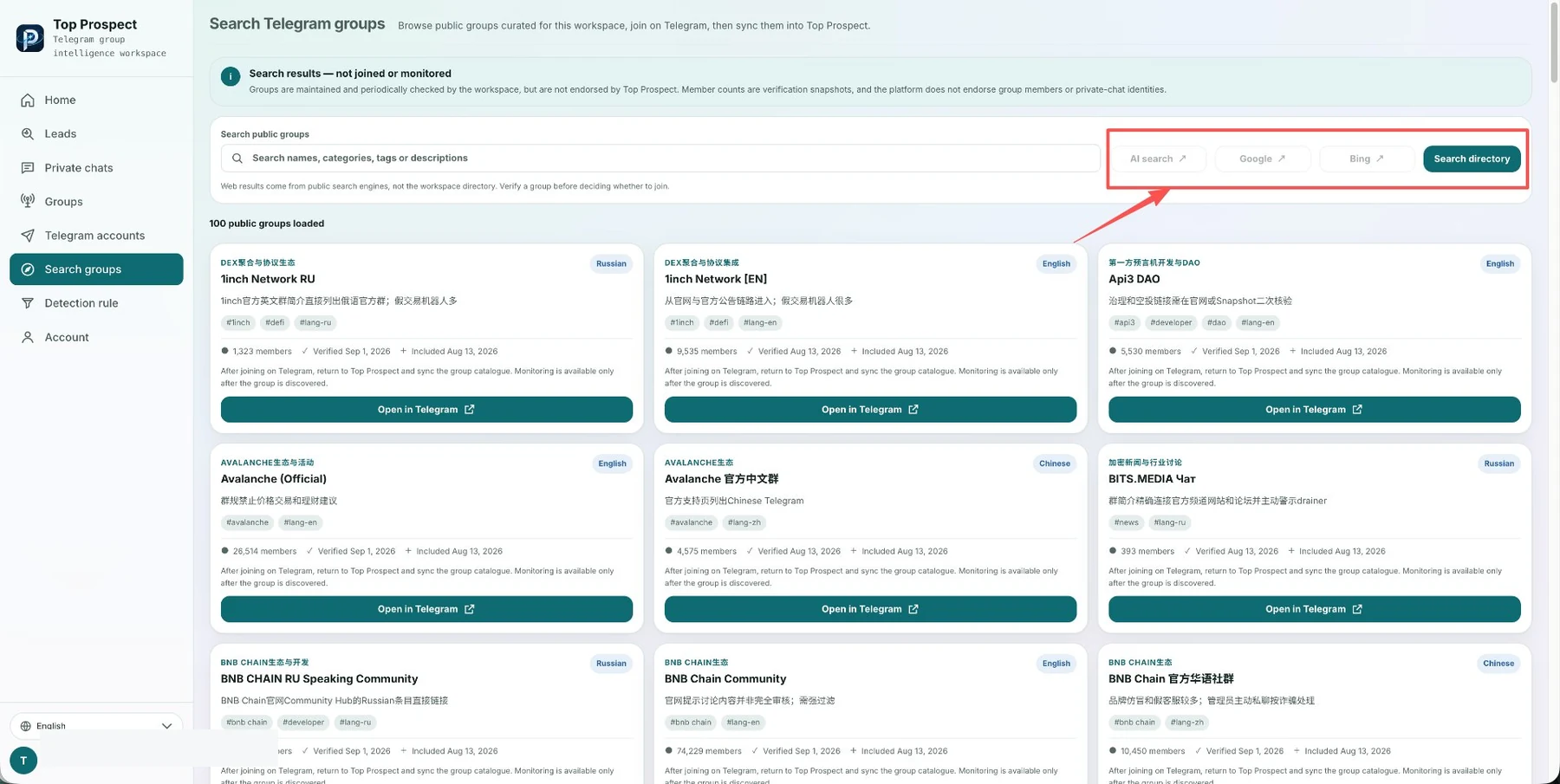
In my first week on this process, I built the pool and identified 60+ developers who had posted number-related needs (illustrative example). Nobody promised me anything, but those 60 names beat the 800-email list — every one of them had stated a need in their own words.
4. When you see a number request, read the context first
When a number request appears, scroll up ten messages before doing anything. The same sentence reads completely differently with different context:
- “urgently need a US number to receive one OTP (one-time password)” — one-time demand, quote per number
- “our app burns a few hundred test numbers a week, which channel has a good monthly plan” — recurring demand, worth a real conversation
- asks for a price and disappears — log it on a watch list, don’t rush
- keeps discussing the stability of one country’s routes — they have continuous consumption and may be unhappy with their current supplier
That last type is the most valuable. They’re not looking for numbers; they’re looking for a reason to switch suppliers — you just need to become the reason.
5. The last step is still your own judgment
What TOP Prospect does is surface the demands worth reading from hundreds of group messages a day. Whether to join a group, send a message, or quote per-number versus monthly is your call.
Virtual number customers are not found by waiting, and not by buying lists — they’re found by watching. Ten minutes building a developer group pool today beats another lead list this month.
Frequently asked questions
Why not just search for "virtual number" groups to find customers?
Because groups with "number" in the name are full of resellers, middlemen, and old buyers comparing prices. The people who actually consume numbers — app developers, QA teams, overseas operations — hang out in their own industry groups and only ask casually when a problem shows up.
When someone asks for numbers, can I just DM a quote?
You can, but read the context first. One-time and recurring demand need completely different quotes. Look at what the person said before and how far the discussion has gone, then decide between a per-number price and a monthly plan. TOP Prospect does not automate joining groups or sending messages — whether and how to reach out is your call.
What is the minimum to do on day one?
Three things: search candidate groups with four keyword sets, filter out irrelevant ones by primary language and member count, then split what's left into one-time-heavy and recurring-heavy pools to observe. With tooling it takes about 10 minutes; by hand it takes a whole evening.
Sources and further reading
This article is human-authored. TOP Prospect processes only Telegram groups the user has explicitly authorized and connected. Its output supports human sales judgement; it does not replace human decisions and does not automatically contact or message group members.
How a Signal worth attention is found
See how Top Prospect finds and organizes Signals worth checking, keeps the original Telegram context, removes duplicates, and helps you decide what to review first. You decide whether to follow up and what to do next.