21:40 to 06:50: one night rebuilding how a DTC team searches Telegram groups
A growth team serving DTC stores spent a night reworking its Telegram group search: starting from industry keywords, finding the wrong groups joined, switching to situation words, running all four search entries, and compressing 180 candidates into 7.
Group names, member counts, candidate counts and time spent appearing below are illustrative scenarios used to explain the screening method, not measured results.
This team sells into the DTC market, and its clients are stores that are scaling and need someone outside to wire up storefront, media buying and payments. They spent one night rebuilding how they search groups. What follows is that night in order.
The starting point was 180 candidate groups and 7 that actually stayed.
21:40, starting from industry keywords as usual
Open the search page and type DTC, then Shopify, then direct-to-consumer. This has been the routine for over a year, and it is easy to explain to anyone who asks.
Each of those returns dozens of groups and the names all look right. Groups with the industry term in the title or description add up to nearly two hundred. The team copied them into a sheet, tagged the source keyword, and prepared to apply as always.
22:50, twenty joins later, they are all peers
Twenty of those went out as applications and cleared by around eleven. Reading the messages exposed the problem.
In those twenty groups, fourteen are dominated by agencies, tool vendors and partnerships resellers, people selling what the team sells. The remaining six discuss platform policy, shipping times and ad creative. Nobody mentions what their store is missing. Not one message that evening was worth following up.
Groups surfaced by industry keywords gather the people talking about the industry. Looking for a scaling store inside them is like hunting for customers at a competitor meetup.
00:20, changing the words: talk about situations, not industries
The second pass drops the industry and searches what store owners actually say. The team listed four groups of words, each tied to a situation.
- Scaling words such as opening a second storefront, launching a new category, switching suppliers, second store. These surface stores already moving up, and teams that have not started will not say them
- Blocker words such as checkout drop-off, carts that never convert, payment page errors, tracking that stopped updating. Behind each one sits a problem that already happened and is costing money
- Tool words such as can it integrate, how do I migrate, can I bulk edit, is there an API. Anyone asking that specifically is already comparing vendors
- Role words such as our store, our ops team, my boss asked, next quarter’s budget. These confirm whether the person can decide
Run all four and the share of industry groups drops sharply, with store owners and ops people asking questions directly. That pass produced over forty groups, almost none of them overlapping the first batch.
02:10, running all four entries
The same words through different entries bring back different things. This step took the most of the night and was worth the most.
In-app search maps the ground first. It queries the public groups the system has already indexed, currently more than fifty, filterable by tag, language and activity. Because the groups are already discussing concrete situations, the tags and descriptions on each card are enough to decide here rather than after joining. Each card carries the group name, description, category tags, primary language, member count, verified time and the date it was indexed.
AI search covers the words you cannot think of. It goes through an external semantic engine that reads the intent of a natural-language request rather than matching keywords. The team typed find DTC teams complaining that nobody owns their checkout flow and increasing spend recently, an intent with no matching keyword that in-app retrieval cannot return.
Google handles the long tail outside the platform. The query is assembled by the system with a Telegram domain restriction already applied, so you append your own words and get public group links under that domain, picking up groups that exist but are not indexed yet.
Bing complements Google. The two index Telegram differently and Bing sometimes surfaces the batch Google missed. Running both is cheap, missing one is not.
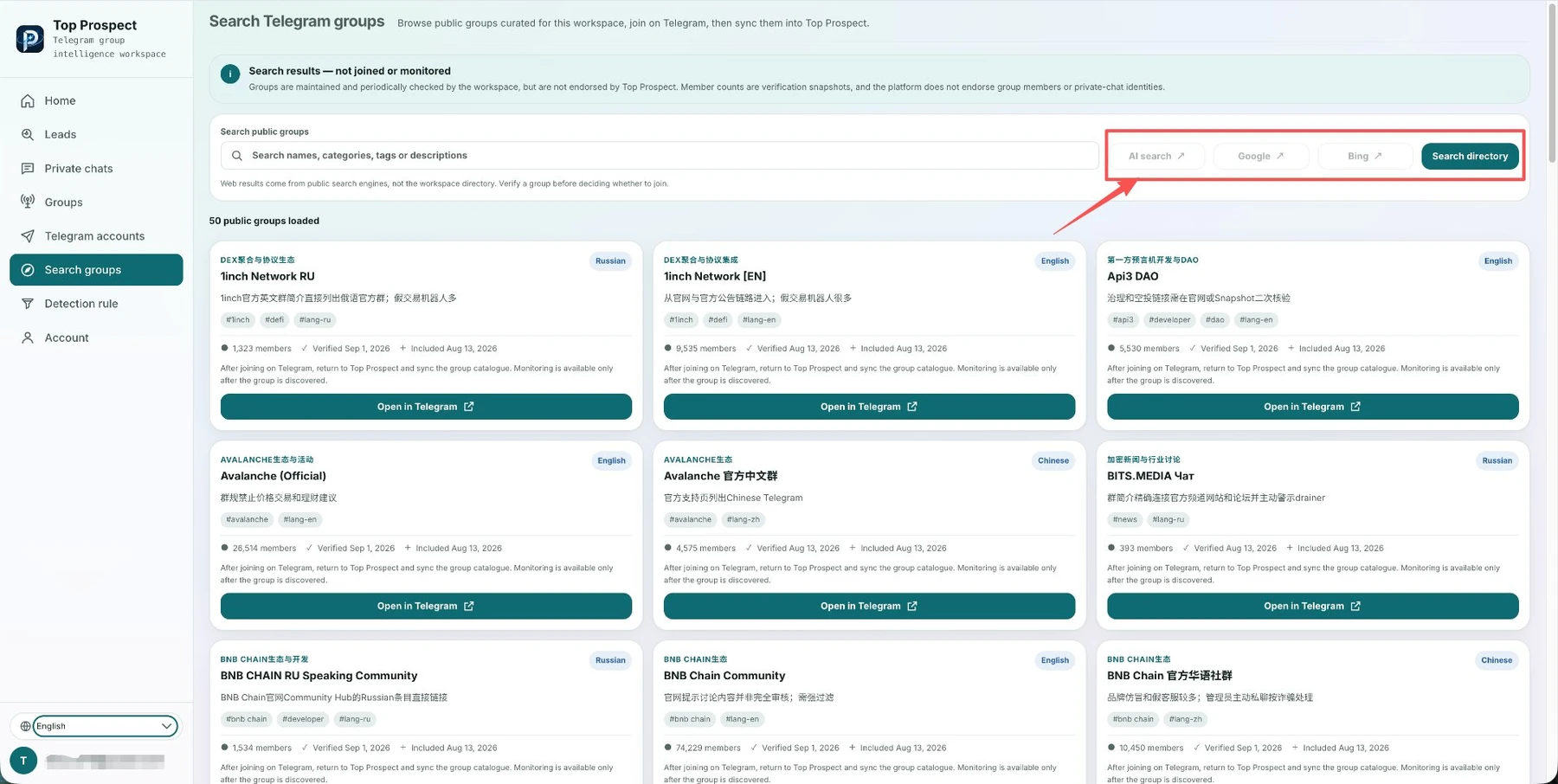 The search groups page in TOP Prospect, with the four entries beside the search box and the indexed public groups listed below.
Search results are candidates only. They do not mean you have joined, and they do not mean the platform endorses the group. Member counts and verified times are a snapshot from the last check. Reading a few days of history before joining beats trusting the description.
04:30, from forty-odd down to seven
The forty-odd groups left from the second pass are not yet something you can hand over. The team walked them through three criteria.
The first asks whether a real situation is present. If nobody in the last three days described a specific problem at their store, and the feed is policy talk and forwards, it goes.
The second asks about time pressure. A new product launching next month, a vendor to be chosen this week, a checkout page to be rebuilt before the peak, statements like these show the other side is already moving. Groups only discussing industry trends are dropped.
The third asks who is speaking. People describing themselves as ops, store manager or owner stay in; accounts that only repost and excerpt do not count.
Forty-odd groups through three criteria leaves seven. Four of them already had someone asking about a concrete plan, two were discussing a vendor switch, and one had just started hiring to add a category.
The gap between two ways of working shows up in the same night. A night of joining by industry keyword screens two hundred, applies to forty, clears a dozen, and leaves three still worth reading a week later. A night of situation words plus three criteria screens 180, keeps 7, joins 4, and far fewer disappoint after joining. What matters is not how many you added, it is whether dawn finds a list you can hand to a colleague. The state of constantly scrolling without being able to judge whether it is worth watching is taken apart in this piece.
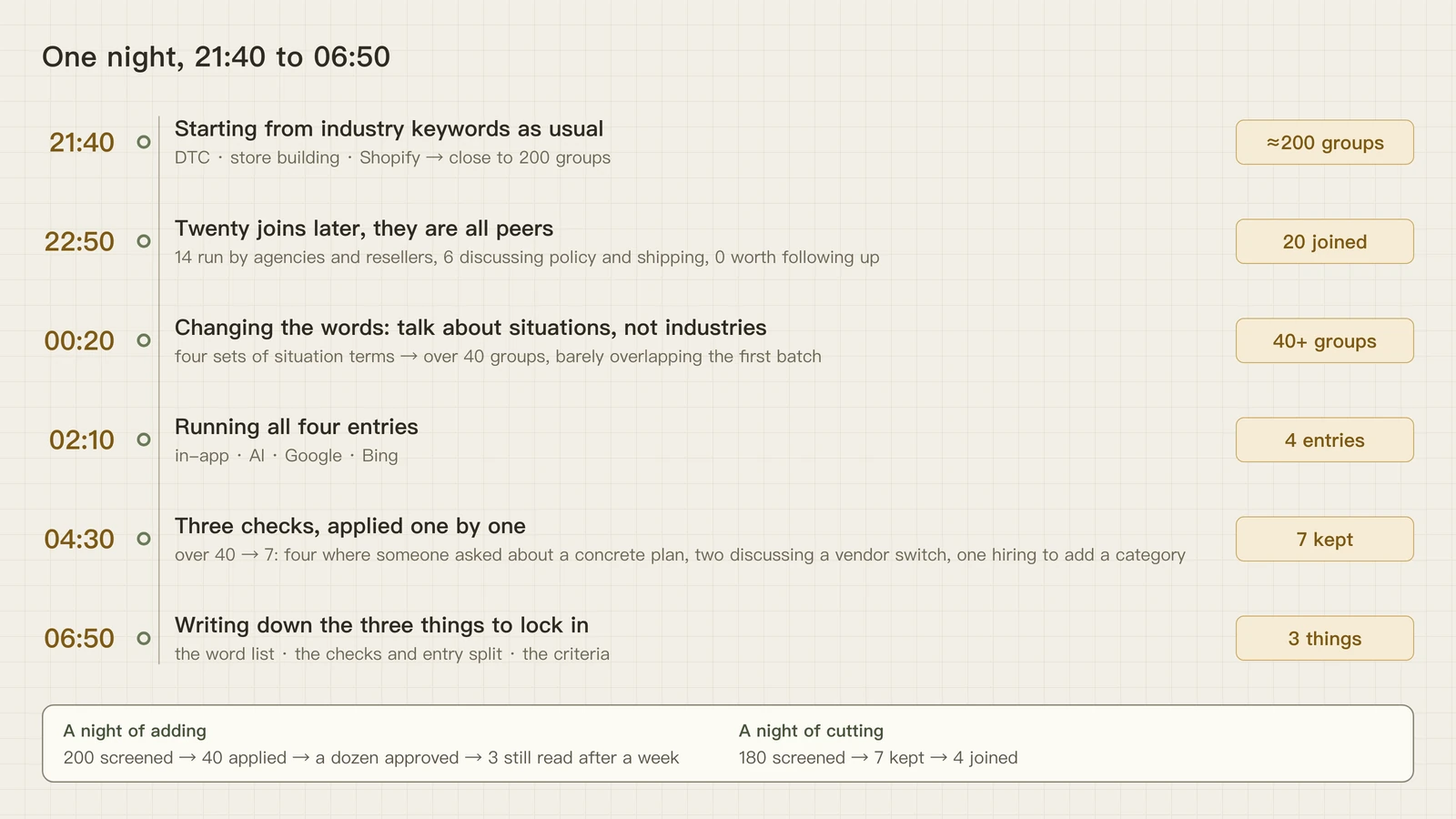 Each time marker carries the move and its count: around 200 groups, 20 joins, 40+ groups, 4 entries, 7 kept, 3 things.
06:50, three things to lock in tomorrow
As dawn came, what the team wrote down was not a group list but three things.
First, the word list gets written down. The four groups of situation words go into a document anyone can run. Words that live only in one person’s search history disappear with that person.
Second, the criteria and the entry split have to be reusable. Three criteria plus the division of labour across four entries fit on one page. The second person on the team should land in roughly the same place running them. For how a peer tracks seasonal peaks, this article is a concrete example.
Third, groups die and criteria do not. Three weeks later two of those seven may go quiet, but the word list and the criteria remain, and one rerun produces fresh candidates. The trap of two reps undercutting each other inside one group is covered from the division-of-labour side in this piece.
Top Prospect splits the work into three stages. Find the groups, connect the ones carrying signal so they can be collected, then use recognition rules to flag the demand inside the conversation. The first question those rules ask is whether you are looking for clients or suppliers, after which the rule binds to your groups and surfaces scored hits, so the list from that night has somewhere to go. To see what the four entries actually look like, walk through topprospect.net.
Sources and further reading
How a Signal worth attention is found
See how Top Prospect finds and organizes Signals worth checking, keeps the original Telegram context, removes duplicates, and helps you decide what to review first. You decide whether to follow up and what to do next.