Two hundred payment groups, twelve worth keeping: the three cuts a U-card channel does
Searching for U-card groups on Telegram returns over two hundred, and a week later only a dozen show real purchasing behaviour. Split the screening into three deletions: the groups that also sell cards, the groups with no payment context, and the groups whose counterparty does not fit.
Group names, member counts, candidate counts and time spent appearing below are illustrative scenarios used to explain the screening method, not measured results.
Type U-card into the search box and Telegram hands back more than two hundred groups. Open the descriptions one by one and they all look plausible, some about card channel sourcing, some about cross-border settlement. Join them in batches and a week later you hit an awkward fact: of those two hundred, roughly a dozen show real purchasing behaviour more than once.
The rest are not worthless, they are simply not yours. Half are peers and resellers selling the same thing, the other half discuss rates, forward ads and trade group invitations. They occupy your message list and the hour you spend reading groups every day.
Why adding groups by industry keyword always drifts
Two mechanisms are at work.
Group names and descriptions are written for search, not for closing. A group called Global Payment Channel Sourcing may be nine tenths resellers quoting prices, while a three-hundred member group whose description is just a community name may discuss regional card rejection rates every day. Telegram search cannot give you that layer, so everyone who joins by industry keyword ends up with the same problem: plenty of groups, no idea which one to keep.
Buyers almost never say U-card. Someone actually hunting for a channel describes where they are stuck: the ad account was banned again and the payment method has to change, this month’s limit is used up, customers report cards declined at checkout. There is not a single industry keyword in those sentences, yet they are the signals worth following up. The same complaint about a limit is small talk in a rates group and a reason to switch providers in a media buyer group.
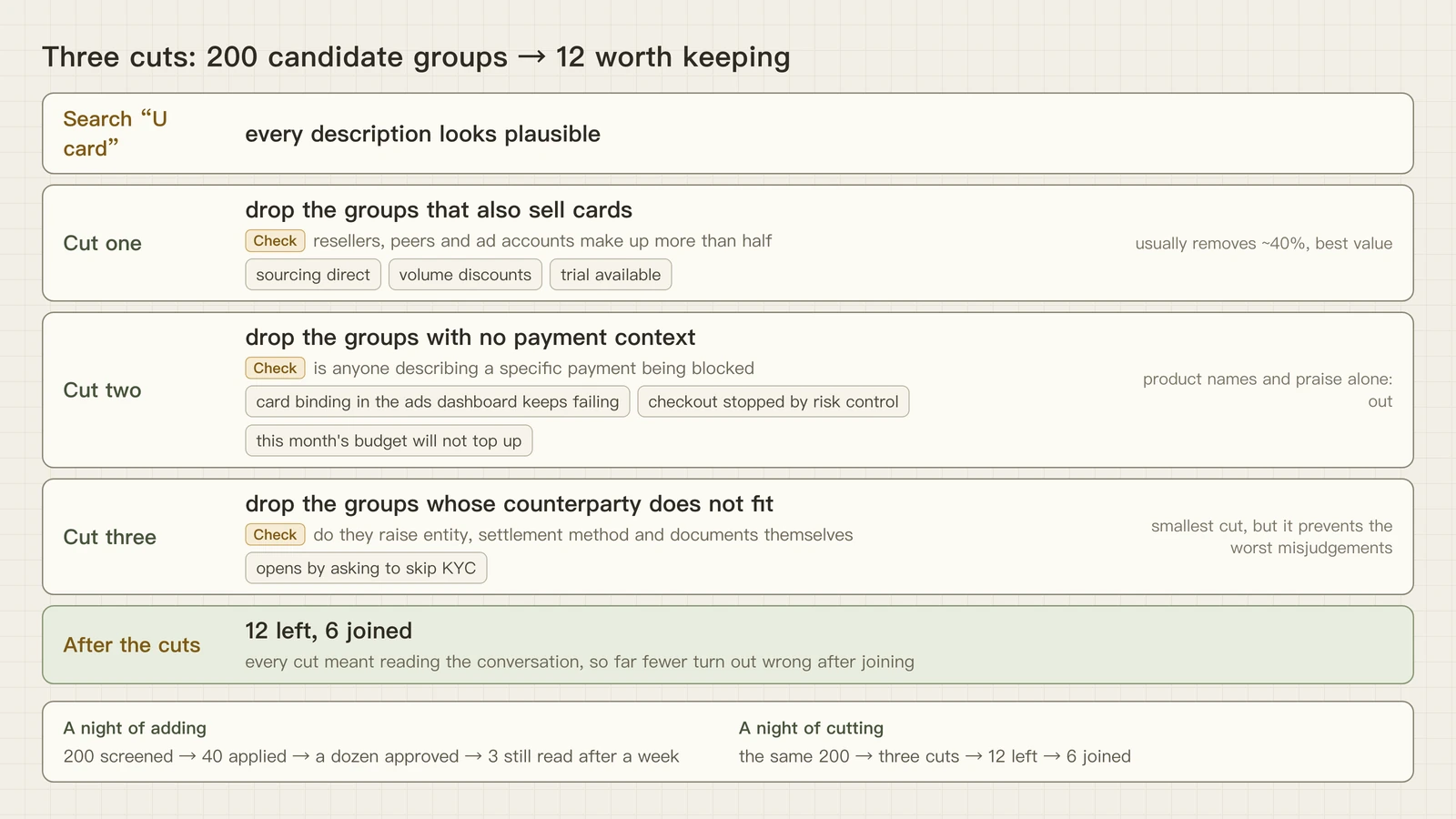 Each cut’s check and the typical phrasings it removes, drawn from the article’s examples, plus how many groups survive the three cuts and how many get joined.
Three hours: one list grows, the other shrinks
Most people work by addition: search a word, apply to whatever looks reasonable, fill twenty slots, move to the next word. Three hours later you hold a list of two hundred groups, half of them peers and the rest forwarding ads.
Subtraction runs the other way. Accept first that the overwhelming majority of results should not be kept, then use three deletions to compress the list. Three hours later you are not holding two hundred groups, you are holding a dozen whose history you have actually read.
Cut one: drop the groups that also sell cards
The first judgement has nothing to do with your own business, only with what the people in the group are doing. If the feed is wall-to-wall sourcing direct, volume discounts and trial available, that is the supply side advertising, and you will find neither clients nor genuine distributors there.
The concrete move is to read the last three days and count who is posting. If resellers, peers and ad accounts make up more than half, cross the group out without hesitating. This cut usually removes around forty percent and is the best value of the three.
Cut two: drop the groups with no payment context
Among what survives, the question is not whether anyone mentions cards but whether anyone describes a specific payment being blocked.
Useful statements look like this: binding a card in the ads dashboard keeps failing, checkout is being stopped by risk control, refunds take two weeks, this month’s budget will not top up. They share one property, the speaker is describing something that already happened and is hurting their business, not comparing products. Statements like that map straight onto a follow-up and are worth marking while you read.
Groups holding nothing but product names and praise read as empty either way, so this cut removes them.
Cut three: drop the groups whose counterparty does not fit
The first two cuts read the conversation, the third reads the person. The same demand can come from an individual or from a company with a full compliance process, and you cannot run both through one set of procedures.
The tell is simple enough, look at whether the person raises entity, settlement method and document requirements on their own. Anyone who opens by asking to skip know your customer checks does not fit your own onboarding conditions, and following up wastes both sides’ time. Someone who names a company entity and expects a contract and a settlement cycle is the one worth pushing. How to order that verification is covered in this piece.
Four searches, one job each
The three cuts need material to work on, and the four search entries supply it in different ways.
In-app search quickly maps which groups in this sector are already indexed. It queries the public groups the system has already indexed, currently more than fifty, filterable by tag, language and activity. Each result card carries the group name, description, category tags, primary language, member count, verified time and the date it was indexed. The first cut can largely be finished here, because the tags and descriptions are enough to tell whether a group is mostly peers.
AI search is for when you cannot name the words. It goes through an external semantic engine that reads the intent of a natural-language request rather than matching keywords. You can write find teams complaining that card binding fails in their ad dashboard and running steady monthly spend, an intent with no matching keyword that in-app retrieval cannot return. The second cut leans on it.
Google reaches outside the platform. The query is assembled by the system with a Telegram domain restriction already applied, so you only append your own words and get public group links under that domain, which covers groups that exist but are not indexed yet.
Bing complements Google. The two index Telegram differently, and Bing sometimes surfaces the batch Google missed. Running both is cheap, missing one is not, and this is the layer that feeds the third cut.
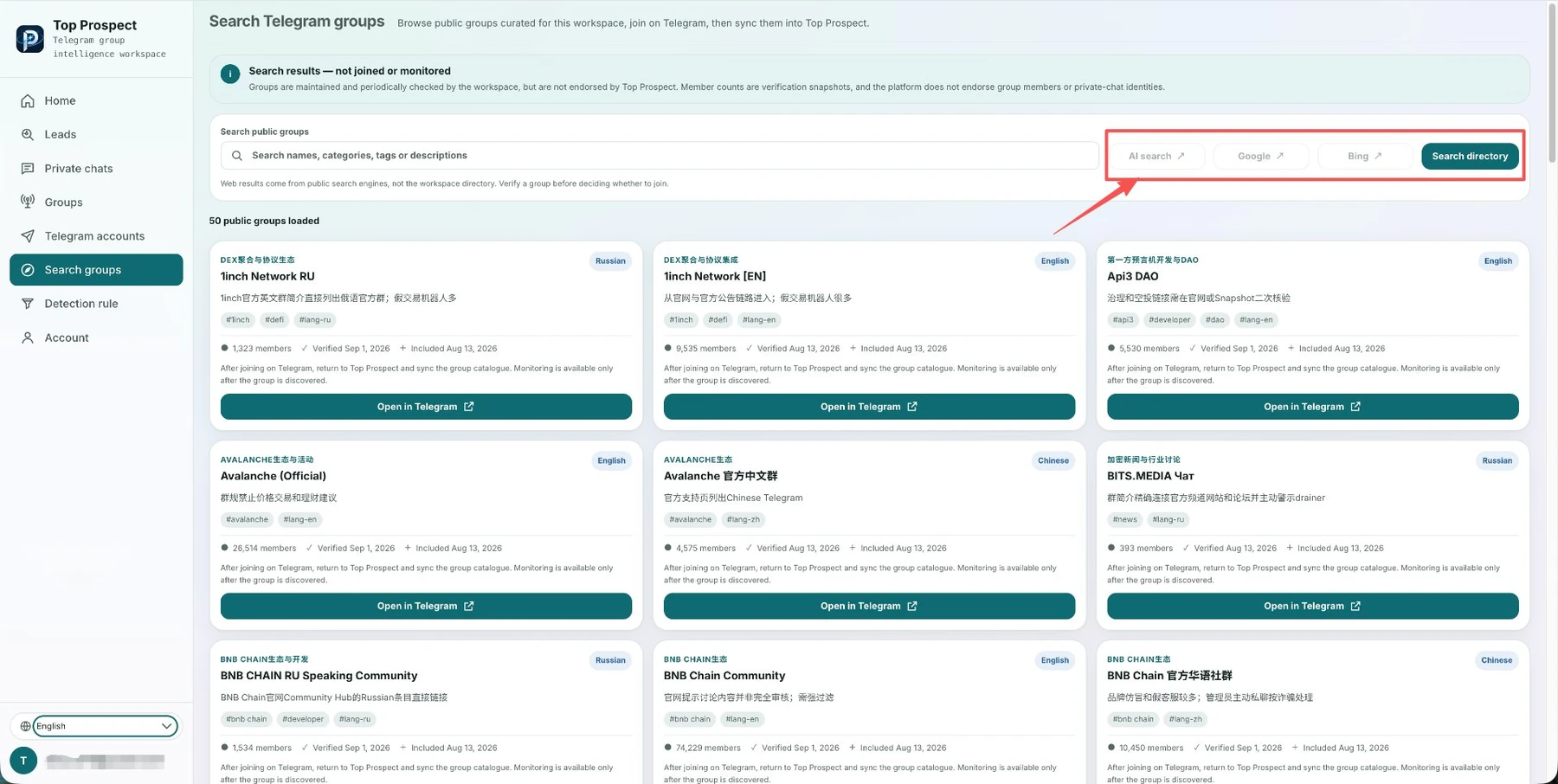 The search groups page in TOP Prospect, with the four entries lined up beside the search box and the indexed public groups listed below.
Search results are candidates only. They do not mean you have joined, and they do not mean the platform endorses the group. Member counts and verified times are a snapshot from the last check. Reading a few days of history before joining beats trusting the description.
One night, two ways of working
A night of addition: two hundred groups screened, forty applications, a dozen approved, and roughly three still worth reading a week later.
A night of subtraction: the same two hundred candidates, three cuts, twelve left, six joined. Because every cut involved reading the conversation, far fewer disappoint after joining.
The difference is not how many groups you added. In the same evening the fork is whether you end up with a candidate list you can hand to a colleague. Write the three cuts down and someone else running them lands in roughly the same place. The failure mode of watching five hundred groups without closing anything is dissected in this article.
Why twelve groups beat two hundred
The four search entries get you your first batch of groups. Three weeks later things move. A campaign pauses, the group goes quiet, the topic shifts and the demand is elsewhere.
Only two judgements are worth keeping, which words are worth searching and which groups are worth holding, and both have to be usable by the second person on the team. Screening experience that lives in one head disappears with that head. The difference from simply stockpiling groups is that groups die while criteria do not. For a peer’s version of the same work, see how payment BD finds new merchants.
Top Prospect splits the work into three stages. Find the groups, connect the ones carrying signal so they can be collected, then use recognition rules to flag the demand inside the conversation. The first question those rules ask is whether you are looking for clients or suppliers, and the second is what you provide, which together decide what kind of lead comes out at the other end. For the conversation layer of qualifying a single buyer, this piece covers it.
To see what the four searches actually look like, walk through topprospect.net.
Sources and further reading
How a Signal worth attention is found
See how Top Prospect finds and organizes Signals worth checking, keeps the original Telegram context, removes duplicates, and helps you decide what to review first. You decide whether to follow up and what to do next.