Stop searching "Web3". These 20 terms turn up 30 groups worth joining in one evening
Searching Telegram with industry words returns media channels, airdrop groups and competitors. Swap them for timing, symptom, compliance and role terms, then use the in-app, AI, Google and Bing entries to judge which groups are worth joining before you join them.
Group names, member counts, lead counts and time spent below are illustrative composites used to explain the filtering method. They are not measured results.
Search for the word Web3 on Telegram and 19 of the first 20 results are media channels, airdrop farming groups, exchange announcement groups and competitors. Apply to all of them and you end up with a respectable list of groups, then discover that none of them contains a project team that is actually spending money.
The trouble is in the few characters you type. An industry word returns people who discuss the industry. A buyer does not talk that way. He describes which step he is stuck on and which date he is up against.
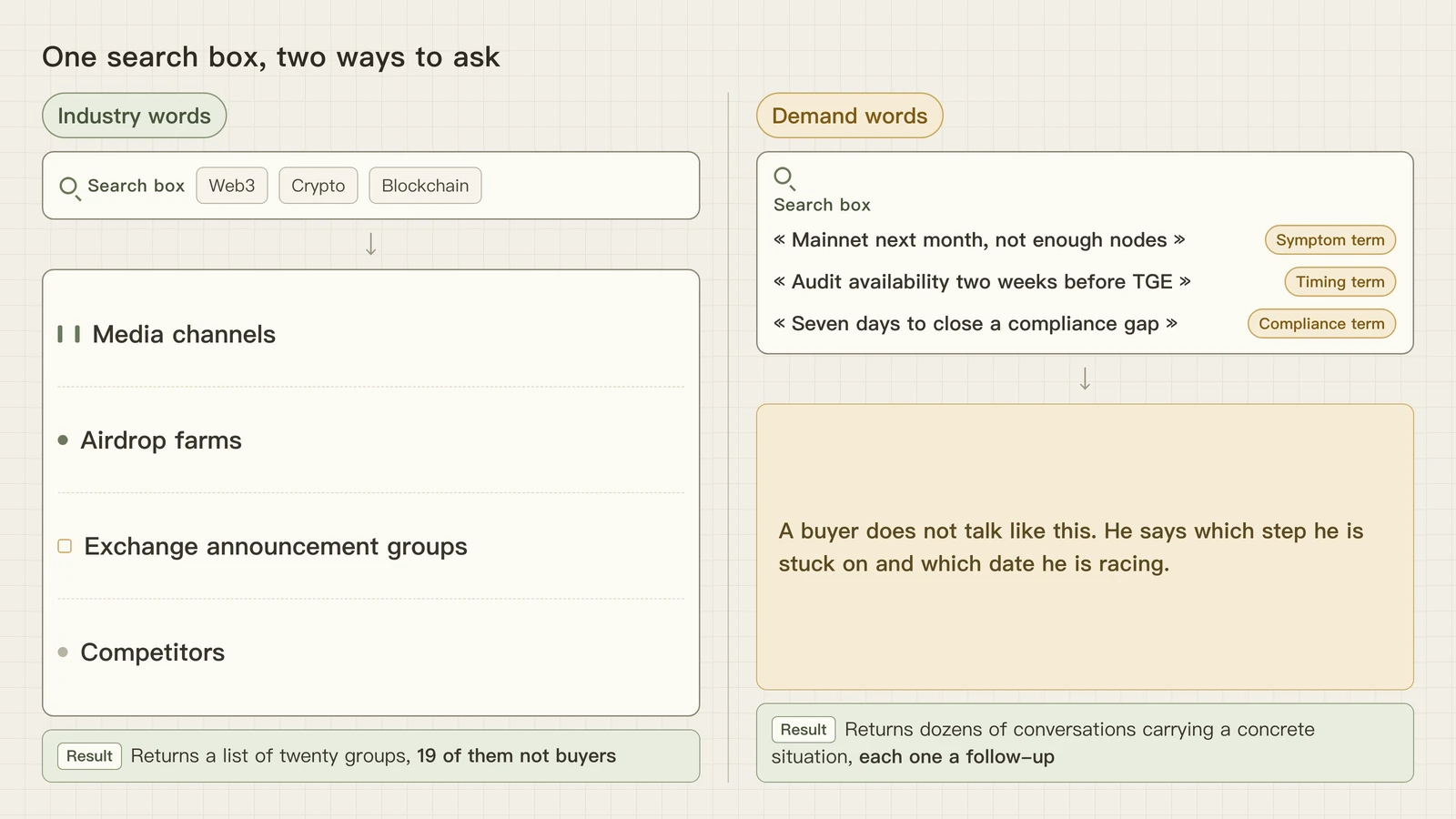 On the left, the twenty groups an industry word returns, 19 of them not buyers; on the right, the conversations a demand term returns, each one a follow-up.
Three hours of blind searching, three hours of searching with words
Same three hours, two approaches.
One is to run Web3, Crypto and Blockchain one after another, applying to anything with a plausible name. Three hours later you hold a candidate list of 20 groups, half of them dead and the rest reposting news.
The other starts by working out how a project team that is spending money would phrase things, and then searches for those phrases. Three hours later you hold something different, several dozen conversations that carry a specific situation. Someone complains about not having enough nodes before mainnet next month. Someone asks about audit availability two weeks before a TGE. Someone has been told to fill a compliance gap within seven days.
In the second approach, the search terms point at a person’s situation.
Why industry words do not find buyers
Two mechanisms are at work.
Group names and descriptions do not reflect what is said inside. A group titled AI and Web3 exchange may be ninety percent reposts, while an 800 member group whose description is the single word builders may discuss nodes, contracts and launch schedules every day. Telegram search cannot give you that layer, so anyone who joins by industry word eventually hits the same thing. A pile of groups and no idea which one is worth reading.
Buying conversations also happen outside industry groups. A project team discusses technical work in its own engineering group, its developer group and its ecosystem partner group, and those descriptions usually contain nothing but a community name. Budget and schedule get mentioned there repeatedly while the group name carries no industry word at all. The same 429 complaint is small talk in a large industry group and a vendor switching entry point in a project team’s engineering group.
A group worth joining shows three things
Read the recent history and look for all three.
- A concrete blocker, one you could actually fix, such as RPC returning 429, users dropping out on the approval screen, or two endpoints reporting different block heights
- Time pressure, mainnet next month, code freeze on Friday, seven days to fill a gap
- A stated role, our project, our team is building this, my boss asked me to check
When all three appear, the group is worth joining. When only the first appears, put it aside. For how that judgement plays out on a single message, see why a repeated 429 does not automatically mean a provider switch.
Twenty search terms in four classes
All four classes share one property. The speaker is describing his own situation rather than describing an industry. Five terms each, and you can rebuild the same structure for your own sector.
- Timing terms, such as mainnet, TGE, code freeze, end of month launch, in two weeks. These filter for projects already in motion, since a team that has not started will not say it launches in two weeks
- Symptom terms, such as 429, timeout, withdrawals frozen, block height mismatch, approval screen drop-off. A complaint is already a requirement, and a complaint with a number in it is worth more attention
- Compliance terms, such as Travel Rule, KYC (know your customer), audit, multi-sig approval, reserve reconciliation. Teams pushed into a decision by an outside rule usually already have the budget approved
- Role terms, such as our project, our team, my boss asked me, budget, schedule. These confirm whether the person speaking can actually decide
One class returns a batch of groups. Two stacked together get closer to the real requirement. Timing plus symptom searches for a project that is about to launch and is complaining about nodes. Compliance plus role searches for a team pushed by a rule whose speaker can also sign off. In practice, run all four classes once and note the groups that appear, then deepen the combinations inside that batch, which gets cheaper every round.
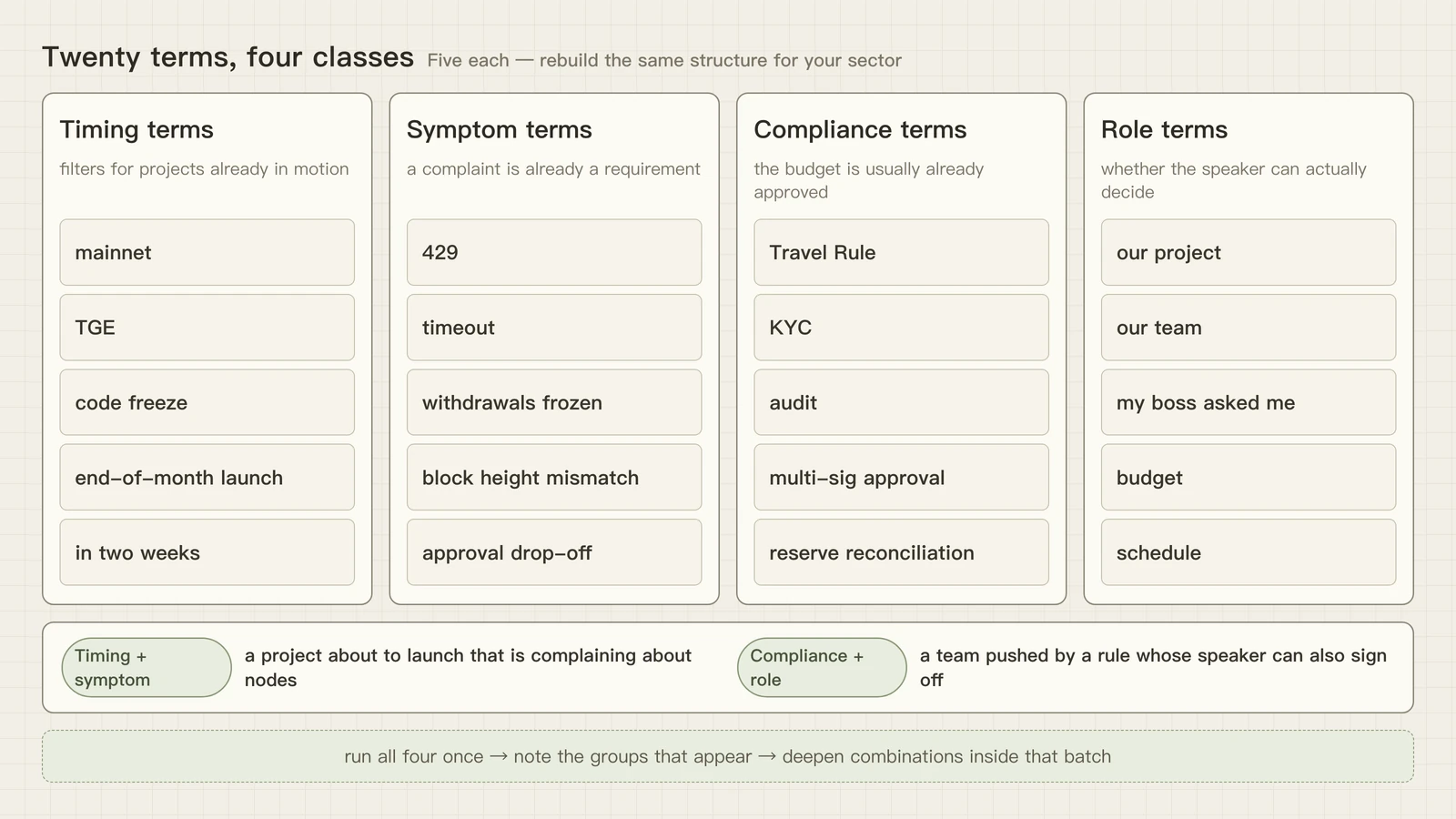 The full list of five terms per class, and what each pairing filters for: timing plus symptom, compliance plus role.
Four entries, four different jobs
In-app search answers what groups already exist in this sector. It queries the public groups the system has already indexed, currently more than fifty, filterable by tag, language and activity. Each result card carries the group name, description, category tags, primary language, member count, verified time and the date it was indexed. You do not have to apply group by group to find out, and you can make a first cut from that list.
AI search is for when you cannot say which terms to use. It works through an external semantic search engine that reads the intent of a natural language request instead of matching keywords. You can write something like find project teams complaining about node timeouts that are close to mainnet, an intent that has no matching keyword, and in-app search cannot return it.
Google reaches outside the index. The system assembles the query for you, already limited to Telegram domains, and you append your own words. What comes back is a set of public group links on Telegram domains, which fills in the groups that exist but have not been indexed yet.
Bing complements Google. The two treat Telegram differently, and Bing sometimes surfaces a batch that Google missed. Running both is cheap. Missing one is not.
The four entries are not a choice between options. The usual order is to start with in-app search and work through the groups that are already indexed with clear tags, then use AI search to cover the part you cannot put into words, and finally use Google and Bing to pick up the longer tail. A full round takes a single pass, far less work than applying group by group to find out that a group is wrong.
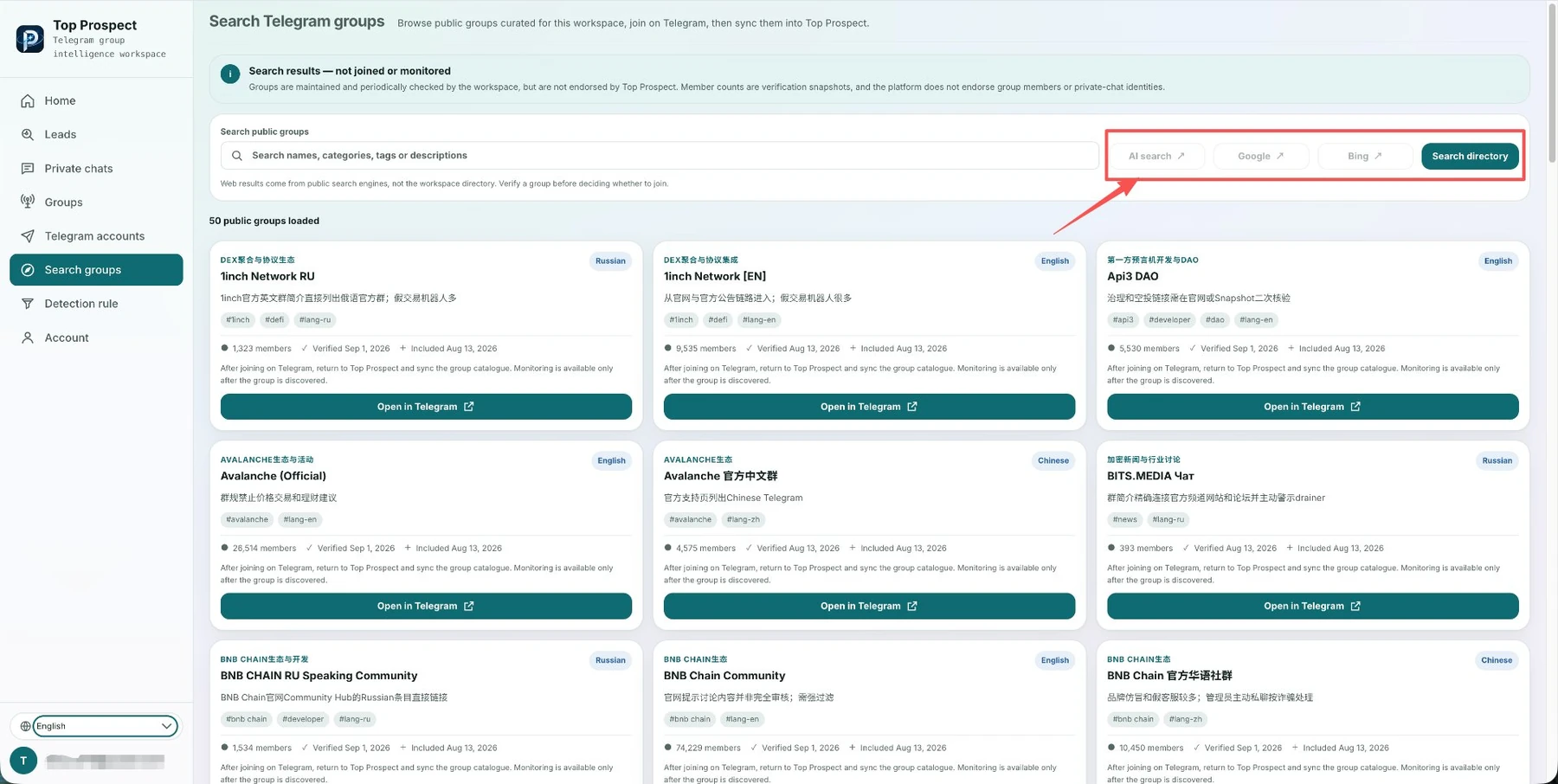 The screenshot above is the search groups page in Top Prospect. The four entries sit in one row. Different words cover different gaps.
A search result is a candidate. It does not mean you have joined, and it does not mean the platform endorses the group. Member counts and activity times on the card are a snapshot from the last check. Reading a few days of history before joining is more reliable than reading the description. For the checks worth running when you pick a tool, this list goes into more detail.
One hour, two approaches
An hour of blind joining turns up twenty groups, fifteen applications, five approvals and roughly one group worth reading long term.
An hour of searching the four classes turns up thirty candidate groups, twelve kept after the three checks, eight joined. Because the conversations were read before joining, far fewer turn out to be wrong afterwards.
The difference is not how many groups you join. It is whether the same hour leaves you with a candidate list you can hand to a colleague. Once the terms and the checks are written down, someone else following them lands in a similar place.
What this method is really meant to leave behind
The four search entries get you your first batch of groups. Three weeks later the situation changes. A project launches and the group goes quiet, the conversation moves and the requirement is no longer there.
Only two judgements are worth keeping, which terms deserve searching and which groups deserve keeping, and they have to be usable by the second person on the team. Experience that lives only in one person’s head leaves with that person, which is why many teams have their sourcing ability tied to a couple of fast-handed individuals. For how to keep managing groups after you find them, the tagging routine in a top Web3 BD’s 24 hours is a useful reference.
Top Prospect splits the work into three stages. Find the groups, connect the ones carrying signals so messages are collected, then mark the requirements in those conversations with identification rules. Finding groups is only the first stage. The last two decide whether you are left holding a pile of groups or a set of buyers worth following up. If you are looking for partners rather than buyers, the standard is different, and this piece covers that side.
To see what the four search entries actually look like, you can walk through them at topprospect.net.
Sources and further reading
How a Signal worth attention is found
See how Top Prospect finds and organizes Signals worth checking, keeps the original Telegram context, removes duplicates, and helps you decide what to review first. You decide whether to follow up and what to do next.